I knew exactly what was in that envelope before she even tore it open.
And I let her laugh anyway.
Later, when I tried to explain that choice to myself, I landed on the same answer every time: after thirty-one years delivering mail in Harlan County, Tennessee, I understood that paper had its own kind of justice. A letter could sit quietly in a box all morning and still destroy somebody’s peace by noon. A certified notice could ruin a meal, a marriage, a reputation. A check could make a person feel saved for exactly ten seconds before the next envelope taught them otherwise.
Timing mattered.
And on that Thursday in Cartwright Hollow, timing was all I had left.
My name is Dottie Callahan. I was a mail carrier for most of my adult life. I worked through rain that came in sideways, ice that turned gravel roads into skating rinks, summer heat that cooked the inside of the truck, and winters when the metal mailboxes burned your fingers with cold. I had been chased by dogs, cursed by drunks, thanked by widows, flirted with by lonely old men, and asked for favors by people who thought the Post Office existed mainly to straighten out their personal disasters.
I showed up anyway.
That had been my identity longer than “wife” ever was.
So when my husband Raymond died after a fast, ugly slide from diagnosis to funeral, I thought the hardest thing ahead of me would be learning the shape of silence in my own house. I thought I would have to adjust to one coffee cup, one plate, one side of the bed cooling too fast. I thought grief was the mountain and widowhood was the climb.
Then the insurance company called.
The woman on the line sounded young and polite. She said she was reaching out to finalize some routine beneficiary details before payment. She asked me to confirm my full name, my address, my relationship to the deceased.
“I’m Raymond Callahan’s wife,” I told her. “Thirty-four years.”
There was a pause.
Not long, but long enough that I sat up straighter in my kitchen chair.
When she spoke again, her tone had changed. It had gone soft and cautious, the way people talk when they realize they’re holding a lit match in a dry field.
“Ma’am,” she said, “there appears to be a second beneficiary form on file. It was submitted fourteen months ago. It lists another recipient.”
Then she read the name.
Shelby Ann Pruitt.
If there had been a camera in my kitchen, it would have caught a ridiculous sight: a sixty-two-year-old woman in house shoes sliding down a cabinet like her bones had dissolved. I ended up on the floor beside the refrigerator, still clutching the phone, staring at the dust under the table and hearing that name echo through my skull as if it belonged to somebody else’s tragedy.
I asked the woman to repeat it.
She did.
Then I asked her where the form had come from.
She gave me what she could. Date filed. Notarized. Valid on its face. Under review now only because of internal processing questions and some mismatch issue they had noticed when they reopened the file after Raymond’s death.
I thanked her. I hung up. And then I sat there a long time listening to the hum of the refrigerator and trying to decide whether I had already known, somewhere deep down, that my marriage had cracks wide enough for another woman to live inside.
The next few weeks turned me into somebody sharper and less forgiving than I had ever been.
I found the truth in scraps.
A receipt in one of Raymond’s old coat pockets. A pharmacy record with an address I didn’t know. Fuel charges that formed a pattern once I spread them out across the table. Then, around two in the morning one awful Tuesday, a Facebook page. Shelby Ann Pruitt, smiling in front of a little house with yellow shutters in Cartwright Hollow, twenty-two miles east. On one post she had typed “Mrs. Pruitt-Callahan” like that name belonged to her as naturally as sunrise.
Eleven years.
That was the length of it, as best I could reconstruct. Eleven years of overlap. Eleven years of excuses. Eleven years of errands, late returns, “helping a buddy,” “working on something out of town,” “phone battery died,” “you know how traffic was.”
Raymond had not just cheated.
He had curated another life.
I might have drowned in that discovery if not for the insurance form. Infidelity is a wound. Fraud is a problem. Problems can be worked.
So I worked.
The signature on the beneficiary form looked like mine at first glance, but only at first glance. The slant was slightly wrong. One loop too tight. The tail of the last name cut short in a way I never did unless I was signing something on the hood of a truck in the rain. It was a decent imitation, but I had spent decades sorting handwriting and matching names to boxes. I knew my own signature like I knew my own face.
Then I checked the notary.
That was when anger stopped feeling messy and started feeling useful.
The notary stamp belonged to a man whose license had lapsed years earlier after disciplinary trouble. The state database hadn’t fully reflected the change when the form was filed, which gave the paperwork just enough borrowed legitimacy to slide through. Careless people would have missed it.
I was not careless.
My cousin Loretta knew an attorney in Knoxville who owed her a favor. I drove out with a folder full of copies and a legal pad full of notes. Dates. Names. Filing timelines. Raymond’s medical records showing he had been diagnosed before the new beneficiary form was ever signed. The attorney, Martin Keel, looked over everything with the calm of a man who knew exactly when a case crossed from ugly to actionable.
“You can challenge the payout,” he said. “And depending on involvement, there may be fraud implications.”
“I want it documented,” I told him.
He studied me. “You want the money?”
I thought about that. About the mortgage. The funeral. The years. The insult.
“I want the truth on paper,” I said. “Money can follow it.”
He nodded as if he understood more than I had said aloud.
After that first meeting, I started carrying a small yellow sticky note inside my old mail satchel. It had the essentials written in tiny neat print: Shelby Ann Pruitt. Policy number. Filing date. Diagnosis date. Notary name. License discrepancy. Attorney phone. It was not emotional. That was the point. When grief threatened to flood me, I touched that sticky note and remembered there was still a structure under all this hurt. Facts. Sequence. Proof.
And then life handed me a cruel little opportunity.
In counties like ours, retired postal carriers never fully retire. When routes get short-staffed, names get remembered. One Tuesday morning the postmaster called asking if I’d be willing to do some substitute work for a stretch.
I asked which routes needed covering.
When he said Route 9, Cartwright Hollow, I went quiet.
“You still know it?” he asked.
“Knew it before half these kids were born,” I said.
I took the route.
The first day I drove out past the tree line and saw the yellow shutters, I had to sit in the truck a minute with both hands on the wheel. I had imagined Shelby a hundred different ways. Seductive. Trashy. Manipulative. Hard-eyed and smug. I had made her monstrous because it was easier to hate a monster than a woman.
Then she came to the door and turned out to be painfully ordinary.
Pretty in a soft, local way. Blondish hair tied up badly. Tan legs. Chip on one front tooth visible when she smiled. She thanked me for bringing her mail. Asked if the road had been rough after the last rain. Talked about tomatoes not doing well in the heat. Once she laughed and said, “I swear I spend half my life paying bills.”
She was friendly.
That detail haunted me more than if she’d been cruel.
I spent eight months delivering to her.
Eight months of utility bills, advertisements, church bulletins, seed catalogs, and doctor statements. Eight months of seeing the house my husband had paid for with time stolen from me. Eight months of hearing her mention “my husband” in the past tense while never realizing she was talking to the woman he had kept hidden.
One blistering afternoon she offered me sweet tea from a mason jar. I took it because refusing would have felt too dramatic, and because I wanted to see if my hand would shake when our fingers touched.
It didn’t.
“Times are still tight since my husband passed,” she told me that day, leaning in the doorway. “Insurance is taking forever.”
I looked right at her and said, “I’m sorry for your loss.”
The words were true. The meaning was not the one she heard.
The legal process moved slowly. Martin filed disputes and notices with the insurer. He sent supporting evidence. He coordinated with the state insurance department about the apparent forgery and notary irregularity. He warned me that bureaucracies often moved in separate lanes, and sometimes one lane paid before another lane froze.
“If a check goes out,” he said, “that won’t be the end of it.”
“I know,” I said.
Still, I wanted to be there.
Last Thursday morning I saw the certified envelope before I even parked. It sat among the sorted trays like a white bone. Shelby’s name. Signature required. Insurance company return address.
I knew what it likely contained.
A release check.
The kind of administrative mistake Martin had warned about.
I also knew what was in my satchel. Another envelope had come through separately, routed from the Tennessee Department of Insurance Fraud Investigation Division. I had seen the seal. I knew the file had matured. I knew the state was moving.
I loaded both and drove the route.
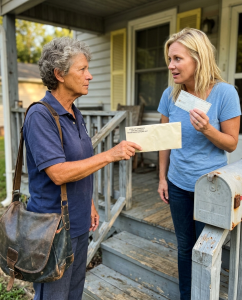
By the time I reached Shelby’s house, the air had gone hot and still. She came out wiping her hands on her shorts, signed for the certified piece without looking closely at me, and tore it open right there on the porch.
Then she laughed.
A full, bright laugh from the belly. Relief lit her whole face. She held the check up over her head like she had just won a prize nobody could take back.
I stood at the foot of the steps and let her have that moment.
Then I reached into the satchel, touched my yellow sticky note by instinct, and pulled out the second envelope.
I climbed the steps slowly.
“Honey,” I said, holding it out, “I think you got one more piece of mail today.”
She smiled while taking it. Then her eyes dropped to the return address.
Tennessee Department of Insurance. Fraud Investigation Division.
The smile faltered.
Then she looked up at me properly for the first time in months.
Not at the uniform. Not at the mail.
At my face.
Something cold moved through her expression. Recognition without context. Fear before understanding.
“Who are you?” she asked.
“That depends which wife Raymond told you about,” I said.
Her mouth opened.
The check dipped in her hand.
And then, instead of denying everything, instead of slamming the door or calling me a liar, she whispered, “Dottie… I didn’t forge anything. Raymond told me you already knew.”
I had prepared myself for rage, excuses, maybe even smugness. Not this. Not a frightened woman who looked as blindsided as I was.
“What did he tell you?” I asked.
Her eyes filled but she didn’t cry. “He said you and him were finished a long time ago. He said you stayed married because of the church and because divorce would embarrass both families. He said you didn’t want people knowing his business after he got sick. He told me the policy change was agreed on. Quietly handled.”
Every sentence landed like a new insult from the grave.
“He said I wasn’t to contact you,” she went on. “Said you wanted privacy. Said he had your permission.”
I don’t know what showed on my face, but she paled further.
“You really didn’t know,” she said.
“No,” I said. “I really didn’t.”
Her hands shook now. The check fluttered against the porch rail. “I never signed your name. He brought papers already signed. Told me they were finished. Said a notary friend took care of it.”
“What friend?”
She gave the name.
The same one on my sticky note.
A dead-end notary with a dead license and, apparently, a living willingness to help Raymond manufacture reality.
Then Shelby said the sentence that changed everything.
“He came back the week before he died,” she said. “He was thin by then. Scared. He gave me an envelope and said if there was ever trouble with the policy, and a woman named Dottie showed up asking questions, I was to open it with her there.”
I took one step closer. “Where is it?”
She swallowed. “Inside. In the bedroom. Taped under the bottom drawer of his dresser.”
We stood there looking at each other, two women who had spent years orbiting the same liar from opposite directions. I wanted to hate her cleanly. The problem was, in that moment, I could see too much confusion in her face to pretend she had built all this alone.
“Get it,” I said.
She hesitated, then turned and went inside. I followed to the doorway but no farther. The house smelled like laundry soap and stale coffee. I noticed little things against my will: Raymond’s old style of boots by the wall, a framed picture of him younger and heavier, the same crooked half-smile I had once loved.
Shelby came back carrying a plain white envelope yellowed slightly at the edges. My name was written on it in Raymond’s handwriting.
That hit harder than anything else had.
I recognized the slant instantly.
I took it from her and for a second couldn’t open it. My fingers had carried millions of envelopes over the years. This was the first one that felt heavier than my hands could manage.
Inside were three things.
A letter.
A photocopy of a deed transfer draft.
And a cashier’s check made out to Shelby, dated two weeks before Raymond died, for an amount that told me he had been moving money long before the policy became an issue.
The letter was four pages, all written by hand.
I read it once on her porch. Then again in my kitchen later that night. The facts did not improve on a second reading.
Raymond admitted the affair. Admitted it had started as “something temporary” and then became “too tangled to unwind without hurting everyone.” He claimed he meant to tell me after the diagnosis but couldn’t bear to face “what that would do.” He claimed Shelby believed we were separated in all but name. He admitted changing the insurance beneficiary and arranging the false notarization because he wanted both women “taken care of,” but knew I would never agree if I understood how much he had already given her.
He wrote that he had intended the policy for Shelby because he had secretly transferred other assets toward me through means I had not yet discovered. He also wrote that if legal trouble arose, the house in Cartwright Hollow should not remain with Shelby because it was purchased partly with funds he had diverted from marital accounts. He instructed her to surrender it “without public scandal” and use the cashier’s check to relocate.
It was classic Raymond, even dead—controlling, cowardly, and determined to manage everyone’s feelings from beyond the point where he had any right to.
But the line that settled everything for me was this: “Shelby did not forge your signature. I arranged the papers and told her what to believe.”
Martin nearly smiled when I laid the letter in front of him the next morning.
“Well,” he said, “that answers several questions.”
The next month was less dramatic than people imagine and more exhausting. Fraud cases are built by documents, not speeches. The state moved ahead on the forged beneficiary filing. The insurer voided the payout and clawed back the check before Shelby could deposit it. The notary was referred for further investigation over prior misconduct. Raymond, being dead, escaped consequences in the legal sense, but his paper trail did not.
The Cartwright Hollow house turned into its own fight. Property records and account tracing showed marital funds had indeed flowed into it. Under pressure from counsel and the evidence in Raymond’s letter, Shelby agreed to a settlement rather than drag the county through a public court brawl. The house was sold. Outstanding debts tied to Raymond’s estate were paid. I received the lawful insurance proceeds and a portion of the sale. Shelby kept the cashier’s check Raymond had left and enough from the settlement to start over in Knoxville, where, she said, nobody would know her name.
I saw her one last time in Martin’s office.
She looked smaller there than she ever had in that yellow-shuttered doorway.
“I would not have stayed,” she told me quietly while papers were being copied. “If I’d known.”
I believed she believed that.
Belief wasn’t forgiveness, but it mattered.
“I know,” I said.
She wiped her eyes with the heel of her hand. “Do you hate me?”
I thought about eight months of handing her electric bills. About the way she had laughed over that check. About the way her face had fallen when she learned I was real.
“No,” I said finally. “I hate that he made fools of both of us in different ways.”
She nodded like that answer hurt because it was true.
After everything settled, I went back to my kitchen and cleaned out a drawer where Raymond used to keep spare batteries, receipts, and things he swore he’d organize later. At the very back I found a packet of old photos. In one, he was younger than either of us liked to remember, standing beside me at the county fair, one arm around my shoulder, both of us smiling like the future was a simple thing.
I sat with that picture a long time.
People always want a villain clean enough to point at. They want one woman innocent, the other guilty, and the dead man either misunderstood or monstrous. But life doesn’t usually package itself that neatly. Raymond had lied to me for eleven years and lied to Shelby almost as long. She accepted too much too easily. I trusted too much too long. He exploited both facts. By the time the truth came due, it was addressed to all of us.
Sometimes I think back to that porch in Cartwright Hollow. To her laughter. To the check raised like a trophy. To the second envelope in my hand. There was a part of me that enjoyed that moment, and I won’t insult anybody by pretending otherwise. After months of swallowing my pride and walking those steps as if I were delivering nothing but ordinary mail, I took a certain cold comfort in watching the truth reach her.
But that wasn’t victory. Not really.
Victory would have been a faithful husband. A simpler widowhood. A house not haunted by duplicate memories.
What I got instead was documentation. Restitution. A corrected record.
And maybe, in its own small way, that was enough.
These days, when the post office calls needing substitute help, I still say yes sometimes. I still know the roads. I still know which dogs bark louder than they bite. I still slide letters into boxes and think about how every life in this county is held together by things people sign, things people hide, and things that eventually arrive anyway.
Paper is patient.
Truth is too.
And if there was one final lesson in all of it, it was this: the biggest red flag wasn’t Shelby’s porch or the forged form or even the second life twenty-two miles away. It was how easily Raymond believed he could choreograph everyone’s reality and leave us to live inside it after he was gone.
He was wrong.
In the end, the truth found the right address.