At her husband’s birthday dinner, Elise’s stepdaughter handed her a legal notice instead of a gift.
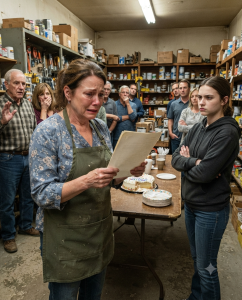
The envelope slid across the white plastic tablecloth and stopped beside a half-melted birthday candle no one had lit.
For a moment, Elise did not understand what she was looking at. The room still smelled like chocolate frosting and burnt coffee. A few of Richard’s old customers were smiling weakly, trying to keep the mood together out of pure habit. Someone near the doorway still held a paper plate and a plastic fork. It was supposed to be one of those awkward, tender evenings people throw after a death because doing something feels easier than doing nothing. Richard had been gone six months, and everyone in town still spoke about him in the present tense by accident.
Then Elise saw the law firm letterhead.
The whole room went silent.
Across from her, Vanessa leaned back in her chair with her arms folded, chin lifted, expression so composed it almost seemed rehearsed. She was Richard’s only daughter, thirty-two, sharply dressed, polished in the way people became when they had spent years trying never to look vulnerable. She had arrived late, spoken to almost no one, and barely touched her cake. Elise had told herself not to expect warmth. But she had not expected this.
“This store belongs to blood,” Vanessa said. “You have thirty days.”
No one moved.
Elise looked down at the notice again. The words blurred at first, then sharpened one by one into something ugly and official. Estate review. Possession. Legal claim. Vacate within thirty days pending transfer of business property.
Thirty days.
A supplier standing by the coffee machine slowly lowered his eyes. One of Richard’s oldest customers shifted his weight and stared at the floor like he wanted to disappear. In the back corner, the refrigerator hummed on, absurdly loud in the silence.
Elise forced herself to look up.
“I was his wife,” she said.
Vanessa’s mouth tightened. “That doesn’t make you his blood.”
There it was. The old accusation in its final form.
Not spoken in whispers this time. Not tucked inside chilly smiles at Christmas dinner or polite dismissals in the hospital hallway. Spoken cleanly, in public, in front of the people who had just sung for a dead man.
Elise folded the notice carefully and slid it back into the envelope. Her fingers felt numb, but her face stayed calm by sheer effort.
“Thank you for bringing this tonight,” she said.
The calm in her voice unsettled even her. She had no idea where it came from.
Vanessa seemed thrown off for half a second, as if she had expected tears or anger. But Elise gave her neither. She stood, picked up the knife, and cut the cake because nobody else knew what to do.
That was the part people would remember later. Not the notice. Not even the line about blood.
They would remember that Elise served cake after being told to leave.
She handed out slices with a steady hand. She refilled the coffee. She thanked people for coming. She smiled when they looked at her with pity. The customers left in ones and twos, carrying guilt in their shoulders and folded napkins in their hands. Richard’s birthday gathering dissolved the same way everything had dissolved since his death: quietly, awkwardly, with no one willing to say the real thing aloud.
By nine-thirty, the store was empty.
Elise locked the front door and turned the sign to CLOSED.
Then she leaned both hands on the counter and bowed her head.
The hardware store was silent except for the refrigerator motor and the tick of the wall clock Richard had never fixed properly. The place still carried him everywhere. In the smell of wood dust and motor oil. In the battered stool near the key-cutting machine. In the old coffee ring on the counter that had resisted every cleaner she tried. In the way regular customers still stepped through the door and looked instinctively toward the back office, forgetting for half a second that Richard would never emerge wiping his hands on a rag.
Elise had spent six months keeping that silence from swallowing the business whole.
She had opened at dawn, closed after dark, negotiated with suppliers, balanced invoices, unloaded trucks, and learned to repair things she used to call Richard for. She had worked the register, swept the floors, and talked to lonely customers who came in for hinges and left ten dollars lighter with no hinges at all. She had held the store together because it mattered to him, and because after he died it became the one place where she still felt close to him.
And now she had thirty days to leave.
She should have gone home. She should have taken off her apron and cried in the privacy of her kitchen.
Instead, she grabbed a rag and walked into the storage room.
Maybe grief had turned her stubborn. Maybe humiliation had. Maybe cleaning was simply easier than sitting still with what had happened. The storage room was cramped and dusty, stacked with old inventory, obsolete fittings, cracked bins, and cardboard boxes with Richard’s blocky handwriting on the sides. It was the part of the store neither of them ever fully tamed. Every few months Richard would promise to reorganize it, then get distracted helping a customer find the right wrench and forget the whole plan.
Elise worked shelf by shelf, sorting what could stay from what had to go. She wiped down metal brackets, stacked paint trays, bundled extension cords, and flattened boxes. As she moved deeper into the back corner, she found the old brass cash register Richard had refused to throw away.
It sat half-hidden behind a tower of paint cans, heavy and ridiculous and coated in dust.
Elise had asked about it a dozen times over the years. Why keep a broken register that had not worked since before they married? Why haul it from one corner to another every spring when they cleaned? Richard always gave the same answer.
“Not that one. That one stays.”
He would say it lightly, but firmly enough that she eventually stopped asking.
Now, standing in the dim yellow light of the storage room with a legal notice still burning in her pocket, Elise looked at that register and felt a strange tug of attention. Not quite memory. Not quite instinct. Something in between.
She dragged it out from behind the paint cans.
The legs scraped the concrete. Dust rose into the air and made her cough. She tried the drawer. Jammed shut.
She frowned, found a flathead screwdriver on the nearby shelf, and worked the edge of it into the seam. The first attempt did nothing. The second shifted the drawer half an inch. On the third, with a sharp metallic crack, the drawer lurched open.
A few coins rattled. An old receipt curled at the corner. Rust flaked onto the floor.
Then something slipped from beneath the inner tray and landed at her feet.
Elise crouched.
It was a folded receipt, a notarized transfer form, and a note written on the back of a hardware invoice.
Her pulse started pounding before she even unfolded the note.
She knew Richard’s handwriting instantly. The thick pen pressure. The hard slash through his t’s. The uneven line spacing whenever he was trying to write fast.
“Elise, I built this store before my daughter was born, but you kept it alive after everyone else left.”
Her breath caught.
She sat back on her heels, staring at the page. For a second the words seemed almost too large to process, as if the meaning was arriving faster than her mind could hold it.
She read on.
“If you’re reading this, then I waited too long to tell you where I put it. Maybe I thought there would be time. Maybe I thought signing the papers was enough. If Vanessa ever comes for this place, don’t hand over what you earned because someone else shares my name. This store is yours.”
Elise covered her mouth with one hand and let out a sound halfway between a sob and a laugh.
She looked at the transfer form next. It was real. Fully executed. Dated two years earlier. Richard’s signature. Notary seal. Legal description of the property and business transfer language clear enough that even Elise, who hated paperwork, understood the center of it.
He had done it.
Not in his final days. Not under medication. Not in panic. Two years ago. When he was still healthy enough to lift cement bags and argue with suppliers and stand in the doorway greeting every customer by name.
He had known.
Or at least he had prepared for the possibility that one day his daughter might come for the store and Elise would be left to defend herself.
Tears blurred the ink. Elise pressed the heel of her hand to her eyes, but more came. Not just from relief. From the sudden, aching proof that Richard had seen her clearly. All those years, all the little practical acts that made up a marriage, all the quiet work no one applauded—he had counted them. He had known exactly who kept the books straight, who remembered supplier birthdays, who restocked the wire shelves after close, who stayed when things were hard.
And he had trusted her enough to make it official.
The next morning Elise sat in a law office across from Martin Hale, the attorney whose firm name appeared on the notice Vanessa had delivered.
He was a careful man in his sixties with silver hair, rimless glasses, and the kind of neutral expression lawyers practiced for decades. He greeted Elise politely, invited her to sit, and clearly expected a difficult but straightforward conversation. Then she slid the papers across his desk.
His expression changed by degrees.
First mild impatience.
Then concentration.
Then surprise so visible he almost forgot to hide it.
He read the transfer form once, then turned back and read it again. He checked the notary seal. Compared the parcel number. Reviewed the note. Opened a file from his cabinet and cross-checked dates. The silence stretched so long Elise could hear the rustle of the office air vent.
Finally he leaned back in his chair and removed his glasses.
“Well,” he said carefully, “this changes things.”
Elise sat with her hands folded tightly in her lap. “Is it valid?”
He looked at her for a long moment, perhaps measuring how much to say before saying it.
“Yes,” he said. “It appears entirely valid.”
Her throat tightened. “So I don’t have thirty days?”
Mr. Hale let out a breath that sounded almost like regret.
“No,” he said. “You do not.”
He placed a fingertip on the transfer form.
“You have the deed.”
The room seemed to tilt and settle at once.
Elise had imagined this meeting ending a hundred humiliating ways. With more delays. More legal language. More reasons why what Richard wanted could not be proven. Instead, one sentence rearranged everything.
Mr. Hale had barely finished speaking when his receptionist buzzed in to say Vanessa had arrived.
Of course she had. She was early, he explained, because she wanted to discuss transition terms.
Transition terms.
Elise almost laughed.
Vanessa entered the office carrying a leather folder and wearing the same controlled expression she had worn the night before. She nodded briefly at the attorney, then looked at Elise with open annoyance.
“I assumed you’d want to settle this quickly,” she said. “Dragging it out won’t help anyone.”
Mr. Hale did not answer right away. He turned the documents on his desk so they faced her.
Vanessa frowned.
Then she saw her father’s handwriting.
The shift in her face was immediate.
She stepped forward, then stopped. Her eyes moved across the note without blinking. The color drained from her cheeks.
“Where did you get that?” she asked.
Elise answered simply. “The old register in storage.”
Vanessa stared at the note as if it had betrayed her personally. Mr. Hale began explaining the transfer—execution date, filing status, legal ownership, why the notice delivered the night before no longer applied—but Vanessa seemed to hear only fragments. Her attention stayed trapped on the paper.
“He never told me,” she said at last, almost to herself.
There was no anger in it. Only disbelief.
Elise watched her carefully. For the first time in years, Vanessa did not look sharp or superior or armored. She looked like a daughter who had just discovered there were parts of her father’s mind she never entered.
“It was signed two years ago,” Mr. Hale said gently. “This was not a last-minute action.”
Vanessa sank into the chair opposite Elise.
Two years. That detail seemed to strike her hardest.
Richard had not made this decision in confusion. He had not scribbled it while frightened in a hospital bed. He had done it while healthy. Deliberately. Calmly.
Vanessa looked up at Elise, pain beginning to edge out the coldness in her eyes. “He told me this store would stay in the family.”
Elise held her gaze.
“Maybe to him,” she said softly, “it did.”
The sentence hung between them.
Vanessa flinched as if she had been touched.
It was not a cruel thing to say. It was, perhaps, the truest thing anyone had said in that room.
Because blood had never been the full story. Not in families. Not in grief. And not in a hardware store held together less by inheritance than by the people willing to stand behind the counter when life turned ugly.
Vanessa lowered her eyes back to the note. When she spoke again, her voice had changed.
“Why would he hide it in that register?”
Elise thought of Richard brushing dust off that stubborn old machine every spring, refusing to throw it away. She thought of the joke he used to make about loyalty. She thought of the thousand tiny practical secrets men like Richard tucked inside ordinary habits.
“Maybe,” she said, “because he thought one day somebody would need to find it.”
Vanessa swallowed.
The office fell quiet again. But it was no longer the charged silence of battle. It was the silence that comes after certainty breaks.
Then Vanessa said something that shifted the ground once more.
“There was an envelope in his desk after the funeral,” she said. “With my name on it.”
Elise looked at her.
Vanessa stared at the note, not meeting anyone’s eyes. “I never opened it.”
Mr. Hale straightened in his chair. “An envelope from your father?”
She nodded slowly. Shame was rising in her face now, visible and raw. “I was angry. I thought it was another apology. Or some explanation I didn’t want.” She gave a bitter little laugh that collapsed as soon as it came out. “I shoved it in a box.”
Elise felt a strange mix of pity and dread.
“Do you still have it?” Mr. Hale asked.
Vanessa closed her eyes for a brief second. “Yes.”
No one spoke.
The pieces were rearranging too quickly. The deed. The note. An unopened letter. Richard, who had never wasted words, had apparently prepared not one protection but two. One for the store. One for his daughter.
Vanessa looked at Elise then, and the hostility that had defined every interaction between them seemed to falter under something older and more frightened.
“What if he knew I’d do this?” she whispered.
Elise did not answer.
What could she say? That maybe he had? That maybe love had made him hopeful and experience had made him careful? That maybe he had seen Vanessa’s anger more clearly than either of them wanted to admit?
Mr. Hale suggested they pause until the envelope could be found. Vanessa nodded numbly, gathered none of her papers, and left the office with the distracted gait of someone walking through the first shock of a hard truth.
By late afternoon she called Elise.
Not because the attorney told her to. Not because the law required another conversation. She called because she had found the envelope and could not bring herself to open it alone.
Elise considered ignoring the call.
Instead, she drove to Richard’s old house.
Vanessa met her at the door looking smaller somehow, stripped of the polished certainty she wore like armor. The living room was neat in the sterile way grieving homes often became—everything dusted, nothing lived in. A cardboard box sat open on the coffee table. Inside were papers, framed photographs, a watch Richard used to wear on Sundays, and at the top, a cream envelope with Vanessa written across the front in his hand.
Vanessa did not sit. Neither did Elise.
“Open it,” Elise said.
Vanessa slid a finger beneath the flap and unfolded the letter inside. Her eyes moved across the first lines. Her expression broke almost immediately.
She handed it to Elise without a word.
The letter was short.
Vanessa, if you’re reading this, it means I didn’t say enough while I had the chance. I know you think Elise took something from you. I know you believe loving her meant I loved your mother less, or loved you less. I didn’t. But grief can turn love into a scoreboard, and that isn’t fair to anyone.
The store is in Elise’s name because she earned it. That isn’t a punishment to you. It’s the truth of who stood with me, who learned the business, who stayed when things got difficult. I hope one day you understand that giving her the store isn’t taking you out of the family. The only person doing that would be you.
Elise looked up.
Vanessa had both hands over her mouth now, eyes wet and wide with the kind of pain pride can no longer contain.
There was more.
If you want to know whether I loved you, stop asking what I left you and ask what I tried to teach you. Don’t confuse being hurt with being right. And don’t punish Elise for a grief that started long before she arrived.
By the time Elise finished reading, the room felt altered.
Not healed. Not softened into something easy. But honest in a way it had not been before.
Vanessa sat down hard on the sofa and cried without trying to hide it. Not delicate tears. The kind that come when years of anger suddenly lose their structure and collapse into grief. Elise stood by the coffee table holding the letter, unsure what role she occupied now—widow, adversary, witness, something almost like family and not yet.
After several minutes, Vanessa looked up.
“I thought he replaced us,” she said. “Mom, then me. I thought if he gave you that store, it proved what I’d been telling myself.”
Elise lowered herself into the chair across from her.
“He didn’t replace you,” she said. “But he also wasn’t wrong about me.”
Vanessa nodded once, crying harder.
That was the first honest conversation they had ever had.
It lasted nearly two hours.
Vanessa admitted she had never visited the store much after her mother died because every corner of it reminded her of a version of her father that belonged to somebody else. Richard in his work boots, laughing, busy, alive. It was easier to resent the place than to grieve what it represented. When Elise married him, Vanessa saw her not as a person but as proof that life had moved on without permission.
Elise admitted that after Richard died, every cold look from Vanessa felt like an accusation she could never answer. She had kept waiting for a peace offering that never came. She had mistaken silence for strength, when sometimes it was simply fear.
By the end of the evening, nothing was magically fixed. Years of resentment did not disappear because two letters surfaced. But the story each woman had been telling herself was no longer intact.
A week later, Vanessa came to the hardware store just before closing.
Elise was sweeping near the front display when she heard the bell over the door. Vanessa stood there in jeans and a plain sweater, looking around as if seeing the place for the first time in years. No legal folder. No armor.
“I brought the original letter,” she said. “I thought maybe it should stay here. With his note.”
Elise nodded and accepted it.
Then Vanessa looked toward the back room where Richard’s old birthday cake had sat on that awful night.
“I also wanted to apologize,” she said. “For the dinner. For the notice. For making you defend something he already decided.”
Elise let the silence sit for a moment. Apologies mattered more when they were not rushed.
“Thank you,” she said.
Vanessa glanced toward the register. “Do you still have that old brass one?”
Elise almost smiled. “In the storage room.”
“Good,” Vanessa said. “He’d haunt us both if we threw it out.”
That was the first time either of them laughed.
Months later, customers would still tell the story badly. They would say Richard left the store to his wife and his daughter fought it, then changed her mind. They would miss the harder truth completely. It had never really been about paperwork. It had been about grief, loyalty, and the dangerous way people use inheritance to measure love.
Elise kept the store.
Vanessa did not contest a thing.
Sometimes she even came by on Saturdays to help with inventory, awkward at first, then easier. They were not suddenly mother and daughter. Neither pretended that. But they became something less fragile than enemies. Something built not from blood, and not from obligation, but from the difficult decision to stop punishing each other for a loss they had both survived differently.
Richard’s note stayed framed in the back office, beside the old black-and-white photo of him standing in front of the shop at twenty-three with a grin too big for his face.
Customers never saw the letter to Vanessa.
That one remained private.
But its message lingered anyway, in every quiet compromise, every Saturday morning inventory count, every cup of coffee left on the counter for Vanessa when she stopped by, every time Elise looked up and saw Richard’s daughter laughing beneath the same fluorescent lights that once held their worst silence.
And even now, people in town still argue softly over whether Richard did the right thing.
Some say a daughter should inherit no matter what.
Some say the person who keeps a place alive is the one who truly owns it.
Maybe both sides miss the point.
Because the real inheritance Richard left behind was not the deed.
It was the truth he forced into daylight: love is not proven by blood alone, grief is not the same as ownership, and the biggest red flag was never the letter hidden in an old register.
It was how quickly pain had convinced a daughter that the only way to prove she mattered was to take something from the one person her father trusted to protect it.