She arrived at his ranch with a false name and a very real wound he never asked about.
By the time the horse reached the yard, it was carrying more will than strength. The mare’s sides were caked in dust and salt, its head low, its gait uneven from having been ridden hard without mercy. The woman on its back looked no better. She was bent over the saddle as though her spine had forgotten how to hold her up, one hand twisted in the reins, the other pressed against her ribs.
Rasco Warkens was at the pump when he saw her come through the gate.
It was the summer of 1878 in Calvel County, Texas, the kind of afternoon when heat sat on a man’s shoulders like punishment. The ranch house shimmered under the sun. The yard was all dry dirt, boot prints, and old wind. Rasco had just hauled up a bucket when the mare wandered in without so much as a call from the road.
He stared for half a second, then set the bucket down.
The rider wore a man’s hat pulled low and a shirt too broad in the shoulder. Blood had dried across one side of her blouse in dark, stiff streaks. She lifted her face just enough for him to see cracked lips, sunburned skin, and eyes so alert they did not belong in that failing body.
“I was told a man named Warkens hires help,” she murmured.
Not help, Rasco thought. Shelter.
But he didn’t say that.
He had lived alone long enough to understand silence had uses. Some people talked because they trusted you. Some talked because they were scared. The worst lies often came from people too tired to stand. So he gave her neither suspicion nor pity.
“First, we get you down.”
She tried to dismount with the last scraps of pride she had left. Her boot hit the ground, her knees buckled, and he caught her before her face struck dirt. She went stiff when his hand touched the blood-soaked fabric near her ribs.
“I’m fine,” she said through clenched teeth.
“Sure,” he replied. “And I’m governor of Texas.”
That earned him the faintest glare, which he took as a good sign.
He got her into the kitchen and sat her on the long bench near the table. Chester, his old yellow-brown dog with half a torn ear and a permanent distrust of strangers, came over, sniffed her wrist, and settled down without a sound.
Rasco noticed.
“Lucky for you,” he said, hanging a kettle above the stove, “he hates most people.”
She leaned back against the wall, pale with strain. “Maybe he has good instincts.”
“Sometimes.”
When the water warmed, he set a lamp on the table and brought over clean cloth, linen strips, and the bottle of carbolic he kept for ranch injuries.
“I need to see the wound.”
Her eyes flashed. “No.”
“You can leave,” he said evenly. “You can get back on that horse and bleed somewhere else. But if you stay in my house, I’m not letting you rot from the inside.”
For a long second, she only watched him.
He was a large man, broad through the shoulders and weathered by years under hard sun. He spoke little even in company and almost never in comfort. Men in town called him decent, difficult, and impossible to impress. Women who remembered him from younger days said grief had turned him quiet after his mother died, and solitude had done the rest.
He waited.
At last she set her jaw, unbuttoned the shirt, and lifted the cloth from her side.
The cut started just beneath her ribs and slashed backward toward her flank. Deep. Jagged. Fresh enough to ooze when the fabric peeled away. Whoever had done it had not sliced in panic. He had driven the knife with intent.
Rasco cleaned it without comment.
She flinched only once, on the carbolic.
“What’s your name?” he asked.
“Clara Hines.”
He tied the final bandage, not looking up. “That the one you want me to use?”
A pause.
“Yes.”
“All right then, Clara Hines.”
He set coffee and cornbread before her. She ate quickly but without greed, which told him she had once been taught manners and had only recently learned hunger. When she finished, she squared her shoulders as if reporting for work instead of rescue.
“I can cook, mend, keep books, and ride,” she said. “I don’t want charity.”
“I don’t offer it. Twelve pesos a month. Meals. Room upstairs. Lock on the door.”
Something shifted in her face at that. It wasn’t gratitude. It was something smaller and sadder. Relief so old it didn’t know how to look human anymore.
“When do I start?”
“Tomorrow.”
“And today?”
“Today,” Rasco said, “you sleep before you fall over dead and make a mess of my floor.”
That almost made her smile.
Almost.
In the days that followed, Clara Hines became part of the house with such quiet efficiency that Rasco had trouble remembering how disorderly things had been before she arrived.
She rearranged his pantry so sensibly that he found himself reaching for things in new places without complaint. She cooked stews, biscuits, beans with peppers, fried salt pork, apple cakes when there were apples to spare, and coffee strong enough to put backbone into the morning. She mended shirts he had nearly given up on and took one look at his ledgers before informing him he had lost forty pesos in bookkeeping mistakes over six months.
“Lost?” he repeated.
“Miscounted, misplaced, and trusted to the wrong men,” she corrected. “Which is just a slower way of losing.”
He took the ledgers back and checked every figure she marked.
She was right.
That was the first thing that made him wary.
The second was the way she moved through the world.
She never entered a room without glancing into the corners first.
She checked windows before sleep.
She startled at male laughter when it came from behind her.
She kept a folded paper hidden in the inner lining of her bag and touched it now and then with the unconscious desperation of someone making sure a heartbeat was still there.
And she never once spoke about the wound, the mare, or the road that had brought her to his gate.
Rasco did not push.
Partly because he disliked being pushed himself.
Partly because every now and then he caught something in her expression that reminded him of a trapped animal deciding whether the hand near it meant food or capture. He had no taste for becoming one more man she had to fear.
One trip into Haskel changed the air between them.
They had gone in for flour, lamp oil, and nails. Clara—still Clara then—stood outside the post office while Rasco loaded sacks into the wagon. A man in a brown coat stepped out of the building reading a paper. The instant Clara saw the page in his hand, she went completely still.
Not nervous.
Not uneasy.
Frozen.
Rasco looked from her to the man. He was nothing special—sunburned, narrow-faced, distracted, the sort of drifter-town clerk who could pass any street unnoticed. But the paper he carried looked official, and when the wind shifted, Rasco caught a glimpse of a sketched shape at the top.
A notice.
Reward, maybe.
The man never looked up. He crossed the street and vanished into the barber shop.
Only then did Clara breathe again.
On the ride home, she said almost nothing.
That evening she sat at the kitchen table, closed the ledger, and said, “I’ll need to stay longer.”
Rasco looked up from sharpening a pocketknife. “Never told you to leave.”
“You might want to after you know more.”
“I know enough.”
Her fingers tightened around the book’s edge. “Do you?”
He nodded once. “You work hard. You don’t steal from me. Chester likes you. That puts you ahead of most people.”
Her mouth parted on what might have been a laugh, but it turned into something else before it reached daylight.
Weeks passed. Summer deepened. The wound knitted. Their silences grew easier.
Sometimes at night they sat on the porch with coffee gone cold in their cups while the sky darkened over the fields and the cicadas made the whole world sound electric. Chester would lie between them, twitching in sleep. Rasco would smoke. She would stare out into the distance as though measuring the road against her memory.
He began to understand that trust with her would not arrive all at once. It would come in fragments. In whether she sat with her back to him. In whether she turned when he spoke her name. In whether her shoulders stayed high when a horse came in after dark.
One night, with the moon hidden and the porch lit only by a weak lantern, she said, “My name isn’t Clara Hines.”
He didn’t act surprised.
Maybe because he wasn’t.
Maybe because by then the lie had become less important than the woman carrying it.
“My name is María Tonent,” she said.
Rasco set his cup down.
“The man who cut me with that knife is still alive.”
The words came slowly after that, as if each one had to push through something heavy inside her.
Hollis Vane was a rancher outside San Merced. Wealthy. Well connected. Widowed. Respectable in public. Generous at church picnics. Dangerous in private.
María had gone to work in his household keeping books after his wife died. She had been recommended by a pastor’s wife who thought she was sending a capable young woman into steady employment. At first, Hollis had treated María with a polished sort of courtesy. Never crude where others could hear him. Never openly violent. Just the kind of man who liked his power admired.
“He drank and talked too much,” María said. “That was the first crack.”
He boasted after whiskey. About cattle moved across county lines under false brands. About land titles altered after signatures had been bought or buried. About debts collected in flesh when money ran out.
Then she found the ledger.
Not the household books. Not cattle receipts. Another ledger hidden in the false back of a locked cabinet in his office.
Inside were names.
Women. Girls. Payment amounts. Routes. Dates. Notes.
Some were marked as hired help. Some as deliveries. Some with descriptions instead of names, as though naming them would make the business less convenient. One entry listed only age, black braid, Apache. Another: widow, no kin, easy to move. Beside several names was the same ugly notation: settled.
“I didn’t know the full shape of it,” María told Rasco. “Only that they were being sold or traded between men who counted people like livestock.”
“How many men?”
“I don’t know. Enough that he wrote like he wasn’t afraid of being caught.”
She copied what she could onto a folded sheet and hid the original ledger where Hollis would never think to search—inside the lining under a trunk used for his dead wife’s winter clothes. Her plan had been simple: leave town, take the copy, send word somewhere official, come back if she had to.
But Hollis noticed before she got away clean.
“He saw ink on my fingers,” she said. “He asked a question I answered too quickly. By the time I reached the stable, he was behind me.”
He had cornered her between the tack wall and the stall door.
He smiled first, she said. That was the part she remembered most. Not the knife. The smile. Because men who acted from temper sometimes stopped when the temper passed. Men who smiled before hurting you had thought about it.
She reached for the nearest thing she could grab—a brass letter opener from his desk she had shoved into her pocket without thinking. She stabbed him in the shoulder. He swore, staggered, drew a knife, and cut her before she could get clear. Then one of the stable hands, a boy named Emmett who had watched more than he ever admitted, opened the side gate and looked away.
“He gave me half a chance,” María said. “That was all.”
She took the first horse she could saddle—the mare belonging to Hollis’s daughter—and rode until she was no longer sure if she was escaping or dying.
“And the copy?” Rasco asked.
“In my bag.”
“And the original ledger?”
María looked into the yard.
“I went back for it before I left.”
That got his attention.
“You were bleeding out.”
“I know.”
“You rode across two counties with both?”
“I didn’t know which one I’d keep if they found me.”
Rasco let out a slow breath. “You should’ve burned the place down while you were at it.”
That startled a real smile out of her at last. Brief. Bitter. Gone quickly.
Then Chester stood.
The dog had been sleeping by the door, but now his head came up, ears sharp.
Rasco heard it a second later.
A horse breathing in the dark.
Then another.
Leather creaking.
He rose, blew out the lantern, and the porch disappeared into black.
“Inside,” he said.
María went still. “Three men.”
“How do you know?”
“Hollis never sends one when he wants someone alive.”
Rasco reached for the rifle by the door and pressed it into her hands instead of keeping it.
She stared at him. “What are you doing?”
“Making sure we don’t both die stupid.”
He moved to the far side of the doorway and watched the yard.
A voice called from the darkness, pleasant as a bank teller.
“Miss Tonent. Mr. Vane says you’ve rested long enough.”
María’s face drained white.
Rasco said quietly, “Back room. Window. Don’t shoot unless you see a face.”
“And you?”
“I’m going to hear what manners sound like from men who ride onto my land after dark.”
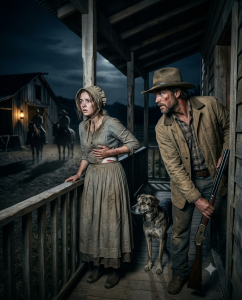
He stepped onto the porch.
Three riders waited beyond the trough, their horses dark against darker ground. One sat slightly ahead of the others, hat low, confidence easy. Hired men, Rasco thought, but not drifters. Men paid regularly enough to expect obedience from others.
“You’re on private property,” Rasco said.
“We only want the woman.”
“That so.”
“She belongs to Mr. Vane.”
Rasco’s voice lost its warmth completely. “Nobody belongs to anybody on my place.”
The lead rider laughed softly. “You’re making this difficult.”
“No,” Rasco said. “Difficult comes later.”
One of the men started to dismount.
Rasco fired into the dirt by his boot.
The horse screamed and reared. The man cursed and grabbed for the saddle horn.
“Next one,” Rasco said, cocking the rifle again, “goes where I intend.”
The yard fell silent.
What the riders didn’t know was that María was no longer in the back room.
She had slipped out the kitchen window while the lead man talked and moved along the side of the house toward the barn. Rasco saw her shadow once, low and quick, then lost it. For one furious second he wanted to drag her back. Then he understood.
The ledger.
If Hollis’s men had found the ranch, they might already know she had evidence. If the house was searched, the paper in her bag would not stay hidden. She was moving to protect it.
The lead rider tried another tactic.
“Mr. Warkens,” he called. “Mr. Vane says if you ask about the ledger before we leave, he’ll consider that an admission that she told you too much.”
That told Rasco all he needed.
He smiled without humor into the dark. “Then tell Mr. Vane I’m asking now.”
The first bullet came from the barn instead of the yard.
María had fired from behind the feed barrels, clipping the shoulder of the rider on the left. Chaos followed at once. Horses bucked. Men shouted. Gunfire cracked across the yard, splintering the porch rail.
Rasco shot the lead rider through the upper arm as the man reached for his revolver. Another ducked behind the trough and fired blind toward the kitchen. Chester exploded from under the wagon barking like a devil and sent one horse plunging sideways into the fence.
The fight lasted less than a minute and felt like an hour.
When it was over, one rider lay groaning in the dirt, one was pinned under a panicked horse with a broken leg, and the lead man was trying to crawl toward the gate while blood soaked his sleeve.
Rasco planted a boot between his shoulders and took his gun.
“Where’s Vane?”
The man spat dust. “Close enough.”
María came out of the barn shaking, the rifle still in her hands. Rasco took it gently and looked her over for blood that wasn’t old. Finding none, he let himself breathe.
The wounded rider under his boot saw her and grinned through pain. “He’ll burn this place for what you did.”
“No,” María said, voice raw but steady. “For what he did.”
They tied the men, hauled them into the wagon, and drove to Haskel before sunrise. Rasco did not bother with the local deputy. María had already told him enough about bought lawmen. Instead they went straight to Judge Tolliver, an old circuit judge staying above the mercantile while court records were being moved. Tolliver was known for two things: hating disorder and hating being made a fool.
Rasco woke him before dawn.
The judge opened the door in shirtsleeves, ready to curse, until he saw the tied men in the wagon and the woman with dried blood on her side.
Then María unfolded the copy of the ledger.
She spoke for nearly an hour.
When she finished, Tolliver did not ask whether she had proof. He asked where the original was.
“In a trunk under Mrs. Vane’s winter lining,” María answered.
The judge turned to his clerk. “Get the U.S. marshal in Denton. And wake Sheriff Bell from the north district, not ours.”
By noon, Hollis Vane still had not realized how badly the ground had shifted.
He was arrested at his ranch just after dinner while drinking coffee on his own veranda. The original ledger was found exactly where María said it would be. More names surfaced. More men were implicated. Two deputies fled. One merchant hanged himself before he could be questioned. A wagon route used for moving stolen cattle turned out to have been used for trafficking women as well.
The scandal ripped through three counties.
Hollis tried every defense he had.
He said María had been dismissed for theft.
He said the ledger was forged.
He said Rasco had corrupted her testimony.
He said the entries referred to labor contracts, not people.
Then Emmett, the stable boy, came in under protection and testified. After him came a widow from Kerr’s Crossing. Then a Mexican girl found in a boarding house outside Winton who identified one of Hollis’s associates by his rings. Then another witness. Then another.
Each story matched the ledger more than the last.
María testified on the third day of hearings.
She wore a plain dark dress Rasco had bought her in town because hers had been ruined beyond mending. She stood straight, one hand resting against the rail, and told the truth in a clear voice that seemed to make the whole room lean toward her.
When Hollis entered under guard, their eyes met for the first time since the night she escaped.
He looked smaller than she remembered.
Not harmless. Never that.
But smaller.
Power had changed shape around him. It no longer looked like certainty. It looked like a man discovering that fear did not travel only one direction.
He smiled at her once during testimony, the same smile she remembered from the stable.
She did not break.
When the hearing ended, Hollis tried one last thing.
As the deputies led him past, he said softly enough that only she and Rasco could hear, “You think this makes you clean?”
María looked at him for a long moment.
“No,” she said. “I think it stops you.”
That was all.
It was enough.
Hollis Vane was convicted on multiple charges the following spring: trafficking, kidnapping, conspiracy, falsifying cattle records, bribery, assault, and murder tied to one of the girls marked buried in his ledger. Two of his associates were sentenced beside him. Others disappeared before trial, which led many in town to mutter that the devil looked after his own. Maybe he did. But not well enough that year.
When the worst of it was over, people began treating María differently.
Some with admiration.
Some with embarrassment, because respectable folks hated discovering they had dined beside monsters and noticed nothing.
Some with suspicion, because there were always people who blamed a woman for surviving ugly truths.
Rasco never asked her to justify any of it.
He fixed the porch rail. Rehung the kitchen window. Bought seed. Repaired tack. Let life return in useful pieces.
One evening, months later, María found him in the yard checking a mare’s hoof.
“You know,” she said, “you still haven’t asked why I came here.”
Rasco glanced up. “Needed a job.”
“That’s all?”
He shrugged. “You came through my gate. That made you my problem.”
She laughed under her breath. “That’s a hard way to say you helped me.”
“I did help you.”
“Why?”
He stood, brushed dirt from his hands, and looked at her with the same plain steadiness he had shown the first day.
“Because you were bleeding,” he said. “Because you were scared. Because whatever followed you was worse than whatever name you used. Pick one.”
María looked down, then back at him. “There was another reason I came.”
He waited.
“In San Merced, before I worked for Hollis, I heard about a rancher in Calvel County whose mother used to hide travelers in storms and feed men who couldn’t pay. They said her son had her same stubbornness and half her patience. I figured if I got as far as your land, I might live long enough to decide what to do next.”
For once, Rasco seemed to have no ready answer.
He cleared his throat. “My mother had all the patience. I just got the ranch.”
“That’s not true.”
He looked away first, which pleased her more than it should have.
By winter, her room upstairs still had its lock. She simply used it less.
By spring, the ledgers belonged to the court archives, Hollis belonged to a cell, and the mare she had ridden in on had become partial to sugar from María’s hand and anyone else’s absolute ruin if they tried to steal her reins.
As for Rasco, he remained quiet, difficult, and impossible to impress.
But not impossible to read anymore.
Not to her.
Some evenings, when the work was done and the sky turned copper over the fields, they sat on the porch with Chester between them, older now and slower, yet still certain he had final authority over the household. The silence no longer held secrets. Only peace, and the odd unfinished thought.
People in town started saying María Tonent had saved herself.
They were wrong.
She had done something harder.
She had survived long enough to tell the truth, then stayed to build a life after it.
And Rasco, without speeches or promises, had given her the one thing fear had nearly taken for good: a place where she did not have to keep looking over her shoulder before she breathed.
Still, if anyone asked which red flag mattered most, the answer was simple.
It was never the knife.
It was the smile of the man holding it.
And if anyone asked whether Hollis Vane deserved forgiveness, nobody who had seen María’s face the night she spoke her real name would have answered yes.
But the harder question lingered longer than the trial, longer than the gossip, longer than the ruin he left behind.
When fear teaches you to lie just to stay alive, and someone believes you anyway, who really saves who in the end?