She walked into that ballroom knowing exactly one thing she hadn’t known in twelve years.
His name was on the program.
Alma Rudd stood at the entrance of the Decatur Ag College Centennial Gala in a navy crepe dress she’d bought with her own money — the first dress she’d bought for herself in longer than she cared to admit — and she let the chandeliers do what chandeliers do.
She let herself be seen.
Not recognized. Not yet.
Just seen.
—
You have to understand what this room meant to her once.
The Macon County Soybean Growers’ Cooperative had been her husband Dale’s whole world. Twenty-two years of early mornings, cracked hands, muddy boots left on the back porch. He’d been a member since before Alma had his last name. He’d believed in this land the way some men believe in the Bible.
And then Dale was gone.
And then everything else went too.
The auction notice went up on a Thursday. By Saturday morning, her brother-in-law Gary Rudd was standing in her driveway with a clipboard, telling her she had sixty days.
She was holding a casserole dish.
She hadn’t even set it down before he turned and walked back to his truck.
She stood there in the gravel for a long time after the engine noise faded. The casserole got cold. She never did eat it.
—
That was twelve years, two states, one bookkeeping certificate, and one very quiet obsession ago.
Alma had kept almost nothing from the farm.
Just one thing.
A small envelope, no bigger than her palm, hand-stitched along the edges with cream-colored thread in the way Dale’s mother used to sew. It held three Macon County heritage soybean seeds — the original variety the family had planted for four generations. Dale had tucked it into his shirt pocket at every planting, every harvest, like a good luck charm he never explained.
She’d had it in her coat pocket on the day of the auction.
And tonight, she’d slipped it under the centerpiece of the head table before the first guest arrived.
No note. No name. Just the envelope, sitting beneath the white hydrangeas like it had always belonged there.
She had a reason for that.
—
The room filled up slowly the way rooms do in central Illinois — handshakes and casseroles-brought-up-in-conversation and ladies asking each other about grandchildren. Alma moved through it gently, greeting people who didn’t know her face, which was exactly the point.
The cooperative had received an endowment this spring. A significant one. Anonymous donor. Enough to restore the agricultural scholarship program, fund a new seed preservation lab, and keep the county extension office open for the next fifteen years.
The local paper had called it a miracle. The board had spent three months trying to identify the source.
They were about to find out.
Alma took her seat at a side table, third from the back, and folded her hands in her lap.
Gary Rudd arrived at seven-fifteen. She watched him from across the room.
He was heavier now. Gray at the temples. He laughed too loud at something the man next to him said, the way people laugh when they want a room to like them.
She felt nothing she hadn’t already made her peace with.
That’s the part people never believe about a story like this.
She wasn’t there for anger. She was long past anger.
She was there because Dale had loved this land, and the land deserved better than what Gary had done to it, and she had spent twelve years quietly making sure she could do something about it.
That was all.
That was enough.
—
At eight o’clock, the board president called the room to attention.
“Before we begin the program,” he said, adjusting his microphone, “we have the distinct honor of recognizing the donor whose generosity has secured the future of this institution.”
A murmur moved through the tables.
“This individual asked for no fanfare and no podium time.” He smiled. “We overruled them on the plaque.”
Gentle laughter.
“We’d like to ask our cooperative board chair to do the honors.”
Gary Rudd stood up.
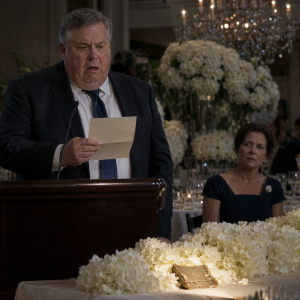
Alma watched him straighten his jacket, pick up the ivory recognition card from the head table, and walk to the podium with the comfortable stride of a man who assumed the room belonged to him.
He tapped the microphone once.
Unfolded the card.
And the small, hand-stitched seed envelope at the head table centerpiece caught the chandelier light in exactly the way she’d known it would — cream thread glowing like something old and patient and still alive.
His eyes moved from the card to the room.
Then back to the card.
The color left his face so completely and so fast that the woman beside Alma actually leaned forward in her chair.
His mouth opened.
Nothing came out.
—
The board president filled the silence with a practiced smile, the way men in his position learn to do. He leaned toward the second microphone and said, “Gary, go ahead and read the name for us.”
Gary’s jaw worked once. Twice.
“Alma Ruth Rudd,” he said.
He said it very quietly, like a man confessing something in church.
But the microphone picked it up just fine.
—
The room did not erupt. This was central Illinois, and central Illinois does not erupt at galas. What happened instead was a specific kind of silence — the held-breath kind, the kind that moves from table to table like a slow current — followed by one woman near the front saying “Lord have mercy” in a voice she probably meant to keep to herself.
Alma stood up.
She had planned to stay seated. That had been the plan. Let the name land, let the room understand what it meant, and then slip out the side door before anyone could make a fuss.
But she stood up anyway. She wasn’t sure why, except that her legs seemed to decide before she did, and she’d learned a long time ago to trust the parts of herself that moved without hesitation.
She was still fifty feet from the podium. There was no reason to go up there.
She didn’t go up there.
She just stood, in the navy dress she’d bought with her own money, and let the room find her face.
It took about four seconds.
Then Dot Magruder, who had brought tuna casserole to Dale’s funeral and never once stopped sending Alma a Christmas card even after she’d moved away, pushed back her chair and started clapping.
Not politely. Not the careful, evaluating kind of applause. The kind with her whole hands, arms raised, the way you clap when something is right with the world after a very long time of things being wrong.
A few others followed. Then several more. Then most of the room.
Gary Rudd stood at the podium and did not clap. He held the ivory recognition card in both hands and stared at it, and Alma almost felt something adjacent to pity for him — almost — before she decided that was more grace than the moment required.
She let herself receive the applause the way she’d let the chandeliers see her at the beginning of the evening. Fully. Without apology.
Dale would have been mortified. He was a boot-scuff-on-the-floor kind of man who never wanted a fuss. She knew that. She loved him for it. But Dale was gone, and the seeds were found, and somebody had to stand up straight and take the credit for what had been built from the ruins of what he’d loved.
So she did.
—
The board president recovered his composure and said something generous into the microphone about legacy and stewardship and the enduring spirit of the cooperative’s founding families. Alma stopped listening to the specific words. She’d heard the shape of them in her head a hundred times over twelve years — lying awake in her apartment in Columbus, in her studio in Terre Haute before that, at the kitchen table in the dark with a cup of coffee going cold in her hands while she ran numbers on a yellow legal pad.
She had not set out to accumulate what she’d accumulated. She wanted to be clear about that, always, when the story got told later, which she knew it would.
She had started with the bookkeeping certificate because she needed to eat.
Then she’d gotten good at it, because she had nothing else to do with her evenings and she’d always been somebody who needed a problem in front of her.
Then a small CPA firm in Columbus had made her a partner, because she turned out to be the kind of bookkeeper who saw patterns that other people missed, and patterns meant money.
And then she’d met a man named Gerald at a municipal bond conference in Cincinnati — not a romantic man, a spreadsheet man, the best kind for the situation she was in — and Gerald had said, quietly, over terrible hotel coffee, that if she wanted to do something specific with what she had, he knew how to structure it so it couldn’t be traced until she chose otherwise.
She had said yes before he finished the sentence.
It had taken six more years after that. Not because she was impatient but because she wanted it to be real, and she wanted it to be permanent, and she wanted to make absolutely sure that the cooperative’s new seed preservation lab would be named for Dale and not for her.
The plaque on that lab would read: Dale H. Rudd Seed Preservation Laboratory, In Memory of a Man Who Understood What a Seed Means.
She had written that herself. Gerald had thought it was a bit much. She’d told him, kindly, to mind his own business.
—
Gary found her near the coat check at the end of the evening.
She had expected this. She had also expected that she would not enjoy it as much as some people might, and she was right about that. She had no interest in his face in this moment.
But she looked at him directly, because that part mattered.
“Alma,” he said.
“Gary.”
He was holding his hat in his hands. An old reflex. Their mother-in-law had insisted on it indoors, and apparently some things stick whether you deserve them to or not.
“I didn’t know you had —” he started.
“I know you didn’t.”
He looked at the floor. Then at the wall. Then, finally, back at her.
“Dale would’ve said this was too much.”
“Dale would’ve said it in a very kind voice while crying a little bit into his coffee,” she agreed. “So he would’ve been right and useless at the same time. That was his gift.”
Gary made a sound that might have been a laugh, if it hadn’t come out so rough.
“I was wrong,” he said. “About the sixty days. About the whole thing.”
“Yes.”
She let it sit there. She wasn’t going to carry it for him.
“The seeds,” he said after a moment. “The envelope. That was Mom’s sewing.”
“It was.”
He pressed his lips together very hard and looked away again. “Where did you — you had those all this time?”
“Dale’s shirt pocket. On the dining room table when I cleared out his things.” She paused. “Gary, I want to be honest with you. I didn’t place them there tonight to be cruel. I placed them there because that variety is going into the preservation lab’s first collection, and I needed you to understand where it came from. Not for my sake. For the record.”
He nodded slowly. It was the nod of a man who understood that this moment was all he was going to get, and that it was considerably more than he’d earned.
“The board is going to want to talk to you,” he said. “About the lab. About everything.”
“I know. I’ll be in touch with them Monday.”
And that was that.
He put his hat on and walked out the front doors, and Alma watched him go, and then she got her coat from the check, and tipped the young woman behind the counter five dollars, and stepped out into the November air.
—
The parking lot of the Decatur Ag College on a November night smells like cut corn and cold pavement and something underneath both of those things that you can’t name but that people who grew up in central Illinois recognize without thinking about it.
Alma recognized it.
She stood beside her rental car and breathed it in.
She had brought one other thing tonight besides the seed envelope. It had been in her coat pocket all evening, next to her phone and her lip balm and the small folded note with Gerald’s number in case anything went sideways with the foundation paperwork.
A photograph.
Dale at the edge of the east field on a June morning, maybe 1998 or 1999, squinting into the sun with one hand raised to block it and the other resting on the fence post like he was holding a conversation with it. He looked happy in the uncomplicated way that people look happy when they are exactly where they are supposed to be.
She looked at it for a while in the parking lot light.
Then she put it back in her pocket, where it belonged, next to everything else she’d carried all these years.
She got in the car.
She drove toward the highway, through the flat and patient dark of Macon County, past fields that had been planted and harvested and planted again the way fields do — indifferent to who owned the deed, faithful only to the season — and she felt, for the first time in a very long time, that the weight in her chest was something other than grief.
She wasn’t sure there was a word for it yet.
She thought maybe she had twelve years of living left to find one.
That seemed like enough.