She walked out of the Petroleum Club through the kitchen.
Past the dish racks. Past the catering staff who pretended not to see her. Past the smell of poached salmon and old money.
And nobody in that ballroom knew she’d left something behind.
—
Seven years later, Shreveport would still be talking about it.
But let’s go back to the beginning.
—
Patrice Mouton had been married to Gerald Fontenot for eleven years.
Eleven years of following him to charity galas she hadn’t been invited to before she met him. Eleven years of learning which fork was which, which wine went with what, and how to smile at his mother, Vivienne, without letting your eyes go cold.
She’d grown up in a shotgun house off Jewella Avenue. Gerald had grown up on Line Avenue. That was the whole story, according to Vivienne. That was always the whole story.
When Gerald left, he left clean. Took the house on Fairfield. Took the Cadillac. Took his mother’s approval, which he’d never really surrendered in the first place.
Patrice took her clothes, her grandmother’s Bible, and a clarity she hadn’t expected.
—
She heard about the wedding through a coworker.
She hadn’t been invited — of course she hadn’t. But somehow, some miscommunication, some overlap in their still-tangled social world, she ended up at the reception.
She wore a dress she’d borrowed from her friend Darlene. Navy blue. Simple. Clean.
She was not there to make a scene. She was not there to cry. She was barely there at all.
But Vivienne saw her.
And Vivienne crossed that marble floor like a woman who had been waiting her whole life for this moment.
“The service entrance,” she said, quietly enough that only Patrice could hear. “That’s where you belong.”
—
Patrice set down her glass of sweet tea.
She smoothed the front of Darlene’s navy dress.
She picked up her small clutch from the gift table — and as she did, she slipped something under the edge of a tall centerpiece arrangement.
A small envelope. Unsealed. Unsigned.
Inside: an index card.
Water-stained at one corner, like it had been sitting in a drawer for a long time.
On it, written in Patrice’s careful schoolteacher handwriting, was a single dollar amount.
No note. No name. No explanation.
Just a number.
—
The florist found it the next morning when she came to collect her vases.
She gave it to the club manager, who gave it to Gerald, who showed it to Vivienne.
They all agreed it was strange.
The number was too large to be a joke.
Too specific — down to the last dollar, cents and all — to be random.
Vivienne told Gerald to throw it away.
He kept it. He didn’t know why.
—
Over the next seven years, Patrice Mouton did something nobody on Line Avenue was watching for.
She went quiet.
Not the quiet of a woman who had given up. The quiet of a woman who was paying attention.
She’d always been good with numbers — it was why Gerald’s mother had found her so useful at the Foundation’s annual gala, and so easy to dismiss afterward. But Patrice had learned more than table settings in those eleven years.
She’d learned how money moved in this city.
She’d learned which buildings sat vacant while their owners waited. Which estates got probated slow. Which old Shreveport families were land-rich and patience-poor.
She went back to school at forty-one. Got her real estate license at forty-three. Started small. Stayed quiet. Reinvested everything.
She didn’t talk about what she was doing because nobody asked.
—
The Thibodaux Building had been a landmark on Texas Street since 1938.
Six stories. Original terrazzo floors. A rooftop nobody had opened in thirty years.
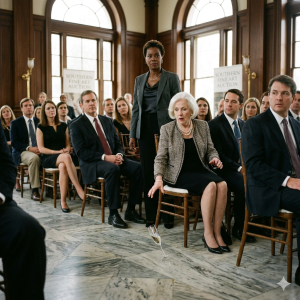
When it came up for auction on a bright Tuesday in October, every developer in Caddo Parish was in that room. Gerald’s new wife’s family had been quietly planning their bid for months. Vivienne had attended two pre-auction viewings personally.
She was in the third row when the auctioneer stepped to the podium.
She was wearing the same pearl earrings she’d worn the night she told Patrice to leave through the kitchen.
She was holding a champagne flute from the pre-auction reception, still half-full.
The auctioneer shuffled his papers. Looked up. Looked back down.
Looked up again.
—
“Ladies and gentlemen,” he said, and something in his voice made the room go still.
“Before we open the floor —”
He cleared his throat.
“The opening bid on the Thibodaux Building has already been placed. In full.”
A murmur moved through the crowd.
“By a Ms. Patrice Mouton.”
The room turned.
From somewhere near the back, a woman in a well-cut charcoal blazer stood up slowly.
Navy dress, someone would later say — though others insisted it was charcoal. She’d been sitting there the whole time. Nobody had recognized her.
In the third row, Vivienne Fontenot’s champagne glass slipped right out of her hand.
It didn’t shatter.
It just hit that old marble floor and rolled, slowly, all the way to the center aisle.
And somewhere in Vivienne’s memory, small and water-stained at one corner —
That number finally made sense.
—
The number on the index card was $2,847,614.37.
That was the appraised value of the Thibodaux Building as of March, seven years prior. Not the public estimate. Not the developer’s wishful-thinking figure that got quoted in the Shreveport Times. The actual appraised value, from the actual appraisal, commissioned by the actual owner’s estate attorney.
Patrice had typed up that appraisal herself.
She’d been working three days a week as a legal secretary for Broussard & Hebert during the last two years of her marriage. Gerald had considered it embarrassing. His mother had considered it proof of something she’d always suspected. Patrice had considered it an education.
When the Thibodaux estate first came into probate, she’d been the one to organize the file. She’d read every page. She’d noted the appraised value, the outstanding liens, the tax delinquency schedule, and the particular clause in old Armand Thibodaux’s will that required the building to be sold intact, not parceled, to a single buyer.
She’d written the number on an index card and put it in her desk drawer.
That was the drawer it had been sitting in when she slipped the card under the centerpiece at Gerald Fontenot’s wedding reception.
She hadn’t left it as a threat. She hadn’t left it as a message.
She’d left it because she wanted someone to know that she knew. That she had always known. That the woman Gerald’s mother had walked past in eleven years of galas without once asking her name had been paying attention the entire time.
And then she walked out through the kitchen and drove herself home.
—
After the auction, a reporter from the Times tried to reach her for comment.
She didn’t return the call for four days.
When she did, she was brief.
She said the building had good bones. She said the rooftop had a view of the Red River that most people in this city had forgotten about. She said she planned to restore the terrazzo floors to their original condition because they deserved it.
She did not mention Vivienne. She did not mention Gerald. She did not mention the index card, the reception, or the kitchen door at the Petroleum Club.
The reporter pressed her. Asked if she had any comment on the Fontenot family’s interest in the property.
Patrice was quiet for a moment.
Then she said: “I’m not aware of any Fontenot family interest in this property. I placed my bid, and my bid was accepted. That’s the whole story.”
She thanked the reporter for his time and hung up.
—
Darlene, who had lent her the navy dress all those years ago, was her first tenant.
Darlene ran a catering company out of a commercial kitchen on Youree Drive that had gotten too small for her business. Patrice renovated the entire basement level of the Thibodaux Building and offered it to her at a rate that was fair and not a dollar lower than that.
“I don’t want charity,” Darlene said, standing in the middle of the unfinished space with her arms crossed.
“It’s not charity,” Patrice said. “I need an anchor tenant with a real operation. You’re it.”
Darlene looked around at the exposed brick and the high ceilings and the freight elevator that Patrice had already had inspected and certified.
“Alright,” she said.
They shook hands.
Neither of them mentioned the navy dress.
—
The rooftop opened in May.
Patrice had hired a landscape architect from New Orleans who had done rooftop work on the Warehouse District and understood about heat and weight load and the particular loneliness of a Louisiana afternoon. She’d specified native plantings. She’d specified ceiling fans rather than misters. She’d specified one long communal table down the center, made from reclaimed cypress, and enough smaller tables around the edges that you could be alone if you wanted to be alone.
The opening was not an event. There was no ribbon. There was no champagne.
She came up early in the morning before anyone else arrived, while the city was still quiet below, and she stood at the railing and looked at the river.
It was exactly the view she had remembered from the appraisal documents, where the estate attorney had noted, somewhat unprofessionally, in the margin of his site visit notes: *remarkable river view, underutilized, significant potential.*
She had underlined that note in pencil when she typed up the file.
She had never unlined it in her mind.
—
Gerald came to see her once.
This was about a year after the auction, on a weekday afternoon. He showed up at her office on the second floor of the Thibodaux Building, where she had put her desk facing the window so she could see Texas Street below.
He looked good. He always had. That had never been the problem.
He sat down across from her without being invited to and said he supposed she’d made her point.
She looked at him for a moment.
“What point is that, Gerald?”
He gestured vaguely at the room. At the building. At all of it.
“You know,” he said.
“I really don’t,” she said. “I bought a building. I run a business. I don’t know what point you think that makes.”
He was quiet. He seemed to be working something out.
Then he said: “She told me to throw that card away.”
“I know she did.”
“I kept it in my desk drawer for seven years.”
“I know that too,” Patrice said. “Gerald, I knew the appraised value when I wrote it down. I knew what it would eventually sell for, within a reasonable margin. I knew your family would want it, and I knew that a cash offer placed before the auction opened would end the bidding before it started. None of that is a mystery. I just did the math and waited.”
He looked at her. “You planned this. Back at the reception.”
She thought about it.
“I planned to leave,” she said. “I planned to go out with my dignity, which your mother made complicated. The card was —” She paused. “The card was just something I needed to do. For myself. The rest came later.”
He nodded slowly. She didn’t think he fully believed her, and she didn’t particularly need him to.
He stood up to leave.
At the door, he stopped.
“The terrazzo floors look good,” he said.
“Thank you,” she said. “They were always good. They just needed someone to pay attention.”
He left.
She watched Texas Street for a while after that.
—
Vivienne never came.
This surprised no one who knew Vivienne and surprised no one who knew Patrice.
There was a rumor, passed through the particular telephone of Shreveport society — which still functioned, in the age of the internet, primarily through church parking lots and the far corner tables of Herby-K’s — that Vivienne had referred to the Thibodaux Building as “that woman’s project” for the first two years, and then, as it became undeniably successful, had simply stopped referring to it at all.
Patrice heard this and found it satisfying in the way that a perfect equation is satisfying. Not triumphant. Just correct.
—
Five years after the auction, the Thibodaux Building was fully tenanted.
The rooftop had been written up in a regional architecture magazine. Darlene’s catering company had outgrown even the expanded basement kitchen and taken on two additional staff. A small law firm on the fourth floor had just made partner. The terrazzo floors gleamed like they had in 1938, when Armand Thibodaux had commissioned them from an Italian craftsman who had come to Shreveport by way of New Orleans and stayed because of a woman whose name the historical record did not preserve.
Patrice thought about that sometimes. The woman whose name the record didn’t preserve.
She’d had the craftsman’s initials inlaid into the floor of the lobby, because they were already there, in a small medallion near the elevator, and she’d wanted to make sure people noticed.
She had not added anything with her own name.
She didn’t need to.
—
The index card, as far as anyone knows, is still in Gerald Fontenot’s desk drawer.
Patrice kept no copy.
She had written the number from memory, and she still has it in her memory, and she has never once needed to look it up.
Some things you just carry with you.
You carry them out through the kitchen, past the dish racks, past the catering staff who are trying so hard not to see you.
You carry them home.
You put them somewhere safe.
And then, when the time is exactly right, you let them turn into something that will outlast every pearl earring and every marble floor and every quiet, devastating instruction about which door someone like you is supposed to use.
Patrice Mouton built something.
That’s the whole story.