She walked right past him like he was furniture.
After eight months of smiling at that man across every white-tablecloth room in Savannah, Margaret Elaine Beauchamp finally stopped smiling.
And that’s when everything changed.
—
Let me take you back to where this started.
Margaret had spent thirty-one years building a life in this city. Not the flashy kind of life. The quiet kind. The kind built on showing up before sunrise to make sure the biscuits were right, the kind where you knew every event planner and florist and venue manager by their first name because you’d worked alongside them for decades.
Twelve of those years, she’d shared her company with a man named Dale Pritchett.
Coastal Elegance Catering. Her name, her vision, her recipes. His sales calls and his handshake deals. They’d built something real together — the kind of Savannah institution that served every Junior League luncheon, every hospital benefit, every debutante dinner that mattered.
She trusted him the way you trust a person who’s sat across your conference table for twelve years.
That was her first mistake.
—
She found out on a Tuesday.
Her attorney called. Calm voice, careful words.
The company had been dissolved.
Not sold. Not closed. *Dissolved.* The contracts — all of them, the hospital, the historic foundation, the museum gala — had been quietly transferred to a new LLC.
A new LLC run by Dale.
And his girlfriend of seven months, a woman named Trina who had never, not once, catered a single event in her life.
Margaret’s signature was on the dissolution papers.
She had never signed them.
—
She sat in her car in the parking lot of her attorney’s office for forty-five minutes.
Then she reached into her purse, pulled out a small index card — the kind you’d use for a recipe, worn soft at the corners from handling — wrote something on it, folded it in half, and slipped it into the front pocket of her apron.
She still wore the apron. Old habits.
She would reach for that card in the months to come. At the Magnolia Society lunch, when someone touched her arm and said, *”Bless your heart, how are you holding up?”* She’d smile, slide her fingers into her pocket, feel the folded edge of it.
*Just fine,* she’d say.
At the Children’s Hospital benefit, when she spotted Dale laughing at the bar with the hospital board chairman — the same chairman who’d given Coastal Elegance their first major contract — she’d feel her jaw tighten.
Then her hand would go to her apron pocket.
And she would smile.
People noticed the card. Of course they did. Women always notice.
*What is that thing she keeps looking at?*
Her friend Loretta asked her directly, at the Preservation Society tea in March.
Margaret just smoothed the card back into her pocket and said, *”Something I wrote down to keep myself on track.”*
Loretta said she looked like a woman with a plan.
Margaret said, *”Loretta, I’ve always had a plan.”*
—
Eight months.
Eight months of charity luncheons and benefit dinners. Eight months of watching Dale network in rooms she helped build, with people whose names she’d put in his mouth years ago.
Eight months of being underestimated.
Because here is what Dale Pritchett never understood about Margaret Elaine Beauchamp:
She wasn’t soft-spoken because she was weak.
She was soft-spoken because she never wasted words on things that didn’t matter.
—
Tonight was the Savannah Civic Gala.
The biggest room in the city. Every mayor, every alderman, every chamber president, every donor who kept this town’s institutions funded and running.
Dale had been telling people for weeks he had an announcement. His new venture. His vision for Coastal Elegance — or whatever he was calling it now. He was going to stand in front of all of them and let them believe he’d built something.
Margaret arrived early.
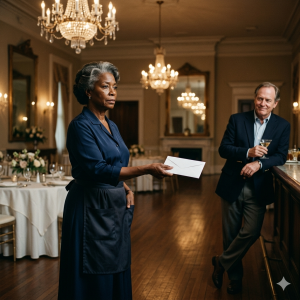
She wore navy. Simple cut, good fabric. The kind of dress that doesn’t ask for attention but holds a room when the room starts paying attention.
She spent the first hour speaking to exactly the right people. Quietly. Warmly. The way she always had.
She had one envelope in her hand.
She’d been carrying it for eight months.
Dale saw her across the ballroom and gave her that particular smile men give women they’ve decided are no longer a threat.
She smiled back.
One last time.
—
Then the mayor crossed the room toward the bar.
Margaret watched him. Waited for exactly the right moment — the still, unhurried moment she had been patient enough to let arrive.
She smoothed the front of her navy dress.
She walked straight past Dale Pritchett without a single glance.
And she held out the envelope — the one she’d been carrying for eight months, the one connected to everything on that small worn index card — directly to the mayor of Savannah.
He looked at her face, then at the envelope, and his expression shifted in a way that told her everything she needed to know.
Dale was still smiling from across the room.
He hadn’t understood yet what he was watching.
—
The mayor’s name was Gerald Whitmore. He’d known Margaret since before he was Gerald Whitmore the Mayor. Back when he was just Gerald who ran the parks commission and ate her shrimp and grits at every civic function he could find an excuse to attend.
He opened the envelope right there at the bar, the way she’d hoped he would. Because Gerald was not a man who let a woman in navy hand him something with that kind of quiet urgency and then slide it into his breast pocket for later.
He read it once. Then again.
Then he looked up at her over the top of the paper.
“Margaret,” he said. “How long have you had this?”
“Long enough to be sure,” she said.
What was in the envelope was not a lawsuit. It was not a demand letter. Those things were already in motion, already in the hands of her attorney, already filed in Chatham County court as of nine that morning. She did not need Gerald Whitmore for any of that.
What she handed him was a letter. Two pages, single-spaced, on her personal stationery. The kind with the small magnolia watermark she’d used for thirty-one years.
It documented, in careful and specific detail, every city contract that had passed through Coastal Elegance Catering over the past four years. The amounts. The renewal dates. The names of the city officials who had approved them.
And it documented the name of the LLC those contracts had been transferred to without the city’s knowledge or a proper rebidding process.
It documented the forged signature.
And it documented one other thing.
The index card.
That small soft worn index card she’d been reaching for across eight months of charity events and benefit dinners — it had not been a reminder, exactly. It had been a list. A record she kept close because she didn’t trust it anywhere else.
Every time someone had mentioned Dale’s new operation in conversation. Every venue manager who’d told her, apologetically, that they’d gotten a call from him offering their contract at a lower rate. Every supplier she’d built a relationship with over twenty years who’d received an email — from a Coastal Elegance address that should have been deactivated — implying she had retired and that Dale was the continuity.
She had written it all down. Date, name, detail. In her small precise handwriting.
Because the index card was not just about keeping herself on track.
It was evidence.
—
Gerald Whitmore folded the letter back into the envelope.
He was quiet for a moment in the way that men are quiet when they realize the ground has already shifted and they are only now feeling it.
“I’m going to need to make a phone call,” he said.
“I know,” Margaret said. “I’ll be right here.”
He stepped away toward the corridor near the coat check, phone already in his hand.
Margaret turned back to the room.
Loretta appeared at her elbow within thirty seconds. The woman had radar.
“Was that what I think it was?” Loretta said.
“Depends on what you think it was.”
“I think it was eight months of work handed to the right person at the right moment.”
Margaret picked up a glass of water from a passing tray. “Then yes.”
—
Dale made his announcement at eight-fifteen.
He stood near the small podium the gala committee used for remarks and he talked about growth and vision and his gratitude to this community. He talked about the future of Coastal Elegance. He used that name like he’d always owned it.
The room listened politely.
Margaret stood near the back with Loretta. She did not look at Dale. She watched the faces of the people listening to him.
She watched the hospital board chairman, who had taken a phone call of his own twenty minutes earlier and returned to the room with a careful blankness on his face.
She watched two of the aldermen glance at each other across the room during Dale’s remarks in a way that meant they had also received calls or texts or quiet words in the corridor.
She watched Gerald Whitmore, who stood with his arms crossed and said nothing and did not applaud when the small appreciative sound moved through the room at the end.
Dale stepped away from the podium pleased with himself.
That was the last moment of the evening he would feel that way.
—
The city opened a formal review the following Monday.
It was not the kind of thing that made a dramatic announcement. It was the kind of thing that arrived as a certified letter and a phone call from the city attorney’s office, requesting documentation.
The kind of thing that, in a city like Savannah, gets known about very quietly and very quickly by every person who matters.
The contracts were suspended pending review. All of them.
Dale hired an attorney. Trina, from what Margaret heard, stopped returning his calls within the week. She had not known about the forged signature. That was the word that came back through the very efficient network of women who move through these rooms and know everything. Trina had believed what Dale told her. And when she understood what she had actually walked into, she walked out.
Margaret’s civil case moved forward. Her attorney, who had been waiting patiently for exactly this kind of institutional backing to give the case its full weight, described the situation as favorable.
Margaret described it as overdue.
—
The thing about the index card — the thing she had never told Loretta or anyone else — was what she had written on it that first day. That Tuesday in the parking lot.
It wasn’t a list yet. The list came later, one careful entry at a time over eight months.
What she wrote first, right there in the parking lot with her hands still not entirely steady, was a single line. Something to come back to. Something to keep her from doing the other thing she had considered in those forty-five minutes, which was calling Dale Pritchett directly and saying every true and deserved thing she had in her.
She hadn’t done that. Because that would have been for her, and this needed to be for something larger.
So instead she wrote the line, and she folded the card, and she put it in her apron pocket.
The line was this:
*Build it back bigger and let the truth do the rest.*
—
Coastal Elegance Catering — her Coastal Elegance, rebuilt and re-filed with the state under her name alone — catered the Savannah Civic Gala the following year.
She arrived early.
She wore the apron.
The biscuits were right.
The index card was still in her pocket. She’d kept it. Not because she needed it anymore. Because she believed in keeping the things that carried you through.
Loretta found her in the kitchen at seven in the morning, supervising the setup, and said, “You know you could hire someone to do this part.”
Margaret looked up from the biscuit pan and said, “I know.”
And she kept doing it anyway.
Because that was who she was.
That had always been who she was.
Dale Pritchett had spent twelve years sitting across her conference table and never once understood that.
Some mistakes you only get to make once.