They sold her over a whiskey debt before she could even brush the road dust off her shoulders.
By the time Josefina Millán stepped down from the stagecoach in Real del Fierro, she was too tired to think clearly and too hopeful to admit it. The trip north from Puebla had taken days, and every mile had been held together by the same fragile dream.
A home.
A husband.
A life that did not feel like punishment.
At twenty-four, Josefina had already buried too much. Her mother had died first, her father a few years later, leaving her with his old medical satchel, a sewing basket, and the kind of practical education no one ever praised in a woman until they needed saving. She had spent the years since then bent over hems, cuffs, and torn collars in dim rooms that never stayed warm. Some weeks she bought bread. Some weeks she bought thread. She had learned how thin the line was between surviving and vanishing.
Then Eusebio Cárdenas’s first letter arrived.
He wrote with care. That was what disarmed her. Men who lied usually lied lazily. Eusebio had not. He had filled pages with details. He lived in Chihuahua, he said, outside a mining settlement but apart from its ugliness. He had a modest place, chickens, some land, and plans to grow more. He wanted companionship, decency, and a woman who knew the value of hard work. He did not want a servant. He wanted a wife.
His letters smelled faintly of clove and tobacco. They came on time. He asked questions about her favorite season, whether she liked music, whether she preferred sweet coffee or bitter, whether she could imagine a courtyard with flowering vines. He told her she had suffered enough and that in the north a person could begin again.
When he asked for marriage by correspondence, Josefina hesitated for three nights.
When she finally signed the papers, she cried afterward, not because she was certain, but because she wanted so badly to believe certainty was possible.
The man waiting for her in Real del Fierro was not the man from the letters.
He looked half-rotten from liquor and self-pity. His coat was stained. His beard was uneven. His eyes held none of the steady kindness he had written with. The moment he called her “good enough,” something in her went cold.
Still, she followed him, because women alone in places like that disappeared quickly, and because hope dies unevenly. One part of her had already understood. Another part still searched for an explanation that would make everything less terrible.
The explanation came inside the cantina called The Bad Night.
Bruno Toro Salgado sat there like a local king in a dirty kingdom, scarred cheek lit by lamplight, silver star pinned to his vest like a joke no one dared laugh at. Josefina understood the balance of power immediately. Men made room for him without being asked. The bartender watched him before serving anyone else. Even Eusebio’s spine seemed to bend in his direction.
When Toro demanded the five hundred Eusebio owed him, Josefina still did not grasp what was happening.
When Eusebio set the marriage contract on the table and offered her instead of cash, she did.
The room seemed to tilt. She heard the words and yet could not believe human lips had shaped them so easily.
“She works,” Eusebio said.
As if that settled everything.
As if a human life could be handed over in categories.
Josefina looked at him then not with heartbreak, but with contempt. He had lured her across half the country with fantasies and fragrance, only to barter her over liquor. In that moment she knew the letters had not been a promise.
They had been bait.
Toro’s laughter made the men nearby grin. The women did not grin. They looked down. That frightened Josefina more than anything else. It meant this was normal. It meant no rescue was coming because nobody here believed rescue existed.
Then Toro grabbed her wrist.
His fingers were thick as iron around her bones, confident, possessive, already certain of ownership.
Josefina did the only thing left to a person when fear became too large to carry.
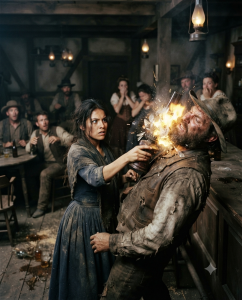
She reached for the oil lamp and smashed it into his face.
For one glorious second, power changed hands.
Fire climbed his beard. The room erupted. Men shouted and lurched away. Toro screamed in pure animal rage, batting at his face as burning oil spread across his jaw. Josefina tore free and ran before anyone’s shock could settle into action.
The night outside was black and merciless. She vaulted the rear fence, stumbled through a muddy yard, then into the trees beyond the camp. Gunshots cracked behind her, wild and furious. Once, a bullet snapped through branches somewhere to her right. She did not look back.
Snow began falling fast in the high ground.
She walked until she could not feel her feet.
She walked until her breath scraped her throat raw.
She walked until she dropped to her knees and understood she might die in those mountains with no one ever knowing her real story, reduced in the mouths of men to a girl who ran and froze.
Then she smelled smoke.
The cabin she found should have frightened her. Hidden places in the wilderness belonged either to hunted men or dangerous ones. But cold strips choice down to instinct. She pushed inside and collapsed.
The giant in the shadows nearly shot her.
He was all hard edges and mountain bulk, with a revolver steady in his hand despite the fever shining in his eyes. Even wounded, he looked dangerous enough to split the room in half. But there was intelligence in his stare, and pain, and the kind of alertness that only belongs to people who have been betrayed before.
When she said Toro’s name, something changed.
“If you’re running from Toro, then you’re not the problem.”
Then he collapsed.
Josefina stared at him on the floorboards, blood spreading beneath his side. She should have been thinking only of herself. A wise person would have barred the door, taken the blankets, and let fate sort him out. But her father’s memory reached across the years with inconvenient force.
He had taught her more than stitching cloth. He had once shown her how to clean a wound, how to set fingers, how to keep calm when another person’s body turned into a battlefield. She had not touched a bullet wound before, but she knew enough to understand that if it stayed inside him, fever would finish what the gun had started.
So she boiled water. Found thread. Found a needle. Found mezcal.
When the liquor hit the wound, the giant woke and nearly crushed her throat in one reflexive grip. The strength in him was terrifying. So was the speed with which he released her once he truly saw her.
The bullet came free at last with a slick burst of blood that nearly made her faint. She stitched him closed while dawn spread slowly across the frost-rimmed window.
Only after she finished did she find the name in a half-open saddlebag.
Jerónimo Reyes.
She had heard it before.
Everybody had. In border towns and market squares, stories about El Oso traveled in fragments. Some said he robbed smugglers. Some said he worked as an enforcer once and then turned on the men he had served. Some said he had killed for less than an insult. Others swore he escorted families through dangerous country without taking a coin. Like all men turned into legend, he had become several contradictory people at once.
What mattered was this: Bruno Toro hated him.
That fact became urgent at sunrise when riders approached the cabin.
Three men first.
They pounded on the door, shouting that they were looking for a woman. Jerónimo, pale with fever, told her where to find the rifle hidden under the table.
“I’ve never shot anyone,” she whispered.
“If they take you,” he said, “they won’t stop at selling you once.”
The first man broke through the door with his shoulder. Josefina fired before she could think. The blast slammed into her body and the man dropped backward off the threshold with a shocked look still on his face. For a split second, the other two froze.
Jerónimo used that second.
He rose from the cot like death forcing itself upright, snatched his revolver, and shot through the doorway. One rider fell near the woodpile. The third ran for cover behind a trough, cursing.
Then more horses sounded in the trees.
Toro had not sent three men to end the hunt. He had sent three to find her.
Jerónimo swore under his breath and grabbed his side. Blood had started through the stitches again.
“There’s a horse in the lean-to,” he said. “Take it and ride east.”
Josefina looked at him, then at the broken door, then at the red blooming through his shirt. “He’s here because of me.”
“He was coming anyway.”
A bullet punched through the wall beside them. Wood splintered across the floor.
Jerónimo shoved a small tin box into her hands. “In the saddlebag outside. Get that first.”
“What is it?”
“Enough to bury Toro if it reaches the right eyes.”
There was no time to ask more.
She crawled out through the back, crouched in the snow, and found the horse trembling in the lean-to. The saddlebag held papers wrapped in oilcloth. She shoved them into her coat just as shouting rose from the front.
When she ran back in, Jerónimo was on one knee behind the table, firing carefully, face white from blood loss.
“I’m not leaving you,” she said.
For the first time, he looked genuinely startled.
People in his life, she realized, usually left.
Together they forced their way out the rear and into the trees, taking the horse because one animal was better than none. Josefina led while Jerónimo leaned half his weight against the saddle. Behind them, Toro’s men spread out through the forest.
By noon, the storm worsened.
By afternoon, Toro himself caught up.
Josefina saw him first through the snow, riding dark and furious, one side of his beard burned away, his cheek blistered and shining red. The sight of him made her stomach knot, but it also gave her a fierce, almost savage satisfaction. He would wear what she had done every time he looked in a mirror.
“You should have stayed in my house!” he shouted.
“I’d rather freeze,” she shouted back.
His expression turned murderous.
The chase ended at a narrow ravine where the path gave out in broken stone and ice. Jerónimo could barely stand. Toro and four men rode in behind them, sealing the way back.
It might have ended there if Toro had been patient.
But men who believe they own other people grow careless when that ownership is challenged. He wanted to savor it. He wanted fear. He wanted Josefina to see him coming and understand that resistance had only deepened her punishment.
He dismounted and advanced slowly, revolver loose at his side.
Jerónimo tried to raise his own gun, but his hand shook.
Toro smiled. “El Oso brought low by a seamstress. That’s almost funny.”
“She saved my life,” Jerónimo said.
Toro glanced at Josefina. “Then she made two bad decisions.”
He took another step.
That was when Josefina pulled the oilcloth packet from inside her coat.
“I know what this is,” she said.
Toro’s face changed.
Not much. Just enough.
Jerónimo saw it too and gave the smallest nod.
Inside the packet were ledger pages, names, dates, and payments. Bribes to officials. shipments of stolen silver. Missing cattle rerouted through fake brands. Whiskey runs protected by the commissioner himself. Enough corruption to tear Real del Fierro wide open if it reached federal hands.
Toro lunged.
Josefina threw the packet, not away, but into the ravine wind behind her. The tied pages scattered like birds over the drop, some catching on scrub, others sailing down toward the half-frozen river below.
Toro shouted and sprang after them on instinct.
Jerónimo fired.
The shot struck Toro high in the chest.
He staggered at the edge, boot slipping on ice. For a moment he seemed suspended between fury and disbelief. Then the ground broke under him.
He vanished into the ravine.
Silence followed. Not perfect silence. The kind after violence, when wind suddenly sounds louder than gunfire.
Toro’s remaining men looked at one another.
Their boss was gone. The ledger was gone. The storm was worsening. Nobody wanted to die for a dead man’s secrets.
They fled.
Jerónimo sank to the ground.
Josefina caught him before he hit the rocks.
It took them two more days to reach the nearest garrison town, traveling in painful stretches, sharing the horse, sleeping in abandoned shelters, speaking little because survival left no room for wasted words. At the barracks, Jerónimo turned over the ledger pages that had snagged in the brush and the names he already knew by memory. That was enough. The commissioner was arrested within the week. Men who had laughed in Toro’s cantina began claiming they had always feared him. Real del Fierro changed faces the way cowards always do when power shifts.
Eusebio was found hiding in a freight shed, trying to leave town before anyone connected him to the marriage scheme. He cried when they dragged him out. Josefina watched from across the yard and felt nothing. Not triumph. Not pity. Nothing. He had made himself too small even for hatred.
She did not stay to watch what became of him.
Months later, after Jerónimo’s wound had healed into a hard seam across his side, he found her in a town farther south where she had rented a tiny room above a bakery and taken in sewing again. But this time there was a difference. The room was warm. The work was hers. The future was not hanging from a stranger’s promise.
He stood in the doorway with his hat in both hands like a man entering church.
“I came to return something,” he said.
It was her father’s old medical satchel. She had left it behind in the cabin during the escape.
Josefina took it from him and laughed softly, the sound surprising both of them.
Jerónimo was never gentle in appearance. He still looked like a man built for storms and bad decisions. But he had learned to wait before speaking. She had learned that not every silence was deceit. Some silences were caution. Some were respect. Some were simply the pause before a person chose honesty.
They began with coffee.
Then conversation.
Then the slow, unnerving realization that trust could grow not from promises, but from proof.
He never offered her a dream painted in sweet language. He asked instead what she wanted. Nobody had ever asked her that before and meant it.
So she answered carefully.
A clean place.
Useful work.
No lies.
No locked doors.
No man who thought gratitude was the same thing as ownership.
Jerónimo listened as if each word mattered.
In time, they built something smaller than the life Eusebio had invented, and because it was real, it felt larger. There was a house, though not grand. A yard, though full of herbs before flowers. A stove that kept heat through winter. Chickens that made more noise than dignity. Patients sometimes came because Josefina had a steady hand and knew how to clean wounds. Travelers sometimes came because Jerónimo knew the mountain roads better than fear did.
People still called him El Oso, but not in her kitchen.
There, he was just the man who split wood before sunrise and pretended not to notice when she corrected his bandages.
Years later, when the story of Bruno Toro’s fall was told in saloons, men usually centered Jerónimo’s gunshot, the ravine, the ledger, the corruption. Men always preferred stories where other men remained the heroes.
But in quiet places, among women who knew how quickly a life could be traded away, the story was told differently.
A seamstress was lured north with lies.
She was sold for whiskey.
She set the devil on fire.
And when the mountain tried to swallow her, she chose not only to survive, but to decide with her own hands what her life would be worth.
That was the part people argued over afterward.
Whether she was brave or merely desperate.
Whether Jerónimo saved her in the end, or whether she saved herself long before he ever stood beside her.
Whether forgiveness was ever owed to a world that had shown her so little mercy.
Josefina herself never answered those questions.
She only went on living.
And perhaps that was the most unsettling thing of all for men like Eusebio and Toro.
They had tried to turn her into a debt.
Instead, she became the reason their names were remembered with shame.