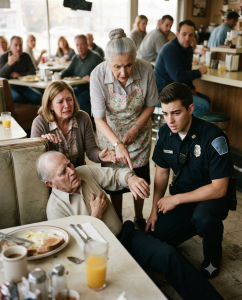
The young paramedic told the old diner owner to step back because she was “just making things worse.”
It happened so fast that most people in the Sunrise Diner didn’t even register the insult at first. They were too focused on the man convulsing beside booth six, too rattled by the scream that had split the room open, too frightened by the sight of his wife on the floor with both hands trembling uselessly in the air.
But Ruth Bennett heard it.
At seventy-one, Ruth had long ago stopped reacting to disrespect in the moment. You could not run a roadside diner for forty-three years without learning when to answer and when to wait. She had dealt with drunks, runaways, grief-stricken widowers, exhausted mothers, kids trying to act tougher than they were, and men who mistook age for ignorance. She had learned that some people needed correction right away, and some needed life to do it for her.
So when the paramedic snapped, “Ma’am, please step back. You’re just making things worse,” Ruth did not argue.
Not yet.
The Sunrise Diner sat just off a two-lane highway where truckers, locals, and travelers all crossed paths. It was the kind of place with a bell over the door, cracked leather booths repaired more than once, and coffee strong enough to wake up a man three states deep into regret. The sign outside was faded, and the pie case by the register never stayed full for long.
Ruth had opened the place with her late husband when she was twenty-eight. He’d been dead twelve years now, but the diner still ran on the habits they built together. Open before daylight. Feed people hot. Listen more than you speak. Never underestimate what someone reveals while waiting for eggs.
That morning was already busy when the bus arrived.
Ruth looked up from the grill as a touring coach eased into the gravel lot, coughing out a crowd of tourists who stumbled in with stiff legs, cameras around their necks, and the vague disorientation of people who had been awake too early in unfamiliar seats. Within minutes every booth was taken, and even the counter filled.
Among them was an older couple who chose booth six near the window.
The woman wore a soft blue cardigan and had the pinched, distracted expression of someone monitoring another adult’s mood. The man beside her was broad-shouldered but pale, with a windbreaker zipped halfway up and one hand resting on the table as if he needed the support.
Ruth brought them menus.
“Morning,” she said.
The wife smiled too quickly. “Morning.”
The husband returned a polite nod. “Coffee, please.”
The wife didn’t look at the menu for long. “He’ll have coffee, and we’ll take scrambled eggs, wheat toast, and orange juice.”
The word orange juice caught Ruth’s attention.
Not because it was strange, but because the wife said it with a kind of purpose. Like she had already decided before they sat down.
When Ruth returned with their drinks, the husband gave a little laugh. “You trying to turn me healthy now?”
The wife pushed the glass toward him. “Just drink some.”
“I’m fine.”
The words were light, but his hand shook when he reached for the coffee mug. The wife saw it. So did Ruth.
“You all right, sweetheart?” Ruth asked, setting down the plates a few minutes later.
The man forced a smile. “Just tired.”
The wife looked at him sharply, as if tired was an answer she was tired of hearing.
Ruth moved on. That was her way. She watched without crowding. She had found over decades that people who didn’t want help often gave themselves away anyway. The trick was noticing what didn’t match.
The wife kept glancing at the orange juice.
The husband kept avoiding it.
When Ruth passed by again with a pot of coffee, she heard the wife speak under her breath.
“Please don’t do this.”
The man’s jaw tightened. “Not here.”
Ruth didn’t pause, didn’t stare. But she tucked the exchange away.
She had seen versions of this before. Spouses who had spent months, maybe years, managing conditions their partners minimized. Men who treated concern like criticism. Women worn thin by carrying responsibility they couldn’t set down, even for breakfast on the road.
Then came the crash.
One second the man was sitting upright, pretending nothing was wrong. The next, he stood abruptly as if to prove he could, took one step, and folded beside the table.
His wife screamed.
The room erupted.
Someone dropped a fork. A child began crying. A man near the register grabbed his phone and shouted that he was calling 911. Ruth’s youngest server stood frozen with a tray in both hands until Ruth barked, “Set it down and clear space.”
Ruth was already moving around the counter.
The wife knelt beside her husband, panic stripping all coherence from her words. “He was talking, he was just talking, I told you—”
The paramedic arrived within minutes, fast and efficient in the way young professionals often are when they still believe speed alone looks like control. He was maybe twenty-four, with a crisp uniform, sharp haircut, and the clipped voice of someone running through protocol while adrenaline burned behind his eyes.
“How long has he been down? Did he seize? History of stroke? Cardiac event? Does he take medication? Ma’am, I need you to answer me.”
But the wife couldn’t. She was crying too hard, trying to say too much at once.
Ruth took one look at the man and felt the answer click into place.
His skin wasn’t just pale. It had that clammy, emptied look she’d seen before. The untouched orange juice sat bright and obvious on the table. And when his hand rolled inward, Ruth saw a metal bracelet on the inside of his wrist, turned toward his palm.
“He’s diabetic,” Ruth said. “His wife ordered orange juice but he never drank it.”
The paramedic barely glanced at her. “Ma’am, step back.”
Ruth pointed. “Turn his wrist.”
“I said—”
“He’s not having a seizure,” Ruth cut in, steady as a metronome. “His sugar’s crashing.”
Something in her voice made him stop.
He grabbed the patient’s wrist, turned it, and saw the bracelet.
DIABETIC.
His whole expression changed.
The correction was instant. He called to the EMT who had just come through the door, asked for glucose, and shifted gears with visible urgency. The wife began sobbing harder, not only from fear now but from what sounded painfully like relief.
Ruth stepped back.
The diner fell silent except for the paramedics’ voices and the husband’s rough breathing. Minutes stretched. The wife clutched the edge of the booth so hard her knuckles turned white.
Then the man’s eyelids fluttered.
The sound that left his wife was raw and broken. She grabbed his hand and kissed it, crying into her own fingers. Around the diner, people let out held breaths. A teenager near the jukebox whispered, “Oh thank God.”
The man focused slowly, confusion overtaking whatever darkness had swallowed him. He looked at his wife as if waking from a nightmare he didn’t remember entering.
By the time the paramedics loaded him into the ambulance, he could squeeze her hand back.
She climbed in beside him, then turned once at the door and looked at Ruth with tears streaming down her face.
“Thank you,” she mouthed.
Ruth nodded. No flourish. No speech. Then she went back inside and resumed work, because in her mind that was what came next.
Crisis passed. Coffee still needed refilling.
But the room felt different now. Softer. Humbled.
People lowered their voices as if the diner had become briefly sacred. Several tourists came up to pay early, speaking to Ruth with reverence they hadn’t had when they first came in. Her servers moved around each other more carefully. Even the griddle sounded quieter.
Ruth cleared booth six herself.
She picked up the napkin holder, straightened a bent fork, and wiped away spilled coffee. The orange juice remained nearly full.
That, more than anything, held her attention.
The bell over the door jingled, and the young paramedic stepped inside alone.
Without the emergency around him, he looked almost boyish. His confidence had lost its hard edges. He approached the booth with his gloves tucked in one hand.
“I wanted to say…” He exhaled. “I’m sorry.”
Ruth kept wiping.
He gave a small, embarrassed laugh. “And ask how you knew.”
Ruth looked at the untouched orange juice.
“Honey,” she said, “I’ve served breakfast to half this county. People tell the truth before they know they’re telling it.”
He smiled at that, but she didn’t smile back yet.
Because she was still thinking about the wife.
The paramedic noticed. “What is it?”
Ruth set down the rag. “She knew.”
He frowned. “Knew he was crashing?”
“She knew something was wrong before he hit the floor.”
He shifted his weight. “Then why didn’t she tell me that?”
Ruth leaned against the booth, crossing her arms. “You’ve ever watched someone love a person who refuses to take care of himself?”
The paramedic didn’t answer immediately.
Ruth continued. “That orange juice was ordered before she even looked at the menu. She kept nudging it toward him. He kept pushing it away without touching it. And when I walked by, I heard her say, ‘Please don’t do this.’”
The young man’s face changed again, but more subtly this time. Less medical. More human.
“You think they were arguing?”
“I think,” Ruth said, “they’d had that same argument more times than either of them could count.”
The paramedic glanced toward the window. “She was terrified.”
“Yes,” Ruth said. “And angry.”
He blinked. “Angry?”
Ruth nodded. “Fear and anger sit close together when you’ve had to save someone too many times.”
That landed harder than anything else she’d said.
He looked back at booth six as if trying to replay the scene from a new angle.
“I thought she was just panicking,” he admitted.
“She was panicking,” Ruth said. “But not only because he collapsed. She was panicking because she saw it coming.”
The paramedic ran a hand over the back of his neck. “I missed that.”
“You’re not the first.” Ruth’s voice softened by half a degree. “Speed helps in emergencies. But listening helps before the emergency.”
He absorbed that quietly.
One of Ruth’s waitresses called from the counter that table three needed more coffee. Ruth lifted the pot and handled it herself, the conversation apparently over. But the paramedic stayed.
After she topped off the mug at table three, he met her near the pie case.
“What did she say?” he asked.
Ruth looked at him.
“Right before he went down,” he clarified. “You said you heard her.”
Ruth hesitated. Not because she didn’t know, but because saying it aloud made the whole thing sadder.
“She leaned across the table,” Ruth said slowly, “and she told him she was done saving him.”
The paramedic stared.
“And then?”
“And then,” Ruth said, “he stood up too fast, probably to prove he didn’t need saving.”
The young man looked stricken by the sheer human foolishness of it.
“Will he be okay?” Ruth asked.
“He should be,” the paramedic said. “Once they stabilize him. But…” He trailed off.
“But what?”
He looked toward the road. “The wife rode with him. She didn’t let go of his hand once.”
Ruth nodded as if that proved everything she already believed.
Around noon, the bus finally pulled out. The diner emptied. The rush passed. Sunlight shifted across the floor in long warm rectangles.
Ruth was slicing pie when the phone rang.
She almost let one of the girls answer, but something made her pick it up herself.
“Sunrise Diner.”
For a moment there was only hospital noise in the background.
Then a woman’s tired voice said, “Mrs. Ruth?”
Ruth recognized her instantly.
“Yes, sweetheart.”
It was the wife from booth six. Her name, she explained, was Elaine. Her husband was Martin. He was stable now. Embarrassed, groggy, defensive, and very much alive.
“I wanted to thank you,” Elaine said. “If you hadn’t spoken up…”
Her voice broke.
Ruth rested a hip against the counter. “You don’t owe me a thing.”
“Yes, I do.” Elaine drew in a shaky breath. “And I think I owe you the truth too.”
Ruth said nothing.
Elaine went on. “He’s been doing this for months. Skipping meals. Pretending he already checked his levels. Telling me I worry too much. We were supposed to be on vacation.” She laughed bitterly. “I spent the whole bus ride watching his hands shake.”
Ruth closed her eyes briefly.
“I ordered the orange juice because I knew,” Elaine whispered. “I knew he was dropping. And when he wouldn’t drink it…” Her breath hitched. “I got so angry. I said something awful.”
“You said you were done saving him.”
Silence.
Then Elaine let out a stunned, broken little sound. “You heard that?”
“Enough.”
“I didn’t mean I wanted him to die,” Elaine rushed to say. “God, I didn’t. I just meant… I can’t be his monitor every minute. I can’t fight him to stay alive more than he fights for himself.” Her voice frayed. “What kind of wife says that right before her husband collapses?”
“The kind who’s scared,” Ruth said. “The kind who’s exhausted. The kind who’s been carrying both sides for too long.”
Elaine cried then, quietly but openly. Ruth let her.
When she could speak again, Elaine said, “He heard me. I know he heard me.”
“Maybe he needed to.”
That startled another silence loose between them.
In the end Elaine promised to call again. Ruth hung up and went back to slicing pie.
That evening, just before closing, another car pulled into the lot.
Not an ambulance this time. A plain sedan.
Martin came in slowly, one hand still sporting a hospital band. Elaine walked beside him, not guiding him, not hovering, just close enough to show she had chosen not to walk away.
The diner was nearly empty. Sunset painted the windows gold.
Martin stopped at the counter in front of Ruth. He looked smaller than he had that morning, as if the collapse had cracked open more than his pride.
“I wanted to thank you,” he said.
Ruth nodded once. “You’re welcome.”
Elaine stood beside him, watching him carefully, but not rescuing him from the silence that followed.
Martin swallowed. “She told me what she said.”
Ruth waited.
His eyes glossed, not with tears exactly, but with the strain of holding them back. “And she was right.”
Elaine turned to him, startled.
He kept going, voice rough. “I’ve been lying. Not just to her. To myself. Acting like it wasn’t serious because I didn’t want to feel weak. Making her the bad guy every time she tried to help me.” He let out a humorless laugh. “Then I nearly died beside a plate of eggs because I was too stubborn to drink orange juice.”
Ruth set down the dish towel in her hands.
Martin looked at Elaine. “I heard you before I went down.”
Elaine’s face crumpled.
He reached for her hand. “And it scared me more than collapsing did.”
For a second neither of them moved.
Then Elaine whispered, “I don’t want to save you alone anymore.”
He nodded. “You shouldn’t have to.”
That did it. She started crying again, softer this time, from somewhere deeper and older. Martin cried too, though he looked almost embarrassed by it. Ruth pretended not to notice and poured them both coffee.
They sat in booth six for nearly an hour, talking in low voices between long silences. Not magically fixed. Not transformed into perfect people. But honest in a way they probably hadn’t been for a long time.
When they finally stood to leave, Martin placed cash on the counter for dinner they hadn’t really eaten and looked at Ruth.
“I thought I was the one being controlled,” he said. “Turns out I was the one making everything harder.”
Ruth tucked the money into the register and shook her head. “Turns out,” she said, “some people only hear the truth after it scares them half to death.”
He smiled weakly.
Elaine squeezed Ruth’s hand before they left.
After the door closed, the diner went quiet again.
Ruth wiped down booth six one last time. The crisis was over now. The story had landed where stories sometimes did—not in triumph, exactly, but in clarity. Which was often worth more.
Outside, headlights moved along the highway. Inside, the coffee stayed hot.
Ruth looked at the empty booth and thought of all the years she had spent feeding strangers while glimpsing the hidden machinery of their lives. Illness. Resentment. Tenderness. Pride. Love. The things people carried into a diner without meaning to set them down.
Martin would live. Elaine might forgive him, or forgive him slowly, or only partly. He might finally learn that being cared for was not the same as being controlled. She might learn that drawing a line did not make her cruel.
But if Ruth had learned anything over four decades of serving breakfast, it was this: the biggest warning sign is rarely the collapse itself. It’s the small truth sitting untouched in plain sight while everyone pretends not to see it.
In this case, it was a sweating glass of orange juice.
And a woman who had been trying to save her husband long before anyone else realized he needed saving.