She’d been feeding the harbor seals for eleven years, and in all that time, nothing on that dock had ever surprised her.
Until him.
His name — she didn’t know it yet. She only knew he appeared every weekday morning at exactly 7 a.m., always in the same good charcoal suit, always alone on the far end of the dock where the old pilings lean toward the water like they’re tired of standing straight.
Margaret Hensley, 71, retired ferry captain, woman who had navigated the Columbia River in December fog and never once blinked — she noticed him the first morning and told herself it was nothing.
She noticed him the second morning and told herself the same thing.
By the third morning, she stopped lying to herself.
There was something about the way he sat. Not relaxed. Not peaceful. The kind of still that isn’t rest — it’s the kind of still that costs something.
He never ate. Never checked his phone. Never looked up when the seals barked or when the morning freight boat groaned past. He just stared at the water like it owed him an answer.
And every single morning, before Margaret got within thirty feet of him, he would reach up to his lapel and turn something face-down.
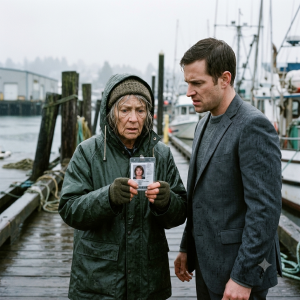
A badge. Laminated, on a metal clip. The kind you’d wear to an office, or a conference, or a hospital.
She could never see what was on it. By the time she passed behind him with her bucket of herring, it was always flipped against his jacket, blank white plastic facing out like a little closed door.
She told herself not to wonder.
She wondered constantly.
Three weeks passed. Then four. The September rain started coming in sideways off the river the way it does in Astoria, that cold mist that isn’t quite rain but soaks you just the same. And one Tuesday morning Margaret filled her thermos, and then — she didn’t plan it, she’d say later, her hand just moved — she filled a second one.
She walked to the far end of the dock.
She watched his hand go to his lapel, watched the badge flip face-down as she got close, same as always.
She sat down beside him without asking permission. Set the thermos between them.
He looked at it. Then at her.
“You don’t have to talk,” she said. “I just thought you looked cold.”
He was quiet for a long moment. Then he picked up the thermos.
“Thank you,” he said. His voice was steady but thin, the way a voice gets when it hasn’t been used much.
They sat together watching a harbor seal drag herself up onto the low dock float, magnificent and unbothered. Margaret had named her Dolores. She told him that. He almost smiled.
She asked him only one question.
Not are you okay. Not what are you doing here every morning. She’d been around enough water and enough silence to know that those questions close people up.
She asked him: “What was it like?”
He turned to look at her.
And something in his face shifted — not broke, but shifted — like a lock turning over that hadn’t moved in a long time.
He started talking.
He talked for forty minutes. Margaret didn’t move. Dolores fell asleep on the float. The morning freight traffic came and went and the mist turned to real rain and neither of them reached for a hood.
When he finally stopped, he looked almost surprised at himself.
“I haven’t said any of that out loud before,” he said quietly.
“I know,” Margaret said. “That’s why I asked.”
He stood to leave, buttoning his jacket. The badge on his lapel swung loose on its clip — the way it always was when he thought she wasn’t looking — face-up for just a moment before he reached for it.
It slipped.
Fell straight down onto the wet planks between them.
Margaret bent and picked it up before he could, the way you do without thinking, just being helpful.
She turned it over to hand it back to him.
And she went completely still.
Because the photograph on the badge was not of him.
It was a woman. Fifty, maybe. Dark hair with gray at the temples, a wide warm smile, the name printed below in clean black letters.
Margaret looked up slowly.
The young man was watching her face. His jaw was tight. His eyes were waiting.
And in that moment, standing on a rain-soaked dock in Astoria with a stranger’s badge in her hand, Margaret understood that the question she’d asked him — what was it like — had only been the beginning.
The badge was the real question.
And she wasn’t sure she was ready for that answer.
She read the name printed beneath the photograph.
Dr. Carol Anne Briggs. And below that, in smaller letters: Department of Palliative Care. Oregon Health & Science University.
Margaret held it carefully, the way you hold something that belongs to someone else’s grief.
She looked up at him. He hadn’t moved. The rain was coming down properly now, drumming on the dock planks, flattening his hair, darkening the shoulders of that good charcoal suit he clearly hadn’t thought about this morning or any morning.
“She was your doctor,” Margaret said. It wasn’t a question.
He shook his head once. Slow.
“She was my mother’s doctor.” He paused. “She was with my mother when I couldn’t be.”
Margaret didn’t say anything. The river kept moving. It always does.
His name was Daniel. He told her that now, the way people tell you their name after they’ve already told you everything else — like the name is almost beside the point.
Daniel Marsh, thirty-four years old, high school history teacher from Portland who had driven to Astoria on a Thursday in August with no particular plan and had somehow never driven back.
He was renting a room above the tackle shop on Commercial Street. He had called in a leave of absence from his school. He had told his friends he needed some time and then stopped answering their texts, not out of cruelty but out of a total inability to explain.
His mother had died in June. Pancreatic cancer, which is the kind that doesn’t negotiate. From diagnosis to the end had been eleven weeks.
He’d been three hours away in Portland when it happened. A Tuesday morning. He’d been grading papers. His phone had been on silent.
“I missed it by forty minutes,” he said. He said it flatly, the way you say something you’ve turned over so many times it’s worn smooth. “Dr. Briggs was there. She held my mother’s hand.”
He’d met Carol Briggs only twice — once at the hospital when his mother was admitted, and once at the end of the hall two days before his mother died, when Dr. Briggs had put a hand on his arm and said, quietly, that he should go home and rest, that she would call him if anything changed. He had believed her. He had gone.
She had called. He hadn’t heard it.
“I’m not angry at her,” Daniel said, quickly, like he needed Margaret to understand that part. “I know she did everything right. I know she was kind to my mother. I know she called.” He stopped. “I just — I keep thinking if I could talk to her.”
Margaret looked at the badge in her hand.
“This was your mother’s,” she said.
He nodded. “From when she was admitted. They gave it to me with her things. I don’t know why I kept it. I don’t know why I started wearing it.” He made a sound that wasn’t quite a laugh. “That probably sounds strange.”
“No,” Margaret said. “It sounds like something a person does.”
She handed the badge back to him. He took it and held it in his palm and looked at it the way you look at something when you’re deciding what it means.
“I kept flipping it over when you walked past,” he said. “I didn’t want to have to explain it.”
“I know.”
“And then you never asked.”
“I know that too.”
He closed his fingers around the badge. The rain had eased slightly, dropping back to that Astoria mist, that particular gray that settles in like it lives here.
Margaret was quiet for a moment, turning something over in her own mind.
Then she said: “I know Carol Briggs.”
Daniel went very still.
“Not well,” Margaret said carefully. “She’s friends with a woman from my church. Ruth Anderssen. They met at some medical conference years ago and stayed in touch. I’ve sat across from Carol at Ruth’s kitchen table three or four times.” She paused. “She’s a good person. She laughs with her whole face.”
Daniel was staring at her like she’d just said something in a language he’d been trying to learn for months.
“She moved to a smaller practice,” Margaret continued. “Closer to her family. She’s in Astoria.”
The word landed between them like something dropped.
Daniel opened his mouth, then closed it.
“I’m not going to push you,” Margaret said. “I’m not going to tell you what to do with that. I’m just telling you because you’ve been sitting on the end of this dock for two months and I think you came here for a reason, and I think maybe the reason is that some things need to be said out loud to the right person and not just to the river.”
He looked out at the water. Dolores had slid back off the float and was somewhere below the surface now, going about her life.
“What would I even say to her?” he said. It wasn’t rhetorical. He genuinely didn’t know.
“Same thing you said to me,” Margaret said. “The truth. That you weren’t there. That it’s eating you alive. That you want to know what your mother’s last hour looked like, because the version in your head is dark and you can’t stop living in it.”
His jaw was working. Holding it together.
“People who do that kind of work,” Margaret said, more gently, “they remember. They remember the patients. They remember the families. I’d bet you everything in this bucket that Carol Briggs remembers your mother’s name.”
He wiped his face with the back of his hand. The rain gave him cover for that, and Margaret looked at the water and gave him the dignity of not watching.
They sat a while longer. The freight channel buoy clanged its hollow note every few seconds, steady as a heartbeat.
Before he left, he asked Margaret how she’d like to be thanked if this somehow worked out, and she told him not to be ridiculous, just come back and tell Dolores how it went.
He smiled at that. A real one, the first she’d seen from him. It changed his whole face.
He came back on a Friday, eight days later.
Margaret was at the dock at her usual time, herring bucket in hand, and she saw him coming from the parking lot and knew immediately from the way he walked that it had happened. Something had released in his body, some long-held structural tension, and he walked like a man who had set down something extremely heavy.
He sat beside her. He didn’t speak for a minute. She let him have that.
“She remembered her,” he finally said. “The second I said my mother’s name, she just — her face. She remembered everything.”
Carol Briggs had met with him for two hours in her home office on a Saturday morning. She’d described his mother the way Daniel had apparently never heard anyone outside the family describe her — her humor, the specific book she’d had on her nightstand, the way she’d asked the nurses about their own families, taking interest in everyone around her even in those last days, because that was who she was.
“She told me my mother wasn’t afraid,” Daniel said. He said it slowly, like he was checking that the words still held. “She said she asked her directly, a few days before, and my mother told her she’d had a good run and she was mostly just tired and a little curious.”
He stopped.
“She said curious,” he repeated.
Margaret felt something move through her chest.
“Carol was with her at the end. She said it was quiet. She said it was peaceful.” He swallowed. “She said my mother asked her to tell me not to let the missing it wreck me. That she knew I’d do that.” A short breath of a laugh, wet around the edges. “Said it sounded exactly like her.”
Margaret looked out at the river.
“It does,” she said, though she’d never known the woman. She said it because it was clearly true.
They were quiet for a while. A pair of cormorants worked the surface fifty yards out. The mist sat soft on the water.
“I’m going to go home,” Daniel said. “Back to Portland. I called the school.”
“Good.”
“I don’t know if I’m fixed,” he said. It was honest, and she respected him for not pretending otherwise. “But I think I was staying out here because I needed to understand what happened before I could go back to my regular life. And now I understand it. Or — enough of it.”
“That’s all you ever get,” Margaret said. “Enough of it.”
He nodded like that landed right.
He left the dock at 8:40 that morning and drove north on 30 toward Portland, and that was the last Margaret saw of him in person.
He sent her a card that Christmas. Just a simple one, a harbor scene, the kind they sell at the gift shops on the waterfront. Inside he’d written: Dolores, I hope you’re well. Tell Margaret I finally started answessing papers again. The misspelling was crossed out and corrected in a second pen color, which made her laugh.
He’d written: I think about that first question you asked me. I’ve started asking it more. It opens things up. You were right about that.
Margaret kept the card on her refrigerator.
In March, she got another one. He’d signed it Daniel Marsh, as if she might have forgotten, which she never would.
And every morning she goes to the dock, and she fills her thermos, and she feeds the seals, and sometimes when a newcomer is sitting at the far end on one of the old leaning pilings — sitting in that particular kind of still that isn’t rest — she fills a second thermos.
She doesn’t always sit down.
But she always notices.
And she figures that’s how it starts.