She’d been keeping bees for forty-one years, and in all that time, she’d learned one thing above everything else.
You don’t disturb what isn’t yours to disturb.
So when the young man appeared at the edge of her property on a Tuesday evening — gaunt as a winter tree, backpack held together with electrical tape, eyes that looked like they’d seen something they couldn’t unsee — Loretta Mae Hutchins did what any sensible woman in the Tennessee hill country would do.
She set a plate of cornbread on the porch rail and went back inside.
She didn’t ask his name.
Didn’t ask where he’d come from.
Didn’t ask about the way he flinched at loud sounds, or why he only ever faced the treeline, or how a young man that thin could move that quietly through the tall grass.
Her bees didn’t seem to mind him. That was enough for Loretta.
He camped at the far edge of the property, near the old red barn she hadn’t used since Earl passed. She could see the flicker of his small fire from the kitchen window at night. She told herself she wasn’t watching.
She was watching.
On the second morning, she found he’d stacked her split wood — two cords of it, neat as a picture — against the barn wall without being asked. The work of hours, maybe all night.
She left a jar of her wildflower honey on the porch rail beside the cornbread.
He was gone before she got up.
On the third evening, she almost spoke to him. He was standing at the edge of the bee yard, perfectly still, watching the hives the way Earl used to watch them — like they were telling him something the rest of the world had forgotten how to say.
She almost walked out there.
Instead, she went to bed early for the first time in months, and she slept the kind of sleep she hadn’t slept since the funeral.
She woke to a Friday that felt different before she even opened her eyes.
She knew, the way you know things when you’ve lived long enough, that he was gone.
The campsite at the tree line was cleared. Not abandoned — cleared. Every trace of him tidied away, like he’d never been there at all.
Loretta stood in the early light and felt something she couldn’t quite name. Not grief, exactly. Something quieter.
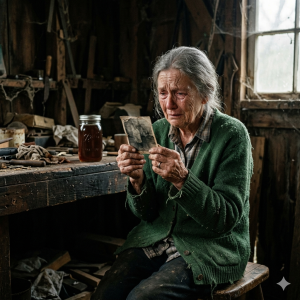
She pulled on her boots and her old cardigan — the green one with the fraying cuffs that she kept meaning to throw out and never did — and she walked to the barn.
She didn’t know why. She just walked there.
The big door was cracked open, the way she’d left it for weeks.
She pushed it wider and stepped inside.
The barn smelled like hay and old wood and something else — something sweet and faint that made her stop just inside the threshold.
There on her workbench, propped against a mason jar of her own wildflower honey, was a photograph.
Small. Water-warped at the corners. The kind of photograph that had been carried a long, long way.
She crossed the barn slowly. Picked it up with two fingers like it might dissolve.
Two little boys.
Matching red raincoats. The bright, brave red of fire trucks and Valentine hearts.
They were laughing at something outside the frame, heads tilted toward each other the way brothers do — like they shared a secret language, like they always would.
Loretta stood in the barn with the photograph and the honey and the quiet, and she thought about the young man’s eyes. About the way he’d stood at the hive boxes like a man trying to remember something.
She thought about the red raincoats.
She turned the photograph over with trembling fingers.
And the handwriting on the back was her late husband’s.
She knew Earl’s handwriting the way she knew her own heartbeat. Forty-three years of grocery lists and birthday cards and little notes left under the sugar bowl. She would have known those letters in the dark.
For a moment she couldn’t breathe.
She read it twice.
*Danny and Cal. Easter Sunday. Best boys in the world. — E.H.*
E.H.
Earl Hutchins.
The barn swam a little. She put one hand on the workbench to steady herself and just stood there, holding the photograph and breathing slowly the way her doctor had taught her, in through the nose, out through the mouth, until the swimming stopped.
Danny and Cal.
She said the names out loud to the empty barn because she needed to hear them in the air.
Earl had a brother. Had. Loretta had known that much. Robert Hutchins, seven years younger, who had packed a duffel bag sometime in the late 1970s and driven away from a family that didn’t know how to be a family and never quite managed to drive back. Earl had spoken of him maybe a dozen times in four decades, and each time with the particular careful stillness of a man walking around a bruise.
They’d lost touch before Loretta ever came into the picture. She had never known Robert had children.
She had never known Earl did either.
She sat down on the old milking stool in the corner — the one with the cracked leg that Earl had always meant to fix — and she looked at the photograph for a long time.
Two little boys laughing in red raincoats.
Earl must have known them once. Must have met them somewhere, sometime, when Robert still allowed for the possibility of family. He’d taken this photograph, or been given it, and he’d written their names on the back in his careful block letters because Earl Hutchins documented things. He kept records. He labeled honey jars by date and hive number. He wrote the names of his nephew and his other nephew on the back of a photograph and he had kept it, and now one of them had carried it here.
Which one.
She already thought she knew.
Cal. Something about the stillness of the young man at the bee yard. Something about the particular way he’d stood there that had tugged at her memory all week without ever quite surfacing. Earl used to stand exactly like that. Weight on his left foot, chin slightly down, the posture of a man listening to something that didn’t make sound.
She’d thought she was imagining it.
She hadn’t been imagining it.
She went back to the house and she did something she hadn’t done in eight months. She went to the closet shelf in the spare room where Earl’s things were, the things she hadn’t been able to touch yet, and she brought down the old shoebox.
Earl had kept a shoebox too. Everybody does, eventually.
Letters, mostly. Old gas receipts. A photograph of his parents looking stiff and uncomfortable in their Sunday clothes. A folded paper with the specs for a beehive he’d designed himself and never quite built. A prayer card from his mother’s funeral.
At the bottom of the box, under everything else: an envelope.
The envelope had Robert’s name on it in Earl’s handwriting, and it had never been opened, and it had never been sent.
Loretta sat on the edge of the spare bed and held the envelope in her lap and understood that she was holding the thing Earl had never been able to do. The reaching out. The bridge he’d started building in his head but never finished in the world.
She put the envelope in the pocket of her cardigan.
She made herself a cup of coffee and sat at the kitchen table and thought about what a person does next.
By nine o’clock she had made some calls. Earl’s cousin Judith, who kept track of everyone. The county records office in the next town. A woman at a veterans’ organization who was patient and kind and didn’t ask Loretta why she was looking.
By noon she knew a few more things.
Robert Hutchins had died in 2019. There had been two sons: Daniel and Calvin. Daniel, the older boy, had died in 2021. An accident. The kind of accident you don’t use the specific word for in a phone call with a stranger.
Calvin Hutchins was twenty-six years old. He had served two tours overseas. He had been discharged honorably fourteen months ago. After that, the trail went quiet in the way that trails do when a person is trying to disappear from everything they’ve been.
Loretta sat with all of that for a while.
Then she got up and packed a paper bag. More cornbread. A container of soup she’d made two days ago and hadn’t finished. Another jar of honey. She added the photograph in its own small paper envelope, and she added the unsent letter with Robert’s name on it, and she carried the bag out to the porch.
She didn’t know if he’d come back.
People like that — people carrying what he was carrying — sometimes they circle. Sometimes they don’t. Sometimes the circling takes years.
She set the bag on the porch rail anyway.
She went back to her bees.
It was a good afternoon for it. Warm and still, the light coming in low and gold through the sycamores. The hives were busy the way they get in late summer, purposeful and humming, every bee exactly where it was supposed to be. Loretta worked slowly, the way she always did, lifting frames and reading what was there. Honey stores. Brood pattern. The particular geometry of a hive that was doing well.
Earl had taught her to read hives. She had taught herself everything else.
She was on the third hive when she heard footsteps in the tall grass behind her.
She didn’t turn around. She gave it a moment, the way you do.
“You forgot something,” she said, to the afternoon air.
A pause. Then: “Yes ma’am.”
His voice was low and a little rough, like a door that hadn’t been opened in a while.
She lifted the next frame, held it up to the light. Thousands of bees going about their business, indifferent to the large and complicated feelings of human beings.
“Your name is Cal,” she said.
Another pause. Longer.
“Calvin,” he said. “Most people called me Cal.”
“Earl used to stand the way you stand,” she said. “Left foot forward. I couldn’t figure out why you seemed familiar.”
She heard him exhale. It was a long exhale. The kind that had been waiting a long time.
“He found us one summer when I was maybe eight,” Cal said. “He and my dad. They had a few years. Not many. But some.”
Loretta set the frame back and closed up the hive and pulled off her gloves. Then she turned around.
He looked worse in the daylight, if that was possible. Hollow under the eyes, jaw tight. But he was standing straighter than he had all week, and he was looking at her directly, and that was something.
“I didn’t know he’d kept that photograph,” Cal said. His voice wavered on the last word and held.
“Earl kept everything that mattered,” she said. “I should have known that photograph would matter.”
She looked at him for a moment. He looked back.
“There’s a letter in that bag on the porch,” she said. “Earl wrote it to your father. He never sent it. I think it was always meant to get there somehow. I think maybe this is how.”
Cal’s throat worked.
“I came because I didn’t have anywhere left,” he said. It was plainly said, without self-pity, like a man reading coordinates off a map. “I found an old letter from him to my dad with this address. I wasn’t even sure I’d stop. I just drove past and then I stopped.”
“The bees didn’t mind you,” Loretta said. “That was a good sign.”
Something in his face shifted. Not quite a smile. The memory of one, maybe. The shape of where one would go when he got back to it.
“He talked about the bees,” Cal said. “Earl did. That summer. He talked about them a lot.”
“He loved them,” she said. “He wasn’t patient about much. He was patient about bees.”
She picked up her gloves and her smoker and she walked toward the house. She didn’t tell him to follow. She just walked, the way she’d left the cornbread on the rail — the offer made, the choice left open.
She heard his footsteps in the grass behind her.
She made coffee. She heated the soup. She put the cornbread on a plate and set it on the table, and she didn’t say anything while he ate because a man eating like that doesn’t need conversation, he needs to be left in peace while he does it.
When he was done she poured more coffee and she sat across the table from him.
She said: “The barn needs some work. Real work, not just the wood. The floor in the back corner has gone soft, and two of the stall doors hang wrong. I’ve been putting it off since Earl passed.”
Cal looked at his coffee cup.
“I’m not in a good way,” he said quietly. “I want to be straight with you about that. I’m not — I’m working on some things.”
“I know,” she said.
“I don’t know how long I’d stay.”
“I know that too.”
He was quiet for a moment. Outside, the bees went on with their work, the same as always, the low steady hum that had been the sound of Loretta’s life for forty-one years.
“You don’t know me,” he said.
“I know you stacked two cords of wood in the dark without being asked,” she said. “And I know you cleared your campsite so clean I almost thought I’d dreamed you. And I know you carried that photograph a long way to put it somewhere it belonged.” She folded her hands on the table. “I know enough.”
He looked up then. His eyes were the color of creek water in October, pale brown and deep, and in them she could see the toll of whatever he’d been through, and beneath that — further down, not gone, just submerged — something that was still intact. Something that had stood at the edge of a bee yard and listened.
“Okay,” he said.
That was all. Just okay.
But the way he said it meant something more. It meant yes, and I’ll try, and thank you, all of it compressed into one small word by a young man who had forgotten how to use the bigger ones.
Loretta nodded.
She got up and refilled his coffee and went to the window and looked out at the hives sitting in their rows in the late afternoon light.
She thought about Earl and his brother, the years they’d lost and the few years they’d found, the letter that never got sent, the photograph that traveled all the way here in a backpack held together with electrical tape.
She thought about how things move through families the way certain traits move through a hive. How something essential persists, generation to generation, even when everything else goes sideways. Even when the line seems broken.
Even then.
“The spare room is at the top of the stairs,” she said, without turning from the window. “Sheets are in the cedar chest. There’s no lock on the door because I never needed one, and if that bothers you, you can tell me and we’ll figure something out.”
She heard the legs of his chair move on the kitchen floor.
“It doesn’t bother me,” he said.
Outside, the last of the afternoon light was going gold and long across the yard, and the bees were coming home.
Loretta watched them.
Forty-one years, and she still loved this part best. The end of the day. Every bee finding its way back.