She’d delivered mail in Duluth for thirty-one years. She knew every cracked sidewalk, every loose gate latch, every dog that pretended to be mean.
But she had never seen anything like this.
It was a Tuesday in January — the kind of cold that makes your truck groan when you start it — when she found the first one.
Tucked under her windshield wiper like it belonged there.
A card. Hand-drawn. Crayon and marker on folded notebook paper. A lopsided house, a yellow sun with too many rays, and three careful words in the middle: *Thank you, Ruth.*
And in the corner, pressed in red ink — a tiny mitten stamp. Like the kind a kindergarten teacher keeps in a drawer.
Ruth Halvorsen sat in her truck for a long minute, heat running, breath fogging the glass.
She didn’t recognize the handwriting. She didn’t know whose car this had been before hers. She turned the card over twice.
Nothing else. Just the little red mitten.
—
She told herself it was a mistake. A card meant for someone else, left on the wrong truck.
But the next Tuesday, there it was again.
Same notebook paper. Same crayon house. Different words this time — *You are kind* — but the same small stamp pressed in the corner.
The same tiny red mitten.
Ruth’s hands went still on the steering wheel.
She was retired. She hadn’t carried a single piece of mail in eight months. Who even knew her truck? Who knew her name?
She brought both cards inside and set them on her kitchen table next to her coffee cup. She looked at them every morning that week like they might eventually explain themselves.
They didn’t.
—
By the fourth card, her neighbor Diane thought it was a secret admirer.
“Ruth, someone is *courting* you,” Diane said, delighted.
“Diane, it’s crayon,” Ruth said.
“Romantic crayon,” Diane said.
Ruth laughed, but she kept every single card. She’d lined them up along her windowsill above the kitchen sink — six of them now, each with that little red stamp in the corner, each with its quiet, earnest message.
*You matter. You are seen. Thank you for being you.*
Who writes things like that? Who *does* things like that?
She had spent all winter doing small things she never mentioned to anyone. Paying for a stranger’s tire repair in November. Leaving grocery bags on two porches on her street. Covering lunch tabs at Brenda’s Diner on Thursdays for whoever looked like they needed it — including, often, the residents who wandered in from the memory care facility two blocks over.
There was one man in particular. He always came in alone. Always ordered the same thing — tomato soup and a grilled cheese. Always looked at the bill with that particular kind of quiet worry.
Ruth had told Brenda: *Just put his lunch on my tab. Don’t make a fuss about it.*
She didn’t know his name. She never introduced herself.
She just kept paying. All winter long.
—
The sixth Tuesday, Ruth made a decision.
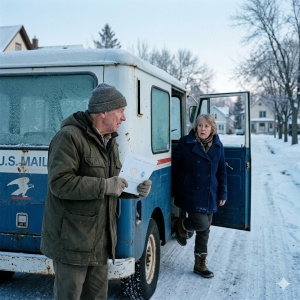
She got up before dawn. She drove to her spot on Garfield Avenue, parked, killed the engine, and waited.
The street was pale blue with early light. A salt truck groaned past. Steam rose off a manhole cover down the block.
She sat for forty minutes with her coffee going cold.
She almost gave up.
And then she saw movement.
Slow. Careful. A figure in a heavy coat and a wool cap, moving along the sidewalk with a deliberateness that looked like it cost something.
He stopped at her truck.
Ruth’s hand went to the door handle.
She watched him lean forward and slide something under her wiper blade, smoothing it down with both hands like he was tending to something fragile.
She stepped out of the truck.
“Excuse me —”
He turned around.
And Ruth Halvorsen, who had walked thirty-one Duluth winters without losing her footing once, felt the ground go soft beneath her.
Because standing at her bumper, clutching a fresh card in both hands, was the elderly man from the memory care unit two blocks over.
The one she’d been anonymously paying lunch tabs for all winter.
His face was open and clear and so, so earnest.
And pinned to the front of his coat, in a little plastic sleeve like a name badge, was a photograph.
Faded. Old. The colors gone soft with age.
Ruth couldn’t move.
Because she recognized that photograph immediately.
She recognized it because she was in it.
—
It was a photograph she had not seen in perhaps thirty years.
She was young in it. Twenty-four, maybe twenty-five, standing on a porch she still knew by heart — her parents’ porch on Arrowhead Road, the green railing, the aluminum storm door. She was holding a cardboard box. Laughing at something off-camera. Her hair was cut short the way she’d worn it that whole decade.
Beside her in the photograph, also laughing, was a little boy.
He was maybe six or seven years old. Winter coat. A wool cap with a pom-pom on top.
Holding, with both small hands, a mitten.
A red mitten.
Ruth looked up from the photograph. She looked at the man in front of her. He was watching her with those steady, earnest eyes, and something in his face was asking a question he didn’t have the words for anymore.
She said, very quietly: “Gus?”
His whole face changed.
It went from hoping to certain in the space of a single second.
“I looked for you,” he said. His voice was rough and slow, the way voices get when they’ve been working hard just to stay clear. “I asked Brenda. She said your name was Ruth. I remembered a Ruth. I remembered a Ruth who was kind.”
Ruth’s throat closed.
—
Gus Aaltonen had been her paper route.
That’s how she thought of it later, sitting across from him at a corner table at Brenda’s Diner with two cups of coffee going warm between them. He had been her paper route. Which sounds like a small thing until you understand what it actually was.
When Ruth was nineteen, she’d taken a job delivering the Duluth News-Tribune in the mornings before community college. She had that route for five years. And in those five years, she’d watched a little boy grow from a kindergartner to a fifth-grader in the yellow house on Crescent View Drive.
She remembered his mother, who worked nights and was usually still asleep when Ruth came by. She remembered the times in winter when she’d seen the boy out on the porch before school, waiting for the bus in the cold, sometimes without adequate mittens.
She had bought him a pair once. Red wool mittens from Kmart. Left them in the mailbox with a note that said: *For the cold. —Your Carrier.*
She had forgotten this.
She had completely forgotten this.
But Gus Aaltonen had not.
—
He told her the story in pieces, with help. His daughter Leanne was there within the hour — Brenda had quietly stepped out and called the facility — and Leanne filled in the gaps her father couldn’t hold onto.
Gus was seventy-three now. The dementia had come on three years ago, taking things in the particular cruel order that dementia does. Names first, then sequences, then faces. Most days were a narrowed-down version of the world. But some things held. Some things were bolted to the floor of him.
“He’s always remembered the mittens,” Leanne said. Her voice was careful and tender in the way of someone who has learned to hold things gently. “Even when he couldn’t remember our address, or what year it was, he could tell you about the lady who left red mittens in the mailbox when he was little. He said she was the first person outside his family who ever did something kind for him when it wasn’t required.”
Ruth put her hand over her mouth.
“He found the stamp in the activities room at the facility,” Leanne continued. “Red mitten. He saw it and he — well, he lit up. The staff said they’d never seen him so focused. He said he needed to find someone.”
He had been working on the cards for months, it turned out. Leanne would drive him past Ruth’s truck on Garfield — he’d spotted it from the window of Brenda’s one Thursday and somehow understood that the woman who drove it was the woman who paid for his soup, and that she was connected, in some circuit he couldn’t fully trace, to something good and old inside him.
He couldn’t have explained the logic. But the logic was there.
“He said he wanted to say thank you,” Leanne said. “And that he wanted her to know she mattered.”
Ruth was crying by this point. She didn’t try to hide it.
“He said those same words,” Leanne said, and she was close to crying herself, “every single time he made a card. We matter. We are seen. He’d say them like he was reading them off something.”
“He was,” Ruth said. “He was reading them off something old.”
—
She stayed at Brenda’s with Gus and Leanne for almost two hours.
They looked at the photograph together. Leanne had found it in a box at her father’s apartment when they’d moved him to the facility — one of those boxes you keep without knowing exactly why, the ones full of school pictures and birthday cards and things that meant something once. She’d slipped it into the plastic sleeve on his coat lanyard so he’d always have something familiar close to him.
He’d never mentioned to her why that particular photo mattered so much.
Now she knew.
Ruth told them about the mitten stamp, about sitting in her cold truck for forty minutes, about the cards lined up along her windowsill. Gus listened with his hands wrapped around his coffee mug and that clear, open expression on his face, and every now and then he nodded like she was confirming something he’d suspected.
When she got to the part about paying for his soup, he looked at her very directly.
“I knew it was you,” he said. “I didn’t know how I knew. But I knew.”
There was a long, good silence.
Outside, a city bus hissed past on Superior Street. The windows of Brenda’s were fogged at the edges from the cold.
“You remembered me from a pair of mittens,” Ruth said finally. “Sixty-some years later.”
Gus thought about this.
“You didn’t have to do it,” he said simply. “That’s the part that stays.”
—
Ruth went home that afternoon and stood in her kitchen for a while, looking at the cards on her windowsill.
Seven of them now. She’d brought the new one in from her wiper blade before she’d driven to the diner.
*You are not forgotten.*
That’s what this one said. In his careful, deliberate handwriting, with the little red stamp pressed into the corner.
She thought about the forty years between a pair of Kmart mittens and a lopsided crayon house on folded notebook paper.
She thought about how kindness doesn’t disappear. How it just travels.
How sometimes it travels for decades through a person’s interior, through everything the world takes from them, and comes back to you one frozen Tuesday morning when you least expect it, smoothed down carefully under your wiper blade.
Like it was always trying to find its way home.
—
Ruth and Leanne have made it a standing arrangement. Thursday lunches at Brenda’s, the three of them. Tomato soup and grilled cheese. Sometimes Leanne’s kids come too.
Gus always brings a card. He draws the house with the lopsided roof and the sun with too many rays, and he presses the little red mitten in the corner. Ruth has them on her windowsill now — the whole row of them, more each week, running past the kitchen sink and turning the corner along the wall.
She told Diane about it over coffee last week.
Diane sat quietly for a long time, which is not something Diane does very often.
“So he remembered you,” Diane said. “All that time. Because of the mittens.”
“Because of the mittens,” Ruth said.
Diane looked down at her cup.
“Ruth,” she said. “I have been wrong about a great many things in my life.” She paused. “But I was not wrong about the crayon.”
Ruth laughed so hard her coffee went cold.
Some things, it turns out, are exactly as romantic as they look.