The first cry came from a livestock trailer no one had opened in three days.
At first, Magdalena Cárdenas thought it was a weak calf or some injured animal trapped under canvas. The roadside stop where she lived sat between long stretches of Sonoran emptiness, and strange sounds traveled strangely at night. Wind could make loose boards moan like a person. A wounded mule could cry like a child. But this sound was different. It was thinner. Sharper. Desperate in a way that turned her blood cold before her mind had time to catch up.
Then a second cry answered it.
Not an animal, she realized.
A baby.
No—two.
She didn’t stop for shoes. She didn’t stop for a lantern. She shoved open the door and ran barefoot across the hard-packed yard, the cold dirt cutting into her feet. The old cattle trailer stood near the fence with its canvas flap tied down, exactly where a drover had left it days earlier before vanishing south with promises to return. Magdalena climbed onto the axle, caught the edge of the tarp with both hands, and yanked it up.
The sight beneath it stole the air from her lungs.
Two newborns lay on a faded military blanket over damp straw. Tiny. Furious. Red-faced from crying. Their fists opened and closed like they were clawing for the world to answer. One screamed with all the force his little body had left. The other made a sound so weak it barely existed.
“Holy Mother…” Magdalena whispered, though the prayer died halfway out.
She bent down and touched the closest baby’s cheek. Warm, but too cold underneath. Both boys had been wrapped in scraps of thin cloth tied with rough cord, as if whoever abandoned them had made the smallest possible effort to keep them alive without truly trying. There was no note. No names. No medal. No saint card. Nothing to suggest who they belonged to.
Which meant, in the eyes of men with seals and papers, they belonged to no one.
Magdalena slid her hands beneath them and gathered them to her chest. They were impossibly light. One smelled of milk he had never had. The other of rain-damp cloth and fear. She tucked them under her shawl and hurried inside, shouldering the door shut behind her.
Her roadside stop was little more than two rooms, a stove, and the stubborn dignity of a woman who had refused to collapse after life had done its worst. She’d been widowed at thirty-four. Her husband had died under a wagon wheel on a flooded road, and after everyone finished saying how tragic it was, they had gone home and left her with debts, silence, and a place half the men in the region assumed she would fail to run alone. She had not failed. She had learned to patch roofs, trade fairly, gut chickens, bargain with mule drivers, and sleep lightly.
But she had never held two abandoned newborns in the middle of the night.
She crouched by the stove, fed it kindling until flames caught, and sat on the floor with both babies under a wool blanket against her body. She spoke to them because silence felt too cruel.
“I’m here,” she murmured.
The smaller one quieted first, his cries dropping to little shudders. The other fought longer, chin trembling, mouth still opening in outrage. Magdalena stroked his face with one rough finger.
“That’s right,” she whispered. “Be angry. Someone should be.”
She knew what she was supposed to do. At dawn, she should send word to town. The Charity Board would take them. The proper people would handle it. Papers would be signed. Officials would nod solemnly.
But Magdalena knew the stories no one said loudly.
The San Jerónimo Foundling House in Hermosillo was where babies without family went to disappear politely. Some survived. Many didn’t. Those who did often came back looking as if the world had already convinced them to stop asking for much. Whenever travelers passed through, women sometimes shared things by the stove after the men were asleep—about fever, spoiled milk, neglect, and children who became quieter and thinner until no one remembered the sound of their original cry.
Magdalena looked down at the boys. They had survived one act of cruelty. She would not send them straight into another before sunrise.
That was when she heard a horse in the yard.
Her spine stiffened. She stood at once, clutching both babies tighter. A shadow passed the window, then a knock landed on the doorframe—firm, not hurried.
She opened the door only as far as she needed to.
Esteban Robles stood outside with his hat in his hand.
He was a man people noticed not because he spoke loudly but because sorrow had carved him into something steady and spare. He was tall, shoulders broad from ranch work, face darkened by years of sun. His ranch, La Quebrada, sat north of the stop, and he sometimes came through for supplies or to leave messages with passing teamsters. He was known as reliable, quiet, and not especially interested in company.
Tonight, though, one look past Magdalena’s shoulder was enough to change his face.
“What happened?” he asked.
“I found them in the trailer.”
He took a breath, slow and controlled. “How long ago?”
“Minutes.”
His eyes moved to the babies, then back to her. Whatever he saw in her expression told him everything else.
“My sister Clara is at the ranch,” he said. “She’s delivered calves, lambs, and more babies than half the midwives around here. She knows how to feed newborns. She has goat’s milk. Clean cloths. You don’t.”
There was no insult in it. Only truth.
Magdalena tightened her grip. “And why would I hand them to you?”
“Because I’m not asking you to hand them over. I’m asking you to help me keep them alive.”
The words hung between them.
Then he added, softer, “If town hears before morning, the Board will come.”
Magdalena studied him. Men could lie from greed, pride, fear, even habit. But this man looked like someone talking from a wound rather than an agenda.
“What do you care?” she asked.
For a moment he said nothing. Then he looked away into the dark yard.
“Three years ago,” he said, “my wife and my son died of fever. My boy was four months old.”
He did not dramatize it. Did not lower his voice for effect. That, more than anything, made Magdalena believe him.
They loaded into the station cart, wrapping the babies under Magdalena’s coat while Esteban took the reins. The road to La Quebrada was rough and black, broken only by starlight and the small harsh sounds newborns make when the world has already demanded too much of them. Halfway there, one boy began crying again. Magdalena rocked him, whispering nonsense and comfort. Esteban kept his gaze ahead.
“Did no one help?” she asked at last, surprising herself.
He answered after a long stretch of wheel-rattle and hoofbeats. “Someone came. A doctor came late. Everyone came late.”
That was all he said.
La Quebrada Ranch emerged from darkness in low outlines—house, barn, corrals, mesquite shadows. Clara Robles opened the door before they even knocked, as if she had been expecting trouble her whole life and preferred to meet it standing.
She was older than Esteban by several years, with quick hands, direct eyes, and the manner of a woman too practical to waste time performing panic. She took one glance at the babies and stepped aside.
“Inside.”
No questions. No gasp. No cross to her chest. Just action.
She heated goat’s milk, tested it against her wrist, dampened strips of clean cloth, and coaxed the boys to suck slowly. Magdalena watched every tiny swallow as if willing each one deeper into life. Clara then crossed to a cedar trunk in the corner of the room and lifted its lid.
Esteban froze.
Inside were folded baby blankets, shirts no larger than her forearm, a knitted cap, and a little wooden rattle. Things saved from a child who had not lived long enough to outgrow them. Clara hesitated only once, then brought the blankets out.
Magdalena saw Esteban’s jaw set hard. Grief moved across his face so quickly that another person might have missed it. But she didn’t.
The twins were wrapped and fed. Their cries softened. Their breathing steadied. One slept with his mouth slightly open. The other seemed unwilling to surrender fully, as though he distrusted peace.
“They stay here tonight,” Clara said.
“Only tonight,” Magdalena answered automatically.
Clara looked at her with something close to pity. “We’ll see.”
Dawn came too soon.
The sky had barely paled when wheels crunched over the yard. Clara went to the window. “Jacinta,” she said.
Jacinta Paredes entered like a gust carrying other people’s secrets. She was a widow, trader, messenger, and the closest thing the region had to a living rumor mill, but Magdalena had learned long ago not to mistake Jacinta’s sharp tongue for a shallow mind. If she came at sunrise, it meant the matter was serious.
She didn’t sit. “The Board already knows.”
Magdalena felt the blood leave her face. “How?”
Jacinta spread her hands. “Because there’s not a miracle or a scandal within twenty miles that stays hidden past dawn. Someone saw tracks at the stop. Someone else guessed the rest. By the time I reached the crossroads, I heard Aldo Villaseñor had been informed.”
At the name, something in Esteban’s posture changed.
Aldo Villaseñor was the president of the Charity Board. Educated. Connected. Impeccably dressed. A man known for public piety and private influence. He donated blankets in winter and arranged food deliveries in drought years. He also had the kind of power that made people lower their eyes when speaking to him, even when they disliked him.
“He’s sending for the twins,” Jacinta said. “Maybe coming himself.”
“No,” Magdalena said instantly.
Jacinta’s gaze flicked to her. “Then you’d better have a reason stronger than law.”
Magdalena looked at the boys sleeping in blankets that had once belonged to Esteban’s dead child. She didn’t yet have a reason that would stand in front of a judge or a priest. She only had instinct, fear, and the certainty that something about this was wrong.
That certainty deepened when she turned to Esteban and found him staring at the babies with a look she did not understand at first.
Recognition.
Not of their faces. Of their danger.
He crossed the room to the cedar trunk and knelt beside it again. This time he lifted out more than children’s things. Beneath the folded fabric was a packet of documents tied with old leather and a silver medallion darkened by age. His hands were steady now, but the stillness around him felt unnatural, like a man holding himself together by force.
Clara’s expression sharpened. “Esteban.”
He ignored the warning in her voice.
Magdalena stepped closer. “What is it?”
He untied the bundle and spread the papers over the table. Birth records. Land agreements. A letter bearing an official seal. Another, unsigned but hurriedly written, stained at the edge as if someone had clutched it with wet hands.
“These were my wife’s,” he said.
Magdalena glanced from the papers to his face. “What do they have to do with the twins?”
For a long moment he didn’t answer.
Then he said, “Three years ago, the night my wife and son died, Aldo Villaseñor came to this house before dawn.”
Clara shut her eyes briefly, as if she had dreaded this sentence for years.
Magdalena spoke carefully. “Why?”
“He said he was helping. He said he had brought medicine. He said my wife had written to him because she was frightened.” Esteban’s mouth hardened. “I had never seen the letter. Not until after the funeral.”
He picked up the stained page and held it out. Magdalena read only enough to feel her skin go cold. A woman’s handwriting. Fear between the lines. References to a child. To pressure. To silence. To “what he promised would never happen.”
“This doesn’t make sense,” Magdalena said.
“It didn’t then, either,” Esteban replied. “My son had a fever, yes. But my wife had spent weeks afraid of something she wouldn’t name. The day before they died, she told me if anything happened, I should never trust a man who looked holy while asking for secrecy.”
Clara turned away toward the stove, her face rigid.
“After they died,” Esteban continued, “Villaseñor made sure everyone focused on the fever. He paid for the burial. He arranged the doctor. He offered condolences before anyone asked why he had arrived before sunrise at a ranch eight kilometers from town.”
Magdalena stared at him. “You think he had something to do with their deaths?”
“I think,” Esteban said, “that powerful men don’t rush across the desert for abandoned babies unless they are afraid of what those babies might reveal.”
Silence dropped heavily across the kitchen.
Jacinta, for once, had no quick answer.
Clara spoke first. “You never told anyone all of this.”
Esteban’s laugh was brief and bitter. “Told who? The priest who dines with him? The doctor who owes him favors? The same Board that signs his papers?”
Magdalena looked down at the twins. One had a faint birthmark near his left ear, shaped like a teardrop. The other had a pale thread bracelet tied around one wrist beneath the blanket, as if someone had meant to identify him and then changed their mind. Tiny details. But suddenly they felt important.
“Could they be his?” Jacinta asked bluntly.
No one answered.
Another possibility entered Magdalena’s mind, darker and stranger. “Or connected to someone he wants hidden.”
Esteban met her eyes. “Exactly.”
Late morning settled over the ranch in a brightness too calm for what was coming. Clara fed the twins again. Magdalena washed and changed them. Jacinta stood watch from the porch. Esteban read through the old letters one more time, his face growing grimmer with every page.
Then Jacinta stiffened.
“Dust,” she said.
Everyone went still.
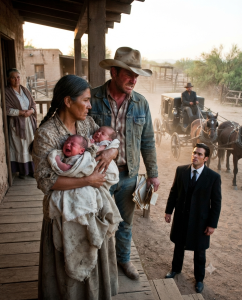
From the front yard, Magdalena could see two vehicles approaching through the heat shimmer: one carriage, one wagon behind it. Too formal. Too deliberate. Men climbed down before the wheels fully stopped. Two wore town clothes unsuited to ranch dirt. Another carried a leather case. Then a final figure emerged from the front carriage with unhurried precision, brushing dust from his dark coat as if even the landscape should apologize for touching him.
Aldo Villaseñor.
He was handsome in the polished way that impressed committees and unsettled widows. Silver had just begun to touch his hair. His boots were clean. His expression, when he looked toward the house, arranged itself into concern.
“There,” Clara muttered. “Concern, right on time.”
Aldo removed his hat as he approached the porch. “Señora Robles. Señorita Paredes. Magdalena.” He nodded to each with practiced warmth. “I came as soon as I heard. Tragic circumstances.”
“No tragedy here,” Magdalena said. “Just babies being fed.”
His eyes flicked past her shoulder, searching the room. “Then I’m relieved they survived the night.”
“How kind of you,” Jacinta said dryly.
He chose not to hear her tone. “By authority of the Charity Board, I’m here to transfer the infants into proper care. Temporary, of course. Procedures must be followed.”
Esteban stepped into view then, and the pleasant mask on Aldo’s face changed almost imperceptibly.
“Esteban,” Aldo said. “I didn’t realize you were involved.”
“That seems to happen often with you,” Esteban replied.
The men behind Aldo shifted uneasily. Clara folded her arms. Magdalena tightened her hold on the smaller twin, who had begun to fuss.
Aldo extended a paper. “Please don’t make this difficult.”
Magdalena did not take it. “And if I do?”
He smiled, patient and cold. “Then I regret I’ll have to insist.”
The smaller twin let out a cry at that exact moment—a sharp, broken wail that sliced through the porch air.
Aldo’s composure faltered.
It was only for a second. Most people would have missed it. Magdalena did not. Neither did Esteban. Something flashed across the official’s face—not annoyance, not pity.
Recognition.
The baby cried again, and Aldo took one involuntary step toward him before catching himself. That was all Esteban needed.
“You know that cry,” he said quietly.
Aldo recovered fast. “Every child sounds the same when distressed.”
“No,” Esteban said. “Not to a man who’s heard it before.”
The yard seemed to draw in around them.
Aldo’s voice cooled. “Careful.”
Esteban took the packet of letters from inside his vest and held them up. “I found my wife’s papers.”
For the first time, true alarm cracked through the official’s control. “That is private material.”
“It became my business the night my family died.”
Aldo’s gaze darted to the men behind him, measuring what they were hearing.
Magdalena felt everything sharpen. The twins. The old trunk. The letter. The way this man had come personally, too quickly, too eager. The strange urgency of it all. She looked down at the baby in her arms, then back at Aldo, and asked the question no one had dared to say plainly.
“Who are they?”
Aldo’s eyes locked on hers.
He might still have lied. He might still have pushed forward under authority and intimidation. But one of the men behind him—the one with the leather case—spoke before he could.
“Sir,” the man said, low and shaken, “is it true?”
Aldo snapped his head around. “Stay out of this.”
Too late.
Esteban unfolded the stained letter and read aloud.
The words were from his wife. Written shortly before her death. They spoke of a young woman from town, hidden during pregnancy, pressured into secrecy because the father was a respected man whose reputation could not survive scandal. The woman had given birth in secret once before, Esteban read, and the child had not been allowed to remain with her. If the new babies lived, there would be “proof no sermon could wash clean.”
Aldo lunged for the paper.
Esteban stepped back.
The movement broke the last illusion of dignity. Clara came down the porch steps like a storm. Jacinta planted herself between Aldo and Magdalena. The men he had brought looked not at the babies now, but at him.
“You self-righteous coward,” Clara hissed.
Aldo drew himself up, rage finally stripping away polish. “You know nothing about the sacrifices required to protect families, livelihoods, order—”
“Whose family?” Magdalena cut in. “Not theirs.”
He turned to her, and for the first time she saw exactly what kind of man he was when admiration failed him. Not benevolent. Not burdened. Only furious that the powerless had become inconvenient.
“Their mother,” he said tightly, “is unfit. Frightened. Weak. She made reckless choices. These children would ruin everything.”
“There it is,” Jacinta said.
The man with the leather case took a step backward as if wanting distance from the statement. Another removed his hat.
Esteban’s voice dropped to something lethal in its calm. “Did you kill my wife to keep this hidden?”
Aldo did not answer. He didn’t need to. The silence said enough.
Clara spoke next, and her words landed like stones. “I remember the medicine you brought that night. I remember how fast your carriage left. I remember my sister-in-law’s eyes before she could no longer speak.”
Aldo’s control broke completely. “She should have stayed out of it!”
No one moved for one full second.
Then everyone understood.
One of the men from town swore under his breath. Jacinta made the sign of the cross. Magdalena felt the baby against her chest stir and settle, warm and alive, as the truth spread through the yard like flame through dry grass.
Aldo had not ridden out for mercy.
He had come to erase evidence.
The rest happened quickly. One man refused to help him. Another openly stepped away. Jacinta announced, in a voice sharp enough to cut rope, that by evening half the district would know every word spoken on that porch. Clara ordered someone to ride for the magistrate in the neighboring jurisdiction—not the one beholden to Aldo. Esteban handed the letters to the town clerk’s assistant, who had come with the party and now looked sick with what he had witnessed.
Aldo tried one last appeal, then one last threat. Neither worked. Without reverence, his authority looked smaller than he had ever imagined.
By sunset, he was under watch.
Two days later, the hidden mother was found in a mission house south of town, half-ill and terrified, where she had been sent to wait until the twins “disappeared properly.” She confirmed enough to destroy what remained of Aldo Villaseñor’s public image. He had fathered the boys. He had concealed her pregnancy. He had arranged for the infants to be abandoned far enough from town that death could do his work for him. And when Esteban’s wife had learned too much years earlier through a cousin employed in Aldo’s household, he had gone personally to silence the danger behind a mask of urgent concern.
Whether he directly caused the deaths in Esteban’s house became the question that consumed the district. Some said the medicine he brought worsened the fever. Others said he delayed the real doctor. Others believed terror and neglect did the rest. The law would spend months arguing over proof.
But in the court of the living, the worst truth had already been decided: when faced with helpless children carrying his blood, Aldo Villaseñor had chosen reputation over mercy.
The twins remained at La Quebrada while the case moved through the proper channels and improper gossip alike. Their mother, once she regained strength, asked to see them. She came trembling, unable at first to do more than stand in the doorway and cry. Magdalena handed her the smaller baby. Clara placed the other in her lap. The room held its breath.
It was not a perfect reunion. There was too much guilt, too much fear, too much damage done by power and shame. But the boys quieted in her arms as if some part of them recognized what the world had tried to sever. That mattered.
In time, arrangements were made. Legal custody became a tangle no one solved cleanly. Their mother was too fragile and too poor to raise both babies alone. Magdalena had already become, in every way except official language, the first person who chose them. Clara had kept them alive. Esteban, despite all the ghosts in that house, had given them shelter when law would have sent them elsewhere to disappear.
So they did something rare and deeply human: they stopped asking which single person had the right to claim the children, and instead asked who had earned the right to protect them.
The answer was all of them.
The twins grew between the roadside stop and La Quebrada, loved in overlapping ways. Magdalena became the steady heartbeat of their earliest years. Clara taught them to stand, eat, and survive. Esteban—who had once thought the sight of baby blankets would destroy him—found that grief did not always close a door forever. Sometimes it opened a different one, painful and unexpected, toward a tenderness he had believed buried with his son.
As for Aldo Villaseñor, his fall was not dramatic in the way stories prefer. It was slower, uglier, and perhaps more fitting. Men who had praised him suddenly remembered appointments elsewhere. Donations were questioned. Testimonials cooled. The magistrate’s inquiry unearthed enough lies, payments, and coercion to strip him of office and leave him facing charges that no polished speech could smooth away.
Years later, people still argued over what the greatest red flag had been. The speed with which he moved to seize the babies. The habit of “helping” where secrecy was required. The way decent men so often hide behind respectability until one desperate cry catches them unprepared.
Others asked harder questions. Whether the twins’ mother deserved forgiveness for leaving them in that trailer, even if terror had driven her there. Whether Esteban’s silence after his family’s deaths had protected evil longer than it should have. Whether Magdalena, by refusing the law at dawn, had saved two lives precisely because she disobeyed what everyone called proper.
No one agreed on everything.
But everyone agreed on this: those boys lived because one woman heard a cry from the dark and refused to walk away, and because one broken rancher made a brave choice before the law could arrive and finish what cruelty had started.
Sometimes destiny doesn’t change with a miracle.
Sometimes it changes because, on the coldest night of someone’s life, the right people decide not to surrender them.