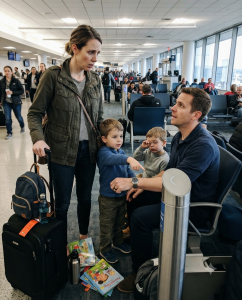
The airport stranger had seemed kind until her son pointed at his watch and said it had been in Mommy’s secret box.
That was the moment Sienna’s entire life tilted.
Airports had always felt vaguely miserable to her, but never dangerous. Too much fluorescent light. Too many people dragging luggage and staring at screens. Too many public places to break down without permission. On that particular morning, though, the terminal in Dallas felt like the perfect place for her life to finally collapse. Bright enough to expose everything. Loud enough to drown out panic. Impersonal enough that no one would notice if she came undone right there between the charging station and the gate.
She had left with twin boys, two carry-ons, and the stale taste of a divorce settlement that already felt like a mistake.
The divorce had been final for three weeks. The marriage itself had been over for much longer than that, though she had spent years pretending the distance between herself and her husband was stress, work, grief, timing, parenthood—anything except what it was. She was thirty-four, exhausted to the bone, and flying back to Philadelphia to move into her sister Mara’s guest room until she could figure out how to rebuild a life that looked stable from the outside and empty from within.
Her sons, Owen and Eli, were six. Old enough to sense sorrow. Too young to understand it.
“Is this a vacation?” Owen had asked that morning while she zipped up the second bag.
“No, sweetheart,” she had said.
“Then why are we bringing snacks?”
Because survival with children always required snacks, but she hadn’t said that.
By the time they reached the gate in Dallas, Owen was dragging his backpack by one strap, and Eli had fallen asleep in a chair with his headphones sliding off his forehead. Sienna’s head ached. Her coffee had gone cold. She had read the same line in her legal folder three times without understanding a word of it.
That was when the stranger picked up Owen’s runaway juice box and handed it back.
“Looks like you’ve got a full flight crew.”
Owen, solemn as ever, replied, “We’re two captains and one tired mom.”
The man glanced at Sienna and smiled, tired in a way that didn’t feel fake.
“That sounds right.”
His name was Adrian.
He said he had a delayed connection and was also headed east. He was dressed like someone traveling for work but not enjoying it—dark blazer, open collar, tablet, worn leather carry-on. He had a silver watch on his wrist, scratched near the edge. No wedding ring. No obvious reason to matter.
And yet, almost immediately, he did.
There was something disarming about the way he interacted with the boys. Careful. Light. Never too familiar. Never overly charming. He didn’t perform kindness like some men did when a woman was nearby. He simply met the twins where they were. When Eli woke up groggy and irritable, Adrian taught them a ridiculous game involving airport codes and animal names. Within minutes, both boys were laughing. Owen insisted PHL meant Penguin Helicopter Landing. Eli countered with Dinosaur Air Landing Station. Even Sienna laughed, despite herself.
For the first time in days, maybe weeks, she felt her body loosen a little.
Then Owen looked at Adrian’s wrist.
“Cool,” he said. “My mom has one like that in her secret box.”
The sentence landed like broken glass.
Sienna’s body went rigid.
Adrian looked down at his watch, then back at Owen. “A secret box?”
There was a box. Locked. Hidden in the back of Sienna’s closet on the top shelf. She had found it almost a year earlier while looking for tax papers. The key had been taped beneath an old jewelry case. Inside were photos, letters, a flash drive, and several expensive items she didn’t recognize—including a women’s bracelet, a man’s watch with a crescent scratch, and an old hospital wristband she had not understood. She had gone through enough to know the box contained a version of her marriage no one had ever confessed to. Then she had done what fear sometimes trained women to do: closed it, locked it, and told herself she would come back when she could bear the answer.
She had never shown it to the boys. But children noticed everything adults forgot they had seen.
Owen leaned closer to Adrian’s wrist. “Same scratch.”
The man’s smile vanished.
Sienna saw it in an instant. A tightening around the eyes. A pause too deliberate to be innocent.
“What scratch?” she asked.
Owen pointed. “There. Like a moon.”
Adrian turned his wrist over, exposing a pale crescent near the frame.
“That’s a common watch,” Sienna said, but even to her own ears the sentence sounded like hope, not belief.
Adrian held her gaze. “Probably.”
Probably.
A single word, and everything changed. His tone was different now. Guarded. Measured. Almost braced.
Then Eli, still foggy from sleep, leaned against her arm and murmured, “Mom’s box had pictures too.”
Sienna went cold.
“Owen,” she said, too sharply, “enough.”
But the damage was done.
“The man in the pictures had that watch,” Owen said. “I thought it was our uncle, but Mommy cried after she saw it.”
Adrian went completely still.
Sienna stared at him, and in that silence something old and buried stirred inside her. Recognition. Not from memory exactly, but from somewhere stranger. She looked at his jaw, his eyes, the shape of his mouth when he stopped smiling. Her boys had always looked like her in obvious ways—her coloring, her freckles, her chin—but there were expressions on both of them she had spent years quietly not naming. Expressions that belonged to no one she could comfortably place.
Until now.
She stood.
“What is your last name?”
He didn’t answer.
“Owen,” she said, voice tight, “go sit by your brother.”
The boys obeyed, confusion replacing their earlier ease.
Adrian lowered his voice. “I didn’t know.”
It hit harder than denial.
“Didn’t know what?”
“That she kept anything.”
She stared at him. She had expected confusion, defensiveness, maybe an awkward apology. Not that. Not language that implied the box had belonged to someone else, not her.
“Try again,” Sienna said.
Adrian reached slowly into his carry-on, then stopped when her posture changed. “It’s just a wallet,” he said quietly.
He pulled out a weathered passport wallet and placed it on the empty seat between them.
“I was trying to figure out how to tell you this,” he said. “But if those boys are the age I think they are, your secret box may not be the only thing your ex-wife hid.”
The word didn’t register at first.
Then it did.
Ex-wife.
Not ex-husband.
Sienna heard herself whisper, “What?”
Adrian’s face changed too late. He knew what he had said. Knew he couldn’t take it back.
“You said ex-wife.”
He exhaled once. “I thought you knew.”
Her skin prickled. “Knew what?”
Instead of answering, he opened the wallet.
Inside was an old photograph.
At first glance, it made no sense. Her ex-husband, Daniel, younger by years. Adrian beside him, wearing the same silver watch. Their bodies angled with the ease of people who had once shared a life, not merely crossed through one. But it was the woman standing in front of them that hollowed Sienna out.
She looked like Sienna.
Not exactly, but enough to make the blood leave her face. Same eyes. Same narrow face. Same mouth.
“It’s not you,” Adrian said gently. “It’s Mara.”
Sienna’s sister.
The terminal seemed to tip sideways.
Mara. The sister whose guest room she was flying home to. The sister who had insisted she come stay “as long as needed.” The sister who had cried over the divorce with a kind of urgency Sienna had thought was loyalty. The sister who had always changed the subject whenever Sienna asked about the years before she met Daniel.
Sienna looked from the photo to Adrian and back again.
Mara looked younger in the picture, deeply pregnant, one hand curved beneath her stomach. Daniel had his hand at her back. Adrian stood close enough to both of them to suggest intimacy, not friendship. On the back of the photo was a date—seven years earlier.
A year before Sienna had met Daniel.
“What is this?” Sienna whispered.
Adrian’s voice was low and careful. “Mara was my wife.”
Sienna couldn’t breathe.
“She left,” he continued. “Or that’s what I was told. Daniel said she’d had some kind of break after the pregnancy. He said she disappeared and wanted no contact. Later he told me there had been an accident. He said the babies were gone too.”
“The babies?” Sienna repeated faintly.
Adrian nodded toward Owen and Eli.
The world narrowed to a pinprick.
“No,” she said automatically. “No. They’re my sons.”
He didn’t challenge her. That made it worse.
“I’m not saying you didn’t raise them,” he said. “I’m saying I think they may be mine.”
Sienna grabbed the edge of the seat.
Images began snapping into place with violent speed. Daniel insisting they move states shortly after the twins were born. The strange silence around the birth records. The way he always handled paperwork. Mara’s prolonged “recovery” period after what the family had called a private breakdown. The whispered phone calls. The hidden box. The years of subtle deflection whenever Sienna asked for details that should have been ordinary.
“You’re lying,” she said, but she heard the weakness in it.
“I wish I were.”
He took out a second item from the wallet—an old photocopy of a private investigator report, worn at the folds. Then a hospital discharge sheet with Mara’s full name on it. Then a photo of Mara in a hospital bed, pale and exhausted, one wrist banded, two bassinets blurred in the background.
Twin boys.
Sienna pressed a hand to her mouth.
“She vanished two days later,” Adrian said. “Daniel told everyone she’d refused treatment, that she abandoned us. I didn’t believe him, but I couldn’t prove anything. By the time I got a lawyer involved, records had been sealed or altered, and Daniel had disappeared. I spent years looking for Mara and for the babies.”
“And then you stopped?” Sienna asked.
“Never.” His eyes dropped briefly to the twins. “I just stopped getting close.”
Boarding was being called. Families lined up. The ordinary world kept moving around them while Sienna’s own history split open at the center.
She looked at her sons.
Her sons.
Whether by birth or by blood or by the brutal, daily labor of motherhood, they were hers in every way that mattered. But the question now was not whether she loved them. It was who had built her life out of someone else’s wreckage.
“Why would Mara let this happen?” she asked.
Adrian’s expression shifted. “I don’t know if she let it.”
That answer struck harder than anything else.
She stared at the photo again. Mara’s smile. Daniel’s hand. Adrian’s watch. Three people standing in one frame, all connected to her life long before she entered it. And somehow she had ended up marrying the man who had once belonged to her sister and had almost certainly stolen children from their father.
It sounded insane.
It was also the first version of her marriage that explained everything.
Sienna boarded the plane in a daze. Adrian was on the same flight. They sat several rows apart by necessity, but before takeoff he passed a folded note through a flight attendant.
I have more documents. I’m not leaving until you know everything.
She stared at the note the entire flight.
The boys slept. Owen’s head in her lap, Eli curled against the window. She watched their faces and tried to reconcile two truths at once: that she had been their mother from their first remembered breath, and that someone might have built that motherhood on deception so profound it changed every name in the story.
When they landed in Philadelphia, her phone buzzed before she even switched it fully on.
Mara: Can’t wait to see you. Boys must be exhausted. I made up the guest room.
Sienna looked at the message until the words blurred.
Adrian met her near baggage claim with a slim envelope.
“Do you want the police first,” he asked quietly, “or your sister?”
Sienna thought of Mara’s face in the photo. Thought of Daniel’s soft, patient lies. Thought of the secret box in the closet and the years she had spent swallowing unease because she didn’t want to tear her own life apart.
Then she thought of Owen pointing at a watch and speaking the truth simply because children have not yet learned how much adults will do to hide from it.
“My sister,” she said.
Mara opened the front door with tears already in her eyes.
“There you are,” she said, reaching for the boys. “My sweet boys—”
Sienna stepped back.
Mara paused.
Adrian moved into view behind her.
The color vanished from Mara’s face so completely that for a second she looked like someone carved from paper.
“No,” she whispered.
The boys clung to Sienna’s legs, sensing the shift.
“You know him,” Sienna said.
Mara’s eyes filled instantly. She looked from Adrian to the twins to the envelope in Sienna’s hand. “Please,” she said. “Not in front of them.”
“That’s interesting,” Sienna replied, her voice strangely calm. “Because apparently everything was done in front of them. Or around them. Or because of them.”
Mara swayed once and grabbed the doorframe.
Adrian didn’t step closer. “Tell her the truth.”
Mara shut her eyes. When she opened them again, the resistance was gone. Not because she wanted to confess. Because she could see the lie had finally reached its edge.
Daniel had not merely cheated. He had engineered.
Years earlier, Mara and Adrian had been married and expecting twins after a difficult pregnancy. According to Mara, Daniel had inserted himself as helper, fixer, protector—the reliable family friend who managed crises. But after the babies were born, Mara spiraled into severe postpartum psychosis. She heard things. Forgot hours. Became frightened of the children and then frightened of herself for being frightened. Adrian wanted treatment. Mara agreed, briefly. Daniel took over the logistics while Adrian handled insurance and work.
Then Daniel told Adrian that Mara had fled the hospital in a break, and that the babies had died during an emergency transfer after a car accident involving Mara’s transport.
It was a lie.
At nearly the same time, Daniel told Mara that Adrian had signed temporary custody papers and vanished with the babies because he couldn’t handle her condition. Another lie.
Daniel separated them while Mara was unstable and Adrian was desperate.
For months, Mara remained in treatment under heavy medication. By the time she was discharged, Daniel had convinced her that the children were better off hidden from her until she was “well enough.” He showed her selective records. Staged legal papers. Controlled contact. And when Sienna met Daniel a year later, he introduced himself as a man who had survived a tragic relationship and was now helping an estranged “family friend” rebuild from a nervous breakdown.
Sienna sat down hard at Mara’s dining table as the story spilled out.
“You knew,” she said. “When I married him.”
Mara broke then, sobbing openly. “I knew he had the boys. I didn’t know how to stop him. Every time I pushed, he threatened to expose my records, to say I was dangerous, to make sure I never saw them. Then you fell in love with him, and he told me if I wanted to stay near them at all, I would stay quiet.”
Sienna felt sick.
“All those years?” she whispered.
Mara nodded, crying harder. “I thought being near them as their aunt was better than losing them forever.”
Adrian’s face looked carved from pain, but his voice remained steady. “And me?”
Mara turned toward him with the shattered look of someone who had lived too long inside her own cowardice.
“I thought you hated me,” she said. “Then I thought if I found you, you’d take them and disappear before I could even explain. Then every year it got harder. The lie got bigger. I told myself I was protecting them from the mess of it. Really, I was protecting myself from what I’d done by staying silent.”
There was no neat place for that truth to land.
Daniel had built the cage. Mara had remained inside it. Adrian had been robbed. And Sienna—Sienna had unknowingly become the final wall that made the lie look like a family.
The police came that night.
Then lawyers. Then tests. Then records dragged into daylight.
The DNA results confirmed what Sienna already knew in her bones by then: Adrian was the twins’ biological father. Mara was their biological mother.
Sienna was the woman who had raised them.
Nothing in the law or the heart knew how to make that simple.
The months that followed were brutal. Court hearings. Emergency custody orders. Therapy appointments. Questions from the boys that no adult could answer cleanly. At first Owen cried when anyone mentioned changing houses. Eli became quiet and clingy and stopped sleeping through the night. Sienna nearly broke every day and kept going every day anyway.
Adrian never tried to erase her. That saved all of them.
He fought for the truth, not for revenge. Mara entered treatment again, this time honestly, without Daniel’s control around the edges of every decision. Daniel, once finally located, was arrested on fraud, custodial interference, falsification of records, and a list of other charges long enough to make the prosecutors call it one of the strangest domestic cases they had ever seen.
In family court, the judge said something Sienna would never forget: “Biology matters. So does history. But the law must also account for who tucked them in.”
Shared custody became a complicated arrangement no one would have chosen and everyone had to learn. Adrian became Dad slowly, carefully, in a way that honored the boys’ confusion instead of bulldozing through it. Mara became Mom again in fragile increments, supervised at first, then longer visits, then therapy sessions where the twins asked painful questions with the directness only children possess.
And Sienna remained what she had always been.
Home.
Not the only home anymore. Not the legal wife she thought she had been. Not the woman with the tidy story. But the one who had held fevers through the night, packed lunches, kissed bruised knees, memorized their fears, and stayed.
A year later, the adults sat together at Owen and Eli’s school concert. Not comfortably. Not naturally. But together.
Owen spotted them from the risers and grinned.
Afterward, he took Sienna’s hand in one fist and Adrian’s in the other, then looked back at Mara and said, “Are we all still weird?”
Everyone laughed, even through the sting of it.
“Yes,” Sienna said.
“Good,” Owen replied. “Because regular families are boring.”
That night, after the boys were asleep, Sienna stood alone in her apartment kitchen and thought about airports, secret boxes, and the tiny moments that crack a life open. One child’s careless observation. One silver watch. One stranger who stopped smiling.
She still didn’t know who had suffered most or who deserved forgiveness first. Mara had failed in ways that hurt to name. Adrian had lost years he could never reclaim. Sienna had been deceived into loving a lie and then asked to keep loving through the wreckage of it. Daniel had caused all of it, but the damage he left behind did not sort itself into simple categories of innocent and guilty.
Maybe that was the cruelest truth of all.
Sometimes the biggest red flag is not a single lie. It is how many people learn to live around it.
And sometimes the family you thought was stolen from you, built on you, or kept from you turns out to be all three at once.