[PART_2]
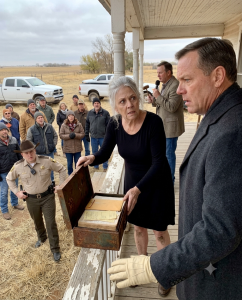
Martha unfolded the last page slowly, and the sound of paper in that silence seemed louder than the auctioneer’s microphone had ever been.
“It went somewhere,” she said.
The sheriff stepped onto the porch beside her now, close enough to see the document before anyone else. His face changed first. Not confusion. Recognition.
There was an account number written in Walter’s careful hand, then copied again from a deposit ledger. Beneath it were dates, transfer amounts, and one name tied to all of it.
Not the bank.
Edwin Pike’s wife’s family trust.
A murmur tore through the yard. Someone actually cursed out loud. Pike opened his mouth, but nothing came out for a second. The perfect calm he had worn all morning was gone now, and underneath it was something much uglier.
Martha’s voice stayed steady. “Walter went back to confront him. He wrote that Pike tried to laugh it off at first. Then he asked how many copies Walter had made.”
The sheriff took the page from her hand.
“That’s enough,” Pike snapped, stepping forward. “This is private financial material. You have no authority to parade it in public.”
The sheriff’s hand moved to stop him before he reached the porch rail.
That was the moment the town truly turned.
Because for the first time, Edwin Pike didn’t look like a banker protecting procedure.
He looked like a man trying to get something back before everyone saw too much.
And Martha, still standing there with that rusted box open in front of her, looked straight at him and said, “Tell them what you offered Walter to keep quiet the week before he died…”
By the time the auction notice went up on the Bell property, most of the town had already decided what kind of story it was.
A sad one, obviously. A widow, newly alone, buried under debts she did not understand. A modest farmhouse on the edge of town about to be sold off piece by piece to settle accounts. There was sympathy for her, of course. Plenty of it. But there was also that quiet, familiar resignation small towns can produce when paperwork enters the room. A belief that signatures must mean something, that ledgers do not lie, and that institutions, even cold ones, are still safer to trust than a grieving old woman saying none of it made sense.
So when people talked about Martha Bell, they did so in lowered voices.
They said she had been devastated by Walter’s death and was probably struggling to accept things he had hidden from her.
They said older men often kept money trouble secret out of pride.
They said Edwin Pike would not push an auction unless he had no choice.
That was the story the town told itself, right up until the morning Martha carried a rusted metal box onto her own porch and destroyed it.
Martha and Walter Bell had lived in the same farmhouse for more than three decades. It sat two miles outside town, white paint weathered thin, porch slanting just enough to make guests notice, with a shed out back and a garden plot Walter kept so neat people joked he could line up tomato plants with a ruler. Their life was not glamorous. Walter repaired engines, welded broken equipment, sharpened blades, and rebuilt old machinery people richer than him would have thrown away. Martha kept the books for the house in a neat script and knew exactly how long flour, lamp oil, and heating fuel could be stretched in a hard winter.
They were not poor in the way people imagine poor. They had enough because they spent carefully, saved religiously, and distrusted debt the way some people distrust storms.
That was why the claim hit so hard after Walter died.
He had been gone nineteen days when Martha first walked into Pike & County Trust and asked why a past-due notice had arrived in an envelope marked urgent. She thought it had to be a mistake. Some clerical confusion. Something that would be cleared up once a person looked at it.
Instead, a young teller turned pale, disappeared to fetch a manager, and sent Martha into an office where Edwin Pike himself eventually received her.
Edwin Pike had the kind of reputation built over years rather than charm alone. He sponsored town events. Sat in the front pew at funerals. Remembered names. Donated quietly but visibly. Spoke in a polished, measured tone that made even bad news sound civilized. He had inherited influence from his father, expanded it through the bank, and worn it so consistently that many people stopped noticing it was power at all.
He invited Martha to sit.
Then he explained, with grave concern, that Walter had carried a series of outstanding obligations tied to earlier emergency lending and later renewed notes. Interest had accrued. Notices had allegedly gone unanswered. The debt now exceeded what the property could reasonably support.
Martha stared at him as if he had begun speaking a foreign language.
“Walter did not borrow money,” she said.
Pike folded his hands. “Mrs. Bell, many spouses don’t discuss these matters in full.”
“He would have discussed this.”
“I understand why you’d want to believe that.”
That sentence stayed with her for days. Not because it was loud, but because of how expertly it reduced her. It did not argue. It dismissed.
She asked to see the documents. Pike provided copies, not originals. There were signatures on them, yes. Walter Bell’s name. Dates that reached back several years. Renewal language, penalty clauses, account references. To anyone else, they might have looked official enough to end the matter.
To Martha, they looked wrong.
Walter’s handwriting had always been forceful and square, letters planted firmly like fence posts. Some of these signatures wandered uphill. Others seemed overly careful, as if someone had practiced them too often. She pointed that out.
Pike gave a patient smile. Stress changes pen pressure, he said. Illness affects the hand.
She took the copies home and laid them on the kitchen table where she and Walter had paid every bill together for years. She sat there until the light outside went blue and then dark. She compared dates. Looked at old check registers. Searched the desk drawers. Nothing matched. No corresponding withdrawals. No mention in Walter’s small pocket calendars. No sudden expenses big enough to justify secret borrowing.
When she returned to the bank a second time, Pike was cooler.
He told her the records were certified. He told her accusations of error were serious. He told her grief often distorts memory. By the time she left, she felt not only powerless but publicly foolish. Tellers had looked down, but she knew they were listening.
Soon, everyone was.
One rumor became five. Walter had maybe gambled. Maybe loaned money unwisely. Maybe helped someone in trouble and been trapped. Maybe Martha simply had not known him as well as she thought.
That was how Edwin Pike won before the auction ever happened. He did not need the whole town to hate her. He only needed them to doubt her.
The sale was set for a cold Saturday morning.
People arrived early, as people always do when something painful is also interesting. Trucks parked along the road. Men wandered the yard, estimating tools and equipment. Women stood in coats and boots with paper coffee cups. A few came out of sympathy. Others came because a farmhouse auction is where bargains appear. More came because they could feel a story forming and wanted to be present when it broke.
Martha had not slept much the night before. Two nights earlier, while looking for a spare kerosene can in the shed, she had noticed one board near the back wall shifting underfoot. Walter had always fixed things before they could loosen. The movement bothered her. She pried at it with a flat tool and found a cavity beneath.
Inside was a metal box.
The box was old, the kind sold decades earlier for storing hardware or receipts, with rust blooming around the hinges and a faint patch where a label used to be. Walter had wrapped it in oilcloth before placing it under the floor. Martha carried it into the kitchen and sat with it in front of her for nearly an hour before she could make herself open it.
What she found inside rearranged the past.
There were bank receipts, payment stubs, deposit confirmations, correspondence copies, and a thick hand-bound ledger in Walter’s handwriting. Neat columns. Dates. Amounts. Notes in margins. Cross-references to receipt numbers. There was also a sealed envelope with one name on the front.
Edwin Pike.
Martha read until her eyes burned.
Walter had taken one emergency note in the storm year, when hail had flattened equipment jobs for weeks and several customers could not pay on time. He had paid it back in installments and then in full. Every payment was documented. Final settlement was stamped. But later, according to Walter’s notes, Pike had presented the same obligation as if it still existed, then claimed it had been rolled into renewals Walter never authorized.
At first Walter seemed to have believed it might be a bookkeeping issue. His early notes were calm. Need originals. Ask for posting dates. Confirm branch entries.
Then the tone changed.
Met Pike again. He says I forgot signing. Impossible.
Asked to see ink originals. He refused.
Compared receipt numbers against Dunn and Mercer entries. Strange repeats.
That was when Martha realized Walter had not merely been defending himself. He had stumbled onto something larger.
The storm year had hit dozens of families hard. Pike, then praised as a savior, had overseen emergency assistance and restructuring. Walter’s ledger suggested some payments accepted during those years were never credited the way borrowers believed. Some were diverted through account adjustments that left debts appearing active long after they should have been reduced or cleared. Names appeared in the margins. Harold Dunn. Elsie Mercer. The Tolland brothers. Others Martha recognized with a sick jolt.
People who had lost land. People who had sold livestock. People who had spent years thinking they had simply failed.
Near the back of the box, she found the letter Walter had written for her in case he did not outlive the matter.
It was brief, direct, and unmistakably his.
If anything happens to me before this is settled, do not trust Edwin Pike’s copies. He showed me notes I never signed and claimed I renewed debt already paid. I told him I had every receipt in the shed box, same place as the ledger. If he tries this after I’m gone, open it in front of witnesses.
Martha had read that line again and again until the words blurred.
If he tries this after I’m gone.
Walter had known. Maybe not every detail, but enough. Enough to hide the box. Enough to leave instructions. Enough to fear Pike would move the second he was no longer there to stop him.
On the morning of the auction, she dressed in black because she had not yet put mourning away. She carried the box herself because no one else was left to carry it.
Edwin Pike arrived last in a dark sedan, polished and composed. He spoke to the sheriff, then to the auctioneer. Anyone watching without context would have mistaken him for the most reliable man there.
The auctioneer made his opening statement. Legal authority. debt satisfaction. final opportunity for objection.
Martha said, “I object.”
Heads turned instantly.
The auctioneer, irritated, told her objections should have been filed through proper legal process.
“It was,” Martha said. “I just didn’t know my husband had filed it for me.”
Then she placed the rusted box on the porch rail and opened the lid.
What followed spread through town so fast people later argued over exactly who heard which line first.
She lifted the ledger. Explained that Walter had kept records of every payment. Produced receipts. Held up the final paid-in-full statement. Read the letter naming Pike directly. The sheriff came closer. The auctioneer stopped speaking altogether. Pike tried to interrupt, but every answer he gave sounded thinner than the last.
Then Martha said there were other names.
The crowd changed at once.
Until that moment, some still wanted to believe this was a private misunderstanding. Tragic but isolated. The second she named Harold Dunn, Elsie Mercer, and the Tollands, the thing widened into a crack running under the whole town.
Harold Dunn, standing near the gate in a canvas jacket, looked as if someone had struck him. He had lost forty acres after the storm year and spent the past decade blaming himself for mismanagement.
Elsie Mercer began crying quietly before Martha finished saying her name.
Pike told Martha to stop. The sheriff told him to let her continue.
She removed another paper from the box: a copied deposit sequence Walter had tracked from bank records, receipts, and account numbers. He had connected payment dates to transfers that did not remain where they were supposed to. And at the bottom of the page was the destination that made the sheriff’s face harden.
A trust tied to Pike’s wife’s family.
The sound that moved through the yard then was not surprise alone. It was outrage mixed with recognition. That particular kind of anger people feel when a suspicion they were too embarrassed to say aloud turns out to have been true.
Pike stepped forward. “Those documents are private and incomplete.”
The sheriff blocked him from the porch.
Martha looked directly at the banker. “Tell them what you offered Walter to keep quiet.”
Pike did not answer.
So she did.
There was another note from Walter, written after what he described as a final meeting with Pike the week before his death. In it, Walter said Pike had first denied everything, then softened, then proposed a “correction” if Walter agreed not to bring in outside auditors. The correction included wiping the Bells’ alleged debt and arranging favorable treatment on future business. In other words, silence in exchange for mercy over a debt that should never have existed.
That broke whatever remained of Pike’s control.
He called Walter confused. Called Martha reckless. Claimed the notes were the product of a sick mind and incomplete understanding. But he was sweating now. Not the weather. Not grief. Fear.
Sheriff Nolan ended the auction on the spot and took possession of the box and papers as evidence. He also told Pike, in full hearing of the crowd, not to leave town until further notice.
The sedan Pike had arrived in sat untouched for another hour while deputies made calls.
By afternoon, investigators from the county had sealed off Pike’s office at the bank. By evening, two former employees had quietly agreed to answer questions. One admitted Pike had personally restricted access to older loan files from the storm year. Another remembered being instructed to reprint loan summaries without original attachment pages “for clarity.”
Within days, the story escaped the county line.
Auditors found irregularities stretching back more than a decade. Not every troubled loan had been fraudulent, but enough had been manipulated to establish a pattern. Payments rerouted. Debt balances misstated. Renewals generated under questionable authority. Vulnerable borrowers pressured when spouses died or records were harder to challenge. Pike had not robbed the rich or powerful. He had targeted those least likely to fight a bank in public.
The trust connected to his wife’s family became impossible to explain away. Money had moved through layers, but it had moved. So had favors, property acquisitions, and conveniently timed settlements.
Pike was arrested before the month ended.
At his arraignment, he looked smaller than the man who had stood on Martha’s lawn. Not humbled exactly. Men like him rarely surrender their belief in their own exceptions. But diminished. Stripped of the town’s borrowed faith.
Pike & County Trust suspended multiple employees, though several were later cleared of wrongdoing. Civil cases reopened. Families who had sold property under pressure were contacted. Some recovered funds. A few recovered land. Others only got confirmation that what happened to them had not been failure but fraud. The relief in that truth was tangled with grief. Vindication arrived too late to restore lost years.
Martha’s house was never auctioned.
The bank’s claim against her was withdrawn, then publicly voided. Lawyers came and went. Reporters knocked. Distant relatives suddenly remembered her address. Through all of it, Martha remained exactly what she had been on the porch: steady, direct, unwilling to be softened for other people’s comfort.
When Harold Dunn came by one evening with his hat in both hands and tears he clearly hated showing, she invited him in and poured coffee before he could apologize for not believing her sooner.
“It wasn’t me you failed,” she told him. “It was easier to trust the man behind the desk.”
He nodded, but he still cried.
That happened more than once. Not always with tears, but with that same bruised realization. The town had not merely watched an injustice develop. It had helped clear the stage for it. It had treated paperwork as proof and composure as character. It had accepted the banker’s version because it fit the world better than the widow’s did.
One spring afternoon, months after the arrest, Martha returned to the shed and replaced the loose floorboard. She kept the metal box in the house after that, cleaned but not restored. She said the rust mattered. Walter had hidden the truth in something no one would value at a glance. There was a lesson in that.
She eventually read all his notes, even the ones not meant for court or sheriffs or witnesses. Some were practical reminders. Fix south hinge. Buy seed potatoes. Check belt on tiller. Others were more personal than Walter had ever been aloud.
If this turns into trouble, don’t let them make you feel small.
That line undid her more than anything else.
Because in the end, it was not only about money or land or forged debt. It was about the quiet machinery of humiliation. The way respectable lies try to make honest people doubt their own memory. The way power counts on loneliness. The way grief can be used like a door left unlocked.
Walter had seen it before Martha did. But Martha was the one who walked through the crowd and opened the box.
Years later, people still talked about the morning of the auction. They remembered the cold, the silence, the rust on the hinges, the expression on Edwin Pike’s face when he understood the story would no longer belong to him. Some remembered the sheriff stepping in. Some remembered the names Martha read aloud. Some remembered the exact moment sympathy turned into fury.
What no one forgot was this: everyone had believed the banker.
Until the widow carried out the proof with both hands.
And maybe that was the part that lingered most painfully after the headlines faded. Not that one man lied, stole, and hid behind authority. Men like that have always existed. It was that so many decent people had mistaken confidence for truth and grief for confusion. That they had almost watched a woman lose her home because the wrong story arrived in a stamped envelope.
The house still stands.
So does the porch.
And now, whenever someone in town says, “Well, the papers say—” there is usually a pause afterward. A hesitation. A memory.
Of a rusted metal box.
Of a widow in black.
And of how close they all came to helping the lie win.