The first time Gabriel Rossy noticed Khloe Higgins, she was standing beneath a chandelier worth more than her yearly rent, being told to breathe more quietly.
It was a Wednesday night at Obsidian Room, one of those Tribeca restaurants where everything was dim, expensive, and curated to make wealthy people feel even more important than they already did. The walls were black stone and smoked glass. The steaks arrived under silver domes. Men who sat in corners decided the fate of companies, marriages, and sometimes people. The air smelled like truffle butter, old Bordeaux, and money that had stopped pretending to be respectable.
Khloe moved through that world in orthopedic insoles that had long ago given up on saving her feet.
She was the kind of woman places like Obsidian pretended to be too refined to hire, until they realized she worked harder than anyone else on the floor. She was a size 18, strong through the hips and shoulders, always one double shift away from collapse, and just attractive enough to be resented by women like Clare and patronized by men who thought pity was a compliment.
Clare, the floor manager, had perfected the art of humiliating her softly enough that customers mistook it for professionalism.
“Tuck your blouse in,” Clare hissed while rearranging a centerpiece on table fourteen.
“It is tucked in.”
“Then stop standing like you’re tired. You make the room look heavy.”
Khloe swallowed the reply burning at the back of her throat. She had learned restraint the hard way. Restraint kept you employed. Restraint paid hospital bills. Restraint got your younger brother through another month even when he didn’t deserve it.
That morning Mason had called her selfish for not letting their mother’s debt go to collections. He said nobody had ever helped Khloe, so why was she still breaking herself to help everybody else. He said she was too soft and too stupid to survive New York.
By noon she had almost started believing him.
Then Toby nearly died over a bottle of wine.
He was the newest helper on the floor, all nervous elbows and frightened apologies, the kind of kid who jumped whenever Clare spoke his name. Khloe had a weak spot for strays. She recognized panic when she saw it.
So when the front doors opened at a quarter past eight and Gabriel Rossy entered with three men, she looked first at Toby.
He had gone white.
Everyone knew Rossy without needing introductions. New York was full of monsters pretending to be businessmen, but Gabriel Rossy was something else entirely: disciplined, quiet, and so dangerous that people lowered their voices just saying his last name. His operations stretched up the East Coast through ports, unions, shell companies, and gentlemen’s clubs that weren’t remotely gentlemanly. Nothing about him was loud, and that made him worse. Loud men wanted attention. Quiet men wanted results.
He sat at the private rear table with Dante on his right and two other men standing back. The room adjusted around him. Servers straightened. A bartender fumbled a glass. Clare practically floated to the table.
“Toby,” she whispered sharply, shoving the wine service toward him, “go.”
Khloe saw his hands shaking before he even crossed the room.
She saw the tray tip.
She saw the wheel of disaster begin to turn and knew nobody else would stop it in time.
The bottle hit first. Then the glass. Red wine burst across the tablecloth and splattered over Gabriel’s tailored charcoal trousers.
A silence dropped so fast and hard it felt physical.
Toby fell to his knees. “I’m sorry, sir. I’m so sorry.”
Dante moved.
Only one step, but it was enough. His hand disappeared under his jacket, and every primitive instinct in Khloe’s body screamed.
She reached them before Clare did.
“Go get a mop, Toby. Now.”
The boy scrambled away.
Khloe grabbed a linen napkin, leaned in just enough to assess the damage, and said, with a calm she did not remotely feel, “I can have these cleaned, Mr. Rossy. But if anyone here tells you mineral water will save wool, they’re lying to you.”
Dante stared at her as if deciding where to bury her.
“Careful,” he said.
Gabriel lifted one hand without taking his eyes off Khloe.
That tiny gesture froze the room.
“You’re not afraid,” he said.
Khloe almost laughed. “I’m exhausted. There’s a difference.”
Something changed in his expression then. Not softness. A man like Gabriel Rossy probably did not own that emotion in public. But there was interest. Sharp and immediate.
“What’s your name?”
“Khloe Higgins.”
“Tell me, Khloe Higgins. If you could ask for one thing right now, what would it be?”
She should have lied. Should have said a promotion, a raise, a second chance for the busboy. Something clean and useful.
Instead she told the truth in the shape of a joke.
“A day off. And a nap that doesn’t end with an eviction notice.”
One side of Gabriel’s mouth moved, almost a smile. She didn’t wait to see if it finished forming. She walked away before her knees gave out.
By the end of the shift, Clare had found new ways to punish her.
“You embarrassed me in front of one of the most important men in the city.”
“He was about to gut a teenager over merlot.”
“You do not know what men like that are capable of.”
Khloe tied her apron loose with tired fingers. “Actually, I think I do.”
At two in the morning she made it back to her apartment in Brooklyn. It was barely larger than Obsidian’s walk-in freezer. The refrigerator buzzed angrily. The radiator clanked. Her mother’s hospital balance, fourteen thousand six hundred eighty dollars, was held to the fridge with a novelty magnet shaped like a strawberry.
Khloe stared at it while taking off her shoes.
Then she crawled into bed fully clothed.
At six sharp, someone knocked.
The sound was crisp and deliberate, not landlord-angry, not neighbor-impatient. Khloe opened the door chain-first and found a man in a black suit standing in the hallway like he belonged there.
“Khloe Higgins?”
“Yes?”
He handed her a matte black box and walked away.
Inside lay a Centurion card with her name engraved in silver. Under it was a note in neat handwriting.
Take the day off. Eviction is no longer on the menu. — G.R.
For a full minute she simply stared.
Then Mason called.
“Tell me you’re not mixed up in something disgusting,” he snapped. “Clare called me. She said you mouthed off to a mob boss.”
Khloe looked at the card again. “I didn’t ask for this.”
“Then send it back.”
“How?”
“You think gifts from men like that are free?”
That question lodged under her skin.
Then she glanced at the hospital bill.
Her mother had been dead for eight months, but the debt remained, as if grief itself came with monthly installments. Khloe had chipped away at it for so long that seeing the total still barely move had started to feel like punishment.
Her fingers shook as she keyed in the number.
When the payment confirmed and the balance dropped to zero, she burst into tears right there on the kitchen floor.
It wasn’t joy exactly. It was release. Pressure leaving a body so used to pain it didn’t know what emptiness felt like.
For the first time in years, she did not put on her work shoes.
Instead she showered slowly, blow-dried her hair, and put on a burgundy dress she had nearly donated because she never had occasion to wear it. Then she took a taxi to Fifth Avenue and walked into an orthopedic luxury boutique with the recklessness of someone trying on a different life.
The sales associate smiled one of those polished, brittle smiles women save for customers they don’t think belong.
“Our wide-size selection is limited.”
Khloe laid the card on the glass counter.
The metallic click changed the atmosphere instantly.
“Then order custom,” Khloe said.
Within minutes she had sparkling water, apologies, and three women kneeling around her feet like they were handling a rare artifact. It should have felt ridiculous. Instead it felt good. Not because the women were suddenly kind, but because for once their cruelty had to retreat behind manners.
When she stepped back onto the sidewalk an hour later with shopping bags in both hands and a pair of shoes that didn’t grind her bones, she almost laughed.
Maybe Mason was wrong. Maybe this didn’t have to mean anything except one miraculous break in a brutal life.
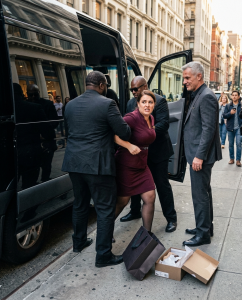
Then the black van pulled up.
Two men stepped out. One seized her arm.
“Let go!”
A silver-haired man with a scar through his brow approached at a measured pace, elegant as a diplomat.
“Victor Vulov would like a word,” he said. “It seems Gabriel Rossy has developed a habit.”
Fear struck clean and cold.
Khloe kicked one man in the shin. He cursed. She opened her mouth to scream, but a hand clamped over it and she was shoved into the van hard enough to bruise.
The door slammed.
When she lifted her head, Mason was sitting across from her.
For a second the world made no sense.
Then it made far too much.
“Mason?” she whispered.
His face looked wrecked. Not guilty enough, just wrecked. “I told you not to use the card.”
“You brought them to me?”
Victor Vulov sat beside him in a tailored coat, one hand resting on a silver-topped cane he clearly didn’t need. He was older than Gabriel by perhaps twenty years, with the composed vanity of a man who had outlived too many enemies to fear being hated. If Gabriel controlled the eastern docks and labor routes, Victor ruled another empire entirely—finance, transport, and imported vice stitched together under a respectable corporate face.
“Your brother only answered questions,” Victor said. “I was curious. Gabriel Rossy is not a generous man. So when he showers a waitress with a black card, I assume she matters.”
“I don’t matter to him.”
Victor smiled. “Excellent. Then calling him should be painless.”
One of the men took her phone from her purse. Another removed the card and handed it to Victor, who turned it over in his fingers like evidence.
“You paid a debt with this,” he said. “Hospital, wasn’t it?”
Khloe stared at Mason. “You told him that too?”
Mason looked away.
And there it was. The deeper betrayal. He hadn’t only sold information. He had sold the private shape of her life. Her mother’s illness. Her money problems. Her desperation. All of it.
“Why?” she asked.
His answer came too fast. “Because I owe them.”
Khloe froze.
Victor’s amusement faded. “Had owed them,” he corrected coolly. “Until this morning.”
Mason scrubbed a hand over his face. “I got into trouble. Sports betting, then loans. I thought I could fix it before you found out. I couldn’t.”
Khloe almost laughed at the cruelty of it. She had spent years bleeding herself dry to keep him afloat, and he had still managed to crawl into debt with wolves.
“So you traded me?”
His silence said yes.
Victor leaned forward. “Enough family drama. Call Gabriel.”
Khloe knew she should stall, but before she could, the screen lit up in the bodyguard’s hand.
Incoming Call: Gabriel Rossy.
No one moved.
Victor’s eyes sharpened.
“Answer,” he said.
Khloe took the phone, her pulse banging in her throat, and lifted it to her ear.
“Hello?”
Gabriel’s voice came low and steady, the kind of calm that always sounds more dangerous than rage. “You’re in a van with Victor Vulov, his driver, two men in front, and your brother who has not yet decided whether he regrets this.”
Khloe went still.
Victor’s face changed first, not into fear but into calculation.
Gabriel continued, “Tell Victor if he keeps driving east, he loses the convoy behind him. If he turns south, he loses the bridge. If he opens that van door in the next thirty seconds and leaves you on the sidewalk, he gets to walk away tonight with his pulse intact.”
Victor took the phone from her hand. “You sound confident.”
“I sound informed.”
Victor smiled without warmth. “You bought a waitress and forgot other men can bid.”
On the other end, there was a pause so brief it almost felt imagined.
“I didn’t buy her,” Gabriel said. “I relieved a pressure point. You are the one foolish enough to confuse kindness with leverage.”
Victor’s expression shifted. That line had landed.
“Then she means nothing?”
Another pause.
When Gabriel spoke again, his voice was quieter. “She is under my protection.”
Something tightened in the van. Even the bodyguards felt it.
Victor lowered the phone slightly and looked at Khloe with new interest, as if the phrase had altered her market value in real time.
“Protection,” he repeated. “How unlike you.”
Gabriel ignored the provocation. “Your car is approaching Canal. You have twelve seconds.”
Victor glanced toward the windshield. That tiny movement was all Khloe needed to know Gabriel was telling the truth. They were being watched.
Victor handed the phone back to her. “You inspire expensive reactions.”
“I didn’t ask for any of this,” Khloe said.
“No,” he replied, almost kindly. “But men like Gabriel and me rarely build wars around women who ask.”
He tapped the partition once. The van slowed.
Then Mason grabbed Khloe’s wrist.
She looked at him, stunned.
“Don’t go with him,” he said, panic tearing through the words. “You don’t understand what being under a man like that means.”
Khloe yanked free. “You sold me.”
“I was trying to keep you away from him.”
“By handing me to someone worse?”
Tears stood bright in his eyes, but she felt past pity. “I was scared.”
“So was I,” she said. “I just didn’t make it your problem.”
The van stopped.
The door opened.
Outside, two black SUVs waited at the curb. Dante stood beside one, coat open, expression hard enough to cut glass. Beyond him, New York moved like normal—horns, foot traffic, steam from a street grate—utterly indifferent to the fact that one of its hidden wars had just brushed past a woman who spent most nights refilling water glasses.
Khloe stepped down from the van on unsteady legs.
Victor remained inside, one hand on his cane. “A final piece of advice,” he said. “Gifts from powerful men are never about what you need. They’re about what they feel when you take them.”
Then the door slid shut.
The van pulled away with Mason still inside.
Khloe turned, panic flashing. “Mason—”
“He’s alive,” Dante said. “For now.”
That answer did not comfort her.
He opened the SUV door. “Get in.”
She didn’t move. “Where is Gabriel?”
Dante looked at her with faint irritation and something else she couldn’t identify. Respect, maybe. Or the reluctant acknowledgment due someone who had become a complication impossible to ignore.
“Waiting.”
The ride downtown was silent. Khloe watched the city blur by and tried to understand how twenty-four hours had carried her from a humiliating shift to a black card, a paid debt, a kidnapping, and a private war between men whose names made other men disappear.
The SUV stopped in front of a townhouse hidden behind iron gates in the West Village.
Inside, everything was quiet. No loud displays of wealth. No gold. No vulgarity. Just dark wood, art that looked old enough to have secrets, and the unsettling feeling that every corner had already judged her.
Gabriel stood near the fireplace, jacket off, shirt sleeves rolled once. He turned when she entered.
For the first time since the restaurant, he looked less like a legend and more like a man. A dangerous man, yes, but still a man—tired around the eyes, controlled to the point of strain, and watching her as though she had become a variable he had not anticipated.
Khloe stopped several feet away.
“You sent me a black card.”
“Yes.”
“Then another man kidnapped me because of it.”
“Yes.”
“My brother sold me out because he owed money.”
Gabriel’s jaw tightened. “Also yes.”
She laughed once, sharp and unbelieving. “Are you always this calm when you ruin someone’s life?”
Something flickered across his face. “I was trying to make yours easier.”
“By doing what? Claiming me?”
“I protected you.”
“You marked me.”
The truth of that settled heavily between them.
Gabriel took a step closer. “In my world, those can look the same.”
Khloe’s anger did not disappear, but it sharpened into something cleaner. “Then let me be very clear about mine. I’m not your weakness. I’m not your pet project. I’m not some wounded stray you get to rescue because I amused you for five minutes over spilled wine.”
His eyes held hers. “You stood between a terrified boy and a loaded gun without knowing who I was.”
“I knew enough.”
“No,” he said softly. “You knew just enough to walk away and still didn’t.”
That landed harder than she wanted.
Gabriel moved to the side table, opened a folder, and handed her a sheet of paper. Mason’s debt. Settled. Another document followed: the title transfer for her apartment building’s unit, the one she rented. A third: a trust account in Toby’s name for school and living expenses.
Khloe stared. “What is this?”
“Solutions.”
“To problems you helped create.”
“To problems I can fix.”
She looked up at him. “Why?”
For the first time, Gabriel seemed to search for an answer instead of reaching for one.
“Because yesterday,” he said, “everyone in that room obeyed fear. You were the only one who obeyed yourself.”
The silence that followed was more dangerous than shouting.
Khloe set the papers down carefully. “I don’t know what you think this is.”
“Neither do I,” Gabriel admitted.
That honesty, of all things, unsettled her most.
She should have left. Maybe any sensible woman would have. But sensible women were not usually the ones who took abuse for years, protected strangers, paid family debts, and still showed up standing. Khloe had never been built for the easy choice.
“What happens to Mason?” she asked.
Gabriel’s expression cooled. “That depends on whether he remains a liability.”
“He’s an idiot,” Khloe said. “A weak one. Not evil.”
“Sometimes that distinction matters less than it should.”
She stepped closer. “It matters to me.”
He studied her for a long moment, then nodded once. “Then he gets one chance. Because you asked.”
That was when Khloe finally understood the true danger Gabriel Rossy posed to her.
Not that he could destroy lives.
That he could rearrange them.
Over the next week, he did exactly that. Mason entered treatment under watch and came out stripped of debt and pride. Toby vanished from Obsidian Room and resurfaced enrolled in culinary school upstate, with strict instructions never to mention who had paid. Clare was fired after an audit uncovered wage theft and employee abuse so extensive even the owners could not protect her. Khloe herself never returned to the restaurant floor.
Instead she took time. Real time. Sleep. Doctors for her feet. A new apartment lease transferred into her own name after she refused Gabriel’s first three offers to buy her an entire building. The fourth compromise was something she could live with: security for one home, not a kingdom.
What she could not easily define was Gabriel himself.
He did not court her like ordinary men. He appeared, disappeared, asked precise questions, listened too closely, and treated her refusals with more respect than most men treated consent. When he was angry, the room changed shape around him. When he was gentle, it was almost worse, because it felt rare enough to matter.
Weeks later, over dinner in his townhouse kitchen rather than some grand dining room, Khloe finally asked, “Did you really send that card because I said I wanted a day off?”
Gabriel poured wine into her glass. “No.”
She waited.
“I sent it because you made me remember what exhaustion looks like when it has nowhere left to go.”
Khloe looked at him for a long time.
“And because I was curious?” he added. “Yes.”
“That’s a terrible reason to interfere in someone’s life.”
“I know.”
“Are you sorry?”
He considered. “For the danger, yes. For meeting you, no.”
It was an infuriating answer. It was also the truest one.
Their first kiss happened later than either of them expected and exactly when both had run out of arguments against it. It did not feel like rescue. It did not feel like ownership. It felt like two stubborn people discovering that being seen could be more frightening than being desired.
Months later, long after Victor Vulov had retreated from Rossy territory and Mason had started the slow, humiliating work of becoming a better man, Khloe passed the old Obsidian Room on foot. She stopped outside the dark glass for a moment and caught her reflection.
Same body. Same face. Same woman.
Only now she no longer mistook survival for the best she was allowed to have.
That was the part that stayed with her more than the card, the money, the fear, or even Gabriel himself: how quickly the world had tried to tell her that a woman like her should accept humiliation as the price of being included anywhere beautiful.
She had almost believed it.
Maybe that was the real red flag in all of it. Not Gabriel’s power. Not Victor’s menace. Not even Mason’s betrayal.
Maybe it was how many people had looked at Khloe Higgins and assumed she would settle for crumbs simply because she had been starving.
They were wrong.
And whether Gabriel Rossy deserved forgiveness for marking her before he understood the cost was a question Khloe never answered cleanly, even to herself.
But one thing she knew with perfect certainty:
The night she stepped between a terrified boy and a dangerous man, everyone in that room saw a tired waitress.
Only one of them saw a force.