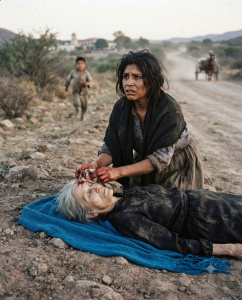
The rich old woman collapsed onto a dirt road just after dawn, and five people walked past her as though her body were nothing more than a stone in the dust.
Only one person stopped.
And the strange thing was, that person could least afford to.
In the valley outside San Miguel de los Olivos, everyone knew the Monteverde name. It carried the heavy weight of land, money, and memory. The Monteverdes owned Santa Esperanza, the largest hacienda in the region, where rows of corn and beans stretched farther than most laborers had ever walked. Their house sat high on a rise above the fields, built with thick white walls, deep verandas, and polished floors that stayed cool even in the hottest months. People lowered their voices when they spoke of the family. Not always from respect. Sometimes from fear. Sometimes from habit.
At the center of that house lived Doña Amparo Monteverde, widow of Don Baldomero Monteverde and mother of Don Anselmo, who now oversaw the business side of the estate with a firm hand and a colder heart than his father had ever shown in public.
Doña Amparo was seventy-six years old and walked more slowly than she once had, but she still carried an authority that made servants straighten their backs when she entered a room. She wore dark dresses, prayed before dawn, and never let anyone touch the old blue shawl she kept folded at the foot of her bed.
The shawl had become something of a legend inside the house.
No maid was permitted to wash it.
No seamstress was allowed to mend it.
If dust settled on it, Doña Amparo brushed it away herself.
Once a month, no matter how much her knees pained her, she washed it by hand and laid it flat in the shade as though she were tending to something alive.
The servants thought it was grief. Some believed it had belonged to her mother. Others whispered it was tied to a promise made in mourning after Don Baldomero’s death. No one knew the truth, because Doña Amparo had never told it.
What no one in town knew was that every two weeks, before the first light truly broke across the hills, the old woman left Santa Esperanza alone.
She took no servant.
She told no son.
She wrapped that blue shawl around her shoulders, tucked coins and food into its folds, and walked to a small chapel near the edge of the poorer quarter. There, through the sacristan and two widows who could be trusted to keep silent, she arranged help for families overlooked by the men who managed the estate. Not families who complained loudly. Not families who had influence. The forgotten ones. The widow with four children and no mule. The old man too sick to harvest his patch. The girl whose father had died owing grain he could never repay.
Doña Amparo never signed her name to any act of charity. She had learned long ago that pride often follows generosity like a shadow. She preferred the recipients not know who had fed them.
That morning in 1928, she had set out as usual while the sky was still pearl gray.
The road was hard and uneven from weeks without rain. She had just passed a stand of mesquite when she heard the rattle of wheels behind her. She tried to move aside, but her sandal caught on a jutting stone. Her body twisted. Her balance failed. She fell backward with a crack that seemed to split the silence itself.
The back of her head missed the worst of it, but her forehead struck dry ground hard enough to open. Blood slid down across her temple and into the blue shawl under her.
For several stunned seconds, she could not move.
Then people came.
An ox driver glanced down from his seat, took in the scene, and flicked the reins as if haste could erase responsibility.
Two market women slowed, crossed themselves, and said someone of her station would surely be found by family.
A spice merchant looked around, calculating risk in the narrow way of men who fear inconvenience more than guilt, and continued on.
A young field hand passed, saw blood, and muttered that he wanted no trouble involving the Monteverdes.
One after another, they chose distance.
Doña Amparo drifted in and out of awareness, hearing footsteps, wheels, scraps of voices, each one fading farther away.
Then another pair of footsteps approached. Lighter. Quicker.
Elvira Montiel was twenty-nine and already exhausted.
She lived in a small adobe house with her son Gaudelio on the edge of town, where the roofs leaked in storm season and smoke from cooking fires hung low in the mornings. Her husband had died three years earlier from a fever that arrived suddenly and left her with debts, a child, and too little time to grieve. Since then, she had survived by taking whatever work came—washing, cooking, scrubbing floors, mending clothes—until she secured a steadier position in the kitchen of Don Severiano Luján’s boarding house.
It was not a good job, but it was a job.
Severiano paid little, watched everything, forgave nothing, and used people’s hunger as though it were a rope around their necks. Elvira knew exactly how replaceable she was. She had already been warned after arriving late once when Gaudelio had fallen ill.
That morning she was hurrying with the boy to school before heading to the boarding house.
Then she saw the body on the road.
Gaudelio saw it too and tightened his grip on her fingers.
The old woman’s face was pale under the blood. Her chest rose, but weakly.
Elvira looked toward town. No one else was stopping.
She thought of Severiano. She thought of the empty kitchen shelf at home. She thought of the rent due in ten days.
Then she looked at the woman in the dirt and understood there are moments when life narrows into one unbearable choice: protect what little you have, or remain the kind of person you can still recognize in the mirror.
“Gaudelio,” she said, her voice firm despite the fear in it, “run to Refugio Bautista. Tell him to bring his cart immediately.”
The boy stared. “Mama, we’re late.”
“I know.”
“Don Severiano will get angry.”
“Let a living man be angry,” she said, kneeling in the dirt. “This señora may die.”
Gaudelio ran.
Elvira gathered the old woman’s head carefully into her lap and tore a strip from her own shawl to press against the wound. Blood soaked through faster than she liked. She kept speaking anyway, not because she expected the stranger to answer, but because silence felt too much like surrender.
“I’m here,” she whispered. “Don’t be afraid. I’m here.”
When Refugio arrived with his cart, he looked startled to find Elvira stained with blood and kneeling over Doña Amparo Monteverde.
“Saints preserve us,” he muttered. “Do you know who this is?”
“No,” Elvira said. “And it doesn’t matter. Help me lift her.”
They took her to Doctor Anastasio Prado’s clinic, a narrow building with limewashed walls and a medicinal smell that clung to the air. The doctor cleaned the wound, checked her pupils, and warned that at her age, a blow like that could be dangerous. Elvira remained in the room while Gaudelio sat nearby, watching with wide, solemn eyes.
It was nearly two hours before Doña Amparo stirred.
She opened her eyes with confusion clouding them, then focused on the face beside her bed.
“Who are you?” she murmured.
“Elvira Montiel,” came the answer. “You are safe now.”
The old woman repeated the name as if testing it against a memory she couldn’t yet grasp.
“Elvira…”
“Yes, señora.”
“May God repay you.”
Elvira managed a weary smile. “You owe me nothing. Anyone would have done the same.”
A strange sadness flickered across Doña Amparo’s face. She knew at once that was a lie, not because Elvira meant to say something false, but because the blood on the shawl proved how many had already chosen not to stop.
By the time Elvira reached the boarding house, the sun was high and the kitchen fires had long since been lit by someone else.
Don Severiano was waiting.
He stood in the doorway with crossed arms and a thin expression of offense that seemed to sharpen his whole body.
“It is eleven o’clock.”
“There was an injured woman on the road,” Elvira said quickly. “She was bleeding. No one would help, and I couldn’t just leave her there—”
“Collect your things.”
The words hit harder than a slap.
“Please,” she said. “My son and I depend on this work.”
“Then you should have remembered that before turning my kitchen into a chapel.”
She stared at him, hoping some crack of mercy might appear in his face.
None did.
He did not shout. Men like Severiano knew that calm cruelty lasts longer in memory.
Elvira left with her apron folded in a cloth sack and Gaudelio walking silently beside her.
The weeks that followed scraped them raw.
First she sold two hens. Then the small table her mother had left her. Then the iron griddle she had treasured from her wedding days, one of the last objects from a life that had once seemed steadier. She knocked on doors for work, but most people in town depended, directly or indirectly, on men like Severiano. No one wanted to offend him by hiring the woman he had dismissed.
The refusals became gentler in tone and harder in effect.
“We have no need.”
“Perhaps next month.”
“My sister’s girl already helps.”
The truth was plain enough without being spoken.
At night, Gaudelio tried to be brave in the quiet way of children who sense too much.
One evening Elvira set a single tortilla before him and insisted she had already eaten at a neighbor’s house.
He broke the tortilla in half and pushed one piece back.
“Eat, Mama,” he said softly. “I know you say you’re not hungry so I will eat.”
She turned her face toward the stove before the tears could betray her.
Until then, she had not regretted stopping for the stranger. But in that moment, with her son offering half of almost nothing, she understood how expensive goodness can become when the world puts a price on it.
Meanwhile, at Santa Esperanza, Doña Amparo had regained her strength enough to think clearly.
The first question she asked was not about her wound.
It was, “Who brought me here?”
When told a poor widow named Elvira Montiel had rescued her, she asked where the woman lived.
The second question was sharper. “And why was she at the clinic for so long?”
A maid, too frightened to soften the truth, explained what had happened.
By the time the story reached the part where Elvira lost her position at Don Severiano’s boarding house, the old woman’s face had gone still in a way the servants recognized as dangerous. Not loud anger. Something deeper. Something that reached backward through years.
“Leave me,” Doña Amparo said.
When they had gone, she asked for an old trunk from the storage room. It was cedar, brass-bound, and locked with a key she wore on a cord around her neck. She had not opened it in years.
Inside were papers, a baby ribbon, a tiny christening gown browned with age, and beneath them all, another piece of blue fabric matching the shawl.
Her fingers shook.
There are memories that sleep for decades only because waking them would destroy the life built on top of them.
In 1876, when she had not yet become Doña Amparo Monteverde but was simply Amparo Ruiz, she had been seventeen, poor, and desperate. A season of drought had emptied cupboards and dignity alike. Her father had died. Her mother had taken ill. There had been a baby girl born in the middle of all that fear—her baby, conceived in shame after a promise of marriage from a man who vanished before the child came.
Amparo had loved the baby with a terror so intense it hurt to breathe.
But she had no milk, no means, and no safe future to offer. Hunger had turned every day into a verdict. When the child was barely weeks old, Amparo wrapped her in a blue shawl and carried her to the chapel where charitable women sometimes arranged wet nurses for abandoned infants. She left the child with a medallion sewn into the hem and a name stitched in faded thread, then collapsed outside, convinced she had committed a sin that heaven itself would never forgive.
She returned the next day in secret, but the infant was gone. A traveling catechist had already taken the baby to another village family willing to raise her. No one would tell Amparo where. Whether from cruelty, caution, or fear, the trail vanished.
A year later, Amparo’s mother died. Two years after that, she married Don Baldomero Monteverde, a widower decades older who needed a respectable wife and never asked too many questions about the years before him. Wealth buried scandal. Time buried grief. And the blue shawl remained the one thing she could never release.
Only one person had ever known the full truth: Baldomero, and even he had taken it to the grave.
Now, as she unfolded the bloodstained shawl on her bed, Doña Amparo noticed something she had not seen in years because she had not dared look closely enough.
The hidden seam.
With careful fingers, she opened it.
A small medallion slid into her palm.
On one side was the image of a saint.
On the other was the name she had stitched with shaking hands half a century earlier.
Elvira.
For a long time, she could not speak. The room blurred. Her chest tightened with grief so old it felt almost holy.
Not proof, perhaps. Not yet. But enough to open a door she had sealed in her own soul.
She sent for the parish records.
She sent for the oldest sacristan in town.
She sent, too, for Doctor Prado, who remembered more family histories than anyone realized.
Piece by piece, the story returned.
A foundling girl delivered from the chapel to a childless couple named Montiel in a neighboring settlement.
The couple later moving to San Miguel.
The wife dying years before, the husband after.
Their adopted daughter: Elvira Montiel.
Doña Amparo listened without interrupting. By the time the final detail settled into place, tears were already on her face.
The woman who had lifted her from the dirt.
The woman who had pressed cloth to her wound and refused to leave her.
The woman who had lost her livelihood because of one merciful act.
Her own daughter.
That same evening, she ordered the carriage prepared.
Don Anselmo objected immediately.
“You are too weak to leave the house.”
“I was too weak to survive a fall, and yet I did,” she said.
He looked at the medallion, the parish notes, the blue shawl. “Mother, after all these years, how can you be certain?”
She fixed him with a stare honed by decades of being underestimated. “A mother knows the shape of her own sin. And sometimes, if God is merciful, He lets her touch the edge of forgiveness.”
The carriage rolled out at dusk toward the poorest part of town.
Elvira was in her kitchen coaxing a weak flame beneath a clay pot when the knock came.
Three slow knocks.
Gaudelio looked up from the stool where he sat doing sums on a scrap of paper. “Who would come now?”
Elvira wiped her hands on her skirt and opened the door.
A servant in Monteverde livery stood outside beside a carriage lantern.
“Are you Elvira Montiel?”
“Yes.”
“The mistress of Santa Esperanza requests your presence. At once.”
Fear moved through her first. Had she done something wrong? Was there some accusation? Some debt? The rich did not summon the poor at night to bring them blessings.
Then the servant added, “She says the blue shawl belongs to you more than you know.”
The carriage took Elvira and Gaudelio up the hill under a sky darkening with stars. Inside the great house, the floors shone and the lamps were already lit. Elvira had never entered beyond the service areas before. Now she was led not to the kitchen but to Doña Amparo’s private sitting room.
The old woman was waiting in a chair near the window, the blue shawl folded across her lap.
For a moment neither spoke.
Then Doña Amparo stood, slower than pride would have preferred, and crossed the room.
“Elvira,” she said, and her voice broke on the name.
Elvira lowered her eyes. “Señora, you sent for me?”
Doña Amparo held out the medallion.
“Have you ever seen this before?”
Elvira frowned. “No.”
“It was sewn into the hem of this shawl. Beside a name.” Her fingers tightened around the cloth. “Your name.”
Something in the room shifted. Even Gaudelio stopped fidgeting.
“I don’t understand,” Elvira said.
“No,” Doña Amparo answered, tears rising again. “How could you? You were never meant to carry the wound of what I did.”
She told the story in full.
Not elegantly. Not like a confession prepared in advance. The truth came out in halting pieces, with shame, fear, and grief all tangled together. She spoke of hunger, of youth, of the baby she had surrendered because she believed poverty would kill her first. She spoke of searching afterward, of losing the trail, of building another life over a broken heart and never daring to tear that life open.
When she finished, the room had gone completely silent.
Elvira looked as though the ground itself had moved beneath her.
“All my life,” she whispered, “I thought I had simply been left.”
Doña Amparo shook her head. “You were never unloved. You were lost. Because of me. Because I believed desperation excused what love should have fought harder to keep.”
Elvira’s face crumpled with emotions too large to sort—anger, disbelief, grief, longing, and the raw ache of a child who realizes too late that abandonment and love can sometimes wear the same face.
“You watched me at that clinic,” she said. “You looked at me as if you knew.”
“I remembered something when I heard your name,” Doña Amparo said. “Not enough to speak then. Only enough to feel fear in my bones.”
Gaudelio moved closer to his mother.
The old woman looked at him and broke completely. “And you,” she whispered, “are my grandson.”
No one rushed the moment. No servant interrupted. Outside, crickets started their evening song.
At last Elvira asked the hardest question. “Why tell me now?”
“Because you saved me when you owed me nothing,” Doña Amparo said. “Because I would rather die ashamed than die silent. And because what was stolen from you cannot be restored by money, but I can at least stop pretending the truth belongs in a trunk.”
The days that followed changed both houses.
Doña Amparo publicly ordered that Elvira and Gaudelio move to a smaller residence on Santa Esperanza land, one with a sound roof and a kitchen garden. She provided wages, not charity, appointing Elvira to manage the chapel stores and distribution for needy families—the very work she herself had done in secret. She settled a fund for Gaudelio’s education and made certain no one in town could punish the boy for his mother’s kindness.
As for Don Severiano Luján, his name reached Doña Amparo’s ears in full. Within a week, several important suppliers who relied on Monteverde grain were instructed, quite politely, to review their arrangements. Severiano found that cruelty costs more when someone powerful decides to remember it. He was forced, before witnesses, to offer Elvira a position back.
She declined.
The refusal was calm. That made it sharper.
Their relationship did not become simple just because the truth was finally spoken. Some wounds heal with tenderness. Others remain visible no matter how often they are touched with care. Elvira could not become a daughter overnight merely because blood and records agreed she was one. She needed time to be angry. Time to mourn the life she might have had. Time to decide whether forgiveness was a gift she could afford.
Doña Amparo, for her part, accepted that repentance is not the same as repair.
But she kept her door open.
And sometimes, in the late afternoon, Elvira would sit with her on the veranda while Gaudelio played in the yard below. They would speak of ordinary things first—the weather, the harvest, the stubbornness of hens. Then, little by little, they would step into harder territory: names, years, regrets, silences.
One evening, as the sun sank gold behind the fields, Elvira reached over and touched the blue shawl folded beside the old woman.
“So this is what tied us together all along,” she said.
Doña Amparo nodded. “And nearly tore us apart.”
Elvira looked out over the land and thought about the road, the blood, the hunger that followed, the knock at the door, the truth waiting inside a seam no one had noticed for decades.
Then she said the only honest thing left.
“I still don’t know whether to forgive you.”
Doña Amparo closed her eyes briefly. “That is your right.”
“But I know this,” Elvira continued, watching Gaudelio laugh as he chased a chicken across the yard. “Had I walked past you that morning, I would have lost more than work.”
Doña Amparo’s mouth trembled. “And I would have died without ever saying your name.”
They sat in silence after that, each woman measuring the distance between guilt and grace.
In the end, perhaps that was the true inheritance—not land, not money, not even blood, but the terrible and beautiful knowledge that one act of mercy can return what years of fear took away.
Still, any person hearing their story would ask the same question:
Was Doña Amparo a monster for giving her child away, or just a young woman crushed by a world that left the poor with no safe choices?
And was Elvira stronger for opening the door to forgiveness… or wiser if she had never fully opened it at all?