She walked out of the Montana psychiatric facility on a cold Tuesday morning in April wearing a cardigan that had gone out of style before smartphones existed, sensible shoes with cracked soles, and an expression so blank it made people look away.
After twenty-two years behind locked doors, Carol Denton was free.
No family came to collect her. No husband. No daughter. No lawyer. The social worker handed her a paper bag with the few belongings she still had, recited instructions in a gentle voice, and pointed her toward the road.
Carol stepped outside and stood there for a long time, staring at the parking lot as if the world itself had become too wide to cross.
For more than two decades, everything in her life had happened at someone else’s command. Medication at seven. Group at ten. Lunch at noon. Lights dimmed at night. Someone always knew where she was. Someone always had a key.
Now there was only the morning, the open road, and the terrible, dizzying realization that she could go anywhere.
The problem was that she had nowhere left to go.
Her husband had made sure of that.
So she walked.
The town gave way to wider roads, gas stations, a church with peeling white paint, then a diner on the edge of Billings with a flashing COFFEE sign in the window and pickup trucks lined out front. Carol had not chosen it for any reason she could name. She was simply tired enough to stop.
That random decision would split open three lives before noon.
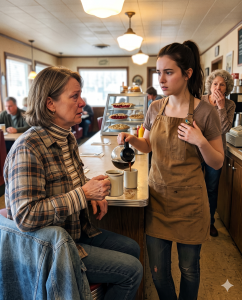
Inside, the diner was warm, loud, and ordinary. A radio played old country songs. Someone laughed too hard at a joke from the grill. Plates clinked. Coffee steamed.
Carol sat at the counter and asked for a cup.
The waitress came over with a pot in one hand and a notepad tucked into the pocket of her apron. She was young, maybe in her early twenties, with dark hair pulled into a ponytail and a tired but pleasant smile.
Carol kept her eyes on the counter. She had trained herself for years not to look too hard at women that age. The math was cruel. Every face became a possibility. Every laugh opened a wound.
But some instinct made her glance up.
Then she saw the button.
A small brass button sewn onto the waitress’s apron strap, round and delicate, stamped with a bluebird in flight.
Carol felt the room drop away beneath her.
She knew that button.
On the morning of April 6th, 1999, she had stitched that very bluebird onto her four-year-old daughter Lily’s yellow Easter coat. She remembered every detail because the memory had become holy through repetition. Sunlight on the kitchen linoleum. Lily swinging her feet under the chair. Carol pricking her finger with the needle twice and pretending to be gravely wounded while Lily laughed until she hiccuped.
Carol had kissed the top of her daughter’s head and thought, with the casual certainty of a mother in a normal life, I will remember this moment forever.
Three days later, her husband had her committed.
At the time, she had not understood how quickly a life could be stolen if the right man decided he was finished with it.
His name was Thomas Denton. To neighbors, he was charming and composed. In public, he opened doors, remembered birthdays, sent flowers after funerals, and spoke about family with practiced warmth. Behind closed doors, he was made of colder material.
Carol discovered his secret by accident. A phone bill with repeated numbers in Missoula. A post office box key hidden in a coat pocket. Receipts that didn’t match his supposed travel. She followed the trail with the stunned persistence of someone hoping every clue would turn out to have a harmless explanation.
It did not.
In Missoula, she found another woman. Another home. Another marriage certificate. Two children. A second life that had been running beside hers for years.
That woman, shell-shocked and furious in equal measure, had stared at Carol across a kitchen table and asked the only question either of them could manage.
“How can he be married to both of us?”
Carol went home and confronted him that night.
Lily was coloring at the table while Carol held the papers in shaking hands. Thomas denied everything until she showed him the documents. Then his expression changed. The warmth drained out. The mask came off.
He told her she was unstable. That she was imagining things. That she needed to calm down before she frightened their daughter.
Carol screamed. She threw a plate. She told him she was taking Lily and leaving.
Two days later, she was sedated in the back of a car, committed on emergency psychiatric paperwork describing her as paranoid, delusional, and a danger to herself and others.
In the early months, she fought like a trapped animal. She demanded a phone. She demanded a lawyer. She demanded to see her daughter. Thomas visited once, immaculate in a gray coat, and spoke to her in the tone of a reasonable man dealing with an unfortunate tragedy. He told her Lily was safe. He told her she needed to cooperate if she wanted treatment to work.
Then he stopped coming.
The years blurred after that. Medication changed her body and softened the edges of time. Doctors retired. Nurses changed. Entire calendars vanished. At some point she understood the truth no one had formally explained: she was never getting out because too many people had accepted the story created for her. Records existed. Diagnoses existed. Her husband’s version of events had hardened into fact.
A nurse once let something slip while adjusting Carol’s blankets.
“Your daughter was very young when they told her,” she had murmured. “She probably doesn’t even remember.”
“Told her what?” Carol had asked.
The nurse froze, horrified by her own mistake.
But Carol already knew.
Lily had been told her mother died.
That was the story that survived.
So Carol clung to scraps instead. Birthdays. The smell of Lily’s baby shampoo. Her favorite cup with the chipped rim. Her refusal to eat strawberry candy even though she loved strawberry jam. A scar on her left knee from falling off a red tricycle in the driveway. The brass bluebird button.
That button mattered more than it should have. Maybe because it was small enough to hold in memory. Maybe because it belonged to one of the last untouched moments before betrayal changed everything.
And now it was here, on a stranger’s apron, in a diner on the first day of Carol’s freedom.
The waitress poured coffee and smiled. Carol stared at her face, trying not to drown in impossible hope. Then the girl laughed at something the cook said, and Carol saw a small gap between her front teeth.
Her hands went cold.
When the waitress turned to reach for the coffee pot, the fabric of her jeans shifted at the knee.
Scar. Left side.
Carol had to grip the counter to keep herself upright.
The girl came back, and this time Carol forced herself to speak.
“That’s a pretty button,” she said.
The waitress looked down and touched it absently. “This? It’s silly. I’ve had it forever.”
Carol said nothing.
“My grandma saved it off an old coat after my mom passed,” the girl continued. “She said my mother sewed it on the day before she died.”
Carol’s mouth opened, but no sound came out.
The girl gave a small, embarrassed shrug. “I know it’s just a button. But I never felt right taking it off.”
Her fingers lingered on the bluebird.
Carol’s hand shook so violently that the coffee cup rattled in its saucer.
The waitress glanced down at the noise. Her eyes landed on the inside of Carol’s hand, where a pale crescent scar sat beneath the thumb.
Carol saw recognition spark in a face that did not yet understand itself.
When Lily was four, Carol had stabbed herself with a needle while sewing that very button. Lily had panicked and grabbed her hand, then later talked about the tiny moon-shaped cut for days. Thomas had laughed and said they would all remember “the great button injury” forever.
The girl looked from the scar to the button, then back to Carol’s face.
“How do you know about the coat?” she asked.
The diner went strangely quiet.
At the register stood an older woman Carol hadn’t noticed when she first came in. She had graying hair, a stiff posture, and the severe mouth of someone accustomed to being obeyed.
Thomas’s mother.
Ruth.
Age had changed her, but not enough. Carol recognized her immediately, and the recognition hit with almost as much force as the button had.
Ruth rushed forward. “Mara,” she said sharply to the waitress, “go in the back.”
Mara.
So they had changed Lily’s name.
The girl frowned. “Why?”
“Just go.”
“I’m not going anywhere.” Her voice trembled now. She looked at Carol again, eyes filling with fear. “Who are you?”
Carol rose from her stool. Her knees nearly buckled.
“Your name is Lily,” she whispered. “You were born January 14th, 1995. You hated strawberry candy. You cried at the end of Homeward Bound even after you’d seen it ten times. When you skinned your knee, you wouldn’t wear the bandage unless I drew a smiley face over the cartoon bears.”
Mara went white.
Ruth stepped closer, lowering her voice to a hiss. “This is not the place.”
“For what?” Carol said. “For the truth?”
The cook had stopped pretending not to listen. A trucker near the end of the counter slowly set down his fork.
Mara looked from one woman to the other. “Grandma?”
Ruth’s face tightened.
Carol saw the calculation there. The same family instinct to manage, redirect, contain. She had seen it years ago when Thomas first brought his mother into their living room after the commitment. Ruth had held Carol’s hand and called it a terrible misunderstanding while signing forms with the other one.
“You knew,” Carol said.
Ruth didn’t answer.
“Did you tell her I was dead too?”
Ruth swallowed. “You were not well.”
Carol laughed then, a terrible sound with no humor in it. “I found out your son had another wife.”
“That is not what this was about.”
“It is exactly what this was about.”
Mara took a shaky breath. “Another wife?”
Ruth’s eyes closed for half a second, and Carol knew the lie machine was failing.
Before Ruth could recover, Mara unclipped the bluebird button from her apron strap and held it tightly in her hand as though it might anchor her.
“If she’s my mother,” she said, “then who is buried in my mother’s grave?”
No one answered.
The question hung in the diner like smoke.
Mara left her apron on the counter and walked out the front door. Carol followed without thinking. Ruth called after them both, but neither turned.
Outside, spring wind whipped Mara’s ponytail loose. She stood by an old sedan in the parking lot, breathing too fast.
“I don’t remember you,” she said.
“I know.”
“I remember a funeral.” Her voice broke. “Or maybe I remember photos from after. I don’t know anymore. I just know there was always a grave. We went every year.”
Carol felt something inside her freeze. “Take me there.”
Ruth came out of the diner clutching her purse. “Mara, stop this.”
Mara faced her. “Get in the car.”
Ruth stared at her granddaughter, and for the first time Carol saw uncertainty overtake the woman’s authority. Then, perhaps realizing she could not stop what had started, she climbed into the back seat.
The cemetery lay twenty minutes away under a sky turning hard and bright. None of them spoke much on the drive. Mara gripped the wheel. Carol held the bluebird button in both hands. Ruth sat behind them in rigid silence.
At the cemetery, they found the stone quickly.
BELOVED MOTHER
ELIZABETH MARA DENTON
1970–1999
Carol stared.
“That isn’t my name,” she said.
Mara looked from the stone to Carol, horror spreading across her face.
Ruth finally spoke. “Her name was Beth.”
The confession entered the air so quietly it felt obscene.
Thomas’s second wife.
The woman in Missoula.
Carol turned slowly. “You buried her as me?”
Ruth pressed her lips together, but once truth begins, it rarely stops where people want it to.
“Beth found out about you,” Ruth said. “She threatened to go to the police. Thomas drove there. They fought on the highway. There was an accident.”
“An accident?” Carol said.
Ruth looked away. “He was drunk.”
Mara made a strangled sound.
Ruth went on because there was no dignity left to protect. Thomas had panicked. Beth’s face had been too badly damaged for easy identification. He already had a wife in a psychiatric facility no one expected to be released. He already had a four-year-old child who could be managed. He used Carol’s documents. Called in favors. Signed what needed signing. Ruth helped. It was temporary at first, she insisted. Just until things were sorted out. Just until Thomas could figure out what to do.
But then years passed. The lie held. And Thomas kept living inside it.
“Where is he now?” Carol asked, though some part of her already knew the answer would be ugly.
“In Idaho,” Ruth whispered. “Stroke two years ago. Assisted living.”
Mara turned on her. “You let me put flowers on a stranger’s grave my whole life.”
Ruth’s composure cracked. “I was trying to keep you safe.”
“From what?”
“From him,” Ruth said, and for the first time her voice sounded old. “You don’t know what he was capable of.”
Carol stared at her in disbelief. “You helped him.”
“Yes.” Ruth’s eyes filled. “And then I spent twenty years terrified of what he’d do if I crossed him.”
The irony was almost too bitter to touch. Everyone had feared Thomas. Carol had simply paid the highest price.
Mara sank onto the low stone border around the grave and put her face in her hands. Carol wanted to reach for her, but twenty-two years stood between wanting and doing.
Instead she sat beside her in silence.
After several minutes, Mara lowered her hands. “Why didn’t you come for me?”
The question cut deeper than any accusation Ruth or Thomas could ever make.
“I tried,” Carol said. “At first, every day. Then every way I could think of. But they medicated me so heavily I could barely hold onto my own name some days. My records said I was delusional. Your father had money, witnesses, paperwork. And once you’ve been locked away long enough, the world stops asking whether you belong there.”
Mara’s eyes brimmed. “I thought nobody wanted me enough to stay.”
Carol inhaled sharply, as if struck.
“I wanted you every minute,” she said. “Even when I thought I’d die in there, I wanted you.”
Mara looked at her then—not at a stranger, not at a ghost, but at the impossible shape of a mother returned from a grave that had never held her. The resemblance between them, obscured by shock until now, seemed suddenly obvious. The same brow. The same narrow chin. The same habit of pressing their lips together before crying.
Slowly, cautiously, Mara reached into Carol’s paper bag, where the facility had returned her possessions: a comb, a handkerchief, a faded wallet, and a small photograph worn nearly white at the folds.
In the photo, Carol held a little girl in a yellow coat. The bluebird button gleamed at the collar.
Mara touched the picture with trembling fingers.
“That’s me,” she whispered.
“Yes.”
“And you kept this?”
“It’s all they didn’t take.”
Mara began to cry in earnest then, shoulders shaking. Carol moved before she could talk herself out of it and wrapped her arms around her daughter.
At first the embrace was awkward, almost formal. Then Mara clung to her with the desperate strength of someone grieving two mothers at once—the one she had been told died, and the one who had been stolen but still lived.
Ruth stood a few feet away, weeping silently into one hand.
Later, there would be police reports, exhumation orders, medical reviews, lawyers, old records pulled from storage, questions from reporters, and a brutal accounting of how easily one respected man had erased a woman by calling her unstable. Thomas, already frail from his stroke, would face criminal investigation before dying months later in an Idaho facility, never again able to command a room the way he once had. Ruth would testify. So would the retired nurse who remembered too much and had regretted her silence for years.
Carol’s commitment was overturned. Officially. Publicly. Too late to return what had been taken, but not too late to name what happened.
Mara’s real identity was restored, though she kept the name Mara as her middle name because, she said, it belonged to the girl who survived the lie. She and Carol did not become mother and daughter again overnight. There was no miracle that could make up for twenty-two missing years. They learned each other slowly. Coffee first. Then walks. Then stories. Then anger. Then the kind of laughter that arrives only after grief has exhausted itself.
Months later, Mara brought out a box of things Ruth had saved in secret all those years and never found the courage to destroy. A lock of baby hair in an envelope. A crayon drawing of a house with three crooked flowers. The yellow coat, preserved badly but still there, one button missing.
The bluebird button was on Mara’s apron.
She unstitched it carefully that night while Carol watched.
“What should we do with it?” Mara asked.
Carol looked at the tiny brass bird resting in her daughter’s palm. For so long it had represented the last thing she had touched before losing everything. But now, somehow, it had become the thing that led her back.
“Keep it,” Carol said. “Not because of what happened.”
Mara smiled through tears. “Then why?”
“Because it found its way home.”
Years of lies had buried one woman, erased another, and left a child standing over the wrong grave.
In the end, none of them were saved by courts or doctors or family loyalty. They were undone by something smaller than a coin, something almost too ordinary to matter.
A brass bluebird.
A mother’s memory.
And a daughter who, without knowing it, wore the truth over her heart the entire time.
Even after everything was exposed, people still argued over who was worst—Thomas for building the lie, Ruth for protecting it, the doctors for believing it, or the whole town for never asking harder questions.
Carol never wasted much time on that debate.
The red flag, she would later say, had not been the shouting or even the betrayal.
It had been how easy it was for a calm man to describe a furious woman as crazy—and how many people found that explanation convenient enough to accept.