The old man almost didn’t stop.
At eighty-one, Earl Denton had lived long enough to trust instinct over convenience, weather over forecasts, and silence over most of what passed for conversation. He had spent most of his life in the Texas Panhandle, where the land didn’t bother hiding its moods. The sky warned you. The wind warned you. The dirt itself warned you. Anyone who ignored those signs usually regretted it.
That January afternoon in Pampa, the warning was already there.
Earl came out of the Dollar General with a plastic bag swinging from one hand and saw the western horizon turning the wrong color. Not sunset gold. Not storm gray. Brown-orange. Thick. Mean. The kind of color that told you dust was coming in hard and fast, strong enough to swallow roads and make sensible people pull off or stay put.
He muttered under his breath, quickened his pace, and climbed into his F-150. He tossed the bag onto the bench seat beside him, started the engine, and glanced once more at the sky.
Then he saw the young woman.
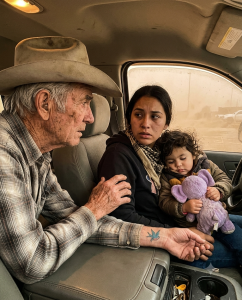
She stood against the side wall of the building with a toddler crushed against her chest. She wasn’t dressed for the cold, let alone for a dust storm. Her jacket was thin. Her scarf looked cheap and overused. The child buried her face in her mother’s neck while the mother whispered steadily into her hair.
Earl’s first thought was practical. Not my business.
His second thought came with more force. If that storm hits before they find shelter, they’re in trouble.
He sat with the engine running and his fingers on the wheel. He should leave. He knew that. The roads would get dangerous in minutes. At his age, you didn’t go courting trouble for the sake of being noble in parking lots.
Then the little girl lifted her face for half a second, and Earl saw cheeks bright red from wind and eyes too solemn for a child that age.
He leaned over and pushed open the passenger door.
The woman looked at him, wary and still.
Earl lifted both hands where she could see them. “Storm’s coming. Get in.”
The wind carried the words away, but she read enough in his face. Or maybe she saw the hearing aids. Maybe she saw a man old enough to be harmless. Maybe she was just too tired to keep weighing danger against danger.
She ran to the truck with the toddler in her arms and climbed in just as the first sheet of dust skated across the lot.
“Thank you,” she said, breathless.
Earl pulled the door shut harder and turned up the heater. “You’re welcome.”
The little girl stared at him as if she expected him to transform into a villain at any second.
Earl gave her a solemn nod. “That’s a healthy amount of suspicion.”
The young woman almost smiled. “She doesn’t trust strangers.”
“Smart kid.”
He introduced himself. “Earl Denton. Canyon.”
She adjusted the child on her lap. “Marisol.”
That was all she gave him. Just Marisol. Earl respected it. People in trouble often had reasons for trimming their lives down to the smallest version they could safely hand to a stranger.
The storm arrived in full force before either of them said much more.
One moment there was a parking lot, a stoplight, a pharmacy sign down the road. The next there was nothing but a roaring brown wall. Dust pounded the truck in waves. The world outside vanished as completely as if someone had draped a filthy blanket over the town.
Earl shifted into park. “We’re not going anywhere till this settles.”
Marisol nodded and hugged the child tighter. “It’s okay, Rosie,” she whispered. “We’re warm now.”
So the little girl was Rosie.
Earl opened his glove compartment and rummaged through old napkins, registration papers, and a flashlight until he found half a pack of peanut butter crackers. He held them out without comment. Marisol looked at them, then at him.
“It’s all I got,” he said.
She nodded to Rosie. The child took one and began nibbling with grave concentration, still never taking her eyes off Earl for long.
“Good,” Earl said. “At least one of us appreciates truck cuisine.”
This time Marisol did smile, only for a second. It changed her whole face. She looked young then. Younger than he had first thought. Young enough to still believe life might turn if she could just hold on long enough.
The cab warmed slowly. Marisol unwound the scarf from her head and used it to brush dust from Rosie’s cheeks.
That was when Earl saw the tattoo.
On the inside of her left wrist, faded nearly to nothing, sat a tiny bluebird.
His chest went tight.
Not because it was unusual. Bluebirds existed. Small tattoos existed. Coincidences existed. But this one was wrong in a very specific way. The edges were uneven. The ink had spread the way cheap ink does when someone pushes it into skin with a sewing needle. It wasn’t a shop tattoo. It was the kind of thing a stubborn teenage girl would do on a summer afternoon because she liked the symbol and thought consequences were for older people.
Earl had seen that exact bluebird before.
Twenty-two years earlier, his daughter Darlene had sat on the tailgate of his truck outside their house in Canyon and tattooed a bluebird onto her own left wrist while he yelled at her about infection, bad judgment, and the general collapse of standards in modern life.
“It means happiness,” she had said, rolling her eyes through the pain. “You should want your daughter to be happy.”
He had fussed for days.
Now he would have given every acre, every paycheck he’d ever earned, every prize buckle from every county dance hall to hear her argue back one more time.
Darlene had disappeared at nineteen.
She left town with a wiry boy named Wade Mercer, a drifter Earl distrusted on sight. Wade had a fast smile, a slow conscience, and the kind of charm that made weak people call him misunderstood. Earl called him trouble. Darlene called Earl controlling. They fought for weeks before she packed a duffel bag, climbed into a borrowed Pontiac with Wade, and drove away.
Two postcards came after that.
One from Oklahoma City. One from Little Rock.
Both cheerful. Both light. Both full of promises to write more once things settled.
Then there was nothing.
Earl and his wife, June, spent years chasing shadows. They called numbers that disconnected. They followed rumors that led nowhere. They filed reports. They hired a private investigator they couldn’t afford. June checked the mail every day until her hands started shaking too badly to sort envelopes neatly. She died with Darlene’s room still kept half-ready, as if a made bed and folded quilt might somehow guide a missing daughter home.
Earl never stopped wondering.
Had Darlene left on purpose and stayed gone out of pride?
Had she gotten in trouble and been too ashamed to ask for help?
Had Wade hurt her?
Had she tried to come back and failed?
There was no answer, only time. And time never healed anything Earl actually cared about. It only taught him how to carry the pain without dropping it in public.
Now here sat a young woman with Darlene’s bluebird on her wrist and a child asleep against her.
Earl stared until he worried he was being rude, then kept staring because he couldn’t stop.
Finally he lifted one shaking finger and pointed. “Where’d you get that?”
Marisol looked down.
Then she looked at him.
Something passed across her face too quickly to name, but it wasn’t surprise alone. It was recognition colliding with fear.
Earl felt his mouth go dry.
“Where,” he repeated, more softly, “did you get that tattoo?”
Rosie had begun to drift toward sleep, purple stuffed elephant tucked beneath her chin. The storm kept scraping at the truck windows like a living thing.
Marisol’s lips parted. “My mother had one.”
Earl’s heartbeat stumbled.
“What was her name?”
She didn’t answer immediately. Her fingers closed over Rosie’s back, protective and trembling. Earl saw then that her fear wasn’t of him. It was of the door she was about to open.
“What was her name?” he asked again.
“Darlene,” she whispered.
The truck seemed to shrink around them.
Earl didn’t move. Didn’t blink. He only stared at the girl—because she was a girl, really, no matter how tired life had made her look—and searched her face for everything he had lost. The line of the jaw. The eyes. The shape of the mouth when she swallowed emotion instead of showing it. He saw echoes. Not enough for proof. More than enough to hurt.
“My mother’s name was Darlene Denton,” Marisol said, each word careful now, as if too much sound might break her. “She told me that was her name before she died.”
Earl’s hand slipped off the steering wheel into his lap.
For years he had imagined learning that Darlene was dead. He had imagined a police officer, a hospital call, a body identified too late. He had imagined grief. What he had never imagined was grief arriving strapped to revelation, sitting beside him in a dust storm with his granddaughter and great-granddaughter.
“When?” he asked.
Marisol looked down at Rosie. “Ten years ago.”
The answer hit harder than he expected. Not because it was recent, but because it meant Darlene had lived for years after she vanished. Lived long enough to have a child. Lived long enough to remember him. Lived long enough to say his name.
“Why didn’t she come home?” Earl asked, and heard the accusation buried under the pain.
Marisol flinched. “She wanted to.”
The storm battered the truck, making the whole cab shudder.
“She tried,” Marisol said. “More than once.”
Earl turned toward her fully. “Then why didn’t she?”
Marisol closed her eyes briefly. When she opened them again, something harder had come into them. Anger. Old and disciplined.
“The man she left with,” she said. “Wade. He never let her.”
Earl’s stomach dropped.
Marisol reached into a worn canvas bag at her feet and pulled out a clear plastic pouch. Inside it was a creased envelope, yellowed at the folds. She held it carefully, like something fragile and dangerous.
“My mother kept things hidden,” she said. “Not because she wanted secrets. Because she was afraid he’d find them.”
Earl took the pouch with both hands. On the envelope, in handwriting he knew as well as his own, were the words Daddy, if this ever reaches you.
His vision blurred.
“She wrote to you three times that I know of,” Marisol said. “Maybe more. He intercepted them. I found this after she was gone.”
Earl couldn’t open the pouch right away. His fingers had gone clumsy. Marisol reached over, unsealed it, and slid the letter out. The paper shook in his hands as he unfolded it.
The letter was dated sixteen years earlier.
Daddy,
I don’t know if this one will get to you. I don’t know if any of them did. Wade says you’d slam the door in my face if I came back, but I don’t believe him anymore. I should have known better than to listen to a man who likes keeping me afraid. I have a little girl now. Her name is Marisol. She has your stubbornness and my temper, poor child. I want to bring her home. I am trying to save enough money to leave. If I can get away clean, I will come. If I can’t, I need you to know I was wrong about a lot of things. Not about wanting a bigger life. But about who I trusted. If I don’t make it back, tell Mama I never stopped hearing her voice when I tucked my girl in. Tell her I was sorry. Tell her I was coming when I could.
The last line was written harder, the pen pressing through the page.
Don’t believe anything he says if he ever shows up alone.
Earl lowered the letter slowly.
For a long moment neither of them spoke.
Then Earl asked the question that mattered most now. “What happened to her?”
Marisol’s face tightened. “He kept moving us. Oklahoma. Arkansas. New Mexico. Back to Texas. He’d work a little, lose a job, blame her, drink, apologize, then do it again. When I was small, I thought that was just what life was. My mom tried to keep things soft around me. She used to tell stories when he was angry, like if she could make the room sound different, it would become different.”
Rosie slept on, one fist in the ear of her stuffed elephant.
“When I got older, I started understanding,” Marisol said. “She wasn’t staying because she loved him. She was trapped. No money. No car that was really hers. No phone he couldn’t check. No family contact he didn’t control. And he was always telling her the same thing—that you hated her, that you’d turned your back, that she had nowhere to go.”
Earl shut his eyes once, hard. Wade had found the one lie most likely to hold.
“She still tried,” Marisol said. “A few times. Once she got as far as a bus station with me and a bag. He found us before the bus left. Another time she hid money in a coffee can. He found that too.”
“How did she die?” Earl asked.
Marisol’s throat moved. “Officially? Pneumonia that turned septic. That’s what the paperwork said.”
Officially. The word sat badly.
“And unofficially?”
“She was sick for days before he took her in.” Marisol’s voice sharpened. “Because he said it was just a cold. Because doctors cost money. Because he always waited until things got bad enough to make help unavoidable. By the time she got to the hospital, she was too far gone.”
Earl bowed his head.
“She made me promise something before she died,” Marisol said. “She said if I ever got free, I was to find Canyon, Texas. Find Earl Denton if he was still alive. Tell him she never stopped trying to come home.”
Earl covered his mouth with one hand.
“I was fourteen,” Marisol continued. “I had no way to go anywhere. Wade kept me until I was old enough to work. Then he started taking my pay too. When I got pregnant, he got worse. Not with Rosie. He wasn’t her father. But he hated that somebody in the house might belong to me instead of him.”
For the first time since she had entered the truck, Marisol looked directly angry rather than frightened.
“I left three nights ago,” she said. “He was asleep. I took Rosie, my papers, the letter, and what cash I had hidden in a tampon box because he never looked there. I knew only two things for certain. Canyon was real. And your name was Earl Denton.”
The dust outside began to lessen. Shapes emerged faintly through the windshield, blurred and ghostly at first.
“You were trying to get to Canyon?” Earl asked.
“Yes.”
“How?”
She gave a helpless little laugh. “Bus when I could. Walking when I couldn’t. Asking for rides only when I had no choice left.”
“And you ended up in a Dollar General parking lot in a dust storm.”
“Yes, sir.”
Earl studied her. His granddaughter. The daughter Darlene had hidden and protected and somehow pointed home, even from the middle of a ruined life. Then he looked at Rosie, who had one shoe untied and dust on her lashes and no idea that her whole future had just shifted.
“Do you have anywhere to go tonight?” he asked.
Marisol’s silence answered.
Earl folded the letter carefully, returned it to the plastic pouch, and set it between them. His voice, when it came, held iron again.
“You do now.”
She looked at him, uncertain.
“I’ve got a house,” he said. “Too quiet by half. Spare room. Heat that works when it feels like it. Neighbors who ask too many questions but mean well. And enough money to buy proper groceries for a child.”
Marisol’s eyes filled. “You don’t even know me.”
Earl looked at the bluebird on her wrist. “I know enough.”
The storm thinned further. The outline of the parking lot returned. A stop sign appeared out of the brown like something rediscovered after years underground.
“There’s one more thing,” Marisol said quietly.
Earl turned.
“He’s looking for us.” Her gaze flicked to Rosie. “Wade.”
The name turned bitter in the truck.
“He knows I took the letter,” she said. “And I think he knows what it means. He used to get drunk and say nobody could ever prove anything about the past. Like it pleased him.”
Earl’s jaw set. “Did he hurt your mother?”
Marisol took a breath. “I can’t prove everything I believe. But I know this. She was scared of him till the end. And when she got sick, he let her get worse. Whether that counts in the law, I don’t know. In my mind, it counts plenty.”
Earl started the truck moving as visibility returned.
By the time they reached Canyon, the winter sun was low and the world looked scrubbed raw. Earl’s house sat exactly where it always had, small and steady on its patch of wind-beaten land. When Marisol stepped inside, she stopped in the hallway and looked around with the stunned stillness of someone entering a place she had imagined but never expected to really touch.
On the mantel stood a framed photograph of Darlene at seventeen, smiling wide, one wrist turned just enough to show a fresh bluebird.
Marisol began to cry before she reached it.
Not loud crying. Not dramatic. Just the silent collapse of a person who has carried herself too long on will alone and has finally found a place where the floor might hold.
Earl stood beside her. “That was the summer she got into everything.”
Marisol laughed through tears. “She told me you yelled about the tattoo for days.”
“I was right.”
“She said you were impossible.”
“I was also right about that.”
For the first time, they smiled at the same memory.
The next weeks changed everything.
Earl called a lawyer in Amarillo, a woman whose husband used to dance at the halls where Earl called Saturday nights. She helped Marisol file for protective orders and temporary custody protections for Rosie. Earl also took the letter, the old postcards, and Marisol’s testimony to the sheriff. The case that followed moved slower than Earl wanted and faster than Wade expected.
It turned out Wade Mercer had a long trail of things half-buried behind him: assault complaints that were withdrawn, unpaid warrants, false names, jobs abandoned after “domestic disputes,” a history of control that everyone around him had mistaken for roughness until the pattern snapped into view. He denied everything, of course. Men like him always did.
But Marisol no longer stood alone in a rented room with no witness to her life.
She had the letter. She had records from the hospital. She had years of details. And, unexpectedly, she had Earl—old, stubborn, patient only when necessary, and absolutely fearless once he had something to stand on.
During one interview with investigators, Marisol finally said aloud what had haunted her for years: “He didn’t have to put his hands around her throat to kill her. He only had to keep her trapped and keep help far enough away.”
The room went quiet after that.
Wade was charged on several counts related to coercive control, unlawful restraint from earlier incidents, financial abuse involving Marisol after she became an adult, and evidence tampering tied to letters and records. The question of Darlene’s death remained more complex, harder to prove the way grief wanted it proved. But the truth no longer belonged to him. That mattered.
Months later, when spring touched the Panhandle and the wind no longer cut like glass, Earl took Marisol and Rosie to the cemetery where June was buried. He stood between the stones and spoke to the two women he had loved most in his life as if they could both hear him.
“She made it home,” he said.
Marisol held Rosie’s hand. The child, now less suspicious and considerably louder, placed a blue wildflower at June’s stone and another at the empty space Earl had set aside for Darlene once the legal paperwork allowed her memorial marker to be engraved.
On it were the words:
Darlene June Denton
Beloved daughter, beloved mother
She never stopped trying to come home
Rosie looked up at Earl. “Was she nice?”
Earl smiled through a throat gone tight. “She was trouble.”
Marisol laughed. “That means yes.”
The house in Canyon changed after that.
There were toys in the living room. Tiny socks in the laundry. Juice boxes in the refrigerator beside Earl’s mustard and pickles. On some evenings, Marisol cooked while Earl pretended not to hover and Rosie danced in socks across the kitchen floor. On Saturdays, Earl would sit on the porch with Rosie on his knee and teach her nonsense square-dance calls until she dissolved in giggles.
Every now and then, Marisol would catch him looking at her with an expression too complicated to untangle. Part grief, part wonder, part apology to the years already lost.
One evening she sat beside him on the porch and held out her wrist, the faded bluebird turned toward the sunset.
“I copied hers when I was sixteen,” she said. “I did it with a sewing needle and bad decisions. Guess that runs in the family.”
Earl looked at the bird and nodded. “Apparently so.”
She went quiet. “Do you think she knew I’d find you?”
Earl watched the sky over the plains. “I think she hoped harder than most people know how.”
That seemed to satisfy something in both of them.
The truth, when it finally came, did not return what had been taken. It never does. It did not give Earl back the twenty-two years without his daughter. It did not give Marisol a childhood free of fear. It did not let Rosie grow up with the easy innocence she deserved from the start.
But it did one important thing.
It broke the lie.
Darlene had not abandoned her family because she didn’t care. She had not stayed away because she forgot where home was. She had not vanished without love.
She had been trying to come back.
And in the end, through a dust storm, a faded tattoo, and the mercy of one old man deciding not to drive away, a part of her finally did.
Some stories end with justice. Some end with forgiveness. This one ended with a house that was no longer quiet and a question nobody in that family would ever answer the same way again: when does a person truly disappear?
Maybe not when they leave. Maybe not even when they die.
Maybe only when nobody remembers the road they were trying to take to get home.