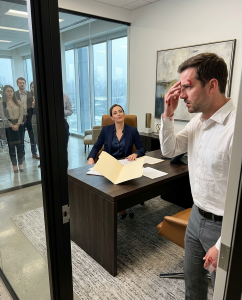
“I’m the boss’s girlfriend. I can fire whoever I want.”
Those were the words Tiffany used after throwing a folder at Jack Wilson’s face hard enough to split the skin above his eyebrow.
She didn’t throw it in a moment of panic. She didn’t lose her temper in some private disagreement. She did it deliberately, from behind the owner’s desk, with her chin lifted and a satisfied expression on her face, as if she had been waiting for this exact moment ever since the owner left town.
By the time Jack touched his forehead and saw blood on his fingers, he already understood what kind of meeting this was.
Not professional.
Not necessary.
Not even real.
It was a public show of power from someone who had just discovered how intoxicating borrowed authority could feel.
“Do you know what time it is?” Tiffany demanded.
Jack stood in the doorway for a beat before stepping fully into the office. “Yes.”
“Then explain why you’re coming in at ten.”
Her tone was sharp enough to cut glass. She was leaning back in the chair like she had a permanent claim to it, one manicured hand drumming against the armrest. Outside the office, a few employees moved more slowly than usual. Some were pretending to sort papers. Some were lingering at their desks. Everyone could sense the scene.
Jack knew better than to answer too quickly. He had been with the company long enough to recognize when something wasn’t a misunderstanding at all.
His schedule was not a secret.
For years, he had been the company’s top salesperson by a distance that wasn’t even close. He had joined at a time when the business was struggling so badly that people whispered about layoffs in the break room and vendors were starting to call twice for payment. In his first month, he brought in enough revenue to stop the panic. In the months after that, he brought in more clients, rescued older accounts that were ready to leave, and became the one person the owner relied on when something big was about to fall apart.
The owner had eventually told him, almost casually, “Come in at ten. You’re on client calls late anyway. I care about results.”
That arrangement had lasted for years.
Everyone knew it.
Tiffany knew it too, though she would later pretend she didn’t.
Jack looked at her and said evenly, “My schedule was approved.”
“Not by me,” she shot back.
There it was.
Not concern. Not policy. Not management.
Ego.
Tiffany had arrived in the office only a few weeks earlier as the owner’s new girlfriend. At first, most employees tried to be polite. Then they tried to stay out of her way. Then they realized staying out of her way wasn’t enough, because Tiffany didn’t just want courtesy. She wanted submission.
She wanted every smile to be slightly too bright. Every greeting to be immediate. Every compliment to sound sincere. If she posted a photo, she expected reactions from the entire office. If she asked how she looked, no answer short of glowing admiration satisfied her. If she entered a room, she wanted the energy in it to rearrange itself around her.
Most people went along with it because it was easier.
Jack did not.
He wasn’t rude. He wasn’t hostile. He simply refused to perform.
That, in Tiffany’s world, was unforgivable.
“You’ve been violating office hours all month,” she said, tapping the folder against the desk. “Three violations are enough for termination. You’re done here.”
Jack kept his voice level. “Did you clear that with the owner?”
Tiffany laughed, and the sound was ugly.
“You’re just a salesman,” she said. “This is my boyfriend’s company. I’m the boss’s girlfriend. I can fire whoever I want.”
Jack studied her for a second and understood the real point of the meeting. She wasn’t trying to correct him. She was trying to break him in front of witnesses.
“Call him, then,” Jack said.
To his mild surprise, she immediately reached for her phone. She was so sure of herself that she didn’t hesitate.
When the owner answered, his voice sounded tired and distant, as if he had been half asleep. Tiffany’s tone changed instantly. It became soft, sweet, almost fragile.
“Baby,” she said, “there’s an employee here who keeps ignoring the rules and coming in late. I want to fire him.”
Jack watched the performance without interrupting.
On the other end came a long exhale. Then the owner said, “Do whatever you want. I need sleep.”
The line went dead.
Tiffany lowered the phone with a slow smile. “You heard him. Get out.”
Jack should have been furious, and part of him was. But what he felt even more strongly in that moment was clarity. Tiffany thought she had won because she had control over the office, the desk, the staff, and the owner’s tired attention. She didn’t understand the difference between authority and value.
Jack did.
“Are you sure?” he asked.
That annoyed her. He could see it in the quick tightening of her mouth.
“Yes,” she said. “Leave.”
He packed his things without another word. Several coworkers avoided eye contact. One looked like he wanted to step in and didn’t dare. Jack didn’t blame them. Fear was already doing its work.
He carried his box downstairs to finance. He had worked only ten days that month, but between base pay and commissions, the money owed to him wasn’t trivial. The finance clerk pulled up his profile, clicked through the numbers, and looked ready to process it.
Then Tiffany appeared in the doorway.
“What are you doing?” she asked.
Jack didn’t turn immediately. “Collecting what I’m owed.”
“No, you’re not.”
The clerk froze.
Jack turned then, box still in one arm. “Excuse me?”
Tiffany folded her arms. “You violated company rules. Your salary is confiscated.”
For one second, the sheer absurdity of it stunned him. Then he laughed.
“Confiscated under what law?”
“Under the new policy I just made.”
The clerk stared at the keyboard like it might save her from being involved. Two employees outside finance had stopped walking entirely.
Jack looked from Tiffany to the clerk and back again. He saw the same thing in both places: one person drunk on temporary power, another paralyzed by it.
He could have argued harder. He could have demanded written justification. He could have called an attorney from that hallway and started the fight immediately.
But something in Tiffany’s expression told him she wanted that. She wanted noise. She wanted the satisfaction of seeing him reduced to anger while she played queen in front of an audience.
So he did the one thing she was least prepared for.
He left.
On the way out, before shutting down the company phone, he glanced at the employee group chat. A new message from Tiffany had already been posted.
“From now on, everyone must respond to any message I post on WhatsApp or Snapchat. Anyone who ignores me will be fired like today’s employee.”
Jack stared at the screen for a long second.
That was the truth of it.
She hadn’t fired him over attendance.
She had fired him because he refused to become part of her personal fan club.
That night, he sat at his kitchen table with a cup of coffee growing cold beside him. The cut on his forehead had crusted over, but it still burned whenever he frowned. His apartment was quiet. Too quiet. It gave him too much room to replay the day.
Then he opened his contacts.
That changed everything.
The biggest accounts in the company were attached to names he knew better than some of his relatives. He knew which executive hated early calls, which one trusted a text more than email, which one panicked over small shipping delays, which one only relaxed when he heard a calm voice on the line. He had spent years building those relationships one solved problem at a time.
The company logo had opened the first door.
Jack had done the rest.
He typed one message.
“I wanted to let you know I’m no longer with the company and will not be managing your accounts going forward.”
He sent it to a handful of major clients first.
Before he finished his coffee, his phone lit up with replies.
“Where are you going?”
“If you’re leaving, we’re leaving.”
“Please tell me this is temporary.”
“Is there a problem over there?”
One client called immediately. Another asked whether the company had been sold. A third texted, “You were the only stable thing about that place.”
Jack didn’t push. He didn’t recruit. He didn’t vent.
He simply answered with professionalism and restraint. Yes, he had left. No, he could not comment beyond that. He appreciated their trust. He would let them know his next move when there was one.
That was enough.
Clients who trust a person more than a company do not wait around to become someone else’s experiment. By midnight, Jack knew with complete certainty that Tiffany had triggered something she could not stop.
The next morning, his phone buzzed with a message from a coworker.
“Boss came back early.”
A minute later, another.
“Tiffany is freaking out.”
Then: “He wants to talk to you ASAP.”
Jack sat back and stared at the messages. He imagined the scene clearly: the owner storming into the office expecting to assert control, Tiffany talking too fast, finance trying to disappear, managers suddenly pretending they had concerns all along. And underneath all of it, the real emergency—clients asking questions, accounts wobbling, money preparing to walk out the door.
The owner called.
Jack let it ring once, then twice, then picked up.
“What happened?” the owner asked immediately.
Jack noticed what he didn’t say. No accusation. No anger over the client messages. No demand that Jack stop contacting accounts.
He already understood the danger.
So Jack told him everything.
He told him about the folder.
The cut on his forehead.
The fake sweet voice Tiffany used on the phone.
The firing.
Finance.
The attempt to withhold his pay.
The group chat message threatening employees for not responding to social media posts.
The owner didn’t interrupt.
When Jack finished, there was a long silence.
Finally, the owner said, “She told me you were insubordinate.”
Jack gave a humorless laugh. “And now your top clients are asking me where I’m going next.”
That silence was heavier.
In the background, Jack could hear movement, then a door closing. Faint voices rose through the line. One of them, unmistakably, was Tiffany’s. She sounded frantic now, not regal. Sharp words. Fast breathing. The tone of someone who had only just realized consequences were real.
The owner came back on. “Your pay will be released immediately.”
“It should have been released yesterday.”
“You’re right.”
That answer mattered. Not because it fixed the damage, but because it confirmed the owner knew how badly he had misjudged the situation.
“I need you to come in,” he said.
Jack looked out his apartment window. “Why?”
“So we can sort this out.”
Jack almost smiled. “Sort what out? The assault? The wrongful termination? The withheld wages? Or the clients leaving?”
Another silence.
Then, quietly: “All of it.”
At the office, the atmosphere had changed completely by the time Jack arrived. The tension that Tiffany once enjoyed now pressed in from every wall. Employees looked up and then quickly away. No one seemed sure where to stand.
Tiffany was in the conference room.
Through the glass, Jack could see her pacing. She wasn’t polished now. Her hair was slightly out of place, her makeup looked hurriedly touched up, and her confidence had collapsed into anger. She pointed when she spoke. She gestured too much. She kept glancing toward the hallway as if expecting the building itself to take her side.
The owner met Jack near reception.
He looked exhausted, older than he had a week earlier. He took one look at the healing cut on Jack’s forehead and shut his eyes briefly.
“She threw that?” he asked.
“Yes.”
The owner nodded once, like he hated the answer but couldn’t deny it anymore.
In the conference room, Tiffany turned the second Jack entered.
“Oh, now he comes back,” she said. “After sabotaging the company.”
Jack didn’t answer her. He looked at the owner instead.
That made her angrier.
“I was protecting standards,” she snapped. “He thought he was untouchable.”
The owner’s voice was flat. “His schedule was approved by me.”
Tiffany blinked. “You never told me that.”
“I told everyone that.”
Her expression shifted. For a second, she looked less angry than cornered.
“So this is my fault?” she asked. “He disrespected me from day one.”
Jack finally spoke. “I didn’t flatter you. That’s not the same thing.”
Color rose in her face. “You ignored me. You acted like I didn’t matter.”
The owner stared at her. And there it was—the real motive, laid bare in the ugliest possible way.
This had never been about attendance.
It had never been about company rules.
It had been about wounded vanity.
“And the pay?” the owner asked.
Tiffany hesitated, then tried for confidence. “I was making an example.”
“You tried to steal from an employee.”
She opened her mouth, then closed it.
At that exact moment, the owner’s phone buzzed on the table. He picked it up, glanced at the screen, and his face hardened.
“What?” Tiffany said.
He turned the phone around.
It was an email from one of the company’s largest clients. The subject line was simple: Account Transition.
The message was even simpler. They would be moving their business elsewhere unless Jack remained directly responsible for their account.
Before anyone could respond, the owner’s laptop chimed with another message.
Then another.
Jack didn’t need to read them. He already knew.
The owner sat down slowly. “How many did you contact?”
Jack met his eyes. “Enough to let them know I was gone.”
Tiffany stared between them. “He can’t do that.”
“He informed clients he was no longer handling their accounts,” Jack said. “That’s not sabotage. That’s basic professionalism.”
The owner knew it too.
Tiffany’s confidence finally cracked. “So what, you’re choosing him over me?”
The question hung there, as childish as it was destructive.
The owner answered without raising his voice. “I’m choosing the truth over the mess you created.”
She stepped back as if he had struck her.
“No,” she said. “They’re only reacting because he manipulated them.”
Jack almost responded, but stopped. He didn’t need to. The clients’ loyalty had already answered for him.
The owner turned to Tiffany. “Pack your things.”
Her whole body went rigid. “You can’t be serious.”
“I am.”
“You’re humiliating me in front of everyone.”
He gave a tired, bitter laugh. “That seems to bother you only when it’s happening to you.”
For the first time since Jack had seen her, Tiffany had no fast comeback. No superior smile. No fake sweetness. Only raw disbelief.
She looked around the room as if searching for support. No one offered it.
Eventually she grabbed her bag, muttered something under her breath, and walked out of the conference room with the stiff, furious movements of someone who still hadn’t accepted that the performance was over.
The door closed behind her.
Silence settled.
Then the owner looked at Jack. “I handled this badly.”
“Yes,” Jack said.
“I should have verified what she told me.”
“Yes.”
“I want to make this right.”
Jack considered him carefully. “You can start by paying what I’m owed. All of it. Today.”
“It’s already being processed.”
“And after that?”
The owner exhaled slowly. “After that, I’d like to offer you your job back. With a written contract. Your schedule documented. Full authority over your accounts. And no one outside the company structure interfering with staff ever again.”
It was a good offer.
Under different circumstances, Jack might have accepted immediately. But some damage isn’t measured by money or title. Some damage is measured by the moment you realize exactly how easily someone will let you be sacrificed for their convenience.
“I’ll think about it,” Jack said.
That afternoon, the money hit his account.
By evening, word had spread through the office that Tiffany was gone, the owner was personally calling clients, and Jack had not yet agreed to return. Competitors began reaching out, some subtle, some direct. One made an offer by the next morning that beat his current compensation and included a signing bonus large enough to make the decision almost effortless.
In the end, Jack didn’t go back.
He chose the company that had wanted him before the chaos and wanted him even more after seeing what his name meant in the market. Several clients followed him within weeks—not because he pressured them, but because trust moves in the direction of reliability.
The owner’s business survived, but not cleanly. It lost accounts, reputation, and the illusion that top talent can be mistreated without consequences. He sent Jack one final message months later: “I should have listened.”
Jack never answered.
He didn’t need to.
Some lessons only make sense after they become expensive.
And if there was an aftershock to all of it, it lived in one uncomfortable question: what was the bigger red flag—Tiffany’s cruelty, or the fact that the owner handed her power so easily and believed her so quickly? Tiffany caused the explosion, but he laid the fuse. That was the part no one in that office would ever forget.