“I’m sorry, I’m late.”
Mariana Ríos said it before she even reached the table, like the apology had been sitting on her tongue for half an hour, burning there.
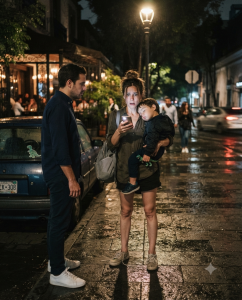
She stood in the entrance of the restaurant flushed with embarrassment, one sneaker untied, a diaper bag slipping off her shoulder, and a sleeping four-year-old draped across her arms with the full dead weight only children seem capable of. He had one cheek pressed against her collarbone and a green plastic dinosaur clutched in his fist.
At a corner table under a hanging amber lamp, Julián Cárdenas pushed back his chair and stood up.
Everything about the night had suggested it would be predictable. A blind date arranged by mutual friends. A nice restaurant in Roma Norte. Good wine. Careful small talk. The sort of evening where two adults assess each other politely and then either agree to see each other again or never mention it.
Then Mariana walked in carrying a child and an entire life she clearly had not planned to explain.
The hostess was staring. A waiter used his shoe to stop a juice box that tumbled out of the diaper bag and rolled across the polished floor.
“Sorry,” Mariana whispered again, hurrying over. “I know I’m late. I know this is a disaster. My sitter canceled forty minutes ago, and I already canceled on you twice before. I thought if I canceled again, you’d think I didn’t want to come.”
Julián looked at her profile picture in his mind and almost laughed at how little it had prepared him. In that photo, she had looked calm and composed, her hair down, blouse neat, expression soft. The real Mariana looked like she had been sprinting through a storm no one else could see.
He had no idea whether he was supposed to hug her, help her, reschedule the date on the spot, or pretend all of this was normal.
So he did the only useful thing he could think of.
He pulled out her chair.
“Sit down before you drop the kid or your dignity.”
For the first time, she laughed. It was brief and frayed, but real.
“My dignity fell somewhere near Insurgentes.”
He helped slide the chair in while she carefully adjusted the boy in her arms before settling him partly on her lap.
“What’s his name?” Julián asked.
“Mateo.”
He pointed toward the dinosaur.
“And him?”
Mariana closed her eyes in surrender.
“Mr. Bites.”
That made him laugh, a real laugh that slipped out before he could stop it. The tension in her face eased by a fraction, as if that sound had told her she wasn’t about to be judged in the way she had feared.
They ordered. Mariana chose the cheapest thing she could find and pretended it was exactly what she wanted. Julián caught the hesitation in her eyes and quietly ordered more for the table without calling attention to it.
For several minutes, they managed something almost normal.
Mariana taught preschool in Del Valle. Julián ran a software company in Santa Fe. She loved old children’s books, street corn drenched in lime and chili, and walking through used bookstores. He liked long weekend hikes outside the city and hated networking dinners. She teased him that wealthy people only called it hiking when they walked in shoes more expensive than some people’s rent.
Then Mateo woke up and ended any illusion of an ordinary date.
He blinked at Julián, frowned deeply, and asked, “Who is he?”
“That’s Julián,” Mariana said, already tense.
“Why?”
Julián covered his mouth to hide a smile.
“Honestly? Fair question.”
Mateo examined him with unblinking seriousness.
“Are you rich?”
Julián inhaled water into his lungs and broke into a coughing fit. Mariana nearly died of embarrassment.
“Mateo! No.”
“Yes,” the boy said. “You can ask. He looks expensive.”
Julián laughed so hard people turned to stare.
“Expensive,” he repeated. “That’s a new one.”
Mateo, satisfied, stole a slice of pizza and accepted the matter as settled.
Something changed after that.
The evening stopped trying to be impressive. It became ridiculous and warm and unexpectedly honest. Mateo provided relentless commentary on the napkins, the lighting, the injustice of pizza arriving without fries, and the fact that adults spoke too much while saying very little. Mariana apologized for him until Julián finally told her the child was more entertaining than most of the investors he met for dinner.
She stopped apologizing.
And once she did, he noticed her more clearly.
He noticed how automatically she tore Mateo’s food into manageable bites. How she checked the temperature of his forehead without interrupting the conversation. How every instinct she had seemed tuned to whether he was hungry, tired, overstimulated, or getting restless. He noticed the deep fatigue in her shoulders and the way she barely touched her own plate until Mateo had eaten.
Whatever arrangement this was, it was not temporary in the way a casual favor would be temporary.
By the time dessert menus appeared, Mateo was fighting sleep again, his small body wilting against her. Julián paid before Mariana could argue and walked them outside into a night that smelled of damp pavement and sweet bread from the bakery down the block.
Her car was old, dented, and meticulously clean inside. A faded dinosaur sticker decorated the back window.
Mariana shifted Mateo higher on her shoulder, and just as she reached for the driver’s side door, he murmured in his sleep.
“Mom…”
The word landed between them like glass.
Mariana froze. Not the startled pause of a woman caught in an awkward misunderstanding, but the full-body stillness of someone struck directly in an old wound.
She brushed his hair back.
“No, sweetheart,” she whispered. “I’m your Aunt Mariana.”
Julián did not speak.
He understood enough to know he was standing near grief.
Then Mariana’s phone buzzed in her hand. She glanced down. Her face emptied of color.
Julián only managed to catch part of the message before she turned the screen away.
His family wants to talk about custody.
She slipped the phone back into the bag too quickly, as if hiding it might make the words disappear.
“Thanks for not running away,” she said.
He looked at the sleeping child, the dinosaur, the old car, the woman trying desperately not to let her private panic spill into the street.
“I was thinking the same thing about you.”
Her phone buzzed again. She stared at it this time.
Her hand shook.
“What happened?” he asked quietly.
She swallowed. “My sister died eight months ago.”
The sentence came out so softly that he almost missed it.
“She was Mateo’s mother,” Mariana continued. “And his father left before the funeral flowers were even dead. He was barely around before that, and after she died, he vanished completely.”
Julián stayed where he was, not wanting to crowd her, but he had the sense that if he walked away now, something human would be lost.
“I took Mateo home with me the week she died,” Mariana said. “It was supposed to be temporary until things were figured out. But no one figured anything out. No one came. No one asked what he needed. They just… disappeared.”
She gave a tiny laugh with no joy in it.
“Except now they’ve returned.”
“His father?”
She nodded. “Not him directly. His parents. Mateo’s paternal grandparents. They suddenly want meetings. Evaluations. Lawyers.” Her eyes filled, but she blinked the tears back. “Because apparently Mateo’s father died last month in an accident in Monterrey.”
Julián stared at her. “What?”
“I found out yesterday. He left behind a policy. Property issues. A trust complication. I don’t even fully understand it yet.” Her mouth tightened. “But now that there may be money attached to Mateo, his grandparents have remembered he exists.”
The phone buzzed a third time.
Mariana looked. Her lips parted.
“They know where I live,” she whispered. “They’re outside my apartment building waiting.”
“Tonight?”
She nodded.
“Don’t go there alone,” Julián said immediately.
She looked at him as if only then realizing he was still part of the scene.
“I can’t take Mateo there with them waiting. He gets terrified when strangers raise their voices.” She took a shaky breath. “And they don’t feel like strangers to him exactly. They feel worse. Like people he’s supposed to know but never learned to trust.”
Julián pulled out his keys.
“Come with me.”
She stared at him.
“That’s an insane thing to say on a first date.”
“Probably,” he said. “But it’s still the right one.”
A thousand thoughts crossed her face. Caution. Pride. Fear. The tired reflex of a woman used to surviving alone. Then Mateo shifted against her and whimpered in his sleep.
That decided it.
Julián drove them to his sister’s apartment instead of his own. His sister was out of town with her family, and the place was only fifteen minutes away. More importantly, it was secure, discreet, and stocked with the practical things children sometimes needed because his sister had twins.
Mariana stood in the kitchen once they arrived, still holding Mateo, while Julián found pajamas small enough to fit him from the hall closet. The apartment was quiet and smelled faintly of lavender detergent.
“Are you sure this is okay?” she asked for the fifth time.
“No one’s going to throw us out.”
“Your sister won’t think this is weird?”
“She will think it is extremely weird,” he said. “But she’ll forgive me if I tell her there was a child involved.”
That won a weak smile.
He helped set up the guest room while Mariana changed Mateo and tucked him into bed. When she came out a few minutes later, she looked both younger and sadder somehow, as if removing the public face she wore in restaurants had exposed the cost underneath.
He made coffee. She sat at the kitchen counter and finally told him the full story.
Her sister Lucía had been twenty-eight when she died. Postpartum complications after a late pregnancy, followed by months of medical issues no one had taken seriously enough until it was too late. Mateo was three then, old enough to understand that something terrible had happened and too young to process why his mother never came home.
Mateo’s father, Sergio, had always been unreliable. Charming when he wanted something, absent when responsibility showed up. After Lucía’s death, he disappeared emotionally first, then physically. He promised to return. He never did.
Mariana had stepped in because someone had to.
At first she kept expecting adulthood to arrive in some official form—papers, instructions, relatives willing to help. Instead, what arrived were bills, silence, and a grieving child who woke up screaming for his mother.
“I started sleeping on the floor next to his bed,” she said, staring into her coffee. “He’d wake up and panic if he didn’t hear me breathing.”
Julián didn’t interrupt.
“The first time he called me Mom, he cried afterward because he thought he’d betrayed her.” Mariana’s voice broke at the memory. “So I told him hearts are big enough to hold more than one kind of love, and that calling me Mom by accident didn’t erase her.”
She pressed her fingers hard against her eyes.
“I don’t even know if I’m doing this right. I’m just trying not to fail him.”
“You’re not failing him,” Julián said.
The certainty in his voice made her look up.
He continued, “You showed up to a blind date carrying him because you didn’t want to break your word. You know his food, his sleep habits, the name of his ridiculous dinosaur. He fell asleep on you twice tonight without fear. Kids don’t do that with people who are failing them.”
She looked away quickly, but not before he saw gratitude move across her face like pain.
Her phone rang around midnight. Unknown number.
She answered on speaker after a moment’s hesitation.
A woman’s cold voice filled the kitchen.
“Mariana, this is Elena Varela, Sergio’s mother. We’ve been waiting outside your apartment for over an hour.”
“You should leave,” Mariana said.
“We are Mateo’s family.”
“So was Lucía,” Mariana replied, suddenly steady. “And where were you when she was buried?”
Silence crackled. Then the older woman switched tactics.
“We are prepared to seek emergency visitation and challenge your temporary guardianship.”
Julián watched Mariana grip the counter until her knuckles blanched.
“You can do whatever your lawyers advise,” she said. “But you do not get to corner me at night outside my home.”
“Elena,” a man’s voice said in the background, hushed but audible, “that’s enough.”
The call ended.
Mariana stared at the phone.
“I have temporary papers,” she said, more to herself than to him. “Lucía signed some things when she got sick. But they’re already saying the father’s side has priority if they contest it.”
“Then you need a better lawyer than they do,” Julián said.
She laughed bitterly. “Sure. I’ll just buy one.”
He met her eyes. “I know someone.”
At one in the morning, Julián called his friend Daniela, a family attorney with the emotional stamina of a war correspondent and the bedside manner of a kind knife. By eight the next morning, Mariana was sitting in Daniela’s office with a folder of documents, while Mateo colored dinosaurs in the waiting area.
The legal picture was ugly but not hopeless.
Lucía’s handwritten declaration naming Mariana as preferred guardian carried weight because it had been properly witnessed during a hospitalization. The paternal grandparents could petition for visitation or custody review, especially now that Sergio was dead and there was a possible financial estate involved, but they would need to prove stability, prior involvement, and the child’s best interest.
“How involved were they before this week?” Daniela asked.
Mariana gave a hollow laugh. “They sent one toy after his third birthday. It arrived six months late and had Sergio’s name on the card.”
Daniela nodded once. “Good. I mean, not good morally. Good legally.”
Over the next few days, a new rhythm formed that none of them had expected.
Julián drove Mariana and Mateo to appointments. He brought takeout when Mariana forgot to eat. He sat on the floor and let Mateo explain, in excessive detail, why Mr. Bites was not a dinosaur but a “battle lizard,” which apparently mattered a great deal. He fixed the broken latch on Mariana’s apartment window and arranged for a security camera to be installed after Elena Varela appeared outside the building again.
Mariana resisted all of it at first.
“You don’t have to keep doing this,” she told him one evening.
He was at her kitchen table assembling a toy shelf Mateo had received from a neighbor.
“I know,” he said.
“That’s not an answer.”
“It’s the only one I’ve got.”
She leaned against the doorway watching him. “You barely know me.”
He tightened a screw and looked up. “That stopped being true the moment you trusted me with the ugliest part of your week.”
Something in her expression softened then, not into ease, but into the beginning of it.
The custody hearing was scheduled three weeks later.
On the morning of it, Mateo refused breakfast and clung to Mariana’s leg. He had been told only that adults were going to talk about where he lived and who took care of him, but children always understood more than they were supposed to.
In the courthouse hallway, Elena and her husband Arturo stood in elegant clothes that seemed chosen to suggest stability and sorrow. They had the polished look of people accustomed to being believed.
Elena’s gaze landed on Mateo first. Her face performed tenderness. It didn’t reach her eyes.
“My poor baby,” she said, stepping forward.
Mateo hid behind Mariana immediately.
That was the first crack.
The second came during testimony.
Elena spoke about family values, legacy, and the importance of blood ties. Arturo emphasized educational opportunities, medical coverage, and a larger home. Their attorney suggested that Mariana, as a single schoolteacher with limited income, could not provide the same long-term security.
Then Daniela stood up.
She presented school records signed only by Mariana. Medical forms listing Mariana as emergency contact, guardian, and the person who attended every appointment. Statements from neighbors, teachers, and Lucía’s closest friend documenting who had actually raised Mateo since his mother’s death. Phone records showing months of silence from Sergio’s family. Security footage of Elena waiting outside Mariana’s apartment building after midnight.
And then came the detail that changed the room.
Daniela introduced documents from the estate proceedings. Sergio’s life insurance and remaining assets were not directly accessible by the grandparents at all. The money was locked in a trust solely for Mateo, supervised by the court until adulthood, with strict restrictions.
The grandparents would gain no control over it through custody.
Not a dollar.
The judge looked over her glasses. “So to be clear, the financial benefit motivating urgency here does not exist in the way the petition implied?”
Elena’s attorney stumbled.
Arturo’s face hardened. Elena’s polished grief cracked wide enough to reveal something mean underneath.
“This is absurd,” Elena snapped before her lawyer could stop her. “That child belongs with his real family.”
Mateo, seated with the court-appointed child specialist in the back, started crying.
Mariana turned instinctively, but the judge was already watching everything.
“Mrs. Varela,” the judge said sharply, “you will control yourself.”
What followed lasted less than fifteen minutes, but it settled months of fear.
The judge denied the emergency custody petition outright, granted Mariana extended legal guardianship pending final adoption review, and allowed only supervised visitation for the grandparents after a child therapist’s assessment—if Mateo wanted it.
Outside the courtroom, Mariana stood absolutely still as if her body had forgotten how to process relief.
Then she started crying. Not elegantly. Not quietly. The kind of crying that comes from holding too much for too long.
Julián was there before she could apologize for it.
She covered her face. “I really hate that you keep seeing me like this.”
He gently pulled her hands down.
“I think this is exactly who you are when you’re brave enough to stop pretending.”
That made her cry harder, which annoyed her enough to laugh through it.
Later that afternoon, after Mateo had been picked up from the child specialist’s playroom and rewarded with fries, ice cream, and the right to lecture all adults present, they went back to Mariana’s apartment.
The place looked the same, but it didn’t feel the same.
The fear that had lived there had lost its teeth.
Mateo sat on the rug pushing Mr. Bites across the floor while Mariana leaned against the kitchen counter in silence. Sunlight cut across the room in warm late-afternoon bands.
“It still doesn’t feel real,” she said.
“It will.”
She looked at him. “Why did you stay?”
He considered lying with something charming and easy, but the day had exhausted any appetite for pretense.
“Because that first night, when he called you Mom and you corrected him, I saw how much it hurt you to say it. And I thought anyone who chooses the harder love when nobody is watching probably matters.”
Her eyes filled again, but this time she didn’t look away.
A month later, they went on their second date.
Officially, Mateo called it a family dinner and insisted on attending the first twenty minutes to “inspect” the restaurant. He declared the bread acceptable, the lighting suspicious, and Julián still somewhat expensive. After that, Mariana’s neighbor took him home.
When Julián and Mariana were finally alone, she laughed so hard at the absurdity of needing a child’s approval rating for romance that she nearly knocked over her drink.
“I should warn you,” she said, smiling over the rim of her glass, “he has very strong opinions.”
“I know,” Julián said. “I’m trying not to take the expensive thing personally.”
Her smile softened.
Then she reached across the table and took his hand.
Not dramatically. Not like a movie. More like someone testing whether something gentle could be trusted to remain.
He turned his hand over and held on.
Months after that, when the adoption process moved forward and the social worker asked Mateo who made him feel safe, he answered without hesitation.
“Aunt Mariana,” he said first.
Then he thought for a second and added, “And Julián. But sometimes he wears shoes that are too clean.”
Even the social worker laughed.
In the end, Mariana adopted Mateo formally. The final hearing was small and emotional. Daniela came. Julián came. Mateo brought Mr. Bites, who was not allowed to testify but was treated as if he might.
When the judge signed the papers, Mateo climbed into Mariana’s lap and wrapped his arms around her neck.
This time when he whispered, “Mom,” she didn’t correct him.
She just closed her eyes and held him.
Later, on the courthouse steps, with sunlight all over the city and traffic roaring by like ordinary life refusing to pause for miracles, Mariana stood between the boy she had chosen and the man who had chosen them both without warning.
Nothing about it was the life she had planned.
It was messier, louder, harder, and infinitely more real.
And maybe that was the part that stayed with everyone who knew the story afterward: not the legal victory, not the blind date disaster, not even the twist of the inheritance that turned strangers into opportunists.
It was the fact that love had entered the room looking completely wrong.
Late. Untied. Exhausted. Carrying too much.
And somehow, it had still been the most honest thing there.
If there was a red flag in the whole story, it wasn’t the sleeping child at a first date or the chaos Mariana dragged in with her. It was every person who only remembered Mateo once there was something to gain. The people who looked like stability were the ones hiding the least love. And the woman who arrived apologizing for the mess turned out to be the only adult who had never once treated that child like a burden.
Maybe that’s what would have broken most people.
Or maybe it’s what revealed them.