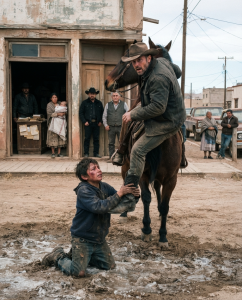
The boy didn’t fall in front of the horse. He threw himself underneath it.
One second Gabriel Montes was riding through the center of San Gregorio, following the hard-packed road that cut through the little northern Chihuahua town like a scar. The next, a child launched out of nowhere and wrapped both hands around his boot while the horse screamed and rose on its hind legs.
The sound split the afternoon open.
People turned. A woman carrying bread froze. Two old men by the feed sacks stepped back. Someone muttered a curse. But no one ran forward. No one shouted for help. In San Gregorio, people had learned the cost of stepping between a powerful man and whatever he wanted.
Gabriel yanked the reins with everything he had. The horse came crashing back down, sideways instead of straight, missing the child by inches.
Dust blew over them both.
When it cleared, the boy was still kneeling in the frozen mud, clutching Gabriel’s boot with a grip that felt desperate enough to break bone. He couldn’t have been older than nine, but there was nothing soft in his eyes. They were too calm. Too fixed. Too old.
“Sir,” he said, breathing hard but not crying, “I need one minute.”
Gabriel swung down from the saddle.
The first thing he noticed was blood at both knees where the fabric had torn open. The second was that the boy didn’t seem to care.
“You’re hurt.”
“I know.”
Gabriel crouched. “What’s your name?”
“Mateo Rivas.”
“What are you doing under my horse, Mateo?”
The boy swallowed. His mouth was trembling, but his voice stayed stubbornly steady.
“My mom is inside Don Baltasar’s store. They’re trying to force her to sign away our ranch.”
Gabriel glanced toward the big general store across the street. It sat there like the heart of the town, broad porch, weather-dark boards, barrels out front, men lounging near the entrance with the lazy posture of people who wanted to be noticed and feared at the same time.
“And why would they be doing that?”
“They say my dad left a debt.”
“Did he?”
Mateo’s jaw tightened. “No. He paid everything before he died.”
There was a beat of silence.
“Why didn’t your mother go to the commissioner?”
Mateo gave a laugh that had no business coming from a child. “Because the commissioner eats at Baltasar’s table.”
That answer landed harder than Gabriel expected. He had been away from this kind of town for years, but he knew the shape of corruption when he heard it. It always sounded the same. Casual. Settled. Like rot had become furniture.
“Why stop me?” Gabriel asked. “Why me?”
The boy looked straight at him.
“Because my baby sister stopped crying.”
It took Gabriel half a second to understand the full terror of that sentence.
Mateo spoke faster then, as if afraid he’d lose his chance. “She’s four months old. Since yesterday she hasn’t eaten right. My mom took her with her because she couldn’t leave us alone at the ranch. Earlier Clara was crying and crying. Then she stopped. I heard the men in there saying if my mom didn’t sign today, tomorrow they’d drag us out anyway.”
Gabriel tied his horse to a post without another word.
When he started toward the store, Mateo let go of him at last and rose shakily to his feet.
“Sir.”
Gabriel turned.
Mateo lowered his voice. “What they say about my mother isn’t true. And my dad didn’t die by accident.”
Something cold slid through Gabriel’s chest. “What do you mean?”
“Before he got really sick, he said the water tasted like metal,” Mateo said. “Ever since Don Baltasar’s mill started dumping into the stream.”
Gabriel stared at him for a second. Then he pushed open the door of the store and walked inside.
The room smelled like flour, oil, soap, tobacco—and fear.
At the far end stood a woman in a worn coat holding a bundled infant against her chest. Her dark hair had been pinned up in haste and was already slipping loose. She stood unnaturally straight, the way people do when they know collapsing would be the same as surrender.
Across from her stood Baltasar Cifuentes.
Gabriel recognized the type before the man even spoke. Expensive boots. Warm coat. Gold ring. Face softened by age and comfort but sharpened by the habit of getting his way. The sort of man who never needed to raise his voice because the town had long since learned to fear his smile.
Two thick-shouldered men stood nearby, saying nothing.
Papers were spread across the counter.
“Mrs. Rivas,” Baltasar was saying smoothly, “I’m trying to be generous. Sign today and I’ll allow you fifteen days to vacate. Force me to file through the courts, and you’ll be lucky to get three.”
“My husband never signed a debt with you,” the woman replied. Her voice was tired, but it did not break. “That signature is false.”
Gabriel stepped forward.
“Then let’s all have a look at the document.”
The three men turned.
Baltasar’s expression hardened by a degree. “And who are you supposed to be?”
“Someone with a nose for fraud.”
For the first time, the woman looked directly at Gabriel. Her eyes were startling—not because they were red from crying, but because they weren’t. It was as if tears had become a luxury she could no longer afford.
“Are you with them?” she asked.
“No.”
Baltasar gave a short, humorless smile. “This is a private matter.”
“If you’re trying to steal a ranch with forged papers,” Gabriel said, “it stopped being private.”
The woman’s arms tightened around the infant. That movement drew Gabriel’s attention to the baby’s face, and what he saw made him forget the papers for a moment. Pale lips. Slack stillness. A baby too quiet, too limp, too drained.
“How long has she been like this?” he asked.
The woman looked startled by the question. “Since this morning she hardly fed at all.”
“Since yesterday,” said a small voice behind him.
Mateo had slipped inside.
The woman turned sharply. “I told you not to come in.”
But beneath the scolding was naked panic.
“Mama,” he whispered, “let me see Clara.”
She hesitated, then angled the baby toward him. Mateo touched two fingers to his sister’s cheek. He said nothing.
Gabriel had seen silence like that before. The kind that came when fear had passed the point of words.
He looked back at Baltasar. “This is over. She’s leaving.”
Baltasar’s expression darkened. “The hell she is.”
Gabriel’s voice dropped. “She’s taking the baby to a doctor.”
One of Baltasar’s men shifted, hand brushing near his belt.
The old instincts returned to Gabriel with frightening ease. He didn’t move, but the room tightened around him. He saw distances, angles, exits. He saw who would lunge first and how he’d stop it.
“I was a federal agent for eight years,” he said quietly. “I know a false signature, a criminal threat, and a cheap intimidator when I see one. If you want to continue this, put every word in writing and make sure there are witnesses. But this woman and her children are leaving right now.”
No one breathed for a moment.
Baltasar’s eyes narrowed. He was doing the calculation. Maybe he could force the issue. Maybe not. But a public fight in broad daylight, with a stranger who wasn’t afraid of him, could create exactly the kind of talk he preferred to avoid.
“This won’t end here,” Baltasar said.
To Gabriel’s surprise, the woman answered first.
“Good,” she said. Her voice was low, cold, and steady as iron. “Because neither will I.”
For the first time, something like respect flickered in Gabriel’s chest.
Baltasar gave a tiny nod to his men and left.
The second the door shut behind them, the woman’s knees faltered.
Gabriel caught her elbow. “Easy.”
She steadied herself with obvious effort.
“What’s your name?” he asked.
“Lucía.”
“I’m Gabriel Montes.”
Mateo looked between them both as if he still couldn’t believe the stranger had stayed.
They crossed town together under the dull, watchful gaze of San Gregorio. A few people stared from doorways. A few pretended not to notice. The winter air cut through clothes and skin alike. Mateo walked with his shoulders tight and his hands raw from cold. Lucía held the baby so close that Clara was nearly hidden inside her coat.
As they walked, Gabriel asked, “How long has Baltasar been after your land?”
“Since my husband died,” Lucía said.
“How long ago?”
“Eleven months.”
“And before that?”
Lucía kept walking. “Before that, he kept offering to buy the ranch. Said it wasn’t worth much to us but could be useful to him because of the water access.”
“The stream behind your property?”
She nodded once.
Gabriel filed that away. “And your husband—Tomás—when did he start getting sick?”
“Three months before he died.”
“What happened to him?”
She took a shaky breath. “At first he said the water from the well tasted wrong. Like metal. Then came the stomach pain. Then tremors in his hands. Then he got so weak he could barely stand. We thought it was some infection. The doctor gave him what he could, but Tomás got worse so fast…” Her mouth tightened. “He was thirty-four years old. Strong as anyone. And in two weeks he was dead.”
Mateo walked in silence, but his face had gone rigid.
Lucía kept going, almost as if once she started she couldn’t stop. “Three weeks after the burial, Baltasar sent a man with condolences and an offer to ‘help settle accounts.’ That was the first time he mentioned a debt. Tomás never told me about any debt because there wasn’t one.”
“Did he ever put anything in writing?” Gabriel asked.
Lucía looked at him sharply, but before she could answer, they reached the small clinic at the edge of town.
Dr. Salcedo opened the door after one hard knock. He took one look at the baby and moved instantly.
“Inside.”
The clinic was simple—whitewashed walls, a narrow bed, shelves of medicine, a coal stove that never seemed warm enough. Lucía laid Clara on the examination table with trembling hands. The doctor wrapped the infant in warmed blankets and began checking her with controlled urgency.
Mateo backed against the wall, hugging himself.
Gabriel took off his coat and set it around the boy’s shoulders.
“I’m fine,” Mateo muttered automatically.
“No, you’re not.”
The boy looked like he wanted to argue. Instead he lowered his eyes and clutched the coat shut.
Minutes passed.
Too many.
At last Dr. Salcedo looked up. “She’s severely dehydrated. We can stabilize her, but she should have been seen sooner.”
Lucía flinched as if struck. “I tried. Yesterday morning I wanted to come, but Baltasar’s man came to the ranch saying there were papers about Tomás’s accounts. Then this morning they sent again and said if I didn’t show up today, they’d take the property by force.”
The doctor’s face darkened, but he said nothing for a moment. He finished adjusting Clara’s blanket and then spoke more carefully.
“There’s another concern.”
Lucía gripped the edge of the table. “What concern?”
He glanced at Gabriel before answering. “I’ve seen similar symptoms in families living near the lower stream. Digestive trouble. Tremors. Skin irritation. Unusual weakness in infants. I can’t prove anything yet, but if the water is contaminated, a nursing mother can pass the effects to her child.”
The room went silent.
Mateo’s head snapped up. “You mean the water made my dad sick?”
Dr. Salcedo didn’t answer immediately, and that was answer enough.
Gabriel stepped closer. “How many families?”
The doctor hesitated. “Enough to frighten me.”
Lucía stared at him. “And you said nothing?”
“I said what I could, as carefully as I could,” he replied, pain slipping into his voice. “This is a small town. Baltasar funds repairs, lends money, controls shipments, employs half the men around here, and has the commissioner in his pocket. If I accused him without proof, I’d be ruined before sunset—and so would anyone who stood beside me.”
Gabriel knew that logic. He hated that he understood it.
The doctor crossed to a shelf and took down an old notebook. “But I kept records.”
He opened it on the desk.
Inside were names. Dates. Symptoms. Addresses.
Family after family.
Lucía stepped closer, one hand still pressed against Clara’s blanket. “Tomás came here before he died, didn’t he?”
“Yes.”
“Did he suspect?”
Dr. Salcedo looked at her with deep reluctance. “He suspected enough to be afraid.”
He turned several pages, then stopped. Tucked between them was a folded sheet of paper, yellowed at the edges and stained faintly in one corner.
Lucía inhaled sharply.
Even before it was opened, she knew the handwriting.
“That’s his,” she whispered. “That’s Tomás’s.”
Mateo took a step forward. “What did he write?”
Dr. Salcedo spoke softly. “He came in late one evening after dark. He was already weak. He said if something happened to him, I should keep this hidden until someone came asking questions out loud—someone who wasn’t afraid.”
His eyes moved to Gabriel.
Gabriel felt the weight of that without wanting to.
He picked up the folded page and opened it carefully. The writing was shaky but legible.
The first lines described the change in the well water. Metallic taste. Oily sheen near the stream bend. Dead fish in the shallows. Then came something worse: Tomás had gone up near the mill one night after hearing machinery long after closing and seen barrels being emptied into a runoff trench that fed the creek.
Lucía stared at the page as if her husband’s voice had just stepped back into the room.
“There’s more,” Gabriel said quietly.
He kept reading. Tomás had written the names of two workers from the mill he believed had seen the dumping. He’d written that Baltasar had offered to buy the ranch twice after learning Tomás had complained about the water. He’d written that if anything happened to him suddenly, no one should believe it was natural.
Mateo’s face drained of color.
Lucía swayed where she stood. “He knew. He knew he was in danger.”
Before Gabriel could answer, a violent pounding exploded against the clinic door.
All four of them froze.
The knock came again. Harder.
Then a man’s voice from outside: “Open up, doctor. Don Baltasar sent us.”
Mateo moved instantly, stepping between the table and the door without even seeming to realize he’d done it. Lucía pulled in a sharp breath and reached for him, but the boy didn’t move. His small body was shaking, yet his eyes were fixed.
Dr. Salcedo went pale.
Gabriel folded Tomás’s letter and slipped it inside his shirt.
“How many men?” he asked.
The doctor crossed quietly to the side window and lifted the curtain edge with two fingers. “Three. Maybe four. One by the hitching post.”
“Armed?”
The doctor swallowed. “Looks like it.”
Another slam rattled the door frame.
“Doctor!” the voice barked. “We know they’re in there.”
Lucía whispered, “If they take that letter—”
“They won’t,” Gabriel said.
It was the calmest voice in the room, and because of that, everyone turned toward him.
For the first time since he’d ridden into San Gregorio, Gabriel stopped feeling like a stranger passing through. The old machinery inside him—the part built for pressure, for danger, for choosing a line and holding it—had fully awakened.
He looked at Mateo. “Take your mother and stand behind the cabinet.”
“I can help,” Mateo said.
“You already did.”
The boy held his gaze for a second, then obeyed.
Gabriel moved the heavy examination table just enough to narrow the entry path if the door gave way. Dr. Salcedo, hands trembling, unlatched a drawer and took out an old revolver.
“You know how to use that?” Gabriel asked.
“I know how to point it.”
“That’ll have to do.”
The pounding stopped.
For one strange second, the silence outside was worse.
Then came Baltasar’s voice, smooth even through the wood. “Montes. You don’t know this town. You don’t know what you’ve walked into. Hand over the paper, and I’ll let you ride out of here.”
Lucía stared. “He knows.”
“Of course he knows,” Gabriel said. “Men like him don’t build empires by missing loose ends.”
Baltasar continued from outside. “That widow can still leave with something. Keep this up, and she’ll lose the ranch, the house, and maybe more.”
Lucía closed her eyes. Gabriel could almost hear the years of pressure in that one moment—the grief, the threats, the humiliation, the fear of what happened to people who refused powerful men in forgotten places.
Then she opened her eyes again.
And when she spoke, her voice no longer shook.
“My husband died because he saw what you were doing.”
Silence outside.
Then Baltasar answered, colder now. “Careful, Lucía.”
“No,” she said. “You be careful.”
Gabriel glanced at her. The transformation in her was visible. Grief had burned too long inside her. Now it had found direction.
Another voice outside muttered something. Boots shifted on the porch.
Gabriel made the decision in the same instant it arrived.
“There’s a back exit?”
Dr. Salcedo nodded. “Storage room.”
“Good. Lucía, take Clara. Mateo, stay with your mother. Doctor, you go with them.”
“And you?” Lucía asked.
“I’ll buy you time.”
“No,” she said immediately.
Gabriel looked at her. “That letter gets out of this room, or your husband dies twice.”
That stopped her.
The doctor led them toward the rear storage room. Mateo looked back once, his face set in that unbearable little-man expression children wear when life has taken too much too soon.
“Will you come?” he asked.
Gabriel gave him the only honest answer he had. “I plan to.”
The front door shuddered under another hit.
Gabriel drew a slow breath and stepped into position.
Outside, Baltasar gave the order.
Inside, Gabriel Montes waited.
What happened next spread through San Gregorio by nightfall and through the whole district by morning.
Baltasar’s men broke the lock and forced the clinic door open, but the narrow entry worked against them exactly as Gabriel intended. The first man through met Gabriel’s shoulder and elbow and went down hard enough to knock into the second. The revolver in Dr. Salcedo’s shaking hand never fired, but it didn’t have to; the confusion bought the few precious seconds needed for Lucía, Mateo, and Clara to slip out through the back.
Baltasar himself stayed outside at first. Men like him preferred distance from ugly things.
But Gabriel wanted him closer.
He let the fight spill onto the porch, into full view of the street, where windows were beginning to crack open and faces were appearing. One man swung at him and missed. Another caught him across the jaw. Gabriel hit back harder. A third went for the knife at his belt and thought better of it when Gabriel drove him into the railing.
Then Baltasar stepped forward, furious now that events were no longer following his script.
“You should’ve kept riding,” he spat.
Gabriel wiped blood from his mouth. “And you should’ve cleaned your water.”
That line landed like a shot.
A woman across the road gasped. Someone else said, “Water?”
People were listening now.
Baltasar heard it too. Panic flashed behind his eyes for the first time. “He’s lying.”
“No,” came a voice from the street.
Lucía was back.
Gabriel’s head snapped toward her. She stood at the edge of the road with Mateo at her side and Clara bundled against her chest. Behind her, two men Gabriel didn’t recognize had joined them—thin, weathered workers in mill clothes.
Lucía lifted her chin. “Tell them what Tomás saw.”
One of the workers looked terrified. The other looked sick.
Then the older one spoke. “We dumped waste at night. Baltasar told us it was harmless.” His voice cracked. “It wasn’t.”
The second man added, “He paid us extra to keep quiet. Said anyone causing rumors would lose work.”
A murmur ran through the gathered crowd. It grew louder when Dr. Salcedo emerged holding his notebook in one hand.
“I have records,” the doctor said. “Families. Symptoms. Dates.”
The commissioner arrived then, red-faced and late, pushing through the crowd like a man suddenly very aware that history was moving without him. He started to bark for order, but too many eyes were on him now. Too many people had heard too much. Too many of the sick belonged to families standing in that road.
Baltasar tried one last time.
“This is a misunderstanding.”
Lucía’s laugh was sharp enough to cut skin.
“No,” she said. “A misunderstanding is a mistake. This was profit.”
The commissioner demanded the papers. Gabriel handed over the forged debt note taken from the store. Dr. Salcedo handed over Tomás’s letter. The two mill workers, shaken and pale, repeated what they knew in front of everyone.
And just like that, the silence Baltasar had ruled with for years began to turn on him.
By the end of the week, regional authorities were called in from outside the district. Water samples were taken. The results confirmed contamination from industrial runoff near the mill. Records from Baltasar’s office showed false debts, forced transfers, and payments made to bury complaints. The commissioner was suspended pending investigation. Baltasar was arrested before the month was over.
Tomás Rivas’s death was officially reopened.
No one could prove, beyond all doubt, that Baltasar had poisoned him deliberately. But the contamination, the pressure campaign, the forged debt, and the timing of everything told a story ugly enough that nobody in San Gregorio ever said “natural causes” with confidence again.
Clara survived.
It took days before she fed normally again and weeks before the fear eased from Lucía’s face whenever the baby slept too deeply. Mateo stopped flinching at hoofbeats in the street. The ranch stayed in the family. Other families near the stream finally came forward, and the case widened far beyond one widow and one deed.
As for Gabriel, he stayed longer than he meant to.
At first it was to help with statements, then to see the legal process through, then because leaving began to feel too much like the old version of himself—the one who rode away before a place could matter.
One evening, months later, he stood by the repaired fence at the Rivas ranch while Mateo tried and failed to look casual asking if he would teach him to ride properly “without almost getting trampled first.”
Gabriel laughed for what felt like the first time in years.
Lucía watched from the porch with Clara in her arms. The winter had broken by then. The stream still needed cleaning. The town still needed courage. None of it was fixed overnight. Some damage never is.
But silence had been broken, and sometimes that is where justice begins.
Tomás’s letter remained folded in a box inside the house, not as evidence anymore, but as a reminder. He had known. He had tried. He had not imagined the danger. And in the end, his voice reached the right hands—just later than it should have.
People in San Gregorio still argue about who changed the town that year.
Some say it was Gabriel, because he stepped in when no one else would.
Some say it was Dr. Salcedo, because he kept the records when fear told him not to.
Some say it was Lucía, because she stood back up after grief should have broken her.
But most people, when they tell the story honestly, start with the same image:
A nine-year-old boy in the mud, under a rearing horse, choosing that risk over one more adult refusal.
And maybe that’s the part that lingers because it asks the hardest question. Not whether evil men exist. They always do. Not whether towns can be bought. Sometimes they can.
The real question is what finally makes someone stop looking away.
Is it courage?
Is it desperation?
Or is it the moment a child decides being crushed is less frightening than being ignored?