Grace Sullivan had reached the point where hope felt insulting.
Not because she didn’t love her son. Not because she wanted to stop trying. But because people kept handing her soft little suggestions as if grief could be coaxed apart with enough breathing exercises and carefully chosen outings.
Take him somewhere calming.
Keep routines gentle.
Don’t force speech.
As though she had spent the last six weeks doing anything except moving as gently as humanly possible around the broken silence in her own house.
Her husband, Daniel, had been dead forty-two days.
That was how Grace measured time now. Not by mornings or meals or the calendar by the refrigerator. By the fact that Daniel had been alive, and then he had not, and everything after that had become one long corridor she walked through beside their son.
Theo was seven years old. Before the funeral, he had been the kind of child who narrated everything. He talked to fish in pet stores. Asked strangers what their dogs’ names were. Explained cloud shapes in full detail from the back seat. He had always been bright, observant, tender in ways that startled adults. He cried once over a dead moth on the porch because, as he told Grace solemnly, “It probably had somewhere to be.”
After Daniel’s funeral, the talking stopped.
Not all at once. Not dramatically.
It faded. A yes here, a no there, then nods, then silence. He still understood everything. He still looked at people when they spoke to him. He just seemed to have retreated somewhere unreachable, as if the part of him that translated feelings into words had sealed itself off to survive.
The therapist called it trauma shutdown.
Grace called it unbearable.
When the therapist suggested the aquarium, Grace almost refused. But Theo used to love the aquarium. It had been one of Daniel’s favorite places too. Father and son could stand in front of the shark tank for half an hour arguing over species while Grace drank bad coffee and watched them from a bench.
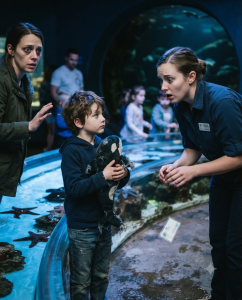
So on a damp Thursday morning, she packed tissues, crackers, Theo’s stuffed orca, and the shreds of patience she had left, and drove them there.
The aquarium smelled the same as always: saltwater, bleach, rubber matting, damp concrete. It was cool and dim inside, full of moving blue reflections and the chatter of school groups. Theo walked beside her quietly, one hand wrapped around the worn black-and-white orca toy that hadn’t left his side since the funeral.
He didn’t smile at the jellyfish.
He didn’t stop at the sharks.
He only paused once, under the long tunnel where silver fish passed above them in one continuous shifting ribbon. Then he kept walking.
Grace followed the map with the determination of a tired woman pretending purpose could still save a day. Tropical reef. Kelp forest. Tide pool touch tank. That was where they ended up when the impossible happened.
The marine biologist running the touch tank was explaining to a cluster of children how to touch sea stars without hurting them. Her voice was calm, easy, practiced. She had rolled sleeves, damp forearms, hair escaping from a careless tie, and a name badge that read DR. NINA HALE.
Grace barely glanced at her. She was focused on Theo, hoping he might show the slightest spark of interest.
Nina smiled at him. “Want to touch one?”
Theo stared at the water.
Grace felt the apology rising automatically. “He’s just—”
Then Theo stepped forward and said, in a small voice that hit Grace like a physical blow, “Uncle Birdie liked the blue ones.”
The species card slipped from Nina’s hand and slapped the floor.
Her face drained white.
“What did he say?” she asked.
Theo repeated only, “The blue ones.”
“The other part,” Nina whispered.
Grace’s stomach clenched.
Birdie.
The nickname was impossible. Daniel’s older brother Thomas had been called Birdie only by family and one childhood friend, Daniel had once told her. Thomas had died at ten, drowning at the old harbor decades before the aquarium had been built over part of it. Daniel rarely spoke of him. When he did, the stories came out damaged, as though memory itself hurt to handle.
Grace had certainly never told Theo. Why would she? The boy had died long before Theo was born.
She turned to her son. “Where did you hear that?”
Theo shrugged like she was asking where rain came from.
Nina’s hands had begun to shake. “Who told you that?”
“The boy near the tunnel.”
There had been no boy near the tunnel.
Grace knew that with absolute certainty.
Nina took a step back. Her throat worked as she swallowed.
“My brother,” she said, “was the only person who called him that.”
Grace felt the room tilt.
Nina looked from Theo to Grace and back again. “Thomas Sullivan was my brother’s best friend.”
Everything slowed after that.
Theo said, “He said you still feel bad.”
Grace asked, “About what?”
Theo answered, “About the shoe.”
Nina closed her eyes like someone bracing for impact.
A shoe. Grace knew about the shoe. Daniel had told her once, years earlier, in the kind of cracked late-night confession that only arrives through whiskey and exhaustion. When Thomas drowned, they found only one shoe. His mother had kept it hidden in a linen drawer for years.
Grace had never repeated that story. Never.
Then Theo said something else. “He said you kept the shell.”
At that, Nina stopped being merely shaken and became devastated.
When she crouched to Theo’s eye level and asked, “What shell?” her voice sounded almost voiceless.
“The one with the red crack,” Theo said. “In your glove box. He said if you still have it, you never stopped waiting.”
Nina flinched so sharply Grace nearly reached out to steady her.
That was when Grace knew this wasn’t chance, or overheard fragments, or a child’s imagination stitched together from adult grief. Theo had touched some hidden wire in this woman’s life and lit up something no stranger should have known.
Nina led them through a staff door behind the touch tank and into a concrete hallway lined with pipes and humming water systems. The sounds of the aquarium faded behind thick walls. Theo walked quietly between them, still holding his orca.
At a gray metal door, Nina stopped.
“My brother was there that day,” she said without turning around. “He was eight. He said Thomas climbed down onto the rocks because something had fallen. Sometimes he said it was a shell. Sometimes he said Thomas wanted to show him something in the water. The story changed every year.”
Grace stood still, every nerve alert.
“My brother died three years ago,” Nina added softly. “Car accident. I thought whatever really happened died with him.”
Theo looked up at her.
“He said it wasn’t the shell,” he murmured.
Nina went still. “What do you mean?”
Theo’s gaze moved to the door. “That’s just what she thought.”
Grace felt a chill move across her skin.
“She?” Nina said.
“There was a girl on the rocks,” Theo said. “He said she saw everything. He said she took the other shoe.”
For a long second, no one breathed.
Then Nina opened the archive room.
It was small and dry, with old framed exhibit plans, newspapers, and photographs from before the harbor became an aquarium. Theo entered like he had somewhere particular to go. He stopped at a black-and-white photograph mounted on the far wall.
It showed a group of children on the old rocks by the harbor. One boy was waving. Another faced the water. Off to one side, half-turned from the camera, stood a girl of maybe nine holding something in her hand.
Something shaped exactly like a child’s shoe.
Nina made a broken sound. “Oh my God.”
A brass plate under the photo listed names. Thomas Sullivan. Aaron Hale. Miriam Vale.
Grace read the girl’s name twice.
“Nina,” she said carefully. “Do you know her?”
Nina didn’t answer immediately.
Then: “She used to volunteer here. Years ago. Before my brother died.” Her voice had gone flat with shock. “She left abruptly. No explanation.”
Grace looked again at the photograph. The girl’s face was blurry in motion, but there was no mistaking the object in her hand.
Theo touched the glass over Thomas’s image with two fingers.
“He said she didn’t mean for him to follow.”
Nina turned to him. “Follow what?”
Theo frowned, concentrating. It was the first time Grace had seen him seem actively engaged with the world since Daniel died. Not cheerful. Not comforted. But present. Listening to something deeper than the room.
“The shiny thing,” he said. “She threw it to scare him. He climbed down after it. Then the rock slipped.”
Grace’s heart pounded so hard it hurt.
Nina covered her mouth again. “Aaron always said Thomas fell.”
“He did,” Theo said. “But not by himself.”
That single sentence rearranged the entire shape of the tragedy.
Nina sank into the nearest chair like her legs had stopped working. “No,” she whispered. “No, if Aaron knew that, why wouldn’t he tell anyone?”
Theo looked at her with a child’s strange calm. “Because she was crying. And because he thought grown-ups would say it was his fault for bringing Thomas there.”
Grace understood then what guilt can do to children. It can turn them into witnesses who guard the wrong person forever. It can make them protect the liar because the truth feels too large to survive.
Nina pressed her palms to her eyes. “Miriam,” she said. “She came to the funeral.”
Grace stared. “Thomas’s funeral?”
Nina nodded. “She stood in the back with her mother. Aaron saw her and started screaming. My dad thought it was grief.” She dropped her hands. “Maybe he was trying to say something.”
The archive room suddenly felt much smaller.
Grace should have left. She should have taken Theo home, called someone, drawn lines around what was happening and refused to cross them. But when Theo had been silent for six weeks and then began speaking in this steady, impossible thread, nothing felt optional anymore.
Nina stood again, shakier this time but determined. She crossed to a filing cabinet in the corner, unlocked it with a ring of keys, and pulled out a thin folder.
“Old volunteer records,” she said. “Please still be here.”
Grace watched her flip through yellowing forms until she stopped.
“Miriam Vale,” Nina said. “Emergency contact… local address.” She looked up. “It’s old, but her mother still owned the bait shop across from the south harbor parking lot when I was a teenager.”
Grace glanced at Theo.
He had gone quiet again, but not shut down. He was listening.
“Should we go there?” Grace asked.
Nina hesitated only a second. “Yes.”
The bait shop still stood, though barely. The sign had peeled into unreadability, and half the windows were papered over from the inside. A bell rang when Nina pushed the door open. The place smelled of dust, cold metal, and old rope.
Behind the counter, an elderly woman looked up from a crossword puzzle.
For one second her expression stayed blank.
Then she saw Nina and all the color went from her face.
“You,” the woman said.
Nina stepped forward. “Where’s Miriam?”
The woman’s hands trembled over the newspaper. “You can’t just come in here after all these years.”
“After all these years?” Nina’s voice sharpened. “My brother died thinking he killed a child. So did Thomas. You don’t get to say that to me.”
Grace held Theo close.
The woman looked at the child, at the stuffed orca, at Grace’s white-knuckled hand around his shoulder. Something in her posture changed then. Not anger. Defeat.
“Miriam lives upstairs,” she said quietly.
The stairs creaked under their weight. At the top, Nina knocked once and opened the door before anyone answered.
The woman inside was in her forties now, hollow-cheeked and sharp-eyed, as if life had carved away everything soft. She looked from Nina to Grace to Theo and then froze.
“I know why you’re here,” she said.
No denial. No confusion. Just exhaustion.
Nina stepped inside. “Then say it.”
Miriam sat slowly at the kitchen table. Her hands were clasped so tightly the knuckles had gone white.
“We were playing on the rocks,” she said. “Thomas had a lucky coin. He kept showing it off. I wanted him to drop it. Just for a second. Just so I could laugh and make him climb.” She swallowed. “I flicked it near the edge. He went after it. Aaron told him not to. Thomas laughed and stepped down anyway. Then the rock shifted.”
Grace could hear every word and still not fully believe them.
Miriam kept talking, as though silence had become impossible now that the truth had finally cracked open.
“When he slipped, Aaron grabbed for him. He missed. Thomas hit the lower rocks and went in. I panicked. I grabbed his shoe because it came off near me. I don’t know why. I think… I think I needed to hold something so I didn’t scream.”
Nina’s eyes filled with tears she didn’t wipe away.
“Aaron saw me with it,” Miriam said. “He started yelling that I made him go down there. I begged him not to tell. I told him it was an accident. I said everyone would hate us. I was nine.”
“And you let him carry that?” Nina asked, her voice shaking with rage. “For the rest of his life?”
Miriam looked at the table. “I told my mother. She said no one needed more pain. She said the boy was gone either way. We gave the shoe back later, left it where they’d find it.” Her breathing hitched. “But Aaron never looked at me the same again.”
Grace understood then why Nina’s brother’s story changed over the years. Trauma had tangled with loyalty and fear until even memory became unstable.
Theo spoke for the first time since they entered.
“He wants you to know Aaron tried.”
Everyone turned to him.
Theo looked at Nina. “He said he still hears the splash because he thinks that means he was too late. But he wasn’t too late. It happened too fast.”
Nina covered her mouth and began to cry.
Not quietly. Not elegantly. The kind of crying that comes from a place too deep to manage.
Grace pulled Theo against her. For the first time in weeks, he leaned back.
Miriam started crying too, but Grace found she had very little room left for sympathy. Nine years old or not, Miriam had chosen silence again and again as she grew older. Aaron had carried the blame into adulthood. Daniel had grown up in a house poisoned by an unfinished tragedy. Thomas’s parents had lived and died with only part of the truth.
Nina eventually lowered her hands.
“My brother deserved better,” she said.
“So did Thomas,” Grace answered.
Miriam nodded weakly. “I know.”
Do you? Grace thought, but didn’t say it.
They left an hour later. Nina took the old photograph from her bag and the copied volunteer file. Miriam’s mother sat downstairs staring at her unopened crossword, as though the letters on the page had become impossible to sort.
Outside, the harbor wind was cold.
Theo stood very still, looking toward the water.
Grace crouched beside him. “Honey?”
He turned to her.
“Is he still talking to you?”
Theo thought for a moment. “No.”
Grace’s chest tightened.
Then Theo added, “I think he just wanted them to know.”
On the drive home, Theo asked for a snack.
It was such a normal request that Grace nearly had to pull over. She handed him the crackers from her bag and listened to him chew in the back seat. Ten minutes later, he pointed out a yellow truck and told her it looked like a toy his dad used to step on in the dark.
Grace laughed and cried at the same time.
Nina called that evening.
She had gone to Aaron’s grave with the red-cracked shell from her glove compartment. She said she’d left it there at last. She also said she planned to tell the remaining Sullivan relatives the truth, gently but completely. No more fragments. No more protected lies.
Grace sat at her kitchen table long after the call ended, listening to Theo hum softly in the living room while arranging his toy whales by size.
Daniel would never know the truth about his brother.
That was the hardest part.
And yet maybe some buried part of him had known all along that the story was wrong. Maybe that was why it had sat in the family like a stone no one could digest. Maybe truth leaves a shape behind even when nobody says it out loud.
Later that night, Theo padded into Grace’s room in dinosaur pajamas and climbed onto the bed.
“Mom?”
It had been so long since he said the word without prompting that Grace almost stopped breathing.
“Yes?”
He lay down beside her and held the stuffed orca between them.
“Dad’s still gone,” he said.
The sentence split her open with its plainness.
“Yes,” she whispered.
Theo nodded against the pillow. “I know.”
Grace pulled him close and kissed his hair.
After a minute, he asked, “Do you think Uncle Birdie was scared?”
Grace swallowed hard. “Probably for a second.”
Theo was quiet. Then: “I think he knows Aaron tried too.”
Grace closed her eyes.
“I think so,” she said.
Theo fell asleep there, one small hand twisted in her shirt. Grace stayed awake, staring into the dark, thinking about children and guilt and the stories families tell to survive. Thinking about how one hidden lie can echo through decades, turning grief into something heavier than sorrow.
Thomas had been failed.
Aaron had been failed too.
And Miriam had spent a lifetime discovering that silence does not erase what happened. It only chooses who carries it.
By morning, Theo spoke again as if language had found its way back through the same mysterious opening it left by. Not fully. Not all at once. But enough.
Enough to ask for cereal.
Enough to ask where his father’s watch was.
Enough to ask whether fish get lonely.
Grace had no explanation she could defend to the world. No version of the day that would sound sensible in a therapist’s office or on paper. Maybe grief had cracked open something strange in her son. Maybe the dead only needed one voice willing to listen. Maybe love and loss bend reality in ways the living still don’t understand.
All she knew was this:
A little boy who had gone silent after his father’s funeral walked into an aquarium and spoke with a dead child’s unfinished memory.
And by the time he was done, the truth had finally surfaced.
Whether that was a miracle or a haunting depended, Grace supposed, on which side of the secret you had been standing all these years.