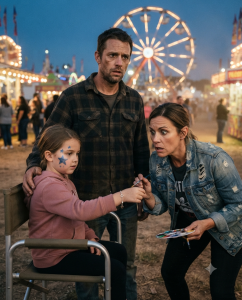
Ryan Keene had never liked county fairs, but grief had turned mild dislike into something sharper.
Everything about the place offended him now. The bright lights. The sticky paths. The music that seemed designed to drown out thought. Happiness at a fair always felt loud, almost defiant, and when you had buried your wife less than three months earlier, defiance could look a lot like cruelty.
But his daughter had asked.
That alone was enough to get him there.
For eight weeks, six-year-old Poppy had moved through the world as if some invisible part of her had gone missing with her mother. She still ate when reminded. Still brushed her teeth if Ryan stood beside her. Still slept, though often in his bed, curled against his side with one hand hooked into his shirt as if she feared waking up alone.
What she did not do anymore was laugh.
Before Elena’s death, Poppy laughed at everything. At dogs in sweaters. At overcooked pancakes. At Ryan mispronouncing cartoon names. She laughed with her whole body, throwing herself into it until Elena laughed too, usually harder.
After the funeral, that sound vanished from the house.
So when Poppy appeared in the kitchen one morning and asked, “Can we go where the lights move?” Ryan understood what she meant immediately.
The county fair had rolled into the edge of town again.
He almost said no. Then he saw the careful hope on her face and said yes instead.
By evening, the fairgrounds were glowing beneath a violet sky. The Ferris wheel turned slowly above the field. The smell of frying oil and spun sugar clung to the air. People moved in every direction, carrying giant lemonades, armfuls of stuffed animals, paper trays loaded with food no one should have eaten without a recovery plan.
Poppy pressed close at first. Then a little farther ahead. Then back again when the crowd thickened. Ryan let her set the pace.
He felt Elena everywhere.
In the glow of ride lights reflected on metal railings. In the sight of little girls with bows slipping loose from their hair. In the booth selling roasted corn, because Elena always insisted that county fair corn somehow tasted better than regular corn and refused to explain why.
His wife should have been there. That fact sat inside him with the hard, familiar weight of a stone.
Elena had gone into surgery expecting to come home.
That was the sentence Ryan had repeated to himself so many times it no longer sounded like language. It had been called routine. Manageable. Straightforward. The doctor had used all the words hospitals loved when they wanted families calm and signatures easy.
Then something happened in recovery.
Then there were complications.
Then hours blurred into alarms and footsteps and staff members saying they were doing everything they could.
Then Ryan was asked if he wanted a chaplain.
Nothing after that had ever felt fully real.
At the fair, Poppy tugged his hand and pointed. “Face paint.”
The booth stood near the Ferris wheel under clipped strands of white lights. A woman in a denim jacket was painting butterflies on one child and a pirate patch on another. Her smile seemed practiced in the best way, warm rather than fake.
Poppy climbed into the chair immediately. “Stars,” she announced. “And maybe moon dust.”
The woman laughed softly and turned toward her.
Then she saw the bracelet.
Ryan noticed the change at once.
Poppy wore a slim silver bracelet Elena had given her before the hospital stay. It was simple, child-sized, elegant in the way Elena liked things to be. Inside, hidden against the skin, was an engraving: E + P.
Elena and Poppy.
The face painter stared at it as if she had seen a hand rise from the grave.
“Where did she get that?” she asked.
Ryan’s answer came out guarded before he even chose the tone. “My wife gave it to her.”
The woman went pale.
She set down her brush with careful fingers, then picked it back up and began painting a blue star near Poppy’s temple. But her hand trembled.
“Do you know my wife?” Ryan asked.
No answer.
He asked again.
Finally the woman said, “What was her name?”
Alarm started low in his body. “Why?”
“Please.”
“Elena.”
The woman closed her eyes. When she opened them, the cheerful booth worker had vanished. In her place was someone older, more tired, and suddenly terrified.
“My name is Mara,” she said. “I was one of the recovery nurses the night your wife died.”
For a second Ryan only stared. Then memory caught up. A woman in scrubs on a late shift. Elena once murmuring that one nurse had stayed kind when others became clipped and distant.
Mara looked at the bracelet again. “That was in Elena’s locked property drawer after she died.”
Ryan felt his throat tighten. “No, it wasn’t.”
“Yes.”
“I took it off my daughter’s jewelry stand myself.”
Mara shook her head once, slowly, as if she hated every word she was about to say. “I’m the one who placed it in the bag with Elena’s wedding ring.”
Poppy turned in the chair, one cheek glittering wet blue. “Daddy?”
He barely heard her.
Impossible was standing three feet away in a denim jacket, speaking calmly.
Then Poppy looked at Mara and said, “Mommy said you cried in the medicine room.”
The brush slipped from Mara’s hand and hit the table.
Ryan looked from one to the other. “What?”
Poppy frowned at the adults for lagging behind. “Mommy said not to feel bad because you stayed.”
Mara’s lips parted. She pressed one hand over her mouth.
Ryan crouched in front of his daughter. “When did Mommy tell you that?”
Poppy touched the bracelet with her free hand. “At night.”
“At home?”
She shook her head.
Children were literal in ways adults forgot. Ryan tried again. “Did you dream it?”
“I heard her,” Poppy said simply.
Mara sank onto a folding stool behind the table.
Ryan should have walked away. He should have protected his daughter from whatever this was. From grief and projection and the dangerous human need to make patterns in pain. But Mara’s face held the look of someone at the edge of a truth she had spent months trying not to name.
“There was a note,” Mara said finally.
Ryan stared at her. “What?”
“In the hospital. Elena gave me something when everyone thought she was slipping in and out too much to speak clearly. I didn’t understand what she was doing at first. Then things crashed fast.”
Mara reached under the table and pulled out a worn canvas bag. From inside, she took a sealed plastic sleeve containing a folded square of pink paper.
Ryan recognized the paper instantly.
Elena bought those little stationery sets from a boutique downtown because she said ordinary notes deserved pretty paper too. She left them everywhere: under coffee mugs, inside lunch boxes, tucked into coat pockets. Sometimes the notes said practical things. Sometimes they were ridiculous. Once she had hidden five around the house just to make him laugh during tax season.
Mara held out the sleeve.
“She told me not to give this to anyone unless I knew for sure what happened mattered,” Mara said. “I told myself I was protecting my job. Then I told myself I was protecting my family. The truth is, I was afraid.”
Ryan took it.
Through the plastic he could already see Elena’s handwriting.
His hands shook so badly he had to step aside from the booth to open it. Poppy stood quietly beside him, suddenly solemn. Mara followed but kept a respectful distance, like someone approaching a memorial she had no right to touch.
Ryan unfolded the note.
The first line hit him like a physical blow.
Don’t let Dr. Vale tell you I signed anything after 9:14. I didn’t.
There were more lines underneath.
If something goes wrong, ask for the medication record from before recovery.
Mara knows where I was when they changed the dosage.
Tell Ryan I didn’t stop fighting.
Tell Poppy I kept the moon.
At the bottom, written more faintly, as if her hand had weakened, was one final line:
He came in after they said visiting hours were over.
Ryan read it twice. Then a third time.
Dr. Vale had been Elena’s surgeon.
Ryan remembered the man perfectly now. Controlled tone. Clean hands. Calm explanations. The exact face of someone who expected to be trusted.
Straightforward procedure, Mr. Keene.
Rare complication, Mr. Keene.
We did everything according to protocol.
Ryan looked up at Mara. “What dosage?”
She took a breath. “There was a post-op medication change entered in Elena’s chart after she came out of surgery. I remember because she reacted badly within minutes. Too sedated, then struggling, then trying to say something. I questioned it, and Dr. Vale said he had adjusted the plan himself.”
“Did she sign anything?”
Mara’s answer was immediate. “No.”
Ryan felt anger cutting through grief like a blade through cloth. “Then why would there be anything in the note about her signature?”
“Because two days later,” Mara said, “risk management circulated a document stating Elena had acknowledged and accepted a revised medication approach after recovery. Her signature was attached.”
Ryan stared.
“I knew it looked wrong,” Mara said. “But not enough to go to court alone. Not against him. Not after they made it clear there had been an internal review and the case was closed.”
Ryan wanted to tear the fairground apart with his hands.
Instead he folded the note back with painful care.
“What happened in the medicine room?”
Mara looked away toward the Ferris wheel. “I cried because Elena was awake enough to know she was in trouble. She wasn’t panicking for herself. She was trying to make me promise that you and Poppy wouldn’t be lied to. I stepped into the medication room because I couldn’t let her see me lose control. She followed me there in the only way she could—by making me come back and listen.”
Ryan heard Poppy’s earlier words again: Mommy said not to feel bad because you stayed.
A chill moved over his skin.
Mara glanced at the bracelet. “When she started declining, Elena pulled that off her own wrist.”
Ryan frowned. “It was Poppy’s bracelet.”
“Yes,” Mara said. “But Elena had it with her. She said she wanted to hold something that belonged to her daughter. She kept turning it over with her thumb. Then she pressed it into my hand with the note and told me if anything happened, I’d know she meant every word.”
Ryan’s mind raced.
At home after the funeral, the hospital had returned Elena’s belongings in a sealed bag. Ryan remembered the wedding ring. The phone. A brush. A cardigan that still smelled faintly of her shampoo until it didn’t. He also remembered later finding the bracelet on Poppy’s dresser and assuming he had put it there in one of those useless blur-hours after the burial.
He had never opened the property inventory carefully enough to notice whether the bracelet was listed.
Grief had made him careless with sequence. With certainty. With nearly everything.
But that still left one impossible question.
“How did it get back to Poppy?”
Neither adult spoke.
Poppy did.
“She told me where it was,” she said.
Ryan looked down. “What do you mean?”
“In the pink box,” Poppy said. “With the ribbons.”
Ryan’s chest tightened.
Elena kept special things in a pink keepsake box in the closet. Cards, hospital bracelets from Poppy’s birth, ticket stubs, a dried corsage, tiny memories she refused to throw away. After the funeral, Ryan had shoved the box onto a shelf because he couldn’t bear opening it.
Three weeks earlier, while cleaning in a numb fog, he had taken the box down. He remembered Poppy sitting on the bed while he sorted through it. He remembered tears, and one of Elena’s old scarves, and finding the bracelet nestled inside tissue paper.
He had thought Elena must have tucked it away before surgery and forgotten.
Had Poppy noticed something then? Had Ryan muttered something aloud without realizing? Had grief filled the gaps and let a child build a bridge where an adult needed one?
Maybe.
But the note in his hand was real. That mattered more than the route by which it had found them.
He turned back to Mara. “Would you testify?”
Fear flashed over her face, but so did relief.
“Yes,” she said. “If you’re ready to hear all of it.”
So they left the fair.
Ryan bought Poppy a paper tray of funnel cake because Elena would have insisted nobody left a fair empty-handed, then carried her to the truck when the sugar and emotion crashed over her all at once. She fell asleep with dried blue stars on her cheeks and one fist still around his shirt.
That night, Ryan called an attorney recommended by Elena’s cousin. By morning, the lawyer had filed an emergency request for Elena’s complete medical record, medication log, and electronic signature history. When the records came, they came redacted, delayed, and defensive.
But not perfect.
The timestamp on the revised medication order had been edited.
The signature attached to Elena’s “consent” came from an earlier intake form.
Security footage showed Dr. Vale entering recovery long after he later claimed he had left the hospital.
And one pharmacy tech, once cornered with dates and logs, admitted off record that an incorrect medication concentration had been pulled and then corrected in the system after Elena crashed.
The case exploded from there.
Risk management stopped sounding polished and started sounding careful. The hospital’s attorneys asked for private meetings. Dr. Vale resigned before the board completed its investigation. Publicly, the statement mentioned “documentation discrepancies” and “deviations from protocol.” Privately, Ryan’s lawyer used more accurate words: negligence, falsification, concealment.
Mara gave a deposition that left her shaking for two days. She described Elena’s clarity, the note, the bracelet, the dosage concern, and the pressure afterward to keep concerns internal. She cried once during testimony and apologized. Ryan’s attorney told her not to. Nobody in that room had the right to ask for cleaner pain.
The settlement came nearly a year later, but the money barely registered.
What mattered was the amended death review.
Elena’s records were corrected.
Her false consent was removed.
The official finding acknowledged that her deterioration followed an improper medication event and that subsequent charting failed to accurately reflect the timeline.
It was not justice in any grand or satisfying sense. Elena was still gone. Poppy still asked for her at bedtime on the worst nights. Ryan still woke up reaching toward a side of the bed that remained cold.
But the lie was gone.
That mattered.
A week after everything finalized, Ryan took Poppy to the cemetery with a blanket, strawberries, and the silver bracelet. She wore it herself and sat cross-legged in the grass, talking to the headstone as if conversation had no reason to stop for death.
“We went to the fair,” she informed her mother. “Daddy was sad and mad, but not at me.”
Ryan let out a breath that almost became a laugh.
Poppy touched the bracelet. “And Mara says thank you for making her brave.”
Wind moved through the trees. Somewhere nearby, someone placed fresh flowers on another grave.
Ryan looked at Elena’s name carved in stone and thought about the last lines in the note. Tell Ryan I didn’t stop fighting. Tell Poppy I kept the moon.
For months, he had treated those words like evidence. Then one day he realized they were also exactly what Elena would have said. Even at the edge of dying, she had been trying to leave them something stronger than fear.
On the drive home, Poppy fell asleep in the back seat.
At a red light, Ryan glanced into the rearview mirror and saw her hand resting near her face, bracelet glinting in the late sun. For the first time in a very long time, the sight didn’t feel impossible.
It felt like inheritance.
He still didn’t know what to do with the part of the story that resisted clean explanation. Whether Poppy had truly heard something no one could account for, whether grief had made certain details travel in ways adults could not map, whether love simply left stronger echoes than medicine or paperwork or locked drawers ever could.
He no longer needed a perfect answer.
The hospital had lied. Elena had tried to tell the truth. Mara had finally helped carry it. Those facts were enough to stand on.
But some nights, when Poppy was half-asleep and the house went soft and quiet, she still touched the bracelet and whispered, “I know, Mommy.”
And Ryan, listening from the doorway, could never fully decide which part of the whole story unsettled him more—
that someone had tried to erase what happened to his wife,
or that Elena, somehow, had refused to let them.
By then, he supposed, the bigger question was no longer whether the dead could leave messages.
It was whether the living were brave enough to listen when they did.