The scissors slipped from Dottie Mayes’ hand the moment the young woman said the street name.
They landed on the wooden floor with a bright metallic snap, but Dottie barely heard it. For one strange second, the sound seemed to come from somewhere far away, as if the little sewing shop on Broughton Street had drifted loose from the rest of Savannah and was floating by itself in the heat.
Overhead, the old ceiling fan clicked in its familiar rhythm. Click. Click. Click.
For eleven years, Dottie had meant to fix that fan. For eleven years, she never had.
Said it kept her company.
Now the sound felt less like company and more like a warning.
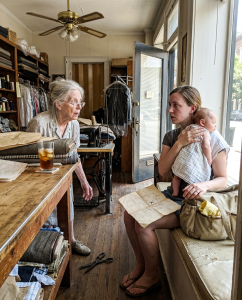
The girl in the window seat looked up, startled by the dropped scissors. She couldn’t have been more than twenty-five. Her dark hair was pulled into a loose knot that had given up hours ago. She had a sleeping baby against her shoulder, a sagging diaper bag at her feet, and the exhausted, sharpened face of someone who had spent too many nights choosing which problem to survive first.
“Did I say it wrong?” she asked quietly.
Dottie could only stare.
Calhoun Row.
No one said that name anymore. No one could. The street had been erased in 1981, flattened and built over until it became the kind of place people drove past every day without suspecting what lay underneath. Children had learned different block names. Property lines had been redrawn. Records had gone missing or been “updated.” Even the people who remembered the old neighborhood had stopped speaking of it aloud, the same way a family stops mentioning a disgraced relative and calls it moving on.
Dottie bent slowly, picked up the scissors, and set them on the cutting table with more care than necessary.
“Where did you hear that name?” she asked.
The girl shifted the baby higher on her shoulder. “I’m looking for it.”
“That’s not what I asked.”
The girl looked down at the folded notebook paper in her hand. She had been taking it out, smoothing it over her knee, studying it, and folding it back up all afternoon. Dottie had pretended not to notice. Pretended not to wonder. Pretended not to feel the old unease building in her chest every time she caught sight of the hand-drawn X in the middle of the page.
Now she understood why.
The girl took a breath. “My mother gave me this before she died.”
Dottie held out her hand. “Let me see.”
There was hesitation there, but only for a second. Then the girl passed over the map.
Dottie knew what it was before her eyes even focused properly. Hand-drawn roads. The church that burned in 1979. Becker’s Grocery with the loading dock. The narrow lane behind the row houses. The dead-end turn. And there, at the very bottom, four small squares representing four houses that no longer existed.
One of them marked with an X.
Underneath, in faint, fading ink, were words that made Dottie’s stomach drop.
For the baby in the yellow blanket.
A memory broke open inside her with such force she had to sit down.
Rain against a porch roof.
Mud on the back steps.
A girl with wild eyes and a baby wrapped in soft yellow cotton.
Please, Miss Dottie. Please don’t make me go back there.
“What’s your mother’s name?” Dottie asked, though she already knew.
“Lena,” the girl said. “Lena Claire Warren.”
Dottie shut her eyes.
When she opened them again, the years between then and now felt thin as tissue.
The girl noticed. “You knew her.”
Dottie looked at the sleeping baby, then back at the young mother in front of her. “I did.”
The girl’s breath caught. “Then tell me.”
Dottie rose and crossed to the front door. The heat outside hit like bathwater gone bad, thick and sticky against her skin. She turned the painted sign from OPEN to CLOSED, slid the lock into place, and pulled the curtain across the glass.
When she turned back, the girl was tense.
“If I meant you harm,” Dottie said, “I would have skipped the sweet tea.”
That got the smallest, strangest little laugh out of her. It disappeared almost immediately, but it was enough to loosen the air between them.
“Sit,” Dottie said.
The girl sat.
“What’s your name, honey?”
“Amber.”
“All right, Amber. I’m going to tell you a story nobody’s asked me for in forty-three years. And once I do, things may not feel simple again.”
Amber looked down at her baby and kissed the top of the child’s head. “Nothing’s felt simple in a very long time.”
That, at least, Dottie believed.
She lowered herself into the chair opposite the window seat and folded her hands in her lap before she noticed they were shaking.
“In the summer of 1981,” she began, “your mother came to my house after midnight carrying you in a yellow blanket.”
Amber’s eyes widened. “Me?”
“You.” Dottie nodded. “You were maybe four months old. Small thing. Didn’t fuss much. I remember that. I kept waiting for you to cry because your mother looked close to collapse, and I thought the sound might finish her. But you just blinked up at me like you were watching a play.”
Amber swallowed hard. “My mother told me I was born in Macon.”
“Your mother told you what she thought would keep you safe.”
The baby stirred at Amber’s breast, then settled again.
Dottie went on. “Lena was soaked through from the rain that night. She had blood on the hem of her gown and mud to her knees. Not enough blood to make me think she’d been stabbed or anything like that, but enough to know she’d climbed or crawled or cut herself getting out in a hurry. Earl wanted to call the police. Lena got so scared when he said it, I thought she’d faint dead away.”
“Why?”
“Because she believed if the police came, they’d bring her back.”
Amber frowned. “Back where?”
Dottie looked at the map again. “To the house marked with the X.”
There was a pause long enough for the fan’s clicking to turn loud.
Dottie could still picture that house exactly: gray paint peeling from clapboard, porch rail split on the right side, shutters hanging crooked, windows too often covered. It sat at the end of Calhoun Row like it was keeping secrets for the rest of the block. People passed it quickly. Even gossip died at that fence line.
“Who lived there?” Amber asked.
“A man named Silas Vane.”
The name meant nothing to Amber at first. Dottie saw that in her face. Then she saw the second thought arrive: if the name meant nothing, why did it sound dangerous?
“He was older than Lena,” Dottie said. “A great deal older. Respected. Wealthy enough. Always pressed and polished in public. The sort of man people called generous because he funded church repairs and scholarship luncheons.” She let out a breath that was nearly a scoff. “In a small city, a polished man can hide behind manners for a very long time.”
Amber’s jaw tightened. “Was he my father?”
Dottie did not answer immediately, and that was answer enough to make Amber’s face lose color.
“Oh my God,” Amber whispered.
“I don’t know what’s written on paper,” Dottie said carefully. “I know what your mother believed. I know what she feared. And I know that when she showed up at my house, she said there were men in that house who would decide your whole life before you were old enough to speak.”
Amber pressed one hand over her mouth.
Dottie looked away for a moment, toward a shelf of thread spools arranged by color. Anything to break the force of the memory. But memory wouldn’t soften just because she wanted it to.
“Your mother had been working there in one of the upstairs rooms,” she said quietly. “That’s what she told me. She never explained every detail, and I was ashamed afterward that I didn’t press harder. I think part of me knew enough without hearing the rest. There were girls in and out of that house, and no one asked why. Not loudly.”
Amber’s eyes filled with horror. “My mother was trapped there?”
“Yes.”
“And no one helped?”
Dottie’s mouth pulled tight. “People help more easily in stories than they do in real life.”
That landed hard because it was true.
Dottie had not stormed the house. Earl had not called a reporter. They had done what frightened decent people often do: the small brave thing instead of the large dangerous one. They had hidden Lena. They had put her on a bus. They had prayed distance would do what courage had not.
“Why are you telling me now?” Amber asked.
“Because you’re here.”
“That’s not enough.”
Dottie met her gaze. “Because your mother is dead.”
Amber looked as if she had been slapped. Dottie regretted the bluntness at once, but not enough to take it back.
“My mother was sick,” Amber said stiffly. “Cancer.”
“I’m sorry for it. Truly.” Dottie softened her voice. “But sickness has a way of forcing truth to the surface. She sent you here because whatever she buried didn’t die with Calhoun Row.”
Amber reached into her diaper bag and pulled out a strip of yellow cloth wrapped around something heavy. She unfolded it in her lap.
A brass key.
Old-fashioned. Solid. The kind made before everything got cheap.
“She left this in a box with the map,” Amber said. “There was also a baby bracelet with no hospital name. And a note that just said, ‘When you have nowhere else to go, find the seamstress with the window seat.’”
Despite everything, Dottie let out a small breath of disbelief. “That sounds like Lena.”
“Do you know what the key opens?”
Dottie stared at it.
Then she looked up sharply. “Did anyone else know about the box?”
Amber hesitated.
That told Dottie more than the eventual answer.
“My mother’s landlord saw me packing after the funeral,” Amber said. “And my ex…” She looked ashamed saying the word, as if it were something she should have prevented. “He came by two nights later asking what my mother left me. He said she’d always acted like she was hiding money. I thought he was just trying to get under my skin.”
“Was he?”
“I don’t know anymore.”
“Did he see the key?”
“No. I don’t think so.”
Dottie exhaled slowly, but there was no relief in it.
Because she remembered something Earl had said the day after Lena left town. He had come back from the bus station with rain still on his sleeves and a tin lockbox wrapped in burlap under one arm.
If that man ever figures out she took this, he’ll tear up half the city looking for it.
Dottie had asked what was inside. Earl had answered, Not something we want in our house.
He would say no more until after dark.
Then, with all the doors bolted and the lamps turned low, he opened it.
Inside were ledger pages.
Names.
Dates.
Amounts.
Initials that were not initials at all once you knew whose business cards sat on church boards and planning committees.
And photographs. Not obscene, but devastating. Men entering the Calhoun Row house at hours they had no reason to be there. Envelopes changing hands. One picture of Silas Vane himself on the porch with a state senator who later made a loud public speech about family values.
Dottie remembered the nausea, the fear, the silence after.
“We should burn it,” she had whispered.
Earl had looked at her as though she had suggested burning a body.
“If we burn it, they win twice,” he said.
“What are we supposed to do with it?”
“Keep it where no one would think to look.”
He had done exactly that.
Then life had gone on, the way life obscenely does. Calhoun Row was demolished. Silas Vane died six years later of a stroke at a charity dinner. Two of the names on the ledger were buried with honors. Another moved to Atlanta and became something important enough that his obituary ran with a photograph. Earl passed in 2009. Dottie never told a soul what still sat hidden because with each passing year it seemed more ridiculous and more dangerous at once.
Now Amber sat in front of her holding the key to that past in both shaking hands.
“My mother told me almost nothing,” Amber said. “She only said there was a place I came from that people paid to forget. I thought she meant it metaphorically.”
Dottie barked out a dry laugh. “No. She meant it exactly.”
Amber wiped at her cheek. “Then why keep proof all this time? Why not expose them?”
That question had teeth.
Dottie answered honestly. “Because your mother wanted you alive more than she wanted justice. And because Earl and I were not heroes. We were scared, and some of those men were powerful.”
Amber looked down. “I drove here with twenty dollars in my purse and a car that overheats in traffic. I am not exactly a hero either.”
“No,” Dottie said softly. “But you came anyway.”
That mattered.
Amber looked at the map once more. “The X. If the house is gone, then where—”
“It isn’t under the house.” Dottie stood.
Amber rose too, baby and all, her whole body taut with alarm and hope.
Dottie crossed behind the cutting table and knelt by a lower cabinet. From the back, beneath folded muslin and an old tin of buttons, she pulled out a ring of keys that had not seen daylight in years.
The sound of them made her stomach tighten.
“Earl hid the box after Lena left,” she said. “Not at our home. Not at the bank. Somewhere no one would think important, somewhere men like Silas Vane would dismiss as women’s clutter.”
Amber’s eyes tracked the keys. “Here?”
Dottie gave a small nod.
“In the shop?”
“In the old workroom behind the storage hall. There’s a cedar chest built into the wall. False bottom.”
Amber stared, then almost laughed from sheer disbelief. “You’ve been sitting on this for forty-three years?”
Dottie looked at her flatly. “Mostly I’ve been hemming pants.”
That broke the tension just enough for Amber to exhale.
Then Dottie’s face turned grave again.
“I need you to understand something before we open it. If those papers are still there—and I believe they are—then this is not just family history. This is evidence. Old evidence, yes, but names don’t stop mattering because time passes. Some families would still kill to keep their fathers or grandfathers polished.”
Amber’s arms tightened around the baby. “You think someone knows I came here.”
“I think someone may have known your mother feared this day.” Dottie’s eyes dropped to the yellow cloth in Amber’s lap. “And I think grief makes people careless. People talk at funerals. They watch who leaves with boxes.”
Amber went pale. “My ex called twice on the drive.”
Dottie’s spine stiffened. “Did you answer?”
“No.”
“Good.”
She led Amber past the sewing tables, through the curtain at the back, into a narrow hallway lined with old dress forms and shelves of fabric bolts wrapped in plastic. The shop smelled different back there—cedar, starch, old paper, and time.
At the end of the hall stood a narrow door painted the same cream as the wall, easy to miss unless you already knew it was there.
Dottie fitted one key after another into the lock until one finally turned.
The room beyond was small and dim. A single high window let in a strip of bruised afternoon light. There were three old mannequins, a stack of hatboxes, a rusted ironing frame, and against the far wall, a cedar chest built into a recessed alcove beneath shelves of patterns.
Amber stepped inside as if entering a chapel.
Dottie crossed to the chest and knelt. Her fingers knew where to press. Earl had shown her once, then made her repeat it with her own hands until she could find the seam without looking. She lifted the panel.
Underneath was a metal box, gone dark with age.
Amber made a sound that was half gasp, half sob.
“It’s really here.”
Dottie sat back on her heels. “Looks that way.”
Amber shifted the baby to one shoulder and reached into the diaper bag for the brass key. Her hands shook so hard she missed the lock on the first try. Dottie steadied the box. Together, without speaking, they got the key in place.
It turned with resistance, then a dull click.
Neither woman moved.
Finally Amber whispered, “Open it.”
Dottie lifted the lid.
Inside, wrapped in oilcloth, were papers tied with string, several envelopes, a thin stack of photographs, and on top of everything else, a note in Earl’s handwriting.
L.C. was telling the truth.
Amber stared at the words and began to cry without sound.
Dottie touched the note with one finger. Earl’s blocky handwriting looked impossibly alive.
Beneath it lay the ledger pages.
The first name Amber read aloud made Dottie’s blood run cold, because unlike Silas Vane, that man wasn’t dead at all.
He was eighty-two now, but still living in Savannah, still appearing at ribbon cuttings, still smiling from fundraising pages, still celebrated as one of the city’s last old benefactors.
Amber looked up, eyes wide with horror.
“He’s alive.”
“Yes,” Dottie said.
Amber turned another page. Then another. The names spread outward into banks, permits, church boards, judges’ chambers, campaign committees. Men who had protected one another. Men whose sons now sat in offices their fathers once occupied.
At the bottom of the stack, folded smaller than the rest, was a birth certificate application never fully processed. It listed the child only as Baby Girl Warren.
Father: left blank.
Attached to it, tucked into the same sleeve, was a short letter in Lena’s handwriting, addressed to whoever found the box.
If Amber ever opens this, tell her I loved her enough to lie.
Amber pressed the heel of her hand to her mouth.
Dottie let her cry.
When Amber finally lowered the paper, her face had changed. There was grief in it, yes, but also the beginning of something harder.
“What do I do with this?”
Dottie was about to answer when both women froze.
From the front of the shop came three soft knocks.
Not the loud rap of delivery men. Not the cheerful tap of Mrs. Beaumont dropping off another hem. Three measured knocks, polite enough to feel threatening.
Amber’s head snapped toward the hallway.
Dottie’s pulse kicked.
No one should have been knocking. The sign had been turned. The curtain was drawn. Most customers, seeing the lock, would simply leave.
Then came a man’s voice through the layers of wall and fabric.
“Miss Mayes? I know you’re in there.”
Amber’s face went white.
Dottie recognized the voice—not from friendship, but from years of hearing it at Chamber of Commerce holiday events, from newspaper interviews, from public speeches made by a man too polished to ever sound hurried.
She turned back to the open lockbox, to the ledger pages, to Earl’s note and Lena’s letter.
Then she looked at Amber and understood that the past had finally done what it had threatened to do for forty-three years.
It had come to collect.
Dottie moved fast for a woman her age. She shoved the papers back into the box, closed the lid, and put both hands on Amber’s shoulders.
“Listen carefully,” she said. “Your mother was right to run. She was right to hide. But she was wrong about one thing.”
Amber’s eyes were huge. “What?”
Dottie’s jaw set as the knocking came again, harder now.
“She thought she was alone.”
In the front room, the man called her name one more time.
This time, another voice answered beside him.
And Dottie recognized that one too.
By the time she realized which family had come to the shop door, she understood exactly how far this secret had traveled—and that keeping Amber safe would mean doing the one thing she and Earl had been too frightened to do all those years ago.
Tell the truth.
They gave the box to a lawyer before sunset.
Not just any lawyer. Dottie called her late husband’s niece, Renee Talbot, who had spent twenty years taking ugly cases nobody else wanted. Renee arrived in jeans, no makeup, and enough anger for three people. She took one look at the ledger, the photographs, the unsigned birth record, and Lena’s letter, then looked at Dottie like an answer to an old prayer had finally staggered through the door bleeding.
“You should have called me years ago,” Renee said.
“I know,” Dottie replied.
Renee didn’t waste time punishing her for it. By nightfall, copies had been made and placed in three separate hands. One set went to a reporter in Atlanta with no loyalty to Savannah’s old names. Another went to a federal investigator Renee trusted from a corruption case five years earlier. The third stayed locked in a safe deposit box under Amber’s name.
When the polished old benefactor who had knocked on the shop door learned the papers were no longer in one place, his confidence broke before the week did.
By the end of the month, two families had issued statements denying knowledge of “historic allegations.” One retired judge left town abruptly. A former state senator’s son threatened defamation, then went silent when the photographs surfaced. Records connected to Calhoun Row—permits, code complaints, unexplained police visits—began emerging from archives people swore had already been searched.
Silas Vane had been dead for decades, but death turned out not to be protection when the living were still profiting from his silence.
Amber gave a statement. So did Dottie.
It was ugly. It was public. It dragged old men’s names and their children’s names into the same light. Some people called Amber brave. Others called her opportunistic. A few suggested Lena had made everything up for money, though there was no money in any of it, only wreckage and delayed truth.
That was how Savannah worked. Beauty in front, rot underneath, and outrage reserved for the person who lifted the rug.
The biggest surprise came six weeks later.
A woman from North Carolina contacted Renee after reading one of the articles. Then another from Jacksonville. Then a third from Mobile. Different ages. Different stories. Same house. Same man. Same circle of polished names. Lena had not been the only one who ran. She had simply been one of the few who managed to leave with something that could prove it.
That changed everything.
The investigation widened. Dead men couldn’t be tried, but living facilitators could. Financial crimes tangled with trafficking records. Bribery surfaced in demolition approvals. The city’s old explanation for Calhoun Row’s disappearance unraveled piece by piece until everyone could see what had really happened: a neighborhood had not just been torn down for development. It had been buried to erase a route to a house too many important men needed forgotten.
Amber learned the truth about her birth in increments, each piece cruel in its own way. Silas Vane had almost certainly been her biological father. Lena had likely understood that and left the line blank to deny him the last form of ownership available to him. The hospital bracelet with no hospital name turned out to be from a maternity home used off-record by women connected to Vane’s network. Lena had never invented Macon out of whim. She had built a false beginning for Amber because real beginnings can become weapons in the wrong hands.
For a while, Amber hated her for the lies.
Then she read Lena’s letter again.
Tell her I loved her enough to lie.
It was not a perfect sentence. It did not erase the damage. But it told the truth in the only language Lena had been left: fear translated into protection.
Months later, Amber came back to the shop with her daughter on her hip and a different look in her face. Still tired. Motherhood saw to that. But less hunted. More anchored.
The fan was still clicking overhead.
“You still haven’t fixed it,” Amber said.
Dottie snorted. “At this point it dies when I die.”
Amber laughed, and the sound warmed the whole room.
Outside, Savannah kept doing what old cities do: hosting weddings under Spanish moss, selling ghost tours to tourists, pretending history was charming when it was actually ravenous. But some things had changed. A memorial marker was proposed for the erased blocks of Calhoun Row. Not everyone wanted it. Of course they didn’t. Memory is expensive for people who inherited comfort from someone else’s cruelty.
Still, the marker went up.
It wasn’t grand. Just stone and brass and names where names could be recovered, with a simple line at the bottom for the ones who had been hidden on purpose.
For those erased, and for those who escaped.
Amber took her daughter there on a cool morning in October. Dottie went with her, leaning on a cane she pretended not to need. They stood together in the thin sunlight while traffic moved along the road that had been laid over old porches, old steps, old fear.
“Do you think my mother would have come back if she’d lived longer?” Amber asked.
Dottie thought about it.
“No,” she said at last. “I think she’d have wanted to. But wanting and surviving aren’t always friends.”
Amber nodded, eyes on the marker.
Then she said, “I used to think the biggest red flag was the lies. Now I think it was how many people benefited from them.”
Dottie looked at her and felt, not peace exactly, but something earned in its direction.
“That’s the thing about evil,” she said. “The monster isn’t always the worst part. Sometimes it’s the people who keep his seat warm after he’s gone.”
Amber was quiet for a while after that.
Then her little girl reached one small hand toward the brass letters on the stone, and Amber caught her before she touched them. She laughed softly, tears bright in her eyes, and kissed the top of the child’s head.
For the baby in the yellow blanket, Dottie thought.
All those years, that line had sounded like a warning. In the end, it turned out to be a promise.
The truth had come late. Too late for Lena. Too late for Earl. Too late for every girl who never got to keep proof long enough to use it.
But not too late for Amber to know who had lied, who had watched, who had paid, and who had loved her fiercely enough to carry both terror and hope in the same shaking hands.
And maybe that was the part people never talked about when they spoke of justice.
It doesn’t always feel clean.
Sometimes it feels like grief with paperwork.
Sometimes it arrives in a seamstress’s shop under a broken fan in the third week of June.
Sometimes it looks less like triumph and more like two women standing where a street used to be, wondering whether forgiveness belongs to the dead, whether cowardice and survival are cousins, and how many polished names it takes to bury a child’s beginning.
Dottie never did answer that last question.
But she stopped pretending the city didn’t know.
And the fan kept clicking, overhead and stubborn, like a witness that had finally decided to speak.