By the seventh rejection, Norah Daly had stopped hoping the men of Red Bow would at least try to hide their disgust.
They didn’t.
They let it show in every glance that slid too quickly over the scars on her hands, every pause before her name, every conversation that lowered when she passed and rose again after she was gone. They had built a whole story around her without her permission. Poor Norah. Damaged Norah. Unlucky Norah. The girl who had dragged her father out of a burning house and still somehow failed him.
By the time Amos Weaver rejected her in the general store, the words should not have hurt anymore.
But pain had a way of finding fresh places to land.
“My mother needs a healthy wife,” he had said, not looking at her. “A whole woman.”
The room had gone still. Norah had felt every eye in it. Widow Higgins behind the pickle jars. The men by the stove. The ranch hands pretending not to stare. For one helpless second she had seen herself through all of them at once: scorched skin, patched dress, no family, no land, no future anyone wanted to claim.
Then her anger rose up and saved her from humiliation.
“Tell your mother to buy a mare,” she snapped. “It might frighten her less.”
The laughter that chased Amos into the street was not for her, but it didn’t belong to her either. Nothing in Red Bow did. Not anymore.
She carried her basket back through the heat, past the saloon porch and the church with the white paint peeling off the frame, past the women who pitied her and the men who judged her, until she reached the boardinghouse alley where she rented a narrow room and earned part of her keep doing wash.
When the line snapped and the wet blankets fell into the mud, the cowboys on the rail above laughed like God had arranged the moment for their entertainment.
“Fire Bride needs a hand.”
Norah knelt and gathered the blankets without a word. She refused to give them tears. She refused to give them a plea.
That was when the shadow fell across the alley.
Gideon Cross had arrived in town that morning, and his presence had spread through Red Bow faster than a brushfire in dry grass. Some said he trapped wolves in the Bitterroots. Some said he had killed a man in Helena. Some said he only came down from the mountains when he needed salt, bullets, or something too heavy to haul alone.
He was huge, scarred, and silent. The sort of man children hid behind skirts to avoid and grown men watched with one hand close to a holster.
Norah rose with a washing paddle in her grip.
“If you came to laugh,” she said, “come closer.”
His gaze moved to the paddle and back to her face.
“I came to ask you to marry me.”
The bitterness in her laugh surprised even her.
He didn’t flinch.
“I heard seven men turned you down,” he said.
“And you came to be number eight?”
“No. I came because they’re cowards.”
She lifted her burned arm.
“This is what they see.”
He rolled up his sleeve and showed her the deep pale ridges crossing his own forearm.
“Scars don’t make you less,” he said. “They prove you lived.”
No man in Red Bow had ever spoken to her that way. Not as if the marks on her skin meant strength instead of shame.
Then he dropped a leather pouch of coins onto the wash bench.
“That clears your debts,” he said. “There’s room in my cabin. We leave at dawn.”
She should have laughed again. Should have thrown the coins back at him. Should have asked what kind of fool married a stranger and rode into the mountains with a man everyone feared.
Instead, she looked at the faces above her in the alley. At the cowboys. At the boardinghouse window where Mrs. Pike was pretending not to watch. At the life waiting for her if she stayed.
Then she looked at the man who had just offered her danger without pity.
By morning, she had chosen danger.
The ride into the Bitterroots taught her two things immediately. First, Gideon Cross wasted no words. Second, he expected competence, not gratitude. He did not fuss when the trail turned treacherous. He simply told her where to place her horse and trusted she would listen. He did not take her reins. He did not reach for her elbow when she dismounted. He did not stare at her scars.
It was strange how quickly respect could feel more intimate than kindness.
The valley where he lived seemed cut away from the rest of the world. Pine crowded the ridges. Wind curled down through the stone passes. The cabin stood in a clearing, broad and low and built to survive things softer houses could not.
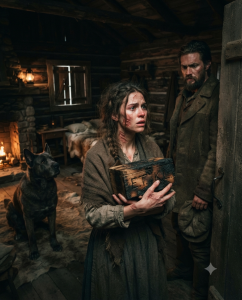
A dog the size of a calf came roaring out from under the porch. Norah stood her ground. Gideon gave one command and the animal fell silent.
“Scrap,” he said. “He bites trespassers.”
“Good,” Norah answered, though her pulse was pounding.
Inside, she found a home stripped to essentials: one large bed, a table scarred by knives and work, tools, rifles, sacks of flour, bundles of herbs drying from rafters, iron pots blackened by years of use. It looked less like a place someone lived in and more like a place someone defended.
That first night Gideon told her she could take the warm side of the bed and he would not touch her unless invited. The words were plain, almost brusque, but they eased something in her chest that had been clenched since they left Red Bow.
Days settled into a hard rhythm. Norah learned the paths around the valley, how to split kindling one-handed when the old scars in her left wrist tightened, how to snare rabbits, how to grease boot seams against meltwater, how to read weather from the shape of clouds snagged on the ridge. Gideon watched without hovering. When she got something wrong, he corrected her the same way he corrected himself: directly, without mockery.
At night, they ate by the fire. Sometimes he spoke of trapping lines or winter stores. Sometimes he said nothing for an hour. Yet the silence between them stopped feeling hostile. It became a thing with shape and warmth, like a blanket neither of them had to mention.
Norah started noticing the small proofs of his nature. The way he fed Scrap before he fed himself. The way he left dry wood stacked by the back door so she wouldn’t have to step into deep snow in the morning. The way he turned his face aside whenever she worked bare-armed near the hearth, as if giving her privacy mattered more than his curiosity.
And yet there were other things. A locked drawer in the table. A rifle cleaned every night even when no trouble had shown itself. The way he sometimes stood on the porch after dark, listening down the valley like a man who expected someone to come.
The truth appeared on the sixth night.
She was sweeping under the bed when the broom hit something solid. A small lockbox wrapped in canvas and tied with rawhide. One corner of it was blackened, as if burned. She would have put it back if not for the initials carved into the lid.
T.D.
Thomas Daly.
Her father.
By the time Gideon entered the cabin with an armload of firewood, the box sat in the center of the table and Norah stood behind it like a sentry.
The look on his face changed at once.
“Tell me why my father’s initials are on this,” she said.
He set the wood down slowly.
“I was there the night your house burned.”
Everything in her went cold.
For years, Red Bow had told the story one way. A lantern overturned. Curtains caught. Bad luck. Nothing suspicious. A tragedy nobody could have prevented.
Norah had clung to that version because the alternative was unbearable.
“You’re lying.”
“I’m not.”
He didn’t move toward her. Didn’t soften his tone. He spoke like a man who knew the truth would do damage whether he wrapped it gently or not.
“He sent for me a month before the fire,” Gideon said. “Your father had concerns about a land claim and wanted a witness he trusted. I was trapping north of the river. By the time I got there that night, the house was already burning.”
Norah’s hands trembled around the edge of the table.
“My father never told me about any land claim.”
“Because he didn’t want you in danger.”
She stared at him. “Danger from who?”
Gideon looked at the box.
“Open it.”
Inside lay folded papers, a silver watch, and a cloth bundle tied with faded blue thread. The first paper was a deed. Not to the little house lot she had assumed had died with her father, but to a parcel of timberland west of Red Bow. Valuable land. River access. Good pine. Enough to change a person’s life.
Beneath it was another document with seven names.
Norah read them once. Then again.
Sheriff Bell. Amos Weaver’s uncle, Harlan. Two councilmen. The livery owner. A banker. Widow Higgins’s brother.
Seven men from Red Bow.
Each signature sat beneath a proposal to buy her father’s timber rights for a price so insulting it made her stomach lurch. At the bottom, in her father’s handwriting, were three hard words:
Refused. All seven.
Norah looked up, her pulse slamming.
“They tried to cheat him.”
“Yes.”
“And after he refused—”
Gideon’s silence finished it.
“No.” The word tore from her throat. “No.”
“I can’t prove who lit the fire,” Gideon said. “Not yet. But I know someone came back after the flames started. They were looking for this box. Your father shoved it into my hands before the roof gave way. He told me to keep you alive and keep these papers hidden until I knew who could be trusted.”
“You let me believe it was an accident.”
His face hardened with something that looked too much like regret.
“You were seventeen. Alone. And surrounded by the very people who wanted that land. If they knew the papers survived, they would have married you off, manipulated you, or buried you before spring.”
The room blurred. Suddenly every pitying look in Red Bow looked different. Every proposal. Every whispered conversation. Every kind offer to “help place” her. They had not been trying to save her from winter.
They had been waiting for a way to get their hands on what belonged to her.
A pounding on the cabin door cut through the silence.
Scrap rose with a growl so low the floorboards seemed to vibrate.
Another knock came, harder.
“Norah!” a voice shouted through the wood. Sheriff Bell.
She looked at Gideon in shock.
He crossed to the wall and took down his rifle.
“They tracked me from town,” he said. “Or they guessed where the papers went once they heard I’d married you.”
“Married me?”
Gideon’s jaw shifted. “I filed it in Missoula before we rode out. Legal and witnessed.”
Fury flashed through her, hot and sharp, but it had to wait. Hoofbeats sounded outside. More than one horse.
Sheriff Bell shouted again. “We only want to talk.”
“That’s a lie,” Gideon said.
Norah stared at the papers in her hands, then at the rifle by the hearth. Her whole life Red Bow had told her she was unwanted, helpless, unfortunate. But if that were true, seven powerful men would never have spent years circling her father’s ashes.
Her father had died refusing to give them what was his.
They had underestimated his daughter.
“What do I do?” she asked.
Gideon met her gaze. “Decide whose daughter you are.”
Something in her settled.
She shoved the papers into the front of her dress, grabbed the second rifle, and moved beside the window.
The men outside called for peace, for reason, for common sense. Then someone tried the latch.
Scrap lunged against the door with a sound like judgment.
The first shot splintered the frame, but not from inside. Gideon fired over the porch roof, close enough to make the horses rear and the men curse. It bought them seconds.
“Back cellar,” he said. “Now.”
“No.” Norah’s voice surprised even her. “If we hide, they burn us out.”
His eyes narrowed. It was not disagreement. It was recognition.
Together they moved to the front room. Norah yanked the door open before the men outside expected it. Sheriff Bell stood there with his hand half-raised, two others behind him, and Amos Weaver further back with fear all over his face.
Norah leveled the rifle.
“You took enough from my family.”
Bell’s expression changed instantly, false concern sliding over greed.
“Girl, put that down. We’re here to protect you from Cross. He’s filled your head with stories.”
“Stories?” She pulled the deed from her dress and held it high enough for them to see. “Then why did seven men offer my father dirt for land worth ten times as much?”
Amos went pale.
Harlan Weaver cursed under his breath. One councilman reached for Bell’s arm, but it was too late. Their faces had confessed before their mouths could.
Bell tried one last smile. “This can still be settled quietly.”
Norah laughed, and the sound cut the cold air.
“That’s what you wanted from the beginning, isn’t it? Quiet. A dead man, a scarred daughter, and no witnesses.”
She saw it then, the exact moment the sheriff realized she was not frightened enough to be managed.
He stepped for his gun.
Gideon fired first, knocking the weapon from Bell’s hand and driving all three men backward in panic. Scrap exploded through the doorway, teeth bared, chaos following him. Horses screamed. One man fell. Another fled for the trees.
Amos didn’t run.
He stood frozen, staring at Norah as if seeing her for the first time.
“I didn’t know,” he stammered. “I swear it.”
She believed he hadn’t known everything. But he had known enough to reject her in public and leave her for the same wolves now circling her cabin.
“Go home,” she said. “And pray you stay there.”
By dawn, Bell was bleeding but alive, disarmed and tied. One councilman had broken a wrist. The others had fled down-valley in the dark. Gideon took Bell to Missoula under guard two days later, and this time there were witnesses enough, papers enough, and rumors enough that the matter could not be smothered. Once the deed surfaced, more truths followed. The banker admitted the pressure campaign. Widow Higgins’s brother cracked under questioning. The livery owner talked to save himself. No one proved in a court of law who set the fire, but everyone in the territory knew why Thomas Daly had been targeted.
Norah inherited the timberland legally before spring.
She could have sold it. Could have gone east. Could have bought herself a proper house in a town where no one knew her face.
Instead, she rode down to Red Bow one final time with the deed in her saddlebag and Gideon at her side.
People stared. Of course they stared. But now it was uncertainty, not pity.
Widow Higgins tried to speak to her on the boardwalk. Norah walked past.
At the general store, Amos Weaver stood near the flour sacks and lowered his eyes the moment he saw her. For once, shame seemed to fit the right person.
She posted notice of ownership on the old board by the church. Terms for lawful timber leases. Payment rates. Boundaries. Trespass consequences.
Then she turned and left without offering anyone forgiveness they had not earned.
Back in the valley, the snow thawed in silver threads down the ridge. Norah and Gideon repaired fence, cut spring wood, argued over where to plant a kitchen patch, and learned each other slowly. He apologized for marrying her on paper without consent. She told him if he ever made such a choice for her again, the scars on his arm would not be the last ones he carried. He nodded as if that were perfectly fair.
Months later, when she finally chose to take his hand in bed instead of merely sharing the mattress, he moved toward her with the same care he used handling a wounded animal that had decided, at last, not to bite.
People would later say Gideon Cross saved Norah Daly.
They were wrong.
He offered her a door. That was all.
Norah was the one who walked through it, opened the box, faced the men who had built a life on her silence, and discovered the truth none of them had ever wanted her to know: she had never been the damaged thing they pitied. She had been the threat they feared.
And if there was any bitter comfort left in that, it was this:
The biggest red flag had never been the scars on her hands.
It had been how quickly a whole town agreed to treat them as if they meant she deserved less.