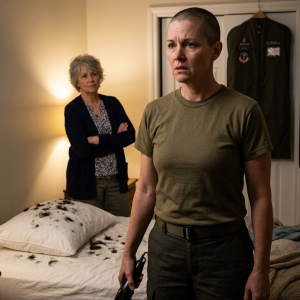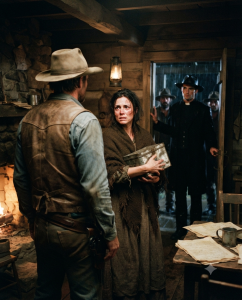
When Leora Vance arrived at the Bitter Hollow station, the first thing people noticed was the shawl.
It was wrapped tightly over the left side of her face despite the lingering heat of the day, pinned beneath her chin with trembling fingers, the fabric darkened in one corner where tears and smoke had dried together. The second thing they noticed was the tin box in her lap. It was small, worn, ugly even—nothing a woman would cling to unless what was inside mattered more than comfort, pride, or survival.
Nobody guessed just how much.
The station smelled of wet wood, coal dust, and old waiting. Leora sat on the narrow bench beneath the tin awning and kept her eyes lowered to the floorboards. She had been there three hours already. Her back ached. The burn on her cheek throbbed with each beat of her heart. Smoke still clung to her skin and hair no matter how many times she had tried to wipe it away with the corner of her shawl.
Across from her, townspeople watched in that cautious way people watched suffering when they feared it might demand something from them.
A woman near the ticket window leaned toward another and whispered, not quite quietly enough, “I heard she walked into the fire herself.”
“Don’t say that,” the other replied, though not with outrage. More with discomfort. “That’s Reverend Brock’s wife.”
The first woman sniffed. “Which is exactly why I doubt the rest. Elias Brock is a good man.”
Leora closed her eyes.
A good man.
She had heard the town say it for six years.
A good man who read Scripture with a trembling voice. A good man who remembered every widow’s name. A good man who pressed loaves of bread into poor families’ hands and told them the Lord would provide. A good man who preached about mercy while studying the faces of young girls a beat too long whenever the light caught them softly.
When Leora first married him, she had believed every word the town said. She had believed herself blessed. Her own father had called Elias Brock a rising pillar of the county—a man of influence, conviction, and spotless faith. He was older than she was, polished in speech, patient in public, deliberate in everything. When he courted her, he brought books, fresh pears, and prayers for her mother’s health. He never raised his voice in front of others. He knew precisely how to appear gentle.
The first time he hurt her, he apologized.
The second time, he quoted Scripture.
By the third, he had taught her the most dangerous lesson of all: cruelty delivered calmly was harder for anyone else to believe.
The train to Larksburg County was supposed to have arrived at two in the afternoon. Then the stationmaster said there had been a delay. At four, another delay. By dusk the sky turned purple over the tracks, and the cold settled in with a warning bite. Leora’s stomach knotted harder with every passing minute.
She had escaped only because Elias thought the fire would finish what the locked door had started.
It nearly had.
The room behind the church had once been used to store hymnals and extra candles. In recent months Elias had begun locking her in there whenever his temper needed privacy. He called it a place for prayer and reflection. The first time, he left her overnight with no food. The last time, he poured kerosene beneath the door and told her through the wood that some women became holy only after the Lord burned away their rebellion.
She still didn’t know whether the scream that brought help had been hers or the stable boy’s who smelled smoke first. In the chaos, while the congregation raced with buckets and shouted for blankets, Leora had crawled through a broken rear window, clutching the tin box she had hidden under the floorboard days earlier.
She had not stopped running until Bitter Hollow.
Now even that refuge was disappearing.
The station door opened behind her with a scrape.
Bootsteps crossed the floor and halted nearby.
“You waiting on the Larksburg line?”
The voice was male, low, and unhurried.
Leora didn’t look up.
“It won’t be coming,” he said. “Bridge at Copperhead Pass gave out in the storm. Three days before they run another train.”
For a moment she felt nothing at all. Then the meaning struck.
Three days.
Too long.
Elias would send men searching as soon as the fire and confusion settled. He would tell the town his injured wife had wandered off in hysteria. He would send church deacons, ranch hands, anyone loyal enough to retrieve her quietly. By midnight he could be standing right where this stranger stood.
Leora rose too fast, swaying. The stranger moved only enough to give her room.
When she finally looked at him, she saw a man in a weathered coat with rain-dulled boots and hands scarred from real work. He had a face browned by sun, the rough beard of someone who lived more with cattle than company, and gray eyes that didn’t pry.
“My name’s Rhett Calder,” he said. “I live ten miles north. I’ve got a spare room.”
Leora stared.
“I don’t have money.”
“I didn’t ask.”
“I can’t tell you who I am.”
“You don’t have to.”
She tightened her grip on the tin box. “Why?”
The station seemed to hush around them. Even the whispering women fell silent, pretending not to listen.
Rhett glanced once at the others in the room, then back at her. “Because nobody else is helping you.”
The words were plain. No charm. No persuasion. No holy varnish.
That was what made them dangerous.
It had been so long since anyone said something honest to her that she didn’t know what to do with it. Yet when she looked into his face, she saw none of Elias’s carefully hidden appetite. No smugness. No performance. Just a man who had seen fear before and understood it could not be argued with.
So she nodded once.
Outside, evening swallowed the last light. Rhett mounted first, then helped her onto the bay horse behind him. He never touched more than necessary. As they rode north, the wind lifted the edges of her shawl and sent pain across the ruined side of her face. She bit down on a sound and held the tin box tighter.
Rhett’s cabin stood alone in a stand of cottonwoods, with a narrow corral to one side and a woodpile under a lean-to roof. It was not much to look at, but it was clean. There was stew simmering on the stove and blankets folded neatly at the foot of the bed. A rifle hung above the mantle. Two mugs sat upside down near the sink like he rarely expected guests but kept space for possibility.
Leora stood just inside the door, drenched in caution.
“You can eat first,” Rhett said.
He filled a bowl and set it on the table. Then he served himself and sat across from her without staring. She noticed that before taking his first bite, he turned slightly aside, as if giving her the privacy of not being watched while she devoured food like someone who had known hunger too intimately.
She hated how much that kindness shook her.
Later, when he told her to take the bed, she refused. He insisted with the same calm certainty and spread his own blanket on the floor by the hearth. He did not ask to see her burns. He did not ask why she startled in her sleep. He did not ask about the box.
The next morning he was gone before dawn to tend his fence line. Leora woke in panic, thinking for one awful second she had imagined the cabin, the stew, the locked door. Then she heard chopping outside and smelled coffee. Her chest loosened by a fraction.
That became their pattern.
Rhett worked. Leora moved quietly through the cabin trying not to look like a person expecting to be thrown back into the fire. On the second day she swept the floor. On the third she mended a shirt from his sewing tin and washed dishes he would have washed himself. She found herself counting peaceful things: the scrape of his boots at the door, the creak of the porch step, the sound of a horse snorting in the cold. Harmless noises. Ordinary noises. Not a key turning in a lock.
Rhett noticed more than he let on.
When she flinched at raised voices from a distant pair of drovers on the road, he closed the shutters. When he saw her struggle to lift a kettle because of the burn stiffness in her arm, he moved it without comment. Once, as she reached for the shawl after it slipped, he stopped midway through entering the room, turned around, and knocked on his own doorframe before coming in again.
No one had ever been that careful with her pain.
That scared her too.
On the third night, a storm rolled over the hills and hammered the roof with rain. The cabin glowed gold inside, the kind of warmth that made truths feel less impossible to speak. Leora sat at the table with the tin box before her. She traced the dent in the lid with one finger while Rhett waited by the stove.
“My husband is Reverend Elias Brock,” she said at last.
Rhett set down the mug in his hand.
“He locked me in a room behind the church and set it on fire.”
He didn’t rush toward her. Didn’t fill the silence with outrage. He just asked, “Why?”
Leora opened the box.
The letters inside had become soft at the creases from being handled so many times. Some had no signatures, only initials. Some were addressed to no one at all, written as confessions never meant to be mailed. Leora had found the first one by accident months earlier tucked inside Elias’s desk Bible. Then another in a sermon folder. Then more in a locked drawer. She had begun collecting them in secret, reading them in terror and disbelief until disbelief was no longer possible.
She slid the first letter toward Rhett.
He read.
Then another.
One girl wrote that the reverend summoned her after evening service to “pray over her sorrow” after her mother died. Another wrote that Elias told her she was tempting men with sinful innocence and must submit to his guidance to protect her soul. Another said he used her family’s debt as a leash, promising mercy if she stayed obedient and silence if she wanted her brothers spared public shame.
By the time Rhett finished the fifth, the room had gone colder than the storm outside.
“There are seventeen,” Leora said. “Seventeen that I found. Maybe more I never did.”
Rhett lifted his gaze slowly. “And he found out you knew.”
Leora nodded. “I told him I was taking them to the sheriff.”
“What happened?”
A humorless smile touched her mouth. “He knelt beside me and prayed for my troubled mind. Then he told the town I’d become unstable from grief and disappointment.”
Disappointment meant barrenness. That was the word Elias used publicly.
They had no children. That failure had become the explanation for everything—her supposed nerves, her silences, her isolation. In private, he used it like a blade. In public, he wore it like sympathy. Poor Leora, so afflicted by womanly sorrow. Poor Elias, carrying the burden with Christian patience.
“He needed everyone to think I was mad before I could speak,” she said. “And when I still wouldn’t burn the letters, he tried to burn me.”
Rhett stood very still, one hand braced on the table. The lamplight sharpened something in his expression Leora had not seen before. Not wild anger. Not reckless heat. Something steadier. More dangerous. Resolve.
“We take them to Judge Horus Weatherbe,” he said.
Leora almost laughed. The judge had attended two of Elias’s Christmas suppers. The sheriff called the reverend “Brother Brock.” Half the county would rather suspect a burned wife than a beloved pastor.
“No one believed me when I had no scars,” she said. “Why would they believe me now?”
Rhett touched the stack of letters with two fingers. “Because paper doesn’t bruise easy and lies don’t hold up well when seventeen girls tell the same truth.”
She wanted to believe him so badly it hurt.
“Tomorrow?” she asked.
“Before sunup.”
The hope that rose inside her was so fragile she feared breathing might break it.
Then something cracked outside.
Rhett’s head turned toward the window.
Another snap answered from the side of the cabin.
Then the unmistakable creak of weight on the porch boards.
Leora’s blood turned to ice. She crossed the room and snuffed the lamp. Firelight from the hearth threw low, moving shadows against the walls. Rain whispered on the roof. Her pulse roared in her ears.
There were three men outside. She could feel them in the pauses between the storm.
One by the window.
One circling toward the back.
One on the porch.
A voice came through the darkness, smooth as oiled wood.
“Leora, darling… come outside.”
She nearly dropped the box.
Elias.
Even now, with her face half ruined and her body still healing, the sound of him reached into her like an old hook.
“Your husband’s here to take you home,” he called.
Rhett rose without a sound and moved between her and the door. His shoulders blocked the firelight.
The latch clicked.
The door opened an inch, then wider, letting a slash of rain and cold into the room. Elias Brock stepped over the threshold in a black coat beaded with water, Bible tucked beneath one arm. He looked exactly as he always did in public—composed, sorrowful, righteous. Two men waited behind him on the porch with their hats pulled low.
“Leora,” Elias said, his voice threaded with concern crafted for witnesses. “There you are. I’ve been frightened out of my mind.”
She stared at him and saw, as she always had in private, the hard vacancy behind the performance.
“You’ve been hurt,” he went on softly, eyes flicking to the shawl. “You’re confused. You shouldn’t be in a strange man’s house.”
Rhett did not move. “She stays.”
Elias finally looked at him. “This is a family matter.”
“No,” Rhett said. “It isn’t.”
For a second the room held only rain and fire.
Then Elias smiled. It was the smile he used before saying something cruel enough to sound reasonable.
“You have something that belongs to me.”
Leora felt the tin box pressing into her ribs. She stepped out from behind Rhett before fear could stop her.
“No,” she said, surprised by the steadiness of her own voice. “I have what belongs to them.”
Elias’s expression changed so slightly most people would have missed it. But Leora had lived beside him. She knew the twitch in his jaw, the narrowing of his eyes, the exact moment control had to tighten because panic had brushed too close.
He had not come for a runaway wife.
He had come for the letters.
“Sweetheart,” he said, gentleness thinning at the edges, “you don’t know what you’re saying.”
“I know every word in every page.”
One of the men on the porch shifted, ready.
Elias lifted a hand to stop him without turning around. “You’ve always been sentimental,” he said. “Keeping every letter.”
The room went still.
Rhett’s gaze cut sharply toward Leora, then back to Elias.
There it was. Spoken too plainly. Not denial. Not confusion. Recognition.
Leora’s fear cracked just enough to let fury through.
“You wrote sermons after reading them,” she said. “I know that too. You stole their pain and preached it back to them.”
The mask almost slipped.
Almost.
Elias drew himself up, every inch the wounded reverend facing slander. “This woman is unwell,” he said to Rhett. “She’s suffered a terrible shock. Give me the box and I’ll forget you involved yourself.”
Rhett’s answer came flat. “No.”
One of the men on the porch stepped inside.
The other followed.
The cabin shrank at once, the air tightening around all of them. Leora looked from Elias to the two men and understood in a cold flash what had truly brought them out into the storm.
Not persuasion.
Not retrieval.
No witnesses would be left.
Elias set the Bible down on the table as carefully as another man might set down a hat. “I tried mercy,” he said quietly. “I tried patience. But rebellion is contagious.”
The words settled like ashes.
Rhett moved first.
It happened fast and brutally clean. He drove his shoulder into the nearest man before the other could get fully through the doorway. The first man crashed into the table, sending letters flying. Leora lunged for the tin box as Elias grabbed her wrist hard enough to make the burn scars scream.
“Ungrateful little fool,” he hissed, the public voice gone. “Do you know what I built?”
She twisted, slammed the box into his cheek, and stumbled free. Papers swirled through the room like trapped white birds while Rhett struck the second man and sent him sprawling backward into the rain.
Elias came at her then, not as a pastor, not as a husband, but as the thing he had always been when no one was looking. His fingers caught the shawl and ripped it aside.
For the first time since the fire, her ruined cheek stood exposed in full light.
He froze.
Not with pity.
With disgust that she had survived looking like proof.
Leora saw the truth in his face and all at once the shame she had been carrying broke apart. The scar was not her disgrace. It was his signature.
“You did this,” she said, loud enough for the men outside and the storm and maybe God Himself to hear.
Elias lunged for the letters.
Rhett caught him from behind and drove him into the table. Wood cracked. The Bible slid off and hit the floor. One of the hired men, blood at his lip, took one look at the scattered pages, the reverend snarling on the boards, and something in his loyalty finally failed.
“What letters?” he asked.
Leora snatched one from the floor and held it up with shaking hands. “Read it.”
No one moved.
“Read it!” she screamed.
The man took the page. His eyes scanned the lines. His face drained.
The other man, still half outside in the rain, looked from Elias to the paper to Leora’s burns and began backing away.
Elias saw the shift and understood at once that his clean escape was gone. He stopped struggling and did what he always did when brute force failed him.
He pleaded.
“She lies,” he said. “She’s barren, bitter, unstable. She—”
“Read another,” Rhett snapped.
The hired man picked up a second letter.
Then a third.
By the time hoofbeats sounded outside—neighbors roused by the shouting and storm—the room had already changed sides. Fear was no longer standing with Elias. It had crossed the floor and settled on him.
Judge Horus Weatherbe arrived after dawn with the sheriff and two deputies, summoned by a rancher who had recognized one of the hired men fleeing down the road. Leora expected the usual disbelief. The polite narrowing of eyes. The suggestion that grief had unstitched her mind.
Instead, there were the letters.
Seventeen pages spread across Rhett’s table, each one a blade sharpened by another girl’s hand.
Weatherbe read them himself. Then he ordered Elias Brock bound before the sun had cleared the trees.
At first the reverend shouted about slander and the devil’s work. By midday he switched to prayer. By evening, when two of the girls named in the letters came forward after hearing rumors of his arrest, he fell silent.
The county did not recover quickly from the truth.
Some refused to believe even after the evidence mounted. Some wept in church pews and said they had been fooled. Some blamed Leora for not speaking sooner, as though survival were simple, as though terror came with a timetable convenient for others. But more voices came. Five women by the end of the week. Then two fathers. Then a former church clerk who admitted Elias had ordered certain correspondence burned.
The case broke open wider than anyone expected.
Elias Brock never returned to the pulpit.
Months later, when judgment had been handed down and the county finally spoke his name with the shame it deserved, Leora stood outside the courthouse with her scar uncovered to the autumn light. The wind touched the damaged skin and she did not hide from it.
Rhett waited beside the hitching rail, hat in his hands.
“You don’t have to come back north with me,” he said. “There’s a boardinghouse in town if you’d rather stay near folks.”
Leora studied him. This man who had opened a locked door in her life without demanding that she walk through it on his terms. This man who had believed her before belief was safe.
“I know,” she said.
He nodded, as if that mattered more than the answer.
She looked toward the square, where people moved in twos and threes beneath the pale sky, and then back at him. Bitter Hollow was behind her. Larksburg no longer mattered. For the first time in years, the road ahead did not look like a punishment.
So she stepped toward him.
Rhett said nothing, but something eased in his face that she would remember for the rest of her life.
They rode north together by sunset.
The scar on her face never vanished. Neither did the memory of the room behind the church or the smoke in her lungs. Some wounds did not close neatly. Some trust returned so slowly it felt like thawing ground after a brutal winter. But little by little, Leora learned that peace was not always loud. Sometimes it arrived as hot coffee left waiting on a table. A door locked at night for safety, not control. A silence that did not threaten anything. A man who never once asked her to be less marked in order to be worth loving.
Years later, people would tell the story in simpler words than it deserved. They would say a wicked reverend was exposed. They would say a brave wife escaped. They would say a cowboy saved her.
But the truth was harder and more important than that.
Leora saved herself the moment she kept the letters instead of burning them.
Rhett simply stood where a decent man should stand when evil finally comes looking for what it thinks it owns.
And maybe that was the part that stayed with people longest—the uncomfortable question after all the dust settled.
How many had seen Elias Brock’s mask and admired it because it was easier than looking closer?
How many had mistaken holiness for performance, patience for goodness, silence for innocence?
And how different might those seventeen voices have sounded if even one person had believed the first girl sooner?