Everyone at the bus depot called Mr. Howard too old to drive, and after a while, they said it so casually it no longer sounded cruel to them.
It was simply what they believed.
He was seventy-two years old, thin in the shoulders, slightly bent at the back, and carrying a limp that made the end of every long shift look painful. When he walked across the depot yard, one side of his body seemed to hesitate before following the other. Younger drivers with louder voices and faster reflexes watched him climb into his bus and shook their heads like he was some kind of stubborn machine that had missed its retirement date.
Mr. Howard heard it all.
Too slow.
Too careful.
Too old-fashioned.
Too old.
He never responded. Not because he didn’t understand what they meant, but because he had spent enough years around people to know the difference between those who judged quickly and those who paid attention. Judgment was loud. Attention was quiet. And in his line of work, quiet had always mattered more.
Every morning, he arrived before sunrise.
He unlocked his bus, climbed the steps with one hand on the rail, and began the same routine he had followed for decades. He checked the lights. He checked the brakes. He adjusted his mirrors, then adjusted them again. He wiped the steering wheel even if it didn’t need wiping. He glanced at the faded photograph taped above the dashboard—a woman in a blue dress, smiling into the camera with warm, amused eyes—and let himself stand still for exactly three seconds before starting the engine.
That woman had been his wife, Eleanor.
She had died eight years earlier, but he still drove as though she might ask him later whether he had been careful.
Some of the younger drivers made fun of the picture too.
“Your co-pilot keeping you in line, Howard?” one of them joked once.
Mr. Howard had only smiled and said, “She usually did.”
They laughed because they thought he was harmless. A relic. Someone too gentle for the speed of the world they lived in now.
The truth was, Mr. Howard had spent thirty years transporting the one kind of passenger that taught a person how to notice everything: children.
Adults lied with confidence. Children lied with panic.
Adults hid things in polished sentences. Children hid them in silence, in changed routines, in missing objects, in eyes that stopped lifting when a familiar face said hello.
Mr. Howard had learned that long ago.
He knew which children usually sat together and which one needed a front seat on rough mornings. He knew who got carsick, who forgot lunchboxes, who wore hand-me-down coats two sizes too large. He knew whose parents waved, whose parents rushed, whose parents never came to the stop but always sent an older sibling instead. He knew who boarded laughing and who boarded already trying not to cry.
His route was not just a route to him.
It was a pattern.
And when patterns changed, he noticed.
That Monday began badly.
Rain had dried overnight, leaving the depot yard damp and shining under the early light. Mr. Howard was halfway through his pre-trip check when the supervisor stepped out of the office with a clipboard tucked beneath one arm and impatience already written across his face.
The supervisor’s name was Dennis Parker, though nobody called him Dennis unless they were angrier than usual. He was younger than Mr. Howard by at least twenty years and had the aggressive confidence of a man who believed efficiency was the same thing as leadership.
He stopped near the front of the bus and watched Mr. Howard recheck a side mirror.
“You know,” Parker said, loud enough for two nearby drivers to hear, “most people your age would’ve had the good sense to stop by now.”
Mr. Howard kept his eyes on the mirror. “Morning to you too.”
That answer should have ended it.
Instead, Parker stepped closer. “I’m serious. We’ve got younger drivers covering double shifts while you take forever on every route.”
One of the drivers leaning against the wall smirked into his coffee.
Mr. Howard lowered his hand. “My routes are completed on time.”
“Barely.” Parker folded his arms. “You hold at stops too long. You do extra checks nobody asked for. Parents complain about delays.”
Mr. Howard knew that part wasn’t true, or not entirely. A parent might have complained once about being late. Another might have complained that he insisted children cross in front of the bus where he could see them instead of behind it. Complaints happened. Safety still mattered more.
He picked up his route sheet.
Parker’s voice sharpened. “Retire before you embarrass yourself.”
The yard went quiet in that ugly way places do when cruelty catches people off guard but not enough off guard to make them intervene.
Mr. Howard looked at him for a moment.
Then he nodded once, neither submissive nor defiant, just done.
He climbed into the bus and closed the door.
By the time the morning route ended, the words had already spread through the depot in softened, joking versions. A couple of drivers avoided his eyes. Most didn’t. People rarely felt guilty for long when the target refused to make a scene.
The afternoon school route started under clear skies.
At the elementary school, children poured out in waves, all motion and noise, dragging backpacks, waving projects, shouting stories from their day before they had even reached the bus steps. Mr. Howard greeted them one by one.
“Easy on the stairs.”
“Back row’s full, Jason.”
“Afternoon, sweetheart. How’d your spelling quiz go?”
Routine settled over the bus the way it always did. Seats filled. Voices rose. A lunchbox clattered to the floor. Someone laughed too loudly. Someone else called dibs on a window.
Then a little boy stepped onto the bus and changed the shape of the day.
His name was Eli Turner.
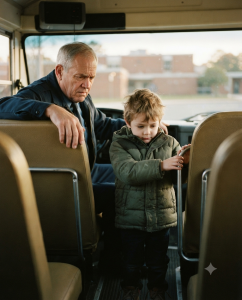
Mr. Howard knew him well enough to recognize what was wrong before he could name it. Eli was usually talkative in spurts, always carrying a red backpack with one broken zipper tab, always wearing his coat half-open because he hated having the top button done. His mother normally waited at the corner near the apartment complex with one hand raised before the bus even turned.
That afternoon, Eli had no backpack.
His coat was buttoned wrong, crooked from the collar down.
His shoes were untied.
He kept his head lowered and moved like he was trying to take up less space than his body required.
Mr. Howard felt a small pulse of concern.
“Afternoon, Eli,” he said gently.
The boy stopped beside the fare box.
Mr. Howard gave him a second. “Where’s your bag today?”
Eli didn’t answer.
There was enough noise behind him that another driver, another adult, might have let it pass. Forgotten backpack. Happens all the time.
But Mr. Howard noticed the boy’s fingers trembling around the handrail.
He softened his tone further. “Your mother picking you up at the usual stop?”
That was when Eli leaned forward, close enough that only Mr. Howard could hear him.
“Please don’t take me home today.”
The words were so soft they almost disappeared beneath the engine noise.
Almost.
Mr. Howard looked at the boy’s face.
Children complained in dozens of familiar tones—frustration, drama, sulking, bargaining. This was none of them. Eli’s whisper was careful, fearful, and threaded with the kind of hope that only appeared when someone felt they had one chance to say the right thing.
Mr. Howard’s attention sharpened instantly.
He glanced at Eli’s left arm and saw a bruise fading yellow at the edge and deepening purple toward the center, partly hidden under the cuff.
He glanced out through the windshield and saw the dark sedan again.
It was parked across from the school, not in pickup, not in a legal loading spot, just sitting under a tree with the engine running. He had seen it on Friday. He had seen it briefly the Thursday before. Same model. Same dull dark paint. Same driver-shaped outline behind the glass, never leaving the car.
A coincidence, maybe.
But then there was Eli, coat wrong, bag missing, whispering not to be taken home.
Something heavy settled behind Mr. Howard’s ribs.
He had seen enough over the years to know that a single sign could mean nothing. Three signs together usually meant something. Five meant act now.
The children were still filing in.
The schedule said he should depart in less than two minutes.
The depot would expect him to keep moving.
Parker, if told later, would probably ask why he had made a scene over a nervous child and a bruise no one could explain.
None of that mattered.
Mr. Howard turned off the engine.
The bus quieted in a slow mechanical sigh.
Several students looked up at once.
“Bus broken?” one boy called.
Mr. Howard stood. “Everyone stay in your seats for a moment.”
He closed the folding door and hit the lock.
The gesture startled a few of the older kids into silence. Eli looked terrified now, as if he thought he had caused trouble instead of preventing it.
Mr. Howard knelt beside the front seat, ignoring the ache in his knee.
“You did the right thing,” he told him.
Eli’s eyes filled immediately, but he nodded.
Mr. Howard took out his phone and dialed emergency services.
He spoke clearly. Bus number. Route. School location. Child passenger requesting not to be taken home. Visible bruising. Suspicious vehicle observed repeatedly near school grounds.
The dispatcher’s voice changed when she realized he wasn’t speculating.
“You believe the child is in immediate danger?”
“Yes,” Mr. Howard said. “And I am not releasing him until officers arrive.”
As he spoke, the sedan across the street pulled away.
Not fast. Not panicked. Just smooth enough to suggest the driver had been watching.
Mr. Howard memorized as much as he could before it vanished around the corner.
He spent the next several minutes doing two things at once: keeping the children calm and keeping Eli close.
“Everything’s alright,” he said to the bus at large, because fear spreads faster than facts among children. “We just need to wait a few minutes.”
He asked one girl about the picture she had drawn in art class. He reminded a pair of brothers to stop elbowing each other. He collected a dropped pencil and handed it back. Small ordinary gestures, one after another, like stepping stones over panic.
Then he sat in the front-facing seat across from Eli.
“No one’s taking you anywhere right now,” he said quietly.
Eli swallowed hard. “He said not to tell.”
“Who said that?”
The boy shook his head so fast it was almost a flinch.
Mr. Howard didn’t press.
A few moments later Eli whispered, “He said my mom gets sad when people ask questions.”
The sentence hit harder than a direct accusation would have. Children often protected the adults around them even when those adults failed to protect them back. Not because they understood the situation, but because fear taught them to carry responsibility that was never theirs.
Mr. Howard kept his voice steady. “Whatever happens next, none of this is your fault.”
Sirens arrived sooner than he expected.
Two patrol cars pulled in first, followed by a school administrator who came running from the building, face pale and confused. Officers boarded the bus calmly, careful not to alarm the other children. One officer crouched to Eli’s level and introduced herself. Another took Mr. Howard aside near the front steps and asked him to repeat everything from the beginning.
He did.
He mentioned the missing backpack, the wrong-buttoned coat, the untied shoes, the bruise, the whisper, the sedan. He also mentioned that Eli’s mother normally appeared at the stop and that the change in routine was part of what troubled him.
“You know the family?” the officer asked.
“Only from the route,” Mr. Howard replied. “Enough to know this isn’t normal.”
That phrase mattered.
This isn’t normal.
Teachers hear it. Doctors hear it. Neighbors hear it. But it only means something when the person saying it has taken the time to know what normal looks like in the first place.
The remaining children were transferred to another bus. Parents were contacted. The school principal arrived and looked overwhelmed. Eli was brought off the bus wrapped in a small blanket someone from the nurse’s office had found. He never let go of Mr. Howard’s hand until the child services investigator asked, very gently, if he could sit in another vehicle for a little while.
Eli looked at Mr. Howard before answering.
Mr. Howard gave him the smallest nod he could.
“It’s okay,” he said. “You’re safe.”
The boy released his hand.
Mr. Howard watched him go, and only then did he realize how hard his own heart had been pounding.
The rest of the afternoon blurred into statements, signatures, and questions. A detective joined the scene after another officer ran the partial plate information from the dark sedan against local records. Mr. Howard overheard only fragments, but they were enough to deepen the dread already pressing at his chest.
By evening, he returned to the depot tired in a way that had nothing to do with age.
Word had reached the garage before he did.
The break room went silent when he entered.
The drivers who usually filled the air with sarcastic noise were suddenly very interested in vending machine buttons, coffee lids, their own hands. Parker stood near the office door with a stiffness that looked almost painful.
Mr. Howard walked to his locker, set down his lunch tin, and removed the photograph of Eleanor from his dashboard before anyone could speak to him.
Finally Parker cleared his throat.
“I heard what happened.”
Mr. Howard closed the locker.
Parker swallowed. “They said… you may have prevented something serious.”
May have. Even then, he couldn’t quite give the moment its full weight.
Mr. Howard said nothing.
Parker looked around, perhaps realizing nobody was going to rescue him from the apology he now owed. “What I said this morning was out of line.”
Still nothing.
The silence became its own rebuke.
Then one of the younger drivers, the same one who had laughed about the photo weeks before, asked quietly, “How did you know?”
Mr. Howard rested one hand on the bench.
Because that was the question beneath all the others. Not how had he stopped the route. Not why had he called the police. How had he known to trust those small details when everyone else might have dismissed them?
He answered honestly.
“Because small things stop being small when they happen all at once.”
No one spoke.
He went home that night to a modest apartment lined with old books and careful habits. He set Eleanor’s photograph on the kitchen table while he heated soup he never ended up eating. He sat in his chair and stared out the window as dusk thickened into night.
The phone rang at 9:17 p.m.
It was one of the officers from the scene.
“Mr. Howard,” the officer said, “I wanted you to hear this directly.”
The apartment found that evening belonged to Eli’s mother and her boyfriend. The boyfriend had a history of violence and had tried to leave when police arrived to follow up. He had been stopped a few blocks away in the same dark sedan Mr. Howard had noticed near the school. Eli’s mother had been frightened, defensive at first, then shaken enough that the truth started coming out in pieces. There had been shouting at home. Threats. Controlling behavior. Discipline crossing lines no child should have to describe.
And Eli had not wanted to go back because, for the first time, he believed something worse was waiting.
Mr. Howard listened without interrupting.
Then he asked the only question that mattered to him. “Is the boy safe?”
“For tonight,” the officer said. “Yes. He’s with relatives approved by child services.”
For tonight.
It was not a perfect answer. It was still enough to loosen something in his chest.
Then the officer added, “He kept asking whether the bus driver listened because he was old.”
Mr. Howard frowned. “What did you tell him?”
The officer let out a quiet breath. “I told him maybe the reason you listened is because you’ve been paying attention longer than the rest of us.”
After the call, Mr. Howard sat in the dim kitchen for a long time.
The next morning, he arrived at the depot before sunrise as usual.
Routine mattered, especially after chaos.
He unlocked the bus. Checked the lights. Checked the brakes. Adjusted the mirrors twice. Taped Eleanor’s photograph back into place.
When he entered the break room for coffee, conversation thinned and then resumed in a different tone, more careful now. Not pitying. Respectful, though awkwardly so.
Parker approached him with two cups instead of one.
“I spoke to regional,” he said. “They want to commend you formally.”
Mr. Howard took the coffee but did not thank him yet.
Parker continued, “They also want to add refresher training for all drivers on recognizing signs of abuse or distress.”
Now that, Mr. Howard thought, might actually matter.
He nodded once.
Parker hesitated. “I should have valued experience the way I value speed. That’s on me.”
Mr. Howard looked at him.
For a moment Parker seemed younger than he had the day before—not in years, but in certainty.
“You can still learn,” Mr. Howard said.
It was not warm. It was not cruel. It was simply true.
Over the next week, details continued to emerge. Eli had tried to tell adults in fragments before, but fear and confusion had made his words easy to dismiss. A teacher had noticed he seemed withdrawn. A neighbor had heard arguments through thin apartment walls. Someone else had seen the sedan near the school and assumed it belonged to a parent waiting for dismissal.
No one had stitched the pieces together.
Not until a seventy-two-year-old bus driver with a limp and a reputation for being too careful treated the details like they mattered.
The commendation came on Friday.
The depot gathered near the parked buses while a representative from the district read from a printed statement about diligence, compassion, and safeguarding children. Parker stood off to one side, expression tight but sincere. Several drivers clapped too loudly, perhaps trying to make up for all the laughter that had come before.
When the paper certificate was handed to him, Mr. Howard accepted it politely.
He didn’t make a speech.
He only said, “Doing the job right isn’t heroism. It’s the job.”
But later, when the ceremony ended and the lot began to clear, one of the youngest drivers approached him privately.
“I didn’t see anything,” the young man admitted. “I was there all week. Same school. Same pickup zone. I never saw that car.”
Mr. Howard folded the certificate once and tucked it under his arm. “You were probably looking for something dramatic.”
The driver blinked.
“Trouble usually starts smaller than that,” Mr. Howard said. “You learn to watch for what’s different, not just what’s dangerous.”
The driver nodded slowly, as though storing the sentence somewhere he might need later.
A month passed.
The route continued.
Children laughed again. Parents waved. New habits formed around the old ones. Eli did not return immediately, and Mr. Howard found himself glancing toward the stop where his mother used to stand. Then one cool afternoon, a different car waited there—an older woman behind the wheel, eyes tired but kind. Eli stepped onto the bus beside her the next day with a new backpack and neatly tied shoes.
He paused at the top step.
Mr. Howard smiled. “Afternoon, Eli.”
The boy looked at him for a second, uncertain, then managed a small smile back.
“Afternoon.”
No dramatic speech. No tearful reunion. Just a child boarding a bus safely, which was exactly how it should have been all along.
When the route ended, Eli lingered at the front.
“My aunt says to tell you thank you,” he said.
Mr. Howard nodded. “You can tell your aunt you were brave.”
Eli looked down. “I was scared.”
“Brave and scared often happen together,” Mr. Howard replied.
The boy seemed to think about that.
Then he stepped off the bus.
That night, Mr. Howard sat for a while before driving home, his hands resting on the wheel, Eleanor’s photograph above him in the fading light. He thought about how close the day had come to going differently. How easily a schedule could have mattered more than a whisper. How many people had seen pieces but not the whole. How often the world mistook slowness for weakness when sometimes slowness was simply the patience required to notice.
Everyone at the bus depot had called him too old to drive.
Maybe what they really meant was that he moved through the world differently than they did.
He did.
He checked the mirrors twice.
He waited for children to cross safely.
He remembered names.
He watched for patterns.
He understood that protecting people was rarely about grand instincts. It was about attention. Humble, repetitive, undramatic attention given so consistently that when one thing shifted, you felt it immediately.
In the end, that was what saved Eli.
Not strength. Not speed. Not authority.
Just an old man who refused to stop noticing.
And if there was an aftershock to all of it, it lived in the question people at the depot still lowered their voices to ask when they thought about that day: who had really been unfit for the job—the aging driver they mocked for caring too much, or the younger people around him who had mistaken care for weakness until a child nearly paid the price for it?