The single mother only took the cleaning job at the funeral home because it paid cash on weekends.
That was the plain truth of it. No hidden meaning, no dark fascination with the place, no spiritual curiosity. Mina was thirty-three, permanently tired, and living in the narrow space between overdue rent and next week’s paycheck. She cleaned offices during the week, a small dentist’s practice on Thursday nights, and now the funeral home on Saturdays because the owner paid in cash at the end of every shift.
Cash meant groceries on Sunday.
Cash meant Leo’s inhaler got refilled before she had to beg the pharmacy for three more days.
Cash meant she did not have to hear her landlord’s careful, patronizing voice asking whether she needed “a little flexibility.”
So she took the job.
The first time she walked into the funeral home, she expected to be unsettled by the polished caskets, flower stands, and chapel lighting designed to flatter grief. Instead, what struck her most was how practical the place was. Vacuum tracks in the carpet. Closet shelves labeled in black marker. Folding chairs stacked behind cream curtains. Death, she discovered, still needed mopping.
By her third weekend, she had a system. Bathrooms first. Hallways next. Break room after that. She kept her earbuds out because she had learned the staff hated seeming disrespectful if family members arrived early. She moved quietly, polished brass without leaving streaks, and kept her head down.
That Saturday, Leo had to come with her.
School was closed for teacher training, and the sitter canceled at the last minute with a text about a fever that might have been real and might have been a better-paying job. Mina didn’t have the energy to be angry. Anger cost time. She packed crayons, crackers, a tablet with fifteen percent battery, and Leo’s toy ambulance into a backpack and drove to the funeral home trying not to think about how ridiculous her life had become.
“Stay in the break room,” she told him for the third time as she set him up at the small laminate table near the vending machine. “Color. Eat your crackers. Do not wander.”
Leo nodded solemnly, because children always mean their promises in the moment they make them.
Twelve minutes later, Mina came back from the north hallway and found the break room empty.
The spike of panic was instant and familiar. She set the mop against the wall and hurried past the arrangement room, past the framed poem about memory and light, and toward the chapel corridor.
That was where she found him.
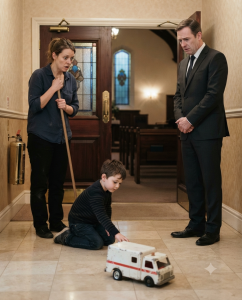
Kneeling on the polished tile, rolling his toy ambulance across the floor and making the faintest whisper of siren noise under his breath.
And standing a few feet away was a man in a dark suit, perfectly still.
Mina recognized him immediately. Daniel Reeves. Funeral director. Mid-forties, neatly combed dark hair touched with gray at the temples, a face that never seemed sloppy with emotion. She had seen him only in passing before, guiding families with soft authority, holding doors, adjusting flower placements, speaking in that low, controlled tone used by people who managed other people’s pain for a living.
But now his attention was fixed completely on Leo’s toy.
Not the child. The toy.
Mina slowed. “Leo.”
Her son looked up, guilty for half a second, then cheerful. “I wasn’t loud.”
Daniel crouched, his eyes never leaving the ambulance. “Where did you get that?”
Leo lifted it like a prize. “The little boy gave it to me.”
Mina felt a cold thread of irritation and embarrassment.
“Leo, what little boy?”
But Daniel was studying the ambulance with the intensity of someone reading a message hidden in plain sight.
It was an ugly little thing, really. White plastic yellowed with age, red stripe half-peeled on one side, one rear wheel bent enough to drag. Mina had picked it out of a free basket outside the laundromat a few weeks earlier. Leo loved emergency vehicles, so she had cleaned it with soap and handed it over. End of story.
Apparently not.
“That ambulance,” Daniel said slowly, “was left on the chapel step the day we buried my son.”
Mina almost laughed from sheer disbelief, but the expression on his face stopped her. He was not reaching for drama. He was not confused. He was remembering.
“The wheel bent when it fell off a flower cart,” he added.
Leo rolled it once.
Click-drag. Click-drag.
Something broke across Daniel’s face then, something so private Mina felt like she should look away.
“He said I could use it,” Leo went on innocently. “Because he doesn’t need sirens anymore.”
Daniel went pale.
Mina dropped beside Leo. “Who said that?”
“The boy.” He pointed toward the chapel doors. “He was sitting there.”
There was no one by the chapel.
Sunlight filtered through stained glass and patterned the floor in bruised colors. The pews sat empty. The organ was silent. The whole place felt suspended in the kind of quiet that comes before a storm or after bad news.
Daniel’s hand found the end of a pew and gripped it. “My son used to sit on those steps before services.”
Mina swallowed. “What was his name?”
“Oliver.”
Leo nodded immediately. “He said his shoes hurt.”
The silence that followed seemed to change the temperature in the hall.
Daniel closed his eyes. “My wife made him wear church shoes for the burial,” he said. “He hated them. He complained all morning.”
Mina’s scalp prickled. She did not know what she believed, and she did not suddenly become a person who believed everything. But she knew when details hit too close to be dismissed.
Leo stroked the roof of the ambulance. “He also said you never opened the drawer.”
Daniel’s eyes opened at once.
“What drawer?” Mina asked.
“The lower drawer in my desk,” Daniel said, not looking at her. “Oliver put something in it a week before he died.”
Leo gave a matter-of-fact shrug. “He said you got mad and forgot.”
That landed even harder than the shoes.
Daniel looked toward his office at the end of the hall. Mina had dusted in there that morning. The room had been orderly to the point of strain, as if neatness was the one thing holding the pieces together.
“What happened to Oliver?” she asked quietly.
“Leukemia,” Daniel said. “He was six.”
Leo’s voice softened. “He said the yellow envelope is still there.”
Daniel turned toward the office so sharply it seemed his body had answered before his mind did.
A yellow envelope.
There was one. Mina knew it from his face.
He stood. “Come with me.”
She should have refused. She barely knew him. Her son was involved in something she did not understand. But curiosity is its own force, and there was something in Daniel’s expression too raw to ignore.
They went down the corridor together.
In the office, everything looked exactly as it had earlier that morning. Mahogany desk. Cream walls. Certificates in black frames. A silver pen tray. A family photo turned face-down beside the lamp, as if even happiness had become too difficult to look at.
Daniel stood over the lower file drawer for several seconds before opening it.
Inside were folders, invoices, memorial pamphlet proofs, sympathy cards, and beneath all of them, flattened against the back, a yellow envelope.
His name was written on it in a child’s crooked handwriting.
Dad.
The room went absolutely still.
Leo smiled faintly. “That’s it.”
Daniel picked up the envelope with trembling fingers. He did not look like a funeral director then. He looked like any father who had found a message from a dead child and was not prepared for what the words might do to him.
He opened it.
Inside was a folded note and a brass key taped to an index card.
Leo whispered, “He said that’s why you couldn’t find it.”
Daniel stared at the key. “No.”
Mina glanced around the office. “What does it open?”
Daniel’s gaze shifted to a narrow built-in cabinet behind the credenza. “The hospice box.”
He swallowed. “My wife thought I lost the key before Oliver died.”
Something changed in the room when he said wife. Mina had the distinct impression that was not a neutral word in this story.
Leo, meanwhile, was rolling the ambulance back and forth against his sneaker. Click-drag. Click-drag. “He said you were fighting about the papers.”
Daniel closed his eyes briefly. When he opened them, he looked years older.
He unfolded the note.
Mina could only see part of the page from where she stood, but the writing was large and uneven, a child trying to make the words neat enough to matter.
I heard you and Mom talking.
If you cry again, use the box.
Don’t let her say no if I already said yes.
Daniel sat down hard in his chair.
“What does that mean?” Mina asked.
He didn’t answer at first. His thumb moved over the edge of the note again and again.
Then he said, “Oliver wanted to donate his trial money.”
Mina frowned. “His what?”
“The research stipend.” Daniel’s voice was hollow. “There was a pediatric trial near the end. We agreed because we were out of options, and afterward there was a compensation payment. Not much, but enough.” He looked toward the locked cabinet. “Oliver overheard us arguing about what to do with it.”
“And your wife said no?”
Daniel laughed once without humor. “My wife said it should stay in the family. For grief counseling, time off, whatever came next. I said it should go where Oliver wanted. He’d been asking to give it to St. Jude’s toy fund, or the children’s wing, or some ambulance charity because he was obsessed with sirens and rescue crews.” He pressed the note flat on the desk. “We had the argument in the kitchen. I thought he was asleep.”
Leo was watching him with an expression too serious for a seven-year-old. “He heard all of it.”
Daniel looked up sharply, as if he had forgotten Leo was still there.
Then he rose, key in hand, and crossed to the cabinet.
He inserted the key. Turned it. Opened the small door.
Inside was a metal lockbox, a folder, and on top of both, a laminated drawing of an ambulance with a stick-figure driver wearing a cape. Mina felt her throat tighten unexpectedly. Children leave traces in the shapes of what they love.
Daniel opened the box.
Inside were bank papers, a sealed check, and another envelope addressed in Oliver’s handwriting:
For when Dad does the right thing.
Daniel made a strangled sound and sat back on his heels.
Mina looked away to give him dignity, but there was no real privacy left in that room. Grief had already dragged everything hidden into the open.
He opened the second envelope.
The note inside was shorter.
Dad, if Mom is still mad, do it later.
Buy toys for the kids who have to stay.
And let them keep them, not borrow.
Please don’t forget this time.
Daniel covered his mouth.
Mina understood then what Leo had meant earlier: He said you were mad and then forgot.
Forgot was the child’s word for what adults do when pain becomes an excuse to abandon the promise they made before pain arrived.
After a long time, Daniel stood and placed both notes on the desk with extraordinary care. “I need to call my wife.”
Mina expected him to step out. Instead, he hit speaker and set the phone down, perhaps because secrecy felt impossible now.
A woman answered on the fourth ring. Tired voice. Guarded. “Daniel?”
“It was in the drawer,” he said.
Silence.
Then, “What was?”
“Oliver’s envelope. And the hospice key.”
More silence, but a different kind now. Not confusion. Recognition.
When she spoke again, her voice had gone thin. “How?”
Daniel glanced at Leo and then at the toy ambulance. “I don’t know.”
Mina heard a shaky inhale on the other end.
“I told you not to keep looking for signs,” the woman said. “I told you it would make things worse.”
“This isn’t about signs,” Daniel replied, though his eyes said he wasn’t sure of that anymore. “He heard us arguing. He hid the key. He left instructions.”
“What instructions?”
Daniel read the note aloud.
By the end, she was crying.
Not soft crying. Angry crying. The kind people do when grief and guilt have been living together too long and can no longer be separated.
“I didn’t want to lose that money too,” she said finally. “Do you understand that? We lost him. We lost everything. I couldn’t survive one more thing being taken.”
Daniel’s face folded, because there it was — the terrible truth beneath the argument. Not greed. Fear. Not cruelty. Desperation wearing a harder face.
“He was asking for one thing,” Daniel said. “One thing.”
“I know.” Her voice cracked. “I know.”
Mina should have felt like an intruder, but instead she felt the awful pull of recognition. This was how many families broke. Not over lack of love, but over what grief made love look like.
Daniel took a breath. “I’m doing it. Today.”
His wife did not answer for several seconds.
Then she said, quietly, “Then do it in his name. All of it. Before either of us can change our minds.”
Daniel closed his eyes in relief and pain at once. “All right.”
When the call ended, no one moved for a while.
Leo finally set the toy ambulance on the desk beside Oliver’s notes. “He said you can keep that too. He only wanted me to bring it back.”
Daniel stared at the toy as if it were impossible all over again.
Later that afternoon, after Mina finished the cleaning shift because bills do not pause for emotional revelations, Daniel asked her to stay an extra half hour. Not to clean. To witness.
Together they went to the children’s hospital foundation office across town, where Daniel signed over the trial funds to create a small memorial account in Oliver Reeves’s name for toys given permanently to long-term pediatric patients. Not borrowed. Not passed around. Kept.
Exactly as Oliver had asked.
Daniel’s wife met them there.
She was beautiful in the ruined, exhausted way grief sometimes leaves behind. She looked at the toy ambulance on the table and began crying before she even sat down. But when the paperwork was placed in front of her, she signed without hesitation.
Afterward, she asked Leo, “Did he seem scared?”
Leo thought about it. “No. Just in a hurry.”
That made her laugh and cry at the same time.
Weeks later, Mina came in for another Saturday shift and found something waiting for her in the office: an envelope with extra cash, a formal offer for steadier hours if she wanted them, and a handwritten note from Daniel.
Thank you for bringing my son back to the place I stopped looking.
She stood there longer than she expected, reading that line again and again.
The toy ambulance was gone. In its place on the shelf sat a framed photo of Oliver — a bright-eyed little boy in a superhero T-shirt, one untied sneaker, one church shoe kicked halfway off. Beside the frame was a plaque for the newly funded Oliver Reeves Toy Cart.
Mina touched the edge of it with two fingers.
She never decided exactly what she believed happened that day in the chapel corridor. Maybe children noticed things adults buried. Maybe grief found whatever crack it needed. Maybe a dead boy with aching feet and unfinished business really had been sitting on those steps, waiting for someone small enough to listen.
What she knew was simpler.
A father had finally opened the drawer.
A mother had finally let go of the money she was using to hold onto her son.
And a child who died at six still managed to make sure other sick children got something joyful to keep.
Sometimes the biggest red flag is not cruelty. It is what sorrow convinces people to postpone until later.
And sometimes later arrives in the hands of a seven-year-old carrying a broken toy ambulance with one dragging wheel.