Drew had not planned to attend another wedding.
He had attended a funeral instead, and after that, every gathering built around joy felt like a language he no longer spoke. The casseroles had stopped arriving months ago. The sympathetic texts had thinned. People had returned to their ordinary lives with the kind of cruel innocence that was not really cruelty at all, just survival. But Drew had remained in place, moving only when his son needed breakfast, socks, a ride to school, or help finding the dinosaur blanket every single night.
That was grief, as far as he could tell. Not dramatic collapse. Just endless movement performed by a person who no longer felt particularly alive.
So when his cousin announced a courthouse wedding and insisted it would be tiny, brief, and painless, Drew almost refused. He could already picture the fake flowers, the careful smiling, the photographs meant to prove that life goes on. But refusing meant questions, persuasion, guilt, phone calls from relatives who thought healing could be arranged through attendance.
He did not have the energy.
Then the babysitter canceled forty-eight minutes before they had to leave.
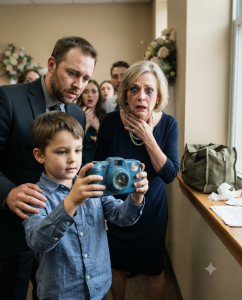
Max appeared in the hallway already dressed in a small blue button-up and crooked khakis, holding the toy camera he had become attached to over the past year.
“Can I come?”
Drew looked at him, then at the clock, then at the mess of reality that always beat out preference.
“Yeah,” he said. “You can come.”
Max grinned, slung the camera around his neck, and marched to the car as if being invited to a courthouse wedding were a privilege most children never experienced.
On the drive over, Drew barely listened as Max took fake pictures through the window and narrated traffic like a documentary. He caught himself glancing at the camera more than once. It was a ridiculous little thing—blue plastic body, scratched lens, sticky shutter button, and a silver crescent moon sticker peeling up at one corner.
His wife had bought it from a thrift bin the year before she died.
He could still hear her voice perfectly when he looked at it. Every serious artist needs terrible equipment first.
She had placed it in Max’s hands with a dramatic flourish, and Max had treated it like he had been awarded something sacred. Drew had never asked where the thrift store got it, and never cared. In those days, life was still made of ordinary assumptions. Toys appeared, bills got paid, people came home.
Now every object seemed capable of carrying history inside it.
The courthouse ceremony room was exactly as joyless as Drew expected. Beige walls. fluorescent lighting. Folding chairs lined in two uneven rows. A window overlooking a parking lot. Two fake floral arrangements trying and failing to soften the fact that half the room looked like it could also process vehicle registrations.
His cousin, Melissa, stood near the front in a short white dress, smoothing invisible wrinkles over and over while her fiancé checked his phone with the guilty air of a man pretending not to be nervous. A clerk with efficient glasses sorted documents at a desk. Melissa’s future mother-in-law discussed flowers no one would remember. And Melissa’s mother, a polished woman named Evelyn, stood near the wall wearing navy silk and pearls, every strand of her hair in place.
Drew had met her only once before. She had struck him as the sort of woman who survived pain by turning it into manners.
Max sat on the end chair and began clicking his toy camera at everyone who smiled at him.
Click.
Pause.
Click.
Each sound scraped against Drew’s nerves. Still, it kept Max occupied, and that mattered more.
Then, just before the clerk called everyone into place, Evelyn turned.
Her gaze landed on the camera.
She stopped so completely that Drew felt it before he understood it. Her hand rose to her throat. Her face drained. For one bizarre second, Drew thought she might be having a medical emergency.
Then she took one step toward Max.
“Where did he get that?”
Drew straightened at once, old protective instincts snapping to attention. “It’s his.”
“No,” she whispered, still staring. “No, it isn’t.”
Max held it up proudly. “It still works mostly.”
Evelyn made a noise so quiet it almost vanished.
Drew moved closer. “What’s going on?”
Her eyes lifted to his face and he saw it there immediately—grief, yes, but also recognition so violent it had become fear.
“That camera,” she said, voice shaking, “was in my daughter’s hospital bag the night she died.”
Everything in Drew’s body went cold.
The room kept moving around them, absurdly normal. Someone laughed in the hall. Melissa asked a question no one answered. The clerk continued stacking forms with bureaucratic indifference. But inside the little knot of space around Drew, Max, and Evelyn, the air had changed.
“What was your daughter’s name?” Drew asked.
“Lena.”
Max frowned thoughtfully, then said, “She said you blamed the rain.”
Evelyn closed her eyes as if the sentence had struck her.
Drew looked sharply at his son. “Max?”
But the boy only shrugged, his expression honest and unguarded. “That’s what she said.”
When Evelyn opened her eyes again, they were wet. “She died in a crash on the highway on the way to the hospital,” she said. “Everyone said the storm caused it.”
“The moon sticker got wet,” Max added. “She was mad.”
Evelyn stared at him in disbelief. “I put that sticker there when she was nine,” she whispered. “She told me cameras should know when it’s nighttime.”
Max smiled at once. “That’s smart.”
Something in Evelyn’s face gave way.
Drew felt his pulse thudding in his throat. Max was not imaginative enough to fabricate detail with that kind of precision. He could invent monsters under the bed, sure. He could claim his vegetables felt sad and shouldn’t be eaten. But this? This was something else.
He crouched in front of his son. “Who told you these things?”
“The lady in the elevator,” Max said.
“There was no lady in the elevator.”
“Not here,” Max said, as if Drew were being slow. “Before.”
Drew straightened slowly.
Evelyn bent down toward Max, her voice careful and unsteady. “What else did she say?”
Max glanced at the camera and then back at her. “She said you never opened the side pocket.”
Evelyn stumbled backward into a folding chair.
Melissa rushed over. “Mom?”
Evelyn barely heard her. “The hospital bag,” she whispered. “There was a zipper pocket on the side.”
Drew looked from her to Max. “You never opened it?”
She shook her head once, ashamed and terrified at the same time. “I couldn’t.”
Max continued in that same mild voice children use when saying impossible things. “She said the picture’s still in there if the ribbon didn’t fall off.”
Now the room truly went silent.
Drew could feel other people watching, but he no longer cared. The wedding had dissolved. There was only this.
Evelyn turned to her handbag with trembling hands and pulled out an old canvas hospital tote, folded flat from years of being carried and never emptied. She laid it on the windowsill. The side zipper was still closed.
“Why bring it with you?” Drew asked quietly.
She stared at the bag. “Because I’ve carried her with me everywhere,” she said. “I just never wanted to prove there was more left to lose.”
Drew understood that more than he wanted to.
She reached for the zipper, stopped, tried again, then drew back as if the metal might bite.
Max touched the moon sticker on the camera. “She said you have to do it before he knows.”
Drew’s head snapped up. “Before who knows?”
Max’s eyes lifted from the toy lens. “The man who said it was an accident.”
Evelyn’s face changed.
Drew saw memory rearranging itself behind her eyes—things once dismissed, phrases explained away, timelines accepted because grief had left no strength to challenge them.
“What man?” Drew asked.
But she did not answer. She only seized the zipper and pulled.
It snagged halfway.
The dry tearing sound that followed made everyone flinch.
“There’s something here,” she whispered.
Melissa knelt beside her. The groom, Aaron, moved closer from the doorway. The clerk stood frozen behind her desk, scandalized by everything.
Evelyn reached into the side pocket and pulled out a photograph wrapped in a faded pink ribbon.
Her breath caught at once. “I gave her this ribbon.”
With shaking fingers, she untied it.
Drew only saw the image for a second before Evelyn’s hand flew toward her chest, but that second was enough to chill him. Lena stood beside a dark sedan in heavy rain, visibly pregnant, her face tense. Next to her was a man gripping her arm hard enough to leave no doubt about the balance of power between them.
Not a stranger.
Someone she knew.
Someone who believed he belonged in the frame.
“She said that’s why he needed the phone too,” Max murmured.
Evelyn looked stricken. “No,” she whispered. “He told us he was helping her.”
“Who?” Drew asked again.
This time Aaron answered.
“My father.”
The room turned to him.
Aaron looked pale. Melissa stood slowly, confusion shifting toward alarm. “What are you talking about?”
Aaron swallowed. “Lena worked for him for a while. Before she died.”
Evelyn stared at him. “Your father said she was one of his tenants.”
Aaron looked away. “That’s what he told all of us.”
Evelyn reached back into the pocket with frantic hands and found a second item: a sealed envelope, slightly warped with age but intact. Across the front, in neat handwriting, were four words that emptied the room of air.
For Mom. Only if something happens.
Melissa made a choking sound. “Oh my God.”
Evelyn could barely hold the envelope. Drew took a step closer, ready in case she fell.
“Open it,” Max said softly.
No one corrected him.
Evelyn broke the seal.
Inside was a folded letter and a small memory card taped to the paper. Her hands shook so hard that Melissa had to help unfold the page. Evelyn read the first line, and all the blood left her face.
“What does it say?” Drew asked.
Evelyn looked up with eyes full of devastation. “She knew she was in danger.”
Melissa took the letter and began reading aloud when Evelyn could not continue.
Mom, if you’re reading this, then Daniel lied.
The name landed like an explosion.
Aaron took a stumbling step backward. “No.”
Melissa’s voice wavered as she kept reading. Daniel says he’ll tell everyone the baby isn’t his. He says no one will believe me. He took my phone once already and deleted the messages, but I printed the photo and saved the recordings. If anything happens on the drive tonight, it was never the rain.
Silence followed.
No one moved.
No one breathed.
Daniel.
Aaron’s father.
Melissa’s future father-in-law.
A respected local businessman who had sent flowers after Lena’s death and stood beside the family at the funeral, speaking in low solemn tones about tragedy.
Melissa looked physically ill. “Your father knew Lena?”
Aaron’s face crumpled. “I didn’t know like this.”
Evelyn reached for the memory card with a hand that no longer seemed to belong to her. “He said he barely knew her,” she whispered. “He stood in my kitchen. He looked me in the eye.”
Drew thought of Max saying, He needed the phone too.
He understood then. Lena had known exactly what she was trying to preserve. A photo. Recordings. Proof. And somehow, in the chaos after the crash, her mother had carried the answer for years without opening the pocket.
The courthouse door opened.
Daniel walked in wearing a dark suit and the pleasant, slightly hurried expression of a man arriving late to a family event he assumed would wait for him.
He stopped when he saw the room.
Evelyn standing with the letter.
Melissa crying.
Aaron ghost-pale.
Drew with one hand on Max’s shoulder.
The old hospital tote on the windowsill like an accusation.
Daniel’s eyes moved once, quickly, to the photograph in Evelyn’s hand.
And that was enough.
He knew.
Drew saw it in the instant tightening around his mouth before the smile returned. “What happened?”
Nobody answered.
Evelyn took one step toward him. Her voice came out calm in the terrible way voices sometimes do when the person speaking has gone beyond panic into certainty.
“You were with my daughter the night she died.”
Daniel laughed softly, too softly. “Evelyn, this is not the place—”
“She was pregnant.”
The smile vanished.
Melissa stared at the man she had been prepared to call family. “Dad?”
Aaron whispered, “Tell me she’s wrong.”
Daniel looked at his son, then at the letter, then at the memory card. The room waited.
Finally he said, “You don’t understand.”
It was the worst possible thing he could have said.
Because innocent people deny.
Only guilty people begin with context.
Evelyn’s eyes filled. “She wrote that you said no one would believe her.”
Daniel’s jaw clenched. “She was unstable. She wanted money. She threatened to ruin—”
Aaron lunged before anyone expected it, shoving his father hard enough to send him against the wall. “Don’t.”
The clerk found her voice at last and shouted that she was calling security, but no one seemed to hear her.
Daniel recovered, straightening his suit. “I was trying to help her. She was hysterical. She jumped out of the car after we argued.”
Melissa recoiled. “You left her?”
“It was raining,” he snapped. “A truck came too fast. I panicked.”
There it was.
Not accident.
Not storm.
Not random fate.
Panic after an argument.
A pregnant woman in the rain.
A man more afraid for himself than for her.
Evelyn made a sound Drew would hear in his sleep for years. It was not a cry. It was the breaking of a life rebuilt on lies.
“She was trying to get to the hospital,” she whispered. “She called me twice and I missed it.”
Daniel opened his mouth, but Aaron spoke first.
“You told us she was a tenant.”
Daniel said nothing.
Melissa looked at her fiancé, then at the man who was no longer merely his father but the center of a dead woman’s final terror. Her wedding dress suddenly seemed obscene in the room.
“It’s over,” she said.
Aaron shut his eyes once and nodded without argument.
Security arrived then, followed by two courthouse officers. Evelyn gave them the letter, the photograph, and the memory card with hands that no longer shook. She had crossed into another kind of strength now, the kind made from having nothing left to protect except the truth.
Daniel tried to protest. He said there was context. He said the letter proved nothing. He said grief had made everyone irrational.
Then one of the officers inserted the memory card into a reader at the clerk’s desk.
There were audio files.
The first recording began with wind and rain hammering metal. Then Lena’s voice, ragged and frightened: If anything happens, it was Daniel Mercer. He’s the father. He took my phone. I printed the picture. He says no one will believe me, but Mom will know my handwriting.
Then Daniel’s voice, closer, angrier than anyone in the room had ever heard from him: Get back in the car.
The recording ended with Lena saying no.
That was all it took.
Daniel was led away in handcuffs through the same courthouse corridor where a wedding had been scheduled half an hour earlier.
No one watched him go except Aaron, whose expression was so blank it looked like shock had emptied him out from the inside. Melissa sat down in her white dress and stared at nothing. The clerk quietly gathered the unsigned marriage documents and set them aside without comment.
Evelyn remained standing by the windowsill, one hand resting beside the old hospital bag.
Drew did not know what to say to her. There are moments too large for language. So he said the only true thing he had.
“She got it to you.”
Evelyn looked at Max.
Max, who was now pressing the sticky shutter button of the toy camera, making it click uselessly at the floor.
“She said you’d listen if I told you exactly,” he said.
Evelyn knelt in front of him and, after a long trembling pause, kissed the top of his head. “I should have listened sooner,” she whispered.
Drew expected Max to say something odd or wise or unsettling.
Instead he only nodded and asked, “Is she done being sad now?”
Evelyn closed her eyes. “I hope so.”
Later, after statements were taken and family members were sent home in stunned silence, Drew carried Max to the car because the boy had finally fallen asleep against his shoulder. The toy camera dangled from one small hand. On impulse, before buckling him in, Drew looked at it one last time.
Blue plastic.
Scratched lens.
Peeling moon sticker.
An ordinary object until it wasn’t.
He drove home through a light summer rain, thinking about all the ways the truth can wait inside a life, quiet and patient, asking only for one unlocked pocket, one child careless enough to repeat the right sentence, one person brave enough to finally look.
His wife used to say children notice things adults survive by ignoring.
That night, after Max was asleep, Drew sat alone in the kitchen and let himself imagine her saying it again. For the first time in months, the memory did not feel like a blade. It felt like a hand at his back.
The wedding never happened.
Aaron called off the engagement the next morning, not because Melissa had done anything wrong, but because grief and shame and betrayal had ripped too much open for vows to survive the week. Melissa moved her mother into her apartment while the investigation reopened Lena’s case. The original crash report was revised. Daniel was charged not only for fleeing the scene and evidence tampering, but for coercion tied to Lena’s pregnancy and the threats preserved in the recordings.
The newspapers called it a shocking courthouse revelation.
But newspapers always flatten the strangest parts.
They did not mention the moon sticker.
They did not mention Max saying there had been a lady in the elevator before they got there.
They did not mention the way Evelyn later swore that the camera had been packed into Lena’s bag by mistake after being left in the back seat of Daniel’s car during one of their arguments.
They did not mention that Max, when asked weeks later if he remembered Lena, only said, “She was worried her mom would be lonely.”
Maybe that was imagination.
Maybe it was grief borrowing a child’s voice.
Maybe not everything needs to be solved before it can be true.
Months later, Evelyn asked if Max could keep the camera.
“It found him,” she said simply.
So he did.
Sometimes Drew still hears the click of that sticky shutter and feels his chest tighten. But now the sound means something different. Not just loss. Not just the unbearable fact that objects outlive people. Sometimes it means that what is hidden is not always lost. Sometimes the smallest, cheapest, most forgettable thing in a room can carry a whole buried life inside it until the exact right moment arrives.
And if there was one question that haunted everyone afterward, it was not whether Daniel deserved forgiveness. No one seriously believed he did.
It was whether the biggest red flag had been there all along, buried under politeness and grief and the convenience of calling something an accident because the truth would have been harder to survive.
Evelyn believed the answer was yes.
Drew did too.
Because a storm can hide many things.
But not forever.