When Clara Montero was brought into Santa Lucía Hospital just after dawn, she looked like someone who had been surviving pain for much longer than one night.
Two broken ribs. Split lip. Bruises on her wrists in different shades of age. Faint marks around her neck that no staircase in the world could explain.
The nurse who admitted her had seen enough women arrive with the same vacant eyes and the same weak explanations muttered beside them. This time, the explanation came from a man in a tailored navy suit who looked better dressed than some people at their own weddings.
“She fell,” Gerardo Montero said quietly. “She took sleeping pills and fell down the stairs.”
He said it with the patience of someone repeating a childish misunderstanding. The kind of tone meant to make everyone else feel dramatic for questioning him.
That was the problem with men like Gerardo. They rarely sounded angry when it mattered most. They sounded reasonable.
Which was exactly why half the city admired him.
Gerardo Montero was the face of a business empire that touched construction, logistics, private investment, and philanthropy. He donated to children’s hospitals. He gave interviews about ethical leadership. He sponsored school programs and appeared in magazines beside smiling families. In photos, he looked like the kind of man mothers trusted and politicians called by first name.
And Clara had stood next to him through all of it.
Always elegant. Always composed. Never too loud. Never too opinionated. Never visibly unhappy.
People called them perfect.
People never saw what happened after the doors closed.
Dr. Elías Rivas did not care how rich or famous Gerardo was. He cared about patterns, and Clara’s injuries told a pattern too clear to ignore.
“A fall doesn’t leave defensive bruising on the forearms,” he said. “Or finger marks around the throat.”
Gerardo turned to him with a faint smile that didn’t reach his eyes.
“With respect, doctor, treat the fractures. Don’t build stories.”
Clara lay still on the bed, listening to the two men as if they were talking across a great distance. Every inhale stabbed her side. Every exhale felt incomplete. Her body was begging for rest, but rest was dangerous now. Rest meant losing time, and time was the one thing Gerardo knew how to weaponize.
For three years, he had controlled everything.
At first, it had come dressed as concern. He wanted her passwords “for emergencies.” He suggested she stop working because she had “nothing to prove.” He insisted the driver take her everywhere because Mexico City wasn’t safe. He opened joint accounts, then quietly shifted most of the assets where only he could move them. He read her messages, corrected her tone, criticized her clothes, monitored her friendships.
When she protested, he didn’t shout right away. He laughed. He called her sensitive. He asked why she was trying to start problems in such a beautiful life.
By the time the shouting started, she already had nowhere private left to think.
By the time the hitting started, she no longer trusted her own memory.
Gerardo had a special talent for making abuse sound like her fault. If he grabbed her arm too hard, it was because she had embarrassed him. If he locked her in the bedroom, it was because she was hysterical. If he took her phone for a week, it was because she needed rest from social pressure. If he recorded her crying, it was because someday she would lie about him and he needed protection.
“No one will believe you,” he had told her more than once. “You live in a mansion, wear designer clothes, and haven’t worked in years. To everyone else, you’re lucky.”
For a long time, Clara thought he might be right.
Then one evening, months earlier, she made a mistake he never imagined she was still capable of making.
She got curious.
Gerardo had been in the shower. His laptop was open in the study. He was usually careful, but that night he had left one folder minimized, perhaps because he trusted fear more than passwords. Clara had seen only a few filenames before he came back, but those few were enough to chill her.
Donor Transfers.
Children’s Foundation.
Panamá Holdings.
Campaign Support.
At first, she told herself it was probably accounting. Tax strategy. Something legal she simply didn’t understand.
Then she saw one familiar name.
A federal prosecutor she used to know personally.
And suddenly the elegant prison she lived in cracked open just enough for the past to come roaring back.
Before marrying Gerardo, Clara had worked in financial investigations. She had been smart, relentless, and unusually good at tracing money through layers meant to hide it. Years earlier, she had been part of a task force looking into suspicious charitable entities used to move funds for political favors and offshore laundering.
That case had imploded.
Witnesses withdrew. Files vanished. One superior advised her to stop asking questions. Another said certain families were “protected.” Then a document surfaced with Clara’s credentials attached to an approval she had never signed. Overnight, she became too compromised to stay. She resigned before she could be publicly ruined.
A month later, she met Gerardo.
He had seemed patient, attentive, almost healing. He knew exactly how to speak to a woman who had been professionally betrayed. He told her she deserved peace. He said she had carried too much alone. He understood her caution, her distrust, her exhaustion.
Now, lying in a hospital bed years later, she understood something that made her feel physically sick.
He had not rescued her from the ruins.
He had walked her into them.
Detective Marisol Vázquez entered the room just after sunrise. She had the practical posture of a woman who did not waste sympathy but did not lack it either. She introduced herself, asked the basic questions, and waited.
“Mrs. Montero,” she said, “can you tell me what happened?”
Clara looked at Gerardo.
He turned his head toward her with a calm expression so familiar it nearly broke her. That face had silenced her at holiday dinners, at charity galas, in front of household staff, in front of his mother, in front of cameras. The slightest shift in his eyes used to be enough.
But pain had done something clarity often failed to do.
It had made fear too expensive.
“My tablet,” Clara whispered.
Marisol leaned closer. “Say that again.”
“My blue tablet. Bottom drawer of my nightstand at the Lomas house. Password is ClaraMontero17. No spaces.”
Everything in the room changed.
Gerardo didn’t move much. Just enough for the truth to show through the mask. A flash of stillness. A tightening at the jaw. A calculation collapsing.
“My wife is delirious,” he said. “She’s sedated.”
“There are videos,” Clara forced out. “Audio files. Transfers. Fake foundations. Panama accounts. Names. Dates. He keeps everything.”
Gerardo looked at her then, really looked at her, and the softness disappeared.
“Be quiet.”
Marisol heard it. So did the officers standing just inside the door.
She closed her notebook. “Mr. Montero, step outside.”
He tried indignation first. Then concern. Then cooperation. Men like him always treated truth like a negotiation.
Before leaving, he leaned close and murmured, “This doesn’t end here.”
Clara stared back through swollen eyes. “It starts here.”
After he left, the room seemed larger somehow. Dr. Rivas adjusted her blanket. Marisol asked measured questions. Clara answered only what mattered.
The tablet contained records Gerardo had never expected anyone to assemble. Over months, Clara had copied files slowly and carefully, always in fragments, always under innocent labels. Recipes. Décor ideas. Event planning. She knew how to hide data because she used to track people who hid it.
“What happens if we don’t access it soon?” Marisol asked.
“At nine, everything goes out automatically.”
“To who?”
“The Attorney General’s Office. Tax authority. Three journalists. A federal prosecutor who used to supervise me.”
Marisol stared at her. “You planned this.”
Clara turned her face slightly toward the window. “I planned for the day I either escaped or died.”
No one in the room spoke for a moment.
At 8:41, an officer confirmed the device had been recovered from the house.
At 8:56, a cyber unit began unlocking and duplicating it.
At 9:03, Marisol received the first call.
“What is the Clara Children’s Foundation?” she asked.
Clara felt a wave of nausea. “His cleanest dirty front.”
“What was it used for?”
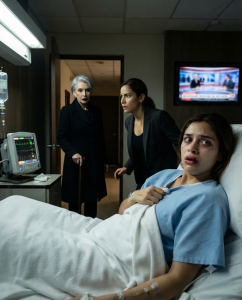
Before Clara could answer, the television flickered on.
Breaking news spread across the screen in red banners and urgent voices. Gerardo Montero had been detained for domestic violence and suspected financial crimes connected to charitable entities and offshore accounts. Commentators spoke fast, repeating his name as though each repetition stripped another layer off his power.
Clara didn’t cry.
Not because she was strong. Because she was stunned.
For years she had imagined this moment as victory. But watching his downfall begin in real time felt less like triumph than impact. A collision. Something enormous had finally started moving, and nobody knew what else it would drag with it.
Then the room changed again.
The nurse at the door went silent first. Dr. Rivas turned. Marisol’s hand instinctively moved toward her badge.
An older woman entered with a cane, a black leather handbag, and the unmistakable authority of someone who had spent decades expecting to be obeyed.
Her silver hair was immaculate. Her lipstick deep burgundy. Her posture slightly weakened, but her eyes were sharp enough to cut.
Clara stared at her and forgot how to breathe.
Teresa Montero.
Gerardo’s mother.
The woman whose funeral had been attended by judges, senators, charity boards, and half the business elite eighteen months earlier.
The woman everyone believed was dead.
For a moment, no one spoke.
Then Teresa looked directly at Clara and said, “You should have stayed quiet.”
Marisol stepped between them. “Identify yourself.”
Teresa gave a thin smile. “Ask for the death certificate. Then ask who signed it.”
The detective’s face changed subtly. Not shock exactly. Recognition of scale.
Clara’s mouth went dry. During her marriage, Gerardo had often spoken about his mother as if she were a saint. Brilliant. Demanding. Untouchable. He kept one framed photograph of her in his office and another in the hallway outside his study. Even in death, she had remained a presence in the house.
Now Clara saw the truth in the way Teresa stood, in the hardness of her gaze, in the complete absence of confusion or shame.
The woman had not disappeared.
She had been hidden.
“You think my son built that empire?” Teresa asked quietly. “He inherited the machinery. He only learned how to use it.”
Marisol asked for backup without taking her eyes off Teresa.
“What exactly are you saying?”
Teresa ignored her. She walked closer to Clara’s bed until Dr. Rivas objected and had to be silenced with a single look.
“If the files from that tablet opened what I think they opened,” Teresa said, “then you didn’t just expose a violent husband. You reopened a network people agreed to bury.”
Clara’s heartbeat sped so hard the monitor betrayed it.
Because she knew what date would be sitting inside those files.
The same date from the investigation that destroyed her career.
The date tied to a transfer she could never explain.
Years ago, while reviewing shell entities and false nonprofit disbursements, Clara had found one irregular authorization connected to a children’s foundation and an offshore logistics account. Her credentials appeared on the approval. She had sworn she didn’t sign it. No one believed her. She was pushed out before she could prove anything.
Now she understood why.
Teresa reached into her handbag and removed an old visitor sticker. A fake name was printed across it, but below the alias was a handwritten date.
That date.
She set it gently on Clara’s blanket.
“It was easier to blame the investigator than expose the family,” Teresa said. “Especially when the investigator was useful.”
Clara felt the room tilt. “You framed me.”
Teresa tilted her head. “Not alone.”
Marisol stepped closer. “Who else?”
But Clara was already seeing the missing pieces lock into place.
Gerardo pursuing her too soon after the scandal.
His relentless interest in her past.
The speed of their marriage.
The way he isolated her before she could reconnect with former colleagues.
The way he monitored what she remembered.
He had not fallen in love with her after her career collapsed.
He had married the one person whose silence protected the collapse itself.
“You married me because I knew too much,” Clara said, her voice cracking.
“No,” Teresa said. “My son married you because you knew too little.”
The words struck harder than any slap.
Marisol asked another question, but Clara barely heard it. Her mind was racing through old files, missing signatures, vanished witnesses, names from newspaper stories, charity galas, campaign donors, shell entities attached to children’s programs. It wasn’t just Gerardo. It had never been just Gerardo.
The fake foundation had moved money.
The money had bought influence.
The influence had buried investigations.
And when Clara got too close, they had ruined her professionally, then folded her into the family to keep her contained.
It would have worked too.
If Gerardo had not started enjoying power more than caution.
If he had not documented too much.
If he had not believed fear guaranteed obedience forever.
Outside the room, footsteps pounded down the corridor. Backup had arrived. Teresa didn’t look worried. That was almost worse than panic.
“You still don’t understand,” she told Clara softly. “An arrest is noise. Scandal is weather. Men like my son fall all the time. What matters is who stays standing after the headlines move on.”
Marisol cut in sharply. “You faked your death. You obstructed investigations. You may be tied to money laundering and witness tampering. You are not walking out of here.”
That finally amused Teresa.
“Detective, by the time you untangle one thread, three people above you will ask why you touched the fabric at all.”
Clara closed her eyes for one second, then opened them again.
For years, she had been forced into silence by pain, shame, and confusion. But now she had something far more dangerous than evidence.
She had context.
And context turned survival into testimony.
“Record this,” Clara said.
Marisol looked at her instantly. “Go ahead.”
Clara fixed her gaze on Teresa.
“The Clara Children’s Foundation was used to route money through medical grants and school partnerships. The offshore account labeled for logistics covered political transfers. The approval that ended my career was forged using access from an internal compliance unit. My husband kept copies because he thought blackmail was safer than loyalty. And his mother”—she drew a painful breath—“is the person who taught him that.”
For the first time since entering the room, Teresa’s face lost a fraction of its composure.
Small. Brief. But real.
That was all Clara needed.
Because the truth about powerful families is not that they never break.
It is that they only break when someone inside stops protecting the story.
And Clara was done protecting any of it.
The next hours came fast.
Gerardo was formally charged and held without immediate release.
Search warrants expanded from the family home to corporate offices.
Journalists began publishing connections between the foundation and campaign finance irregularities.
Two former employees requested protective custody.
One retired official suddenly announced medical leave.
Another denied knowing the Monteros at all, which only made his archived photos with them spread faster.
Teresa was detained before noon.
Not because the system had become pure overnight, and not because justice suddenly grew brave. She was detained because too much had surfaced too quickly, and too many copies of the files already existed. The scandal could no longer be sealed in one room, one family, one frightened woman.
Clara stayed in the hospital for four more days.
On the second day, a prosecutor she once trusted came to see her. He looked older, more tired, and far less certain than the man she had once reported to.
“You were set up,” he said.
“I know.”
“We should have protected you.”
She turned her face toward the window. “You should have listened.”
He had no answer for that.
By the time Clara was discharged, the city had turned her into a symbol before she had decided whether she wanted to be one. Some people called her brave. Others called her calculating. A few whispered that she must have known more than she admitted if she lived inside that house for three years.
That part hurt most, because it contained the ugliest truth.
She had known some things.
Not everything. But enough to feel wrong.
Enough to hesitate.
Enough to survive by pretending not to understand the full shape of what surrounded her.
Survival had made her quiet.
Silence had made her useful.
And usefulness had nearly destroyed her.
Months later, the Montero empire was fractured, though not erased. Trials were ongoing. Names continued to surface. Some allies vanished. Some reinvented themselves. Some acted scandalized as if they had not benefited for years.
Gerardo sent two letters from detention. Clara never opened either one.
Teresa never asked to see her.
In the end, Clara did something no one expected. She did not give interviews. She did not write a memoir. She did not build a public brand from the wreckage. She testified, submitted every file she had, and disappeared from the society pages completely.
She rented a small apartment under her own name. She bought her own groceries. She answered her own phone. She learned, slowly, that peace often feels unfamiliar before it feels good.
Sometimes, late at night, she replayed the first moment she spoke in that hospital room.
My tablet.
Two words. That was all it took to shift the entire structure.
Not because those words were powerful by themselves, but because they were spoken after years of forced silence.
That was the part people missed when they told her she was brave.
Bravery wasn’t what got her there.
Exhaustion did.
Pain did.
The final realization that silence would not save her did.
And even after everything, one question never left her completely.
Who had been more dangerous: the husband who hurt her openly in private, or the family machine that taught him how, protected him while he did it, and nearly convinced the world he was the victim of her instability?
She never found that answer cleanly.
Maybe there wasn’t one.
Maybe the biggest red flag had not been the first bruise, or the first lie, or even the first threat.
Maybe it had been how many people were willing to admire power before asking what it cost the person standing closest to it.