The invitation had sat on Nina Mercer’s kitchen counter for four days before she finally answered it.
Birthday party. Saturday. Backyard. Just a few school friends.
The card itself was cheerful—yellow balloons, crooked cartoon candles, a handwritten note from Evie Delaney’s father thanking families for coming. It should have felt harmless. It should have felt like the kind of ordinary event divorced mothers say yes to if they want their children to keep one foot planted in normal life.
But Nina had stopped trusting ordinary things.
At thirty-three, she was six months out from a divorce that had split her world into paperwork, pick-up schedules, automatic smiles, and a level of fatigue she had not known a person could survive. She had gone back to work before she was ready because bills did not care about heartbreak. She packed lunches with shaking hands some mornings and still remembered to put little notes in Caleb’s backpack because he deserved one parent who looked like she was holding it together.
Her son had adapted too well.
That was what scared her most.
Caleb was seven, bright, sensitive, and strangely careful with adults when he sensed they were fragile. He did not cry much when his father moved out. He asked only a few questions. He seemed to accept every new arrangement with such grace that Nina sometimes lay awake wondering whether her child had simply learned too early that love came with conditions and sadness was something to be managed quietly.
So when he came home from school talking breathlessly about Evie’s birthday party and how everyone would be there and how he really wanted to go, Nina said yes before fear could overrule her.
By Saturday afternoon, she regretted it.
“Will there be games?” Caleb asked from the back seat as they drove.
“Probably.”
“Cake?”
“Definitely.”
“Do I have to wear the nice shoes?”
“Unfortunately, yes.”
He groaned, then laughed, and Nina tried to let his excitement carry her the rest of the way.
The Delaney house sat on the edge of town behind a low fence and a patch of overgrown flower beds that had once been tended with care. It was a lovely property in the faintly neglected way homes become lovely after loss. The swing set was sturdy but weathered. The porch rail needed paint. A hand-painted sign by the mailbox read HAPPY 8TH, EVIE in looping, imperfect letters.
Nina parked at the curb and took one long breath before getting out.
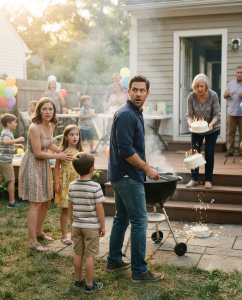
The backyard was already full. Children darted between folding tables. A few parents stood near a cooler talking about school schedules and summer camps. The air smelled like charcoal, cut grass, and buttercream frosting.
And by the grill stood a man in rolled-up sleeves, tongs in one hand, trying very hard to look like none of this was difficult.
He was tall, broad-shouldered, probably early forties, with the particular exhausted watchfulness Nina had only ever seen in adults carrying more than they admitted. He turned at the sound of the gate and nodded.
“You must be Caleb’s mom.”
“Nina.”
“Mark.”
That was it. No performance. No polished charm. Just recognition from one tired parent to another.
Nina noticed the ring mark on his left hand almost by accident. The wedding band itself was gone, but the pale circle beneath it remained.
Then she saw his eyes move—again and again—to a little girl in a yellow dress near the patio. Counting. Measuring distance. Tracking risk.
That was how Nina knew before anyone said a word that he was doing this alone.
Caleb ran toward the games with a gift bag swinging from his hand. Nina stayed back near the drinks table long enough to introduce herself to Mark’s mother, a silver-haired woman named Lorraine who was carrying too much at once and pretending she was not emotional about the party. Nina offered to help with cups. Lorraine thanked her with the brittle warmth of someone determined to keep the day from becoming sad.
Nina had just turned toward the lemonade when she heard Caleb say, clear as a bell, “Happy birthday, Birdie.”
The yard changed.
Mark stopped moving.
Evie’s smile vanished.
Nina looked up, already sensing something was wrong before she understood what it was.
Evie stared at Caleb. “Why did you call me that?”
He frowned at her confusion. “Because that’s your name.”
Mark reached them in three strides. “No,” he said too quickly. “That’s not her name.”
Caleb blinked. “It is in the dream.”
Nina felt her stomach drop.
She crossed the patio at once. “Caleb, what dream?”
He pointed with casual certainty toward Evie, as if none of this were strange. “The lady told me. The one in the blue room.”
Mark’s face lost all color.
Nina followed the line of Caleb’s finger and saw through the open back door a glimpse of an upstairs hallway and a room painted a soft powder blue. Something in the stillness of it made her skin prickle.
Mark crouched beside his daughter but kept his eyes on Caleb. “Who told you that nickname?”
“Her mom.”
Evie’s lower lip trembled.
Nina’s first instinct was to correct him, explain him, soften it somehow. “He has a vivid imagination,” she began.
“She died last year,” Mark said quietly.
Everything inside Nina seemed to stop.
Caleb tugged her sleeve. “Did I say something bad?”
“No,” she said, because he was seven and deserved kindness even inside confusion. “No, baby.”
Evie whispered, “Mommy called me Birdie.”
Mark’s jaw clenched hard enough for Nina to see it from where she stood. “How do you know that?”
Caleb lowered his voice with solemn patience. “The pretty mom in the picture by the stairs told me. She said Birdie gets sad on birthdays now.”
There was, Nina remembered in a sudden rush, a framed photograph by the staircase. Mark. Evie. A dark-haired woman smiling into the summer sun.
No one had pointed it out. No one had discussed it. Caleb had barely been in the house a full minute.
Then Lorraine stepped onto the patio holding the cake, saw Caleb clearly for the first time, and dropped it.
The frosting splashed across the stone. A few children laughed. Adults turned.
Lorraine did not look at the cake. She looked at Caleb.
“His eyes,” she whispered.
Mark turned to her. “Mom?”
But she seemed unable to answer.
What followed happened in pieces. One of the other parents, sensing something deeply private was unfolding, distracted the nearby children and steered the noise of the party toward the yard. Mark picked up Evie, who had begun crying quietly. Nina stayed close to Caleb, torn between apologizing and fleeing.
Then Mark asked, with deliberate calm, “What else did she say?”
Caleb considered the question. “That this was still her house.”
Lorraine made a strangled sound.
“She said Daddy always burns the first burgers because he watches the door too much,” Caleb added.
Mark stared at him.
Anna, Nina guessed. The dead wife. That had been her name? She had to be. Because this was no lucky guess. That line landed like an old private joke.
Lorraine nodded through tears. “She used to say exactly that.”
Nina was not a superstitious woman. She had no interest in ghost stories and no patience for people who gave magical meaning to everything painful they could not bear to explain.
But standing there in a stranger’s yard, watching her son speak in the steady voice of a child simply repeating what he had heard, she could not force this into anything ordinary.
“She said there’s something in the blue room,” Caleb went on. “Something he never found because he stopped opening the closet after she died.”
Mark’s face changed then, and Nina saw beneath the shock something heavier. Guilt. Fear. The look of a man who knew there were doors in his own life he had nailed shut out of grief.
Evie lifted her wet face from Mark’s shoulder. “Mommy hid things in the wall,” she whispered.
Mark stared at her. “What?”
She rubbed her eyes. “Her bird nest.”
Lorraine sank into a patio chair as if her knees had failed.
The decision to go upstairs was not really made aloud. It simply happened. Mark handed Evie gently to his mother, glanced once at Nina as though aware of how insane this all was, and said, “I need to check.”
Caleb reached for his hand without hesitation.
Nina almost stopped him. She almost gathered her son and left.
Instead she followed.
The upstairs room was smaller than Nina expected. Powder-blue walls. A white desk by the window. Shelves with labeled binders. The frozen neatness of a room preserved too quickly after death.
“This was Anna’s office,” Mark said. “Then her writing room. After she got sick, she stayed in here a lot.”
The closet door opened only halfway at first, blocked by bins and coats. Mark removed them one by one. Lorraine stood in the doorway clutching Evie. Nina kept one hand on Caleb’s shoulder.
“Behind it,” Caleb whispered.
At the back of the closet, Mark found a panel loose enough to pry away by hand.
Inside was a dented tin box sealed with yellowed tape.
Written across the lid in neat black marker were the words: FOR WHEN HE’S READY.
Mark’s hands shook as he lifted it out and set it on the floor.
Inside were letters. Many of them. Some addressed to Evie at different ages. One to Lorraine. One to Mark. Beneath them sat a small voice recorder and a velvet pouch.
The room went silent except for breathing.
Mark picked up the pouch first. A silver key fell into his palm.
He stared at it as if recognizing an old enemy. “Anna had a locked drawer in our bedroom,” he said. “After she died, I couldn’t find the key.”
Taped to the recorder was a note in Anna’s handwriting: Play this only after you read my letter. And please, Mark… don’t be angry until the end.
Lorraine whispered Anna’s name and began to cry.
Mark opened the letter addressed to him.
Nina did not mean to read over his shoulder, but he did not seem to know she and the others were in the room at all. His entire world had narrowed to the page in his hand.
At first, his expression was only grief. Then confusion. Then something harsher.
He read the first page, then the second, then sat down on the floor like his legs had given out.
“What is it?” Lorraine asked.
Mark did not answer.
Evie slipped from her grandmother’s arms and padded into the room barefoot, stopping just beside him. “Daddy?”
He looked at her, and Nina saw at once that whatever Anna had written, it had not been cruel. It had hurt him, yes. But not in the way betrayal hurts. In the way truth hurts when it arrives years after it could have changed something.
Finally he handed the letter to his mother.
Lorraine read with trembling hands. By the middle of the second page, she covered her mouth.
Nina did not ask. She waited.
Mark stared at the recorder. “Anna knew she was dying sooner than she told us,” he said at last.
Lorraine looked up sharply.
“She found out the cancer had spread months before she admitted it. She didn’t tell me because she said she was trying to buy Evie one more normal summer.” He swallowed. “And because she was trying to finish something.”
He reached into the tin and pulled out a stack of envelopes tied with blue ribbon.
“Birthday letters. School letters. Graduation. Wedding, maybe. She wanted to leave Evie pieces of herself.”
“That’s beautiful,” Nina said softly.
“It is,” Mark said. “That isn’t the part she thought I’d be angry about.”
He held up the letter. “She wrote that two weeks before she died, she saw someone outside the elementary school parking lot. A woman sitting in a car crying before pick-up. She recognized her from the hospital waiting room.”
Nina went still.
Mark looked at her now.
“A divorce hearing, child support office, legal aid clinic—she didn’t know which. She only knew you looked like someone trying not to fall apart. She says she wanted to get out and talk to you, but she was weak and didn’t want to frighten a stranger.”
Nina’s throat tightened.
Mark went on. “A few days later, she saw Caleb on school grounds. He was alone by the fence, crying because another kid said his family was broken. Anna talked to him.”
Nina’s eyes filled instantly. Caleb had come home upset one day that spring, but he had refused to say why.
“She says he told her his mom smiled when she was sad and his dad didn’t live with them anymore and birthdays felt weird because happy things were different now.”
Caleb leaned into Nina, embarrassed to hear himself described.
“Anna told him families can be broken and still be real,” Mark said. His voice shook. “She told him that if he ever saw Evie looking lonely, he should call her Birdie because that was what her mother called her when she needed reminding that she was loved.”
Lorraine lowered the letter. “Oh, Anna.”
Nina stared at Mark. “She met my son?”
He nodded. “Just once, maybe twice. She wrote that she didn’t tell me because she wasn’t supposed to be walking that much then, and she knew I’d worry. She says Caleb reminded her of… hope.” He glanced at the final paragraph and shut his eyes. “She says she asked him to do one thing for her if she was gone before Evie turned eight. She told him that if Birdie looked sad on her birthday, he should say her name out loud so Evie would know she was still being loved.”
Nina sank onto the edge of the bed.
That explained the nickname.
It did not explain the blue room.
Or the hidden box.
Or the exact words about the burgers.
Mark looked at the recorder again and pressed play.
Static crackled. Then a woman’s voice filled the room.
Warm. Tired. Smiling through it.
“Mark, if you’re hearing this, then either I managed to annoy you from beyond the grave, or our daughter finally had the birthday where the house felt too quiet.”
Lorraine sobbed openly. Evie’s face lit up with shock and wonder. “Mommy?”
Mark bent forward with one hand over his eyes.
Anna’s voice continued. She apologized for hiding the box. She said she knew Mark would not be able to handle the letters right away, and she was right. She said the closet panel was the only place he never looked because it hurt too much. She told Evie she loved her more than every bird in every sky. She told Lorraine that grief was not loyalty if it kept the living from rejoining life.
Then she laughed softly and said, “And yes, Mark, you still burn the first burgers because you watch the door instead of the grill. I know you. I always will.”
Everyone in the room cried then, even Nina.
At the end of the message, Anna said one more thing.
“If Caleb is there when this is found,” she said, “please don’t be frightened. I told him things children remember better than adults do. They listen with their whole souls.”
The room went so quiet afterward that the ticking of the hallway clock sounded enormous.
Nina looked at her son. “Do you remember meeting her?”
He hesitated, then nodded.
“A little.”
“Why didn’t you tell me?”
He twisted his fingers together. “Because I forgot for a while. Then when we got here, I remembered the blue room.”
Mark stared. “How?”
Caleb looked around the room, uncertain how to explain something obvious. “Because it smells the same.”
There was nothing supernatural in that answer, not really. Just the way memory works in children—fragmented, sensory, buried until a color, a hallway, a voice, or a smell pulls it back into the light.
And yet none of them would ever forget how it had felt downstairs when he first said Birdie.
The silver key opened the locked drawer in Mark’s bedroom. Inside was a second stack of letters, a folder of practical documents, and a note Anna had left for him about moving forward. She had written plainly, almost sternly, that grief must not become a home their daughter was forced to live inside forever.
By the time they came downstairs, the party had softened into something smaller and stranger but somehow warmer. The other parents had sensed enough not to ask questions. Someone had salvaged cookies. A neighbor ran to the bakery for replacement cupcakes. The children, resilient as ever, resumed games.
Evie held Caleb’s hand for the rest of the afternoon.
At one point Nina found Mark near the fence staring at the yard as twilight settled over it.
“I’m sorry,” she said. “For all of this. I had no idea.”
“You didn’t do anything wrong.”
“Neither did Caleb.”
Mark looked toward the children. “No. He didn’t.”
After a pause, he added, “Anna would have liked you.”
Nina laughed once through the ache in her chest. “I think she already did.”
He turned then, and for the first time that day she saw something other than grief on his face. Not happiness. Not yet. But the loosening of a knot pulled too tight for too long.
“She wrote one more instruction,” he said.
Nina raised an eyebrow.
“She said if life ever put the right people in my yard at the wrong time, I was not allowed to pretend that timing was a mistake.”
Nina smiled despite herself. “That sounds manipulative.”
He almost smiled back. “She was very persuasive.”
Months later, the Delaney house looked different.
Not transformed overnight. Real grief never works that way. But the flower beds were being restored. The blue room had become half memory room, half craft room for Evie. Lorraine came by on Thursdays and no longer spoke in whispers. Mark still overcooked the first round on the grill more often than he admitted.
Nina came by too.
At first for playdates. Then for coffee. Then because one lonely life had recognized another and decided, cautiously, not to look away.
Caleb and Evie became inseparable at school. Evie still answered to Evie in public, but at home, when she was sad or sleepy or needed comfort, she was Birdie.
On her ninth birthday, she wore another yellow dress. Mark grilled in the backyard. Nina set out plates. Lorraine brought the cake and held onto it firmly this time.
Before they sang, Evie looked up at Nina and asked, “Do you think Mommy can still see us?”
Nina glanced toward the open back door, toward the house that had once held a hidden box, a locked drawer, and a message waiting for the exact day it was needed.
Then she looked at the child, at Caleb beside her, at Mark trying not to burn anything while pretending not to listen.
“I think,” Nina said carefully, “love notices where it’s needed.”
Evie seemed satisfied with that.
Maybe that was the whole truth. Maybe it was only the part humans can bear.
Because even after everything had been explained—the schoolyard meeting, the forgotten promise, the triggered memory, the hidden letters—one detail never sat neatly in reason.
Caleb remained adamant that when he saw Anna again in the blue room on that first birthday, she was not a memory. She was there.
Nina never argued with him.
Mark never did either.
Perhaps children do remember what adults train themselves to lose. Perhaps grief leaves impressions in walls, in air, in color, in the places where someone loved hard enough to remain. Or perhaps a dying mother simply knew exactly how to place one last hand on the future and trust it to arrive.
Either way, a lonely boy spoke a secret nickname in a crowded backyard, and a house full of people learned that the dead do not always leave in silence.
Sometimes they leave instructions.
Sometimes they leave mercy.
And sometimes, when the living have become too frightened to open the rooms that still hurt, love finds the one child honest enough to open them anyway.
That was the part Nina carried with her long after the shock wore off.
Not the dropped cake. Not the ghostly feeling of that blue room. Not even the hidden letters.
It was this:
The thing that finally reached a grieving father was not proof.
It was permission.
And there are moments in a life when that matters even more.