Felicity Mercer had become the kind of woman who could calculate groceries in her head while carrying two bags, answering her daughter’s questions, and pretending not to notice the final notice folded inside the electric bill. Life had trained her into a constant state of practical motion. There was no room for indulgence, no money for sentiment, and certainly no time for mysteries.
That was why she almost ignored the community page post when it appeared on her phone during her break behind the restaurant.
Free upright piano. Must go this weekend. Prefer family with child who’ll actually use it.
Ordinarily, she would have scrolled past. Free things from strangers often came with hidden conditions. Broken legs. Mold. Missing parts. Delivery complications. The humiliating possibility of sounding needy in front of people who could afford to be generous.
Then she thought of Ivy.
Her seven-year-old daughter had never had a formal lesson in anything, but music seemed to live in the child as naturally as breath. She drummed rhythm patterns on the edge of cereal bowls. She repeated jingles after one hearing and somehow improved them. She could identify when the ice cream truck was coming three streets away, not from the tune itself, but because, as she once explained very seriously, “the notes wobble before the corner.”
Felicity had laughed then. Later, alone, she had cried.
Talent was lovely. Talent without money behind it was often just another beautiful thing the world never got around to helping.
So she messaged.
The response came two hours later from a man named Simon Vale. Yes, it was still available. Yes, delivery could be arranged. Yes, he wanted it to go to a child who would play it, not to a reseller or a decorative living room. He did not bargain, ask questions, or behave like a man trying to get rid of junk. His messages were polite, spare, almost formal. The only unusual detail was the final line:
It belonged to my wife. I’d like to see where it’s going.
Felicity almost changed her mind after reading that. There was something deeply personal in the wording, something fragile. But Ivy had seen the piano photo over her shoulder and gone utterly still.
“Can we ask for it?” she whispered, as if loud hope might scare it away.
That settled it.
Saturday arrived with rain and a gray sky that made their apartment seem even smaller than usual. Felicity spent the morning clearing a corner near the window where a secondhand shelf had once stood. Ivy tidied the area three times, then placed her stuffed rabbit on the rug nearby “so he can hear the first song.”
At twelve-fifteen, the truck arrived.
The movers brought the piano up with visible irritation, muttering to each other about old buildings and impossible stairwells. The man supervising them stood in the doorway, one hand resting against the frame, as if he needed the support more than the workers did.
Simon Vale was not what Felicity expected.
The online messages had suggested someone brisk, maybe detached, perhaps practical to the point of coldness. Instead he looked like someone carrying grief with the dull discipline of long practice. His dark jacket was damp from the rain. His boots were scuffed. His expression was composed, but only in the way a sealed crack is composed.
“It belonged to my wife,” he said when he introduced himself.
There it was again. Not a detail. A fact that seemed to explain everything and nothing.
Felicity nodded and moved aside. “Thank you for bringing it.”
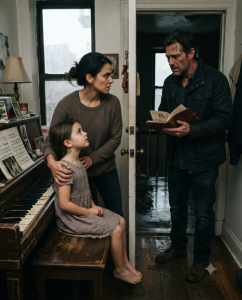
The piano entered the apartment like another presence. Old dark wood. A chipped corner. Faded brass pedals. Keys worn with years of touch. It had weight beyond its size, a sense of having belonged somewhere else for too long to be neutral now.
Ivy appeared at the end of the hall, barefoot, clutching her stuffed rabbit, and stopped as if confronted by a miracle she had been too careful to picture in detail.
Simon saw her. For the first time, his face softened.
“You want to try a note?” he asked.
Ivy nodded.
He lifted the cover, and she pressed a single key with the solemn care of a child touching something sacred. The note rang out—small, lonely, beautiful.
Then Ivy tucked her hair behind her ear.
Simon stopped breathing.
That was how it looked to Felicity, anyway. His eyes fixed on the pale crescent birthmark just below Ivy’s left ear, and all the muted grief in him sharpened into shock so immediate it felt invasive.
Felicity moved before thinking, stepping half in front of Ivy.
“What is it?” she asked.
Ivy touched the mark automatically. “It doesn’t hurt.”
“I know,” Simon said.
The answer came too fast. Too certain.
Felicity felt every protective instinct rise.
Her daughter’s birthmark had always attracted harmless comments. Pretty shape. Looks like a moon. Looks like a comma. But Simon wasn’t reacting with curiosity. He was reacting with recognition.
“My wife used to draw that mark,” he said after a silence. “The same shape. The same place. On the neck of a little girl.”
The movers reentered with the bench, sensed the tension, and left again with unusual speed. When the front door shut behind them, the apartment seemed to contract around the four of them: Felicity, Ivy, Simon, and the piano that had suddenly become the center of something she did not understand.
Ivy sat on the bench and tapped two keys together. “Did your wife play?”
Simon shook his head. “She wrote.”
That answer changed everything.
A writer could invent. A writer could obsess. A writer could sketch a child as part of a novel or a private symbol no one else understood. Felicity grasped at those explanations instantly. But then Simon pulled a worn leather notebook from inside his jacket with hands that were trying very hard not to tremble.
“I almost didn’t bring this,” he said.
“Why did you?” Felicity asked.
“Because the last thing my wife wrote before she died was a child’s name.”
He opened the journal to a page near the back.
There was a sketch of a little girl, not exact enough to identify but close enough to unsettle. Head tilted. Hair tucked behind one ear. And there, below that ear, a crescent-shaped mark.
Underneath the drawing, in slanted handwriting, were six words:
If I ever find Ivy, give her the song.
Felicity felt as though the air had been taken out of the room.
Ivy.
Not some vague reference. Not a child. Not her. Ivy.
“That’s impossible,” she said.
Simon’s face held no triumph, no performance, no desire to persuade. Only exhaustion. “I know.”
He told her his wife’s name was Mara.
Mara Vale had been a novelist once, modestly successful, then increasingly private in the last three years of her life. A diagnosis had followed—an aggressive illness, sudden and cruel. But according to Simon, the journal had started before the diagnosis. Long before. At first Mara had simply drawn the crescent mark in margins, on receipts, on grocery lists. Then she began sketching a child. Then writing fragments.
“She called them visitations at first,” Simon said quietly. “Not ghosts. Not dreams. She was very specific about that. She said sometimes she heard a melody before she fell asleep, and with it came flashes of places she’d never seen. A hallway. Rain on windows. A little apartment. A child with a pale mark under her ear.”
Felicity should have dismissed him then. Ordered him out. Closed the notebook and told him grief had made him vulnerable to patterns that weren’t real.
But he kept saying things he could not know.
The apartment had peeling paint near the kitchen arch that she kept covering with a hanging towel when visitors came. Mara had written about a cracked tile by the radiator. She had described a rabbit with one bent ear.
Ivy’s rabbit had one bent ear.
Felicity stared at the notebook in her hands and felt logic slipping under the pressure of accumulated detail.
“What else is in here?” she asked.
Simon hesitated, then sat carefully on the edge of a dining chair as if his legs were no longer entirely dependable.
“Mostly fragments,” he said. “And one instruction she made me promise I’d follow.”
He looked at the piano.
“She said if I ever found the girl, I had to make sure she learned a specific piece on this instrument.”
Ivy turned on the bench. “Why?”
Simon’s answer came slowly. “Because she believed the song would tell us whether we were already too late.”
Children can sense when adults are frightened, even if they don’t understand the cause. Ivy went quiet after that, resting her fingers on the keys without pressing down.
Felicity took the notebook from Simon and turned pages with growing unease. Drawings. Fragments of melody written without bars or key signatures. Sentences crossed out so violently they nearly tore the paper. Then one page stopped her cold.
At the top was a date three months in the future.
Beneath it, in hard, carved handwriting:
When Ivy plays it, don’t let him hear.
Felicity looked up. “Who is him?”
Simon shook his head. “Mara never named him clearly. Sometimes she wrote ‘the listener.’ Sometimes ‘the man outside the song.’ Once just ‘your brother knows.’”
“Your brother?” Felicity said.
His face changed.
That was the first moment she truly feared him—not because of anger, but because of what he clearly had not wanted to admit.
“My brother Daniel was there near the end,” Simon said. “He handled a lot after Mara got sick. Appointments. Paperwork. Hospital visits when I couldn’t be in two places at once. He thought the journal was a symptom at first. Then Mara stopped letting him in the room when she was writing.”
“Why?”
“She said he asked the wrong questions.”
It sounded ridiculous. It should have sounded ridiculous. But the notebook in Felicity’s lap had already moved the day beyond ordinary standards of sense.
Simon told her Mara had left one final voicemail the night she died. In it, she sounded weak but lucid. She told Simon to keep the piano. To wait for the child with the mark. To trust the melody when the time came. And then, her voice suddenly urgent, she said: Don’t let Daniel hear her play. He’s been listening longer than I knew.
That line had hollowed Simon out.
He played the voicemail for Felicity from his phone, and hearing the dying woman’s voice made the entire thing worse. Mara did not sound delusional. She sounded terrified and specific. Not rambling. Warning.
Ivy listened from the bench, clutching her rabbit. “Why would someone listen to a song before it’s played?” she asked.
Neither adult answered.
A sound interrupted them then—a shift in the hallway outside. Not footsteps moving past. Not a neighbor fumbling with keys. Just the distinct, awful stillness of someone standing directly outside the door.
Felicity turned instinctively.
Simon’s face drained of color.
The doorknob did not move, but the floorboard outside gave a small creak under redistributed weight.
Felicity mouthed, “Who is it?”
Simon whispered back, “I don’t know.”
But the lie was visible.
He did know who it might be.
Felicity crossed the room, peered through the peephole, and saw only a man’s shoulder and the edge of a dark coat. Whoever it was stood too close to see properly. Then came a soft knock.
Not neighborly.
Not impatient.
Measured.
Ivy slid off the bench and hurried toward Felicity, who caught her with one arm.
“Don’t answer it,” Simon said.
That decided her more than anything else. She stepped back from the door, locked the deadbolt though it was already locked, and guided Ivy into the kitchen.
The knock came again.
Then a voice, calm and male: “Simon? I know you’re in there.”
Simon shut his eyes.
“Daniel?” Felicity whispered.
He nodded once.
The voice outside continued. “Mara’s journal is family property. You shouldn’t drag strangers into grief.”
Felicity felt anger cut clean through fear. Family property. As if the dead woman’s final warnings were an inconvenience being tidied.
“She told him about us?” Felicity asked.
“She never met you,” Simon said. “But if Mara said there would be an apartment and a child and a piano… Daniel might have followed me in case I found something.”
Outside, Daniel knocked a third time. “This doesn’t have to be dramatic.”
The phrase was so polished it made Felicity believe instantly that drama had followed him for years.
Ivy tugged her sleeve. “Mom.”
Felicity looked down. Ivy was staring at the piano, not the door.
“What?” Felicity whispered.
“I know that song.”
The room seemed to stop.
Simon stared. “What did you say?”
Ivy pointed to the open page in the journal where a few wavering notes had been scrawled without context. “I know it. I hear it sometimes when I’m trying to sleep.”
Felicity felt every hair on her arms lift.
“No,” she said too quickly, the word aimed at the whole situation. At the notebook. At the man outside. At coincidence itself.
But Ivy had already moved back to the bench.
Daniel’s voice sharpened through the door. “Simon.”
Simon took one step toward Ivy. “Don’t.”
Felicity didn’t know whether he was speaking to Ivy, to Daniel, or to fate.
Ivy lifted her hands and pressed the first notes.
The melody was simple at first. Sparse. Unfinished. It sounded old in a way that had nothing to do with age, as if it belonged to a room long emptied out. Then the next phrase came, and Simon made a choking sound Felicity would remember for the rest of her life.
Because the piano answered.
Not magically. Not impossibly. But with resonance so exact it was as though the instrument had been waiting, holding a memory in its strings for the one touch that could wake it.
From the hallway, Daniel stopped speaking.
Total silence outside the door.
Inside, Ivy continued, eyes distant, playing slowly but without hesitation, as if following instructions she had received somewhere none of them could reach.
Simon grabbed the notebook and flipped frantically through pages until he found one near the back. There, beneath a rough staff of the same melody, Mara had written:
If she remembers the second movement, he lied about the hospital.
Felicity turned to Simon. “What lie?”
His face crumpled with sudden understanding. “Daniel told me Mara was unconscious the last night. He said she couldn’t speak.”
Another line on the page, half-smeared:
He’ll try to keep the ending unheard.
Outside, the doorknob rattled once.
Felicity jumped.
“Call the police,” Simon said.
But Ivy was already entering the second part of the melody, and with it came something stranger than fear—recognition. Simon rushed to the piano bench, not stopping her, only watching her hands with tears gathering in his eyes.
“Mara used to hum this,” he whispered. “Only the first half. She said she could never remember how it finished.”
Ivy played three more notes. Then paused.
She looked up, confused. “It changes.”
“How?” Felicity asked.
Ivy tilted her head, listening to something none of them could hear.
“Depending on who’s telling the truth.”
The hallway went violently quiet.
Then Daniel’s voice, no longer smooth: “Open the door.”
Simon backed away from it instead.
Felicity called emergency services with shaking fingers and gave the operator the address, her voice steadier than she felt. While she spoke, Ivy resumed playing.
The final section of the song was lower, darker, almost hesitant. Then it rose into a sequence so piercingly sad that Felicity found herself gripping the kitchen counter to stay upright. Simon sank into a chair and covered his mouth.
At the exact end of the melody, one final note lingered in the apartment.
And from the other side of the door, Daniel whispered, with naked panic this time, “That’s not the version she wrote down.”
Everything changed at once.
Simon looked up slowly. “You heard her play it.”
The silence outside was answer enough.
The police arrived within minutes. Daniel tried to leave before they reached the hallway, but one of the neighbors had seen him pacing outside Felicity’s apartment and pointed officers in the right direction. His explanation unraveled quickly. First he claimed concern for Simon’s mental state. Then he claimed the journal had been manipulated. Then, when asked why he had waited outside the door listening instead of knocking like a normal relative, he had no good answer.
What came after took months, not hours.
Mara’s medical records were reviewed. Security footage from the hospital was pulled. A nurse came forward remembering an argument between Mara and Daniel the night before she died. More importantly, a backup recording surfaced in Simon’s cloud account—an earlier voicemail Mara had tried to send but failed. In it, her breathing was ragged, but her meaning was unmistakable.
Daniel had been pressuring her to give him the journal.
He believed, in a way Simon never fully understood, that Mara’s visions had value. Commercial value, personal value, strategic value—his explanations shifted. He had already been feeding details from her notebooks to a private collector of “anomalous materials,” a phrase so absurd Simon would have laughed at it in any other context. But Mara, weak as she was, had realized too late that Daniel was less interested in protecting her than in owning whatever made her strange.
She had hidden part of the melody.
Not in paper.
Not in Simon.
In anticipation.
She wrote only the first movement in the journal and left the rest to the child she kept seeing but could not find. Somehow, impossibly, she trusted that the girl with the crescent mark would remember what she herself could not keep.
Why Ivy? No one ever answered that perfectly.
Simon offered theories. Mara had always said some things moved backward before they moved forward. Felicity never embraced the language, but she could not argue with what had happened in her apartment. There was the journal, the name, the mark, the rabbit, the melody Ivy knew without learning.
Maybe Mara had seen fragments of a future. Maybe she had dreamed across a boundary most people never touched. Maybe there were patterns in the world that only appeared when grief and love pressed hard enough against time.
What mattered was simpler.
Mara had been right to be afraid of Daniel.
She had been right to trust the child.
She had been right about the song.
Daniel was eventually charged not with anything supernatural, but with things far more mundane and therefore easier to prove—coercion, fraud tied to items he had sold from Mara’s papers, interference with medical care, and obstruction when investigators uncovered altered records connected to the final hospital night. The law did not need to understand the melody to understand a liar who had profited from a dying woman’s fear.
The piano stayed in Felicity’s apartment.
At first she wanted it gone. Every time she looked at it, she felt the world bend in a way she had never asked for. But Ivy loved it, and when a volunteer music teacher from the neighborhood heard the story—minus the parts no one could explain—and offered free lessons, Felicity said yes before pride could interfere, just as she had with the piano.
Simon visited sometimes, always with permission, always gently. He brought copies of Mara’s published books for Ivy when she was older. He never acted like the piano gave him ownership of any part of their lives. Over time, he became something difficult to name and impossible to dismiss: not family exactly, but not a stranger anymore either. A witness, perhaps. A bridge left behind by someone neither of them could stop missing.
Ivy continued to play the melody now and then, though never quite the same way twice. She said it was “rude” to force a song to tell more than it wanted. Felicity accepted that as the kind of sentence children should not be able to say and yet sometimes do.
Years later, when Ivy was old enough to read Mara’s books, she found a line in one of them that Simon swore he had never noticed before:
Some children are not predicted. They are remembered early.
Felicity closed the book and sat very still after reading that.
She had spent so much of Ivy’s life feeling guilty—guilty about money, about the father who left, about all the doors she could not open for her daughter. The free piano had entered that shame like charity. But it turned out not to be charity at all. It was a message carried the long way around.
A dead woman had seen enough of something to leave a warning.
A grieving husband had been brave enough to follow it.
And a little girl with a crescent-shaped mark below her ear had sat down at an old piano and told the truth before she was even old enough to understand why adults were afraid of hearing it.
The part Felicity returned to most, though, was not the journal or the police or even the impossible accuracy of Mara’s visions.
It was the fact that Mara, facing death, had not written a prophecy about power or fame or money.
She had written a child’s name.
She had tried to protect her.
She had made sure the right people would listen.
Maybe that was the strangest thing of all—that in the middle of fear, greed, illness, and all the ordinary ugliness that ruins lives, the truest force in the story had not been mystery.
It had been care.
And even now, on rainy afternoons when Ivy sat at the piano and let a note ring longer than necessary, Felicity still sometimes caught herself looking at the pale mark beneath her daughter’s ear and wondering which part should unsettle her more:
That a dead woman had known her child existed before she ever arrived—
or that, in the end, the dead woman had understood exactly who around her could not be trusted.