Elena Ruiz hated sleepovers, and not for the reason other parents usually did.
It wasn’t the noise, the sugar, the worry that boys would stay up too late and wake up impossible the next morning. She could handle all of that. What she hated was the exchange between adults. The forced smiles. The polite doorway jokes. The silent inventory every parent seemed to take of every other household.
Whose house was bigger.
Whose child seemed calmer.
Whose life looked more stable from the porch.
For divorced mothers, those moments could feel unbearable.
Elena had spent three years rebuilding a life after a marriage that had ended not with drama but with erosion. Her ex-husband hadn’t cheated. He hadn’t disappeared. He had simply grown tired of the friction, tired of the bills, tired of the version of himself that family life seemed to produce. By the time he left, Elena was too emotionally worn out to even hate him properly.
She just learned how to become efficient.
She learned schedules, custody calendars, emergency backup plans, quick dinners, school forms, and the exact amount of loneliness a woman could carry while still sounding cheerful in front of a second-grade teacher.
So when Mason begged to sleep over at Finn Patterson’s house, Elena’s first instinct was no.
Finn lived with his father, Joel, who had been widowed nearly two years earlier. Everyone at school knew that much. Claire Patterson had died after a sudden illness that people described gently and vaguely, as if precision might be disrespectful. Joel had survived the aftermath the way some people did—by becoming impeccable.
He volunteered.
He remembered details.
He never forgot pickup.
He looked perpetually tired in a way that made other parents trust him more.
Elena trusted him too, at least in the practical sense. She had spoken to him often enough. They both knew the fatigue of raising a child while pretending you weren’t one dropped ball away from falling apart.
So she finally said yes.
Mason packed pajamas, a toothbrush, his favorite dinosaur, and enough excitement for three children. Elena drove him over on a Friday evening under a low gray sky and stood on Joel’s porch trying not to look like she was examining the place for signs of dysfunction.
Joel opened the door wearing jeans and a faded navy sweater. Finn bounced behind him, already barefoot, already shouting something about popcorn and a movie and a pillow fort.
“Thanks again,” Joel said. “They’ve been looking forward to this all week.”
Elena smiled. “Mason would’ve mutinied if I said no again.”
Joel gave a tired laugh. “Same here.”
It should have felt ordinary. It almost did.
Then, as Mason rushed inside, Elena’s eyes drifted for one brief second to a framed photo on the hall table.
Claire.
Blonde-brown hair tucked behind one ear. Bright open smile. The sort of face people called kind because it looked like it had room for other people’s mess.
And suddenly Elena remembered something she had not thought about in months: a weekend at a lake house almost two years earlier, the last time she had seen Claire alive.
The memory came and went too quickly to catch. Elena said goodnight and drove home.
At ten the next morning, Joel texted: They’re still asleep. Can he stay another hour?
Elena answered yes.
Then the uneasiness began.
She could not have explained it. It was not panic, not suspicion exactly, just a low persistent agitation. She cleaned the kitchen. Started a load of laundry. Poured coffee she barely drank. Every few minutes she looked at the clock and felt more certain she needed to go get Mason.
At ten-thirty, she gave in to it.
Rain had begun by then, a thin steady rain that silvered the streets and made the world feel suspended. Joel called for her to come into the kitchen when she stepped inside, and Elena followed his voice with her keys still in her hand.
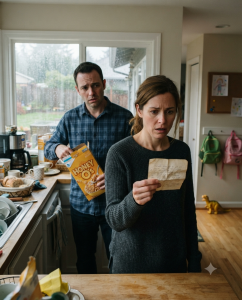
He was standing at the counter with an open cereal box and a folded note.
The boys were nowhere in sight.
“What is that?” she asked.
Joel’s face was almost white. “Mason found it.”
She moved closer and saw her own name written on the paper.
The handwriting pricked at her memory before she even placed it.
Then Joel said, “Mason said Claire told him where to look.”
The room changed.
By the time Mason burst into the kitchen and announced, with cheerful certainty, that “Miss Claire” had shown him the secret note, Elena could feel her pulse in her fingertips.
Children made things up. Children dreamed vividly. Children repeated names they heard in passing and stitched them into stories. Elena knew all of that. But then Mason said Claire had told him to look in the honey cereal box if Elena ever came “in the rain,” because she would not want Joel to know first.
And Elena stared at the cereal box.
Honey cereal had been her comfort food during the collapse of her marriage. It was ridiculous, specific, and private. Only a few people had known. One of them had been Claire.
When Joel finally handed over the note, Elena unfolded it with shaking hands.
If this reaches Elena before Joel tells her the truth, then I ran out of time.
Below that were several lines, brief and direct. Claire said Elena had been right about Joel. She wrote that if Finn ever mentioned “crashing in the blue room,” he should be believed. She warned Elena that if Joel described her as confused near the end, Elena should ask why Claire changed her will three days before she died.
At the bottom was one final warning: Don’t let him know what you remember about that weekend at the lake until you hear the recording.
The lake.
With that, Elena’s memory sharpened.
The weekend had happened about a month before Claire died. A shared rental. Two couples, two children, one rainy Saturday trapped mostly indoors. Elena had nearly forgotten it because her own divorce had begun unraveling during that season, and everything from that year felt dim around the edges.
But she remembered enough.
Claire crying quietly in an upstairs bathroom.
Joel insisting she was overtired.
A slammed door late at night.
And the next morning, Claire gripping Elena’s wrist while the men packed the car and whispering, “If anything ever happens too fast, don’t believe the first version.”
Elena had assumed Claire meant her illness. Or fear. Or stress.
Now the words sounded like a warning.
Joel said, “There’s more than one note.”
He opened the locked drawer beside the stove and showed her three additional envelopes. One addressed to Finn. One to Joel. One blank.
Elena asked how long they had been there.
“They weren’t,” he said. “I was in this drawer last night.”
His voice had the blunt, frightened honesty of someone who no longer trusted his own understanding of the room. Elena did not know whether to believe him, and that frightened her more.
Then Finn came halfway down the stairs, clutching the banister, and in a small voice said, “Dad, are you finally going to tell them about the blue room now?”
Every adult instinct in Elena went rigid.
At the end of the hall was a basement door painted the same cream color as the trim. She had barely noticed it when she arrived. Joel noticed her noticing it and went visibly cold.
“What’s in the basement?” she asked.
Joel looked at Finn. Then at Mason. Then back at Elena.
“A room Claire used as an office,” he said. “Storage mostly now.”
Finn shook his head immediately. “That’s not what Mom called it.”
Joel closed his eyes for one second, defeated.
Elena crouched down so she was level with Finn. “What did your mom call it?”
“The blue room,” Finn whispered. “She said if she ever forgot where she put the truth, it would still be there.”
Joel inhaled sharply.
That did it.
“Elena,” he said, “the boys should not hear this.”
“Then send them to the living room.”
He hesitated, then did exactly that, his voice so tight Elena almost did not recognize it. The boys vanished reluctantly, cartoon volume rising a moment later as if normalcy could be restored by sound.
But the house no longer felt normal.
Joel stared at the basement door for several seconds before speaking.
“Claire thought I was hiding money from her,” he said. “Near the end she became fixated on certain things. The office downstairs was where we fought about finances. About insurance. About… everything.”
“Was she right?”
Joel’s expression shifted from grief to something harder to name.
“I did hide things,” he said. “Not the thing you’re thinking.”
It was the first honest sentence Elena had heard from him all morning.
He went to the basement door, unlocked it, and switched on the stair light. The smell that rose from below was dry paper, old paint, and the faint metallic scent of a room shut too long.
The basement itself was finished better than she expected. Shelves lined one wall. Plastic storage bins sat stacked in columns. At the far end was a small room with a blue-painted door, faded now but unmistakable. Joel stopped outside it without touching the knob.
“She worked down there when Finn was little,” he said. “Then later… when she got sick, she spent more and more time alone.”
“Open it,” Elena said.
Inside, the office had been frozen.
A desk. Filing cabinet. Corkboard. A dying houseplant turned brittle in its pot. Dust lay over everything, but not evenly. Some items had been moved more recently than others.
On the shelf beside the desk sat an old digital voice recorder.
Elena saw it first. So did Joel.
Neither moved.
Then Joel said quietly, “I’ve never seen that.”
Elena almost laughed at the absurdity of the sentence. This morning had become a chain of impossible claims, and yet she believed him again. Not because he deserved it, but because his fear did not look manufactured anymore. It looked like a man confronting a version of his marriage he had spent two years refusing to fully examine.
Elena picked up the recorder.
It powered on.
There was one saved file.
Her thumb hovered over PLAY.
“Wait,” Joel said.
She turned.
His face had changed. Less defensive now. More ruined.
“There are things I should have told people after she died,” he said. “I told myself I was protecting Finn. Protecting Claire’s dignity. Maybe I was protecting myself.”
“From what?”
He swallowed. “From what kind of husband it made me.”
Elena said nothing.
So he told her.
Months before Claire died, she had discovered Joel had taken out a line of credit against the house without telling her. His consulting income had become unstable. He was underwater on a side investment he had hidden from her. He had been moving money around desperately, convinced he could fix it before she found out. Instead, she found documents in the blue room.
They fought constantly after that.
Then Claire became seriously ill, and Joel used her diagnosis as an excuse not to confess the full extent of the financial damage. He handled the paperwork. Met with insurance people alone. Told himself he was sparing her stress while actually preserving control.
“She started recording things,” he said. “Arguments. Conversations. She said I revised reality too easily.”
“Did you?”
He nodded once.
That answer landed harder than denial.
“On the night you remember at the lake,” he continued, “she found out I’d changed beneficiary paperwork on an account. I told her it was temporary. She didn’t believe me.”
Elena remembered the slammed door. Claire’s red eyes. The pressure of her grip.
“What about the will?” Elena asked.
Joel shut his eyes briefly. “She changed it because she hired a lawyer without telling me. Put some assets in trust for Finn. Named a second executor in case anything happened.”
“Who?”
“You.”
The word struck Elena like a slap.
“What?”
“She never told you?”
“No.”
“I only found out after she died.”
That made no sense and yet it did. Claire had trusted her. Not intimately, not in a best-friend way, but in the practical, observant way women sometimes choose each other in moments of danger. Elena had noticed things. Claire had known that.
Elena looked down at the recorder in her hand and pressed play.
For a second there was only static.
Then Claire’s voice filled the small blue room.
Weak, but unmistakable.
If someone is hearing this, it means I was right not to trust how this would be explained after I’m gone. Joel is not going to kill me. I need that said clearly. But he is capable of letting a lie do the work of violence if the lie protects him.
Elena felt the air leave her lungs.
On the recording, Claire spoke in careful fragments. She explained the debt. The hidden accounts. The way Joel had minimized her concerns until she doubted herself. The way he had used her illness to suggest she was too tired, too medicated, too emotional to manage documents. She said she had begun leaving records in separate places because she no longer trusted what might disappear from the house.
Then Claire said the thing that changed the center of the story.
She was not afraid Joel would physically hurt her.
She was afraid he would let her son grow up inside a false version of her.
If I die soon, she said, he will call me confused. He’ll say I forgot what I signed, what I said, what I feared. He will not need to invent much. Sick women are easy to edit.
Joel made a noise beside Elena, something between a gasp and a flinch.
Claire continued. She said she still loved her husband, which somehow made the recording more devastating. She said he was not a monster. He was a man who feared shame more than truth, and that fear had turned him into someone dangerous in quieter ways. She said Finn deserved honesty. She said Joel deserved the chance to tell it himself, but if he did not, then the papers in the blue room and the envelope hidden for Elena should force the story into daylight.
The recording ended with one final request.
Please don’t let my son remember me through anyone else’s convenience.
Silence returned to the room.
Elena lowered the recorder slowly.
Joel sat down in Claire’s desk chair like his legs had failed. He covered his mouth with one hand and stared at the floor. When he finally spoke, his voice was shredded.
“She wasn’t wrong.”
Elena waited.
“I didn’t kill her,” he said. “But I did exactly what she thought I would. I let everyone believe the softened version because it made me look like a grieving husband instead of a selfish one.”
He looked up at Elena with eyes that had lost all their practiced steadiness.
“She got sicker so fast at the end. I kept thinking I’d tell the truth later. After the funeral. After the estate process. After Finn stabilized. Then every month that passed made it uglier to admit.”
“What truth exactly?”
“That she died angry with me. That she changed legal documents because she didn’t trust me. That I spent the year after her death quietly correcting records in ways that favored me before the trust lawyer forced the issue.”
Elena stared at him.
“Did you steal from your son?”
His face crumpled. “Not outright. But I delayed transfers. Delayed disclosures. Told myself I needed time. Claire knew I would.”
That was the moment Elena understood the full shape of it.
Not murder.
Not a haunting in the simple sense.
Not innocence either.
Claire had anticipated the story that would swallow her once she was gone. She had prepared against erasure.
And somehow, through a child’s impossible midnight claim or coincidence too strange to categorize, the truth had finally surfaced.
“What happens now?” Elena asked.
Joel looked toward the stairwell where the boys were laughing faintly above them.
“Now,” he said, “I call Claire’s lawyer. I hand over everything in this room. And I tell my son the truth in the only way he might someday forgive.”
They spent the next two hours opening boxes, sorting files, photographing documents. The trust attorney, once reached by phone, was grim but not surprised enough for Elena’s comfort. Apparently Claire had left instructions that certain materials be reviewed if hidden correspondence ever emerged.
By afternoon, the story of Claire’s estate had shifted formally. Joel did not fight it. Maybe he was too tired. Maybe the recording had stripped him of any remaining defense. Maybe grief, once mixed with shame, had finally become heavy enough to force honesty.
Before Elena left, Finn asked if his mother had been mad.
Joel knelt in front of him and answered with a courage Elena had not expected from him that morning.
“She was hurt,” he said. “Because I didn’t tell the truth when I should have. That was my fault, not yours, not hers.”
Finn cried. Joel cried with him.
Mason, confused but loyal in the uncomplicated way children can be, handed Finn the plastic dinosaur as if that might solve mourning, guilt, and adulthood all at once.
It did not solve them.
But it helped.
In the weeks that followed, there were meetings, paperwork, uncomfortable disclosures, and one very quiet ripple through the school community when the trust adjustments became known in pieces among parents who pretended not to gossip. Joel resigned from the PTA. Sold the house six months later. Not because anyone forced him to, but because he said he could not raise Finn in a place built so carefully around silence.
Elena kept one thing for herself: the first note from the cereal box.
Not as evidence. There were copies for that.
She kept it because she still did not know what to make of the way Mason had found it.
He remained maddeningly calm about the whole thing.
“Miss Claire was worried,” he told her once over macaroni. “She said grown-ups wait too long to say important stuff.”
Elena asked him whether he had really seen Claire.
He shrugged. “I saw a lady in Finn’s room. She knew my name. She looked sad, not scary.”
Then he asked for more cheese and never brought it up again.
Elena never decided whether she believed in ghosts.
She did believe in unfinished truths. In women who learned, too late, how easily they could be rewritten. In the instinct that dragged a mother across town in the rain before anyone had told her to worry.
And sometimes, when she thought about Claire’s voice on that recorder, what stayed with Elena most was not the fraud or the will or even the secret notes hidden inside an ordinary kitchen.
It was the line that felt larger than all of it.
Sick women are easy to edit.
That was the part that haunted her.
Not because Claire had been right about Joel. But because she had been right about the world around him too.
And Elena still wasn’t sure which was worse: the husband who let the false version stand, or how easily everyone had been willing to believe it.