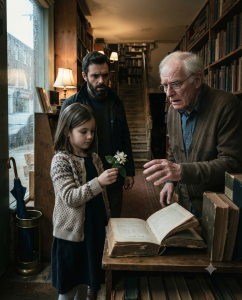
Gavin Hart used to think grief would arrive in the obvious places.
In the hospital room where the machines made promises no one believed. In the church where everyone wore dark colors and spoke in softened voices. In the bedroom closet where his wife’s sweaters still hung in patient rows, carrying the faintest trace of perfume if he leaned in close enough.
He had expected those places.
What he had not expected was a used bookstore on a windy Saturday afternoon.
He had not expected his daughter to stand in the classics aisle holding a pressed white flower while an old man behind the register turned ghost-pale and asked a question that made no sense at all.
Where did you get that?
The whole thing had begun because June missed bedtime stories.
That was how Gavin explained it to himself while driving downtown, the heater clicking, leaves skidding across the street ahead of them. June sat in the backseat with her knees tucked up, chin almost touching the collar of her yellow coat. She had her mother’s habit of looking out the window as if every passing storefront contained a secret. Since Claire died eight months earlier, that habit hurt Gavin more than almost anything else.
June had asked after breakfast if they could go to “one of Mommy’s story places.”
At first, he pretended not to understand.
Then she said, “The kind where books already know things.”
So he took her to Bell & Pine Used Books, mostly because Claire had loved places like that. The kind with creaking floors, mismatched chairs, old editions with inscriptions from strangers, and shelf notes written in careful pencil by someone who loved language enough to argue with dead authors in the margins. Claire could lose an hour in a store like that and emerge with three novels, a poetry collection, and some small object she insisted had “character.”
The bookstore was exactly the sort of place she would have loved.
Warm lamps glowed against rows of dark wood shelves. The front windows were blurred with a fine, cold rain. A brass bell above the door gave a single soft ring when they entered, and the smell of dust, paper, and old varnish wrapped around them so completely Gavin felt as if they had stepped out of the weather and into another decade.
June slipped away almost at once.
She wandered first to the children’s corner, then swerved unexpectedly into classics because a faded blue ribbon stuck out from a copy of Jane Eyre. Gavin was only a few feet away when she tugged the book free.
A dried white flower drifted out.
The old man shelving paperbacks nearby looked up and went still.
Gavin had seen grief before. On doctors, on relatives, on himself in mirrors he wished he had not glanced into. The expression that crossed the owner’s face belonged to that family of pain. It was immediate and involuntary, as if the flower had reached into him and pressed some hidden bruise.
“My wife left a jasmine bloom inside that book the week before she died,” he said.
His name, they would learn, was Elias Bell. He had owned Bell & Pine for thirty-seven years with his wife, Miriam. She handled poetry and front-window displays. He handled invoices, repairs, and the kind of practical work that kept the place afloat. Together they had made the bookstore into the center of their lives. When Miriam became sick, they moved hospice care into the apartment upstairs rather than leave the shop behind.
June listened to all of this as if she were hearing facts she somehow already knew.
Then she said, “It smells like the hall.”
Elias stared at her.
There was, in fact, a narrow back hallway with a red runner leading to the staircase. He told them nurses had gone through it each day during Miriam’s final week. Flowers had passed through it too. So had casseroles, folded blankets, medicine bags, and finally silence.
But that was not the part that shook him most.
“The lady by the tall books said you never moved the blue umbrella,” June said next.
Gavin turned cold.
Near the front entrance stood a brass umbrella stand. In it leaned a navy-blue umbrella with a curved wooden handle polished smooth by use. It looked like an ordinary object, something any store owner might forget to put away. But Elias’s face gave him away before he spoke.
“That was hers,” he said quietly. “She left it there after the last rain before she got too weak to come downstairs. I never moved it.”
Gavin crouched beside June and asked the question he had begun dreading.
Who had told her these things?
“The nice lady near poetry,” June answered.
There was no one there.
Only the rolling ladder. Tall shelves. A gap in the air where someone might once have stood.
Elias lowered himself onto a stool as if his legs had failed. “Miriam stood there every afternoon,” he whispered. “She rearranged those shelves every season, even when they didn’t need it.”
Then June said the sentence that changed the day.
“She said you were supposed to find the note before winter.”
That struck Elias harder than the flower and the umbrella put together.
During Miriam’s final days, he admitted, she had spoken several times about something he still hadn’t found. He had assumed fever and medication had scrambled her words. Still, after she died, he searched. He checked her desk, dresser drawers, recipe tins, old coat pockets, even the storage room in the basement. He searched books too, but never Jane Eyre.
When June opened the novel to pages 214 and 215 and reached into the spine with eerie certainty, a folded paper emerged from a crack so deep in the binding it might have slept there for years.
Elias took the book in shaking hands.
He did not open the note.
Not yet.
Because June was still listening to something none of the adults could hear.
“She said don’t read it upstairs first,” June murmured.
That stopped him cold.
“What does that mean?” Gavin asked.
June stared toward the dark corridor and said, “She said if he reads it up there first, he’ll think she forgave the wrong thing.”
A change moved through Elias then, subtle but unmistakable. It was not belief, exactly. Not yet. It was memory. Something he had buried because it hurt too much to examine.
“The night before Miriam died,” he said slowly, “someone came to the store after closing.”
The rain thickened outside, running silver down the glass.
“I heard the bell,” Elias continued. “I was upstairs with her. By the time I got to the stairs, I only saw a man through the window. Dark coat. He was walking away. I thought he’d come to the wrong place and left.”
June looked at him with solemn certainty. “He didn’t leave.”
Those words seemed to take the air from the room.
Elias set the folded note carefully on the counter and moved toward the umbrella stand. Gavin followed, one hand hovering near June as if physical closeness might somehow protect her from whatever this was becoming.
The navy umbrella stood in a brass holder with two canes and a rolled newspaper gone soft with age. Elias lifted the umbrella. Nothing happened.
Then June pointed. “Under the felt.”
At the base of the stand was a round pad of dark green felt, worn thin around the edges. Elias bent, peeled it back, and revealed a shallow metal plate screwed into the bottom. Wedged between the plate and the stand was a narrow, brittle slip of paper.
A receipt.
He drew it out as if defusing something.
The print was faded but legible enough under the counter lamp. It was from a notary office dated the day before Miriam died. One line had been circled in blue ink:
Amendment filed removing beneficiary designation: Elias Bell.
Below it, in a sharper hand than the printed lines, Miriam had written one sentence.
Not my choice.
Elias stared at those words so long Gavin thought he had stopped breathing.
“What is it?” Gavin asked quietly.
Elias swallowed twice before he could answer. “My brother,” he said. “Thomas handled some of our legal paperwork when Miriam got sick. He’s a lawyer. He said she wanted to simplify the estate. I told him to do whatever she asked.” His voice cracked. “After she died, he told me the store had been sold to cover debts I didn’t know existed. He said Miriam changed things at the end.”
Gavin looked around at the shelves, the lamps, the register, the old floor that seemed to hold the weight of decades. “But you still own it.”
“For now,” Elias said. “The sale was delayed. Zoning dispute. Probate issue. Thomas said paperwork takes time.” He looked at the receipt in horror. “If Miriam didn’t remove me, then someone did it for her.”
The folded note waited on the counter.
This time Elias opened it.
The paper shook in his hands. Miriam’s writing was small but firm, the kind made by someone conserving strength and refusing to waste it.
If you are reading this, then I was right to hide it where only patience or a child would find it.
Do not trust Thomas.
He came after hours and brought papers he said were routine. I was weak and half asleep, but I knew my signature had already been copied onto one page. When I refused to sign anything else, he said you would lose everything because you were “too sentimental to save the store.”
He thought morphine made me confused. It did not.
The umbrella stand holds the receipt he dropped when I told him to leave. I could not get downstairs, so I asked Lena to press the jasmine in Jane Eyre and hide this note where you never look long enough.
You stop at the obvious pages, my love. Start where the spine hurts.
If he tells you I chose him over you, he is lying.
I loved you to the last ordinary minute.
Save the shop.
Elias had to stop reading.
He pressed the paper to his mouth and turned away. Gavin looked toward June. She stood perfectly still, hands folded around the fragile jasmine. She did not look triumphant or afraid. She looked relieved.
“Who’s Lena?” Gavin asked after a long silence.
Elias lowered the note. “Our upstairs tenant. College student. Helped with errands at the end.” A bleak understanding passed through him. “She moved out the week after the funeral. Thomas told me she left without a forwarding address. Said she was too upset to speak to anyone.”
“He paid her,” Gavin said.
Elias gave a numb nod. “Or frightened her.”
The bell above the door rang.
All three of them turned.
A man in a charcoal coat stepped inside, carrying no umbrella despite the rain. He was in his early sixties, broad-shouldered, clean-shaven, and so neatly dressed he looked almost polished. His eyes moved first to Elias, then to the open note, then to the receipt in his hand.
Whatever softness remained in the room vanished.
“Elias,” the man said, managing a smile that died quickly when no one returned it. “I was in the neighborhood.”
Thomas.
Gavin did not know what to do with the sudden, irrational certainty that the room had been waiting for this exact moment.
Thomas saw the paper more clearly and his expression hardened. “What is that?”
Elias’s voice came out thin but steady. “Something Miriam left where you didn’t think I’d find it.”
Thomas shut the door behind him. “You’re upset. Let’s not do this in front of customers.”
“There are no customers,” Elias said.
He was right. The shop had emptied without Gavin noticing. Rain hissed against the windows. The lamps cast pools of gold that made Thomas’s wet coat look almost black.
Thomas held out a hand. “Give me the note.”
June took one step behind Gavin.
That small movement seemed to settle something in Elias. He straightened. The trembling in him remained, but it was no longer helpless trembling. It had changed into anger old enough to be useful.
“No.”
Thomas exhaled through his nose. “You don’t understand what you’re looking at.”
“I understand enough.”
Thomas’s gaze flicked toward Gavin and June, calculating. “Who are these people?”
“The ones who found what you buried,” Elias said.
For a moment Thomas looked genuinely confused. Then his eyes rested on June, and something almost superstitious crossed his face before he forced it away.
“You always were easy to manipulate,” he said to Elias. “Miriam was sick. Confused. I protected you from a mess she created.”
Elias lifted the receipt. “By forging documents?”
Thomas’s jaw tightened. “Lower your voice.”
“By stealing my wife’s store while she was dying?”
The accusation cracked through the room.
Thomas took a step forward. Gavin moved without thinking, placing himself slightly between June and the counter. Thomas noticed and stopped.
“This is absurd,” Thomas said. “Any court will side with signed paperwork.”
“Then it’s unfortunate,” Gavin said quietly, “that you came in while we were discussing a forged beneficiary change and a hidden receipt from the notary office.”
Thomas turned sharply toward him. “And you are?”
“A witness.”
It was not much, but it landed.
Thomas looked back at Elias. “Don’t be stupid. You can’t prove—”
“I can prove Miriam wrote this note,” Elias cut in. “And I can prove you lied about her wishes.” He drew a shaky breath. “And if Lena helped hide it, maybe she’ll finally tell the truth too.”
At that, Thomas’s composure cracked for the first time. “Lena won’t say anything.”
The words came too fast.
Too sure.
Everyone heard it.
Elias did too.
Something grim and almost peaceful settled over his features. “So you did threaten her.”
Thomas realized too late what he had admitted. He took another step back, eyes darting toward the door, toward the note, toward the front window where rain blurred the street into streaks of gray. Whatever plan he had when he entered the store was collapsing in real time.
He reached for the paper anyway.
Elias jerked it out of reach.
“Don’t,” Gavin said.
Thomas glared at him. “Stay out of this.”
But then June spoke, very softly.
“She said you’d still make it ugly.”
Thomas turned toward her.
For the first time, his face lost all polish. He looked frightened.
Not of a child, exactly. Of what she represented. Of the fact that something he believed hidden had risen anyway.
He left three minutes later after Elias told him the police were already being called, whether or not that was true. The threat was enough. Thomas did not run. Men like him rarely ran when they still believed they could explain. He simply straightened his coat, looked once more at the note in Elias’s hand, and walked into the rain without another word.
The silence after he left felt enormous.
Elias sank into a chair behind the counter and cried with the restraint of someone who had spent a lifetime practicing not to. Gavin stood nearby, one hand on June’s shoulder, not speaking because there was nothing useful to say.
Eventually Elias wiped his eyes and asked, “Did she really talk to you?”
June considered the question with the seriousness children reserve for important truths.
“She didn’t talk like us,” she said. “It was more like when you remember something before it happens.”
Gavin would later turn that sentence over for weeks.
Maybe June had noticed details adults missed: the umbrella, the hallway, the way grief leaves patterns in a room. Maybe she was piecing together fragments with the wild, exact intuition children sometimes have. Maybe something stranger had happened in Bell & Pine that day.
Gavin never found an explanation that satisfied every part of him.
But explanations mattered less once the practical consequences began.
With Gavin’s statement, the receipt, the note, and later a very shaken phone call from Lena, the truth came apart quickly. Thomas had tried to pressure Miriam into signing over control of the business while she was medicated and weak. When she refused, he prepared paperwork using copied signatures from older documents. He had planned to force the change through probate, count on Elias’s exhaustion, and sell the store before anyone dug too deeply.
Miriam had known enough to hide proof where Thomas would never think to look.
Months later, Bell & Pine still belonged to Elias.
The blue umbrella remained by the door, though now it was polished and opened sometimes on rainy mornings before the store unlocked, as if use itself had become a form of remembrance instead of betrayal. A framed pressed jasmine sat near the register in a small brass frame. Elias did not label it. He did not need to.
Gavin and June returned often.
Sometimes they bought books. Sometimes they only wandered. Elias kept a chair near the children’s section now, and on Saturdays he read aloud in a voice that was rough in places and beautiful in others. June still tucked treasures into books, though now she always showed the shopkeeper first. Leaves. Ticket stubs. Notes to no one and everyone.
One cold afternoon in early winter, Gavin watched her slip a small drawing into a battered fairy-tale collection. On it she had written, in careful block letters: SOME THINGS STILL FIND THEIR WAY BACK.
He did not stop her.
He thought of Claire then, of all the ordinary minutes that end before anyone knows they are the last. He thought of Miriam, who had hidden love and warning together inside a novel because she knew grief makes people miss what hurts most to see. He thought of the strange mercy of being led, one painful page at a time, toward the truth.
Elias was not wronged forever.
Thomas was not clever enough in the end.
Miriam was not silent.
And whatever had happened in that aisle between the tall books, whatever name a person gave it, one fact remained impossible to shake:
Sometimes the dead leave behind more than absence.
Sometimes they leave instructions.
Sometimes they leave justice.
And sometimes, in the middle of an ordinary Saturday, they leave one small child standing exactly where the living forgot to look.