The first thing Ben noticed about the woman in the back row was that she looked like someone who had come to lose something.
Not to watch a school concert. Not to clap at off-key songs or film a child in a paper snowflake costume. To lose something.
She sat three chairs away from him in a dark coat and green scarf, hands clasped so tightly in her lap that even from a distance he could see the strain in her fingers. She didn’t glance at her phone. She didn’t smile at other parents. She stared at the stage with the kind of careful, painful attention that only grief could teach.
Ben had no idea who she was.
He was too busy trying to slow his breathing after racing from the parking lot with a crooked tie and a paper coffee he no longer wanted. He had made it, barely, and that alone felt like a victory. Chloe had stood in the kitchen that morning wearing her oversized choir shirt and looking so serious it unsettled him.
“Please don’t make me look for you and not find you.”
She had said it quietly, but it hit harder than anger ever could.
Since Emma died two years earlier, Chloe had changed the way she measured love. She didn’t ask for toys, special days, or big promises. She counted who showed up. You came. You stayed. You watched. Ben knew exactly why. He had missed too much already. One dance recital because of a client emergency. One reading day because he’d been delayed at the hospital with his father. Chloe had never yelled about it. She had only gone quieter, and the silence had followed him for months.
So he came.
And then everything went wrong.
The children filed onto the risers. Chloe found him in the crowd and visibly relaxed. Ben smiled and lifted a hand. The piano began. The choir started singing.
Then Chloe looked past him.
Her face changed so fast it made his stomach drop.
She stopped singing. Stopped moving. The music continued around her while she stood frozen in the second row, eyes fixed on something in the audience with terrified disbelief.
A teacher motioned from the wings.
Sing.
Smile.
Keep going.
Chloe whispered one word into the microphone.
“Mom?”
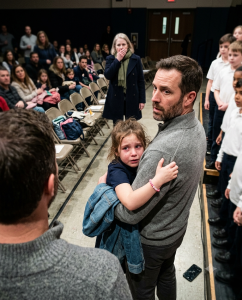
The auditorium erupted in confused sound. Gasps. Nervous laughter. The abrupt death of the piano. Ben was already on his feet, shoving past knees and handbags. By the time he reached the stage, Chloe was crying hard enough to shake.
He gathered her into his arms. She clung to him, but kept looking over his shoulder.
At the woman in the back row.
“She was in Mommy’s picture box,” Chloe sobbed. “The beach one. The hidden one.”
Ben’s entire body went still.
At home, on the top shelf of his closet, he kept a sealed plastic box of Emma’s belongings he still had not sorted. He had opened it a few times, always with the intention of organizing it, and always failed. There were cards, old appointment papers, photographs, a perfume scarf, and dozens of fragments of a life he still couldn’t handle touching for very long.
He had never shown Chloe that box.
But children found things adults thought were hidden.
In the hallway outside the auditorium, with parents trying not to stare, Ben finally faced the woman. Up close, the resemblance was impossible to ignore. She was older than Emma had been, maybe by ten years, but the family likeness sat heavily in the eyes and mouth.
“Do I know you?” Ben asked.
She looked as if the question hurt.
“My name is Laurel,” she said at last. “Emma was my sister.”
Everything after that seemed to happen in slowed fragments.
Laurel explained that she had received a letter six months after Emma died. It had been forwarded twice, buried under unopened mail after a move, and left unread until the week before. Emma had written it before her death and marked it clearly: Only if I’m gone.
Ben felt anger first. Then confusion. Then something worse.
Emma had told him she had no family. No siblings. No one she trusted enough to bring into their lives. It had been one of the things that made Ben fiercely protective of her. He believed he was all she had.
Now a stranger stood in front of him holding proof that wasn’t true.
Laurel handed him the letter with trembling fingers.
Ben opened it in the school hallway while Chloe stood pressed against his side.
The first lines were written in Emma’s unmistakable slanted handwriting.
Laurel,
If Chloe sees you before Ben knows, she will think you’re me. That isn’t your fault. It isn’t hers. It’s mine.
Ben read the sentence twice.
His mouth went dry.
The rest came in painful pieces.
Emma and Laurel had once been extremely close. After their mother disappeared into addiction and their father died young, Laurel, twelve years older, had practically raised Emma. By the time Emma was a teenager, Laurel had become part sister, part parent, part shield. The beach photo Chloe remembered had been taken during the best summer of Emma’s life, the one before everything broke.
It broke when Emma got sick.
Years before Ben met her, Emma had been diagnosed with an aggressive autoimmune illness. The treatments were brutal. She lost weight, then hair, then months of her life to fear and hospitals she refused to remember. During one especially bad stretch, she vanished from everyone except Laurel. She rented a room near a treatment center two hours away and refused to let friends see her. Laurel was the only one allowed in.
Then Emma met Ben after she went into remission.
She told him the cleaned-up version. Bad illness, rough family, no one important left. Ben never pushed too hard because he saw the pain in her when the subject surfaced. When the illness returned after Chloe was born, Emma hid the first recurrence the same way she had hidden the first: privately, stubbornly, in pieces.
That was where the letter changed.
Ben felt it before he understood it.
Emma had discovered signs that the disease was progressing again when Chloe was three. She was terrified. Ben had just started a new job. Money was tight. Chloe was little. Emma did not want her daughter’s earliest memories to be of hospital corridors and her mother disappearing behind swinging doors.
So when one round of treatment went especially badly, Emma called Laurel.
Laurel came immediately.
For six weeks, Laurel stayed in a short-term rental near the hospital and helped Emma through the worst of it. On three separate days, when Emma was too weak to stand and Ben was trapped at work or out of town for a training he could not leave, Laurel picked Chloe up from daycare and kept her until Ben got home. Chloe was so young that on the first day she burst into tears, reached for Laurel, and called her Mommy.
Emma never got over it.
She wrote that line in the letter too.
I know it sounds childish, but I hated hearing my daughter call someone with my face by my name.
Ben stopped reading and looked up. Laurel was crying silently.
“That’s why Chloe reacted,” Laurel said. “She was little, but some part of her remembered me. I hoped she wouldn’t.”
Ben’s head was spinning, but he kept reading.
The worst part wasn’t the resemblance. It wasn’t even the lie about the missing family.
It was what came after.
Emma confessed that during those six weeks, she had asked Laurel to do something cruel.
She asked her to disappear again.
No more visits. No more contact. No chance that Chloe would bond with the woman who stepped in when Emma could not. Emma told Laurel that if she loved her, she would stay away and let Emma remain the center of Chloe’s world. Laurel fought her on it. They argued in a hospital parking lot until both of them were shaking. Laurel accused Emma of punishing her for helping. Emma accused Laurel of making her feel replaceable.
Their last conversation ended with Laurel saying, “I don’t know how to forgive this.”
Emma responded, “Then don’t.”
Neither of them called again.
Ben had to stop reading because his vision blurred.
He had known Emma as generous, funny, patient, stubborn, and deeply loving. Seeing jealousy and fear inside her handwriting felt almost unbearable. But it also made terrible sense. Illness had stripped her of so much control that motherhood became the one territory she could not bear to share.
The final pages of the letter were apology.
Emma wrote that as her health failed for the last time, she understood too late what she had done. She had confused fear with protection and pride with love. She had stolen years from Laurel, denied Chloe a piece of her family, and built her marriage on a lie Ben never deserved.
If you are reading this, she wrote, I am gone, which means my pride won too long. I need you to know three things. First, Ben loved me better than I loved myself. Second, Chloe was never safer than when she was with you. Third, if there is any mercy left for me, please don’t punish them for my cowardice.
Ben lowered the letter slowly.
The hallway felt too small for what he was carrying.
Chloe looked between him and Laurel, frightened by the silence. “Daddy?”
Ben crouched so he was level with her. His throat tightened before the words came.
“This lady is your mommy’s sister,” he said gently. “Your aunt.”
Chloe studied Laurel’s face again. “That’s why she looks like her?”
Laurel nodded, covering her mouth as tears slipped through her fingers. “Yes.”
Chloe was quiet for a long moment. “Did Mommy know you were coming?”
The question wrecked them both.
Laurel answered honestly. “She hoped I would. But she didn’t know if I could.”
Ben might have left then. He might have taken Chloe home and dealt with the rest alone. Part of him wanted to. Another part wanted to demand why Laurel had chosen a school concert for this, why she hadn’t called first, why she had obeyed a dead woman’s instructions so literally that she sat in the back row and watched a child panic.
But Emma’s letter explained even that.
Watch Chloe first. See who she is now. Decide whether coming closer would help her or only satisfy your grief.
Laurel hadn’t come to intrude. She had come to be sure.
Ben looked at her and saw what he had missed at first glance. Not threat. Not deception. Fear. The fear of a woman who had already lost her sister and was terrified of doing harm to the only piece of her left.
The principal approached carefully and offered them a private room. They ended up in a cramped office with construction-paper art on the walls and a box of stale tissues on the desk. There, away from the crowd, Laurel told Chloe stories about Emma that Ben had never heard.
How Emma used to collect sea glass and swear each color meant a different future.
How she once cut her own hair at thirteen and blamed the family cat.
How she hated bananas, loved thunderstorms, and cried at commercials involving old dogs.
At first Chloe listened with suspicion. Then with fascination. Then with that raw, hungry attention children have when they realize there is still more of someone they miss to be found in the world.
Ben sat quietly, absorbing each revelation with a strange mix of gratitude and grief. He was angry at Emma. He loved her no less for it, but he was angry. Angry that she had trusted shame more than him. Angry that she had denied Chloe family. Angry that even in death she could still upend a room and leave him holding the pieces.
Yet as Laurel spoke, he could also see Emma’s fear clearly for the first time. A sick mother hearing her toddler call another woman Mommy. A woman who had spent her life being abandoned suddenly imagining that even her child could shift her love elsewhere. It was irrational, unfair, and painfully human.
Before they left the school, Chloe did something none of them expected.
She climbed down from her chair, walked slowly to Laurel, and held out her hand.
“Can I see the beach picture?” she asked.
Laurel let out a sound that was almost a laugh and almost a sob. She pulled her phone from her bag, opened a scanned copy of the photograph, and showed it to her.
Emma and Laurel stood barefoot in wet sand, laughing at something beyond the frame, their hair blown across their faces, arms linked so tightly they seemed impossible to separate.
Chloe touched the screen with one careful finger.
“She looked happy,” she said.
“She was,” Laurel answered. “That day, she really was.”
That night Ben opened the storage box with Chloe beside him instead of asleep in the next room. Together they found the original photograph, tucked inside a book of old medical bills. On the back, in Emma’s handwriting, were seven words:
The summer before fear made me small.
Ben stared at the line until he had to look away.
The weeks that followed were uneasy, tender, and far from simple. Laurel did not rush. She did not try to claim space she hadn’t earned. She met them for hot chocolate first, then a park visit, then dinner. Chloe asked impossible questions with a child’s brutal honesty. Why didn’t Mommy tell us? Did she still love Aunt Laurel? Was she mad when she died? Ben answered what he could and admitted what he couldn’t.
Sometimes Chloe cried after seeing Laurel because the resemblance reopened the wound. Sometimes she laughed because Laurel told stories about Emma with the exact same snort Emma used to hate in herself. Healing, Ben discovered, was not a straight line. It was a series of returns.
One month later, Chloe had another school performance.
This time she asked two people to come.
Ben arrived early. Laurel sat beside him, not in the back row but right next to his seat, hands still nervous, scarf still green. When Chloe walked onstage, she looked for both of them.
She found them.
And this time, instead of freezing, she smiled.
After the concert, Chloe ran into the aisle and threw herself at Ben first, then Laurel. The hug with Laurel was shorter, tentative, but real. Laurel closed her eyes as if she did not trust herself to have hoped for it.
Driving home, Ben thought about Emma’s letter folded in his coat pocket. He still hadn’t decided whether to forgive her for the lie. Maybe forgiveness was too tidy a word for something so tangled. He understood her better now, which was not the same as excusing her. Love had made her brave in some places and selfish in others. Illness had made her frightened, and fear had made her smaller than she wanted to be.
But the truth she hid had not destroyed them.
It had hurt them. It had delayed something precious. It had stolen years they could never get back.
And still, in the strangest way, it had returned a piece of Emma to the house she left behind.
Later that night, Chloe taped a copy of the beach photo beside her bed.
“Aunt Laurel can come to the next one too,” she said sleepily.
Ben tucked the blanket under her chin. “I think she’d like that.”
When he turned off the light, he stood in the doorway for a long moment looking at the photo on the wall. Two sisters on a beach, laughing before fear and pride tore them apart.
The biggest red flag had not been that Emma had secrets. Everyone has secrets. It was that she had believed the truth would make her less loved.
Ben wished she had trusted him enough to be wrong.