The widowed father only came to the county clerk’s office because his daughter’s school forms needed a signature.
That was it.
Adam Rourke had not arrived looking for mystery, danger, or some impossible collision with another family’s grief. He had come because the school district had rejected one line on a form and told him he needed an updated county record before his daughter could be properly enrolled for the fall. He had come because nothing in his life seemed allowed to stay simple anymore.
Since his wife, Emily, died the previous winter from a sudden aneurysm, Adam had learned that grief did not only live in bedrooms, hospitals, and anniversaries. It lived in government offices. It lived in blank spaces on paperwork. It lived in the moment a receptionist asked for “mother’s information” and then went quiet when she saw his face.
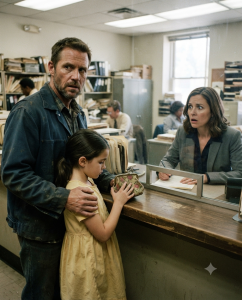
He was thirty-eight and permanently tired. He worked hourly shifts at a hardware supply warehouse outside town, picked up extra weekend loading jobs when they were available, and had become the sole parent to six-year-old Sophie, who moved through the world with the stubborn brightness of a child who had not yet accepted that adults could break for good.
That morning, she had insisted on coming with him.
Summer camp had ended the week before, childcare had fallen through, and Sophie had announced she was old enough to sit quietly in an office “like a business person.” She had dressed herself in a yellow cotton dress with a crooked bow at the back and worn her prized possession across her chest: a tiny floral coin purse on a long string strap.
Adam had bought it for a dollar from a church sale three months earlier.
He remembered the moment because Sophie had dug it out of a cardboard box under a folding table, held it up to the light, and gasped like she had discovered treasure. The purse was old-fashioned, too delicate for a child, with faded pink flowers and a brass clasp that bent slightly to the left when it closed. He had almost said no. Then he saw the excitement on her face and handed over the dollar.
After Emily’s death, joy came in strange, small forms. A cheap purse was enough.
The county clerk’s office sat inside an aging brick building near the courthouse square. The lobby smelled like stale air, paper dust, and printer toner. Brown plastic chairs lined one wall beneath public notices nobody read. A tired plant leaned toward a narrow window. Somewhere deeper inside, a copier whirred with mechanical determination.
Adam took a number and sat with Sophie beside him. She swung her purse against her hip, then rested it in her lap and whispered to the zipper pouch inside as though checking on important contents. Adam barely noticed. He was focused on the folder in his hands: school forms, a certified copy of Emily’s death certificate, proof of residency, and two handwritten notes reminding himself not to forget what he needed to ask.
He hated bringing the death certificate anywhere.
Every time he held it, it felt like helping the world erase her properly.
When their number flashed, they stepped to Window 4.
The records officer behind the glass looked to be in her fifties, with a composed face, a gray blazer, and lipstick applied so carefully it suggested discipline rather than vanity. Her name badge read SHARON MILES.
She took Adam’s paperwork and began reviewing it with efficient calm.
“ID, please.”
He slid it across.
She stamped one form, initialed another, then asked a routine question about emergency contact changes. Adam answered automatically, his voice flat from repetition.
Sophie, meanwhile, set her coin purse on the counter and began digging around for a sticker she wanted to show him. A shiny gold star she had saved from a doctor’s visit. Her small fingers fumbled with the brass clasp.
That was when Sharon stopped moving.
Her eyes dropped to the purse and stayed there.
Adam noticed the shift instantly. Grief had made him attentive to tiny changes in people’s expressions. He knew the difference between sympathy, discomfort, impatience, and alarm. What crossed Sharon’s face was none of those exactly. It was recognition followed by disbelief.
“Is something wrong?” he asked.
Sharon looked up at him, then at Sophie, then back to the purse. “Where did she get that?”
There was something in her tone that made Adam straighten.
“At a flea market,” he said. “Why?”
Sharon swallowed hard. “That purse belonged to my sister.”
For a second Adam thought he had misheard her.
The office noise continued around them—phones ringing, footsteps, a printer spitting pages—but it all seemed to blur at the edges.
Sophie grabbed the purse protectively. “It’s mine.”
Sharon’s expression softened for the child. “I know, sweetheart.”
Adam looked more closely at the purse. Faded floral fabric. Brass clasp. Bent on the left side. He had seen it a hundred times. Had helped Sophie shut it when the clasp snagged. Had emptied out pebbles and candy wrappers from it before washing her dress. It had never seemed important.
“What happened to your sister?” he asked.
Sharon’s hand tightened around the stamp she still held. “She was missing for nine months,” she said quietly. “They found her body in February.”
The words dropped heavily between them.
Adam felt Sophie lean against his leg, unaware of what had just changed. He was about to apologize, to say there must be some mistake, when Sophie opened the purse, peered inside, and announced with total innocence, “She said I could keep it because you never liked it anyway.”
Sharon went white.
Adam turned to his daughter. “Who said that?”
“The lady in the hallway.”
Adam’s first reaction was immediate and practical. He looked over his shoulder.
There had been no lady in the hallway.
He had scanned everyone when they came in, the way he did everywhere now. He knew who had passed them: an older man carrying deed folders, two teenage boys at the vending machine, a janitor rolling a yellow cart toward the restroom, and a woman with a stroller who had left before their number was called. No one had stopped to speak to Sophie.
“Which lady?” he asked carefully.
Sophie frowned, impatient at adults making simple things difficult. “The nice one. She said the purse looked better on me.”
Sharon lifted a hand slowly to her mouth. “My sister used to say that purse made her look old.”
Adam felt a chill spread across his shoulders.
Sophie nodded. “Yes. She said the blue one was prettier.”
This time Sharon made a strangled sound.
“There was a blue one,” she whispered. “A matching set. She bought both at a train museum gift sale when we were teenagers.”
Adam stared at his daughter.
He had never heard of a matching blue purse. Sophie could not have guessed it. Children invented things all the time, but not details that landed with that kind of precision.
“What was your sister’s name?” he asked.
“Lydia.”
Sophie brightened. “Yes. Lydia said you never checked the pocket under the lining.”
Sharon’s hand slipped from the counter.
Adam looked at the purse as if it had become something alive.
“There’s a pocket?” he asked.
Sharon nodded faintly. “Our mother stitched one inside. Lydia used to hide train money in it when she was sneaking into the city.”
Sophie added, “It’s not money now.”
A silence gathered around them, dense and impossible.
Adam held out his hand. Sophie passed him the purse. He turned it slowly beneath the fluorescent light, searching the inside seam. At first he saw only faded floral lining and wear along the corners. Then, near the lower edge, he noticed a line of thread slightly darker than the original stitching.
“There,” Sharon whispered.
Adam carefully tugged at the seam with a fingernail. The thread gave with a soft snap.
Inside was a folded scrap of paper.
The paper had yellowed with age and handling. It had been tucked into the hidden pocket so long it had taken the shape of the seam. On the outside, in pen pressed hard enough to score the fibers, one word was written:
SHARON
Sharon stared at it, motionless.
Then all the blood seemed to leave her face at once.
Adam had seen grief before—fresh, numb, furious, hollow—but this was different. This was grief meeting unfinished business. Her sister, who had vanished and then been found dead after nine months, had apparently hidden a note in a purse no one knew was missing. A purse that had somehow passed through unknown hands, landed in a church sale box, and ended up with a widower’s daughter.
Before Sharon could reach for it, Sophie said quietly, “She said you have to read it somewhere private.”
Adam felt another jolt.
Sharon looked at Sophie with the raw, frightened attention of someone no longer able to deny what she was hearing.
“And she said if the man from the red truck is still around,” Sophie continued, “don’t let him see it.”
This time Sharon’s reaction was immediate. She looked over Adam’s shoulder, then toward the lobby entrance, then back at the note.
“Come around the side,” she said in a low voice. “Now.”
She pressed a button under the counter and signaled another employee to cover the window. Her hands were shaking.
Adam followed her through a half-door into a narrow records room lined with metal file cabinets. Sophie stayed close beside him, her small hand slipping into his. Sharon shut the door, locked it, and drew the blinds over the inner window before she finally turned back to them.
The clerk’s office professionalism had disappeared. She was just a sister now. Pale, frightened, trying not to fall apart.
“Lydia dated a man named Curtis Vane,” she said. “He drove a red pickup. Older than her. Charming when people were watching.” Sharon laughed once, bitterly. “My sister had terrible taste in men when she wanted to believe she was being rescued from her life.”
Adam said nothing.
“About a month before she vanished, she told me she’d found out something about him. She wouldn’t explain. Said she needed proof first.” Sharon stared at the folded note. “Then she went missing. Curtis told police they’d argued and she took off. He said she was always threatening to leave town. They questioned him, but there wasn’t enough. Lydia’s body was found off a service road near the old rail line in February. Exposure, trauma, too much time… by then they couldn’t prove what happened.”
Sophie pressed against Adam’s side.
Sharon continued, “Two weeks after they identified her, Curtis came into this office. Smiling. Casual. Asked whether anyone had tried to request copies of Lydia’s public records. He said he was trying to settle loose ends for her family.” Her mouth tightened. “He never did anything for her family.”
Adam glanced at the door. “Why weren’t the police told about that?”
“They were,” Sharon said. “It meant nothing officially. But it bothered me. It still bothers me.”
She looked down at the note.
For a second it seemed she couldn’t make herself touch it. Then she drew in a breath, picked it up carefully, and unfolded the paper.
Adam watched her eyes move across the lines.
She didn’t blink.
Then she sat down hard in the nearest chair.
“What is it?” he asked.
Sharon handed him the note without speaking.
The handwriting was uneven but clearly adult, written in haste:
Sharon,
If you’re reading this, he found out I kept copies. Curtis says it’s about money, but it’s not just money. The red truck is registered under his cousin’s name. Check the storage unit at Delmar Road, locker 18, under L. Pike. Key is taped behind the frame in my apartment bathroom. If anything happens to me, don’t trust him and don’t trust Deputy Harlan. They’ve been meeting near the old rail yard after dark. I saw the girl’s bracelet in Curtis’s glove box. It had dried blood on it.
I didn’t know where else to hide this.
I’m sorry I waited.
Lydia
Adam read it twice.
Then a third time.
There was more in that note than a plea for justice. There was another victim. A bracelet. A deputy’s name. A storage locker. Corruption. Evidence Lydia had hidden because she believed she might not live long enough to hand it over.
Sharon was crying now, silently and without control.
“She knew,” she whispered. “She knew she was in danger.”
Adam folded the note carefully. “We call the police.”
Sharon let out a broken laugh. “She just wrote don’t trust one of them.”
He looked at her. “Then state investigators. Someone outside the county.”
That snapped her back into motion.
She wiped her face, reached for her office phone, then stopped. “No. Not from here.”
Adam understood at once. If Lydia’s warning was true and someone local was involved, they couldn’t assume privacy inside a county office.
“Do you know where her apartment key would be?” he asked.
Sharon nodded slowly. “The landlord boxed up most of her things after she was declared dead. I have some of them. The bathroom frame might still be in storage.”
Sophie tugged Adam’s arm. “She said the key is still there.”
Both adults looked at her.
“In the silver tin with the broken angel,” Sophie said matter-of-factly. “She said Aunt Sharon kept it because she couldn’t throw it away.”
Sharon inhaled sharply.
“I do have that tin,” she whispered. “It’s from our mother’s dresser.”
Within twenty minutes, Sharon had taken emergency leave, handed Adam back his unfinished school papers, and led him and Sophie to her car in the rear employee lot. She kept scanning the street as though expecting a red pickup to appear at any moment.
Her house sat on a quiet road behind a line of maples. Inside, it smelled faintly of lemon polish and old books. She led them to a spare room where several labeled storage boxes were stacked against the wall.
Her hands trembled so badly Adam finally said, “Let me.”
He opened the third box and found the silver tin near the bottom, tarnished and dented, with a small ceramic angel glued to the lid—one wing broken off. Inside were buttons, hairpins, ticket stubs, and at the very bottom, a tiny brass key wrapped in tissue paper.
Sharon sat on the edge of the bed and covered her face.
“She knew I’d keep it,” she said.
Adam stood with the key in his palm, feeling the gravity of what they were about to do. “Where’s Delmar Road?”
“Outside town. Behind the old feed mill.”
He didn’t like the idea of driving there with a child, but he liked the idea of splitting up even less. In the end, they left Sophie with Sharon’s elderly neighbor, who asked no questions beyond whether there had been “some family upset.” Adam told her only that they had urgent business.
Then he drove Sharon’s sedan out toward Delmar Road while Sharon used her cell phone to call a state investigative hotline she found from an old case flyer. She spoke in measured bursts, giving only enough to trigger an immediate response and refusing to say more over an open line. The dispatcher promised agents could meet them, but they were already on the access road by then.
The storage facility was half-fenced and mostly empty, with rows of aging metal units under a sky going gray with late afternoon cloud. Locker 18 sat near the far end.
Adam parked and cut the engine.
“Maybe we should wait,” Sharon said, though her hand was already on the door handle.
Then they both saw the lock.
It had fresh scratches around it.
Someone else had been there recently.
Adam’s pulse jumped. “Stay behind me.”
He hated how useless those words felt. He was not a cop. He was a widower in work boots holding a purse note and a brass key. But he was also the only person standing between Sharon and whatever Lydia had died trying to expose.
The brass key slid into the padlock.
It turned.
Inside the unit were three boxes, a folding chair, and a green metal tool chest.
For one awful second Adam thought they had come too late.
Then Sharon opened the nearest box and froze. “Oh my God.”
Inside were copies of vehicle registrations, bank deposit slips, and photographs. Lots of photographs. Curtis beside his red truck. Curtis meeting with Deputy Harlan near the rail yard. Curtis carrying duffel bags into the storage unit at night. One image showed a teenage girl Adam didn’t recognize climbing into Curtis’s truck, wearing a bracelet on her wrist. In another, the same bracelet sat on the truck console, darkened with what could very well be blood.
The tool chest held flash drives, a ledger, a handgun registration slip with a scratched-off serial number, and envelopes of cash.
“Lydia was documenting everything,” Adam said.
Sharon opened the final box.
It contained a journal.
The last entries were shaky, frantic, written closer and closer together on the page. Lydia described discovering that Curtis and Deputy Harlan had been running stolen goods and extorting undocumented workers who couldn’t safely go to police. Then the entries changed. Lydia mentioned the missing teenage girl from a nearby town. Mentioned seeing her alive in Curtis’s truck. Mentioned finding the bracelet later. Mentioned Curtis telling Harlan that “one problem became two.”
Sharon made a sound like she couldn’t get enough air.
Before Adam could respond, a truck engine growled behind them.
They turned.
A red pickup rolled slowly down the gravel lane and stopped twenty feet from the unit.
Curtis Vane stepped out.
He was older than Adam expected, heavy through the shoulders, sun-worn, wearing the relaxed smile of a man used to talking his way out of trouble. But when he saw Sharon and the open locker, the smile vanished.
For a heartbeat, no one moved.
Then Curtis said, “You shouldn’t be here.”
Adam stepped forward without thinking. “State investigators are on the way.”
It was a bluff, but only partly.
Curtis’s eyes flicked over the open boxes, the journal, the photographs. His expression hardened. “Lydia should’ve minded her own business.”
Sharon flinched as if struck.
Adam saw it then: not guilt in Curtis, but irritation. Lydia’s death, to him, had been an inconvenience.
“You killed her,” Sharon said.
Curtis didn’t answer.
He didn’t need to.
The silence did it for him.
Then another vehicle appeared at the end of the lane—an unmarked SUV, then a second behind it. Curtis turned at the sound. Two agents stepped out, followed by uniformed officers from outside the county jurisdiction. Sharon had made the right call after all.
Curtis took one step backward.
An agent shouted, “Hands where we can see them!”
Curtis looked toward his truck, calculating.
Adam would later remember that instant with painful clarity—not because of what happened, but because of what did not. Curtis did not reach the truck in time. Two officers had him against the side of it before he crossed the gravel. He fought just long enough to confirm exactly what kind of man he was.
Deputy Harlan was arrested that evening.
By the next morning, the story had spread through the county in fragments: corrupt deputy, hidden evidence, murdered woman’s note, storage unit, second victim tied to an unsolved disappearance. Investigators recovered enough from the locker and Lydia’s journal to reopen multiple cases. The bracelet matched the missing girl’s family description. Financial records tied Curtis and Harlan to theft, blackmail, and evidence tampering. The journal, combined with the photographs and flash drives, gave prosecutors the structure they had been missing.
Lydia had not just left a message.
She had left a map.
A week later, Adam returned to the county clerk’s office to finish Sophie’s school paperwork.
This time, Sharon came out from behind the counter to greet them. She looked older than she had the week before, but lighter too, as if grief had shifted shape now that it no longer had to carry doubt. She knelt in front of Sophie and handed her a small gift bag.
Inside was a blue coin purse.
Matching the floral one.
Sophie gasped. “It’s the prettier one.”
Sharon laughed through tears. “That’s exactly what Lydia always said.”
Adam stood there with the completed forms in his hand and felt, for the first time in months, that the world could still produce something stranger and kinder than pain. Not easy. Never easy. But real.
Later that night, after Sophie had fallen asleep with both purses on her bedside table, Adam sat alone in the kitchen and thought about all the accidents that had not been accidents at all. A church sale. A child’s stubborn attachment to a trinket. A clerk who happened to look up at the right moment. A dead woman who had hidden the truth in the one place no one thought to check.
He still did not know what to call what had happened in that hallway.
He only knew his daughter had spoken with certainty about a woman she had never met, and because of it, a killer had finally run out of places to hide.
Sometimes, Adam thought, the worst thing in the world is not that evil exists. It’s that ordinary people doubt themselves long enough for evil to keep breathing. Lydia had doubted too long. Sharon had grieved too quietly. The police had accepted too little. Adam himself had nearly dismissed Sophie’s words as imagination.
That was the part that stayed with him most.
Not the arrest. Not the evidence. Not even the note.
The warning.
How often does the truth arrive looking too strange to trust? How many red flags get filed away because they are inconvenient, emotional, or impossible to explain neatly?
Sharon got justice for her sister.
Curtis and Harlan got charged.
The missing girl’s family finally got answers they had been denied.
But even after all of that, Adam couldn’t stop thinking about the small brass clasp that stuck on the left, and how close they all came to never opening it at all.