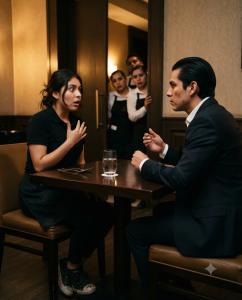
The first time they tried to humiliate Marisol, they expected laughter.
What they got instead was silence so complete it seemed to pull the oxygen out of the room.
At La Cúpula, that kind of silence was rare. The restaurant was built for noise disguised as elegance: crystal tapping against polished tables, low conversations full of money and secrets, shoes gliding across marble, expensive people pretending not to notice the workers orbiting around them. It was one of the places in Polanco where men made reservations under last names instead of first names, where women wore perfume that lingered after they left, and where one wrong move from the staff could cost someone a week’s wages in tips.
Marisol knew all of that better than anyone.
She had worked there long enough to memorize the habits of rich people and the moods of coworkers who had learned to survive by being cruel before someone could be cruel to them first. She was twenty-seven, always tired, always counting money in her head. Her black sneakers were cracked near the toes. Her wrists ached after double shifts. The skin on her palms stayed rough no matter how much lotion she used. By the time midnight came, she usually felt like a machine held together by caffeine, obligation, and stubbornness.
Still, she kept showing up.
She showed up because rent did not care that she was exhausted.
Because groceries did not care that customers snapped their fingers at her.
Because her younger brother Mateo, now twenty-two, still smiled with embarrassed gratitude every time she brought home leftovers wrapped in foil and said she’d already eaten at work.
Mateo had lost much of his hearing when he was a child, after a fever that got bad faster than anyone expected. Their mother was gone. Their father had disappeared long before that. So over the years, what remained between Marisol and Mateo stopped feeling like ordinary sibling loyalty. It became something fiercer. Protective. Silent. Unbreakable.
That was why every Wednesday night, after closing at La Cúpula, Marisol rode the Metro clear across the city to a free Mexican Sign Language class in Iztapalapa. She would arrive half-awake, smelling like coffee and fryer oil, and still force her hands to keep moving through lesson after lesson. Other students learned for work, curiosity, or school credit. Marisol learned because she had promised herself Mateo would never feel alone inside a world built for people who could hear.
At the restaurant, no one knew.
To them, she was simply strange.
She never stayed after hours to drink.
Never flirted with bartenders.
Never joined in when the gossip got especially vicious.
Never volunteered anything personal.
That made people suspicious. Or maybe bored. Sometimes those two things were the same.
Bruno, the shift supervisor, especially disliked her. He was one of those men who mistook mockery for charisma. He was handsome in the polished, shallow way that worked on people who only met him for five minutes at a time. The longer anyone knew him, the more they noticed the edge beneath everything he said. He liked making jokes that landed like little cuts, then acting offended if someone called him cruel.
Carla, one of the other servers, orbited around him with the hungry loyalty of someone who needed to stay on the winning side of every room. Together, they turned Marisol into a running joke.
“The nun.”
“The queen.”
“The waitress with the tragic shoes.”
Marisol usually ignored it. She had no extra energy left for fighting people whose lives were smaller than their mouths.
Then Thursday came.
Bruno found her during prep, just as the evening rush was beginning to build. He carried a tray in one hand and that familiar crooked smile on his face.
“You’ve got the private room tonight,” he said.
Marisol paused. “Who’s in it?”
He glanced toward Carla and another waiter. Their faces were already lit with anticipation.
“Mr. Rivas.”
The air shifted instantly.
Even the line cooks went quieter for a second.
At La Cúpula, everyone knew the name Esteban Rivas. No one knew exactly what he did, which only made the stories multiply. Some said he moved contraband. Some said he cleaned dirty money through real estate. Some said he had connections from Santa Fe to Tepito to the northern border and that people grew nervous when his name surfaced in the wrong conversation. Others swore half the rumors were invented because rich people loved the thrill of sitting near danger and calling it gossip.
What everyone agreed on was simpler.
He was not a man anyone wanted to offend.
He came every Thursday, always alone, always dressed in dark immaculate suits. He had black hair swept straight back, a narrow scar near his cheekbone, and a stillness that was more unsettling than anger. He paid in cash. He tipped heavily. He never spoke.
Because Esteban Rivas was deaf.
Or, as Bruno loved to suggest, “pretending.”
That was the joke.
They wanted to send Marisol in and watch her fail. Watch her speak, get no answer, panic, repeat herself louder, maybe get flustered enough to drop something. They wanted her turned into a spectacle.
Carla leaned toward Bruno and murmured just loudly enough, “Let’s see if Miss Superior can get him to respond.”
Marisol heard the laugh that followed, and something inside her went cold.
Not broken. Just cold.
She took the tray and walked to the private room.
The lighting inside was softer than the main dining room, amber against dark wood and polished glass. Esteban sat at the far end of the table, one hand resting near an untouched water glass. He didn’t look up when she entered.
“Good evening, sir,” Marisol said. “My name is Marisol. I’ll be serving you tonight.”
Nothing.
Behind the door, she could almost feel the others listening.
Then she really looked at him.
His eyes were fixed not on the table but on her mouth, with the tight concentration of someone assembling meaning from fragments. In that instant, the prank revealed itself completely. They thought they were testing her. In reality, they had shoved her into the one conversation in the building she knew how to have.
Marisol set down her notepad.
Lifted her hands.
And signed, “Good evening. My name is Marisol. What would you like to order?”
Esteban looked up so quickly that his composure fractured.
“You know sign language?” he signed back.
His movements were clean and exact, practiced to the point of elegance.
Marisol nodded. “I learned for my brother.”
For the first time since she had entered, his face softened.
Not dramatically. Just enough to make him seem suddenly less like a legend and more like a man who had spent too long bracing himself against people’s ignorance.
He placed his order in sign. She repeated it back. He asked how long she had been learning. She told him almost a year. He asked if her brother lived with her. She said yes. He asked whether her brother signed fluently. She said, “Better than I do.”
When she returned with the first course, Esteban thanked her in sign without hesitation.
It should have been an ordinary moment. A customer thanking a waitress. But for Marisol, the ordinariness itself felt extraordinary. No pity. No overcompensation. No awkwardness. Just clarity.
At the door, Bruno and Carla kept peeking through the crack, their expressions tightening as the scene refused to become the entertainment they had planned.
By dessert, Esteban no longer looked merely surprised. He looked attentive. Curious. As if Marisol had stepped unexpectedly into a part of his life he kept sealed off from everyone else.
When he finished dinner, he paid in cash as always. After he left, Marisol found a tip so large it made her catch her breath.
Beneath the folded bills lay a plain card.
Esteban Rivas.
Nothing else on the front.
On the back, in neat handwriting:
Thank you for seeing me correctly.
Marisol slipped the card into her apron before anyone could comment.
But Bruno saw enough.
“What were you doing in there?” he asked later, the fake casualness in his voice stretched thin.
“Serving him,” Marisol answered.
Carla crossed her arms. “You seem very pleased with yourself.”
Marisol looked at her. “You sent me in there to be humiliated.”
Carla’s face sharpened. Bruno’s did too.
“It was a joke,” he said.
“No,” Marisol replied quietly. “It was cruelty.”
The room went still.
People like Bruno relied on one thing above all: that the person they hurt would keep pretending not to notice. Marisol had broken that agreement. She had answered back in front of witnesses.
That night she took the Metro home with the card in her pocket and a knot in her stomach she couldn’t explain.
She lived with Mateo in a cramped room in Iztapalapa, above a repair shop whose metal shutters screeched every morning before sunrise. Mateo had left a plate of rice and eggs on the table and a note beside it in his slanted handwriting.
Saved you dinner.
Marisol smiled despite herself. Mateo was already asleep when she sat down to eat. He always slept hard after long days helping at a print shop owned by a family friend. It wasn’t glamorous work, but he liked it. Ink, paper, design software, and the comforting logic of visual things.
She almost told him about Esteban. Instead, she folded the card into her wallet and went to bed.
The next day at La Cúpula, everything felt off.
Conversations stopped when she passed.
The hostess gave her a strange look.
Two servers who never cared where she was suddenly seemed to know every corner she turned.
By afternoon, she opened her locker and immediately knew someone had gone through it.
Nothing was stolen, but her belongings had been rearranged. Her sign-language notebook, which she normally kept buried under extra tights and a cheap deodorant stick, sat right on top.
She touched it and felt a chill.
That evening, the reservation system updated.
Private Room.
Mr. Rivas.
Requested server: Marisol.
Bruno stared at the screen too long.
“He requested you by name?” Carla asked, almost whispering.
Marisol kept her expression neutral, but inside, unease tightened. Rich customers requested pretty waitresses all the time. That wasn’t unusual. But this felt different. Not predatory. Strategic.
When Esteban arrived, the energy in the restaurant changed. Even people who had no idea why looked toward the back hallway more often than usual.
Marisol served another table first, then found a folded napkin tucked beneath the register drawer.
Stop signing with him. For your brother’s sake.
Her vision blurred for half a second.
She turned slowly, but every face nearby was performing innocence.
Only a handful of people knew about Mateo.
No one should have been using his name as a threat.
Marisol slipped the napkin into her apron and forced herself toward the private room. Esteban was already seated, waiting.
The moment she entered, he studied her face and signed, “What happened?”
She hesitated, then handed him the napkin.
He read it once. His expression didn’t flicker.
“Who knows about your brother?” he signed.
“Almost no one.”
He reached into his jacket and placed a small silver key on the table.
“If anyone asks, you never saw me give you this.”
Marisol stared at it. “What is it?”
“Locker 17 at the Avenida Central bus terminal. Go tomorrow before noon. Alone.”
A pulse thudded painfully at the base of her throat. “Why?”
Esteban’s gaze moved briefly to the door.
“Because the people who tried to humiliate you were not just making a joke,” he signed. “They were making sure I stayed away from the one person in this building who could understand me clearly.”
Before Marisol could process that, a shadow stopped outside the private room.
Esteban signed one more sentence.
“Bruno works for men who are looking for Mateo.”
Everything inside Marisol dropped.
For a second, she saw only Mateo as a child with a fever, Mateo concentrating through sign practice, Mateo waving off her worries every time money got tight. Looking for him? Why? He was no one. He went from home to work and back again. He minded his own business. He had no enemies.
Unless he had seen something.
The thought hit her so fast it felt like a slap.
Mateo worked at a print shop.
People printed all kinds of things.
Documents. IDs. Shipping labels. Forms.
Esteban must have seen the realization on her face because he gave a slight nod.
The shadow outside moved on.
“Tomorrow,” he signed. “Bus terminal. Locker 17. Do not bring your phone.”
Then he picked up the menu as if nothing had happened.
Marisol somehow finished the service without dropping a single plate. Bruno watched her all night, his smile stretched too carefully. Carla avoided her eyes.
As soon as her shift ended, Marisol left by the employee exit and took a route home she never used, doubling back twice before entering her neighborhood. When she reached the room above the repair shop, Mateo was awake, sitting at the table with his laptop open.
He looked up and immediately signed, “You’re late.”
She signed back, “We need to talk.”
His smile faded.
Marisol sat down across from him and asked, as steadily as she could, “Has anyone unusual been to the print shop?”
Mateo stared at her for a long moment before looking away.
That was answer enough.
Bit by bit, the truth came out.
A month earlier, a customer had brought in a rush job just before closing. Mateo had worked on the layout because the owner’s nephew, who usually handled digital files, had left early. While formatting the pages, Mateo noticed the documents didn’t match. The names and numbers were inconsistent. The photos had been altered. It looked like a batch of fake IDs tied to transport permits and customs paperwork.
Mateo had copied one file to a flash drive before printing, not because he planned to blackmail anyone, but because he panicked. The men collecting the documents looked dangerous. One of them noticed Mateo paying too much attention and grabbed his shoulder hard enough to bruise. After that, Mateo began keeping the flash drive hidden, unsure whether to go to the police, destroy it, or pretend none of it had happened.
He hadn’t told Marisol because he thought he could keep her safe by staying quiet.
Instead, he had put both of them in the path of something much larger.
“Where is it?” she signed.
Mateo hesitated. Then he reached beneath a loose board under the bed and pulled out an old tin box. Inside was the flash drive.
Marisol closed her eyes for a second.
The next morning, before sunrise, she left home without her phone and carried the silver key in her fist the entire Metro ride. Every station felt louder than usual, every person more suspicious. By the time she reached the Avenida Central bus terminal, her nerves were stretched so tight she could barely breathe.
Locker 17 sat in a dim hallway near the long-distance platforms.
She inserted the key.
Inside was a manila envelope, a prepaid phone, and another note in Esteban’s handwriting.
If you opened this, it means Bruno’s people are already close. Read everything before you decide whether to trust me.
The envelope contained copies of surveillance stills, receipts, shipment manifests, and photographs of men Marisol recognized from the print shop parking lot when she’d once picked up Mateo. Bruno appeared in two of the photos, shaking hands with a heavyset man beside a truck. Another image showed Carla speaking with the same man outside La Cúpula.
At the bottom was the clearest proof of all: a customs document bearing an alias that linked the fake permits to a smuggling route.
Tucked underneath was a final sheet explaining the rest.
Esteban Rivas had once worked with the network moving those shipments. Not as a low-level errand runner but as a financial fixer. Years earlier, an attack ordered by one of the network’s rivals had killed his older sister. Esteban survived with partial injuries and hearing loss that eventually became near-total deafness. After that, he kept his position, but not his loyalty. Quietly, patiently, he began collecting evidence. He needed someone inside certain civilian businesses to slip, to leave a trail. Mateo’s copied file had become the missing piece connecting forged documents to the transport chain.
Bruno had been placed at La Cúpula because the restaurant served as a meeting point. Carla, drowning in debt, had been helping him for months.
Marisol read the pages twice, then gripped the prepaid phone with numb fingers.
It rang before she could decide whether to turn it on.
Esteban’s message appeared in text:
They know you opened the locker. Go to platform 12. Now.
Marisol ran.
By the time she reached platform 12, Esteban stood near the rear of a departing bus, dressed more casually than she had ever seen him, his face harder than before. Beside him was a woman in plain clothes holding a badge clipped low at her belt. Federal anti-smuggling task force.
Esteban had not gone to the police openly because the network had people inside local units. He had been building enough evidence to make one move that could not be buried.
“You can still walk away,” the woman told Marisol once they were seated in the back of an unmarked vehicle. “But if you do, they won’t stop looking for your brother.”
So Marisol stayed.
The next forty-eight hours moved like a storm.
Mateo was relocated to a safe apartment.
The flash drive was verified.
The task force cross-referenced the files in Esteban’s envelope.
Phones were tracked.
Bank transfers surfaced.
Vehicles tied to the forged permits were intercepted before crossing north.
Bruno tried to run the night officers came for him.
He made it as far as the alley behind La Cúpula before agents pinned him against a dumpster. Carla was arrested in the staff hallway, crying so hard she could barely stand. She kept repeating that she never meant for anyone to get hurt, which sounded hollow next to the evidence already stacked against her.
The owner of La Cúpula claimed ignorance. Maybe he was telling the truth. Maybe he had chosen not to ask questions that kept the private room full and the cash flowing. Either way, his restaurant was shuttered for investigation.
When Marisol finally sat across from Bruno in an interrogation room days later, separated by glass, he looked smaller than she had ever seen him.
“You ruined your own life,” he said bitterly when the interpreter finished signing his words for her.
Marisol stared at him.
“No,” she answered through the interpreter. “You just thought people like me would never speak.”
Bruno looked away first.
Esteban testified too. Not publicly at first, but enough to set the prosecutions in motion. Without the false glamour and rumors wrapped around him, he seemed different. Still reserved. Still dangerous in the way wounded men often are. But the mystery had burned off. In its place was grief, discipline, and a loneliness Marisol now understood.
Weeks later, when the city had moved on to newer scandals and La Cúpula remained dark behind police seals, Esteban met Marisol and Mateo at a small café far from Polanco.
Nothing about the place was elegant. Plastic menus. Uneven tables. Coffee too bitter. It felt honest.
Mateo thanked Esteban in sign for helping protect him.
Esteban answered, “You protected more people than you know.”
Mateo, after a pause, smiled and said, “My sister says you looked terrifying the first time she saw you.”
Marisol flushed. Esteban’s mouth shifted with the closest thing she had seen to a real laugh.
“And now?” he asked her.
Marisol held his gaze.
“Now you look like someone who was tired of being feared when what you really needed was to be understood.”
For a moment, none of them moved.
Outside, buses hissed at the curb and the city kept rushing forward the way it always did, indifferent to who had survived what.
Esteban looked down at his coffee, then back at Marisol. “You changed the night you walked into that room,” he signed.
She shook her head gently. “No. I think I just stopped letting other people decide who I was.”
That was the truth of it.
Bruno and Carla had tried to turn her into a joke because they believed dignity belonged only to people with money, power, and protection. They thought poverty meant weakness. They thought silence meant emptiness. They thought kindness made a person easy to use.
They were wrong on all counts.
Marisol kept studying sign language after everything ended, not because the danger had taught her something dramatic, but because the original reason remained. Mateo still needed her. She still wanted a bigger life than survival. Eventually she found work at a different restaurant, smaller and less glamorous, where the owner actually learned enough sign to greet deaf customers properly. Mateo started taking design classes at night. The two of them still counted every peso, still worried about rent, still lived carefully.
But fear no longer arranged the furniture of their lives.
As for Esteban, he disappeared from the gossip pages of rich neighborhoods and reappeared nowhere at all. Sometimes Marisol would go weeks without hearing from him. Then a message would arrive—brief, precise, almost shy. A check-in. A question about Mateo. Once, a photograph of a sunset from a highway outside the city. Nothing sentimental, which somehow made it feel more real.
What happened between them after that was not the kind of ending gossip loves. It was slower. More fragile. Built from truth instead of performance. And maybe that was why it mattered.
Because the strangest part of the whole story was never that a feared man noticed a poor waitress.
It was that the people who tried to humiliate her accidentally forced the truth into the open: the strongest person in the room had been the one they considered the easiest to crush.
And the biggest red flag had never been Esteban’s silence.
It had been the laughter of people who thought another person’s dignity was theirs to play with.