The single mother only went to the pediatric dentist because her son’s toothache had kept them both awake for two nights. She was tired, short on patience, and mostly thinking about how much the visit might cost.
Then the dentist saw the little boy’s lunch napkin, went pale, and asked why he still had the one her daughter carried the morning she vanished.
That was how Marisol’s Thursday stopped being about a cavity and became the strangest day of her life.
At thirty-one, Marisol did not have room in her schedule for mysteries. She barely had room for groceries.
She lived in a one-bedroom apartment above a laundromat where the pipes knocked all night and the hallway always smelled faintly of detergent and burned toast. Her six-year-old son, Nico, slept on the pullout sofa because the bedroom was just large enough for her bed, a plastic dresser, and two baskets of unfolded clothes she kept promising herself she would get to on Sunday.
Most weeks were built out of survival math. Which bill could wait. Which shift she could take. Which apology she would owe her son for another rushed dinner, another late pickup, another promise altered by money.
Nico usually made it easier. He was one of those children who accepted inconvenience with heartbreaking grace. He could turn a bus ride into an adventure and a scrambled dinner into a game. He talked to pigeons like they were old neighbors. He carried odd little treasures in his pockets and believed most problems could be solved with a blanket and a snack.
Then came the toothache.
By the first night, he was whimpering.
By the second, he was crying in short, embarrassed bursts, trying to hide it because he had somehow convinced himself that “big boys don’t cry over teeth.” Marisol held him against her chest in the dark and told him big boys cried over whatever hurt. He nodded, said okay, and cried anyway.
She paced the kitchen in socks, reheating washcloths, checking her phone for the time every six minutes. She dosed children’s pain medicine exactly by the label. She searched “emergency pediatric dentist cheap no insurance” at two in the morning. By dawn on the third day, both of them looked haunted.
The office that could fit them in was across town.
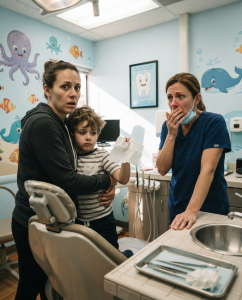
Pediatric Smiles of Brook Hollow occupied the first floor of an old medical building that had tried very hard to become cheerful. Murals of sea life covered the walls. There were cartoon octopuses brushing giant teeth, dolphins wearing crowns, and a turtle holding a floss container like a trophy. The waiting room had bead mazes, faded board books, and a fish tank with no fish in it, only fake coral and a sign that said NEW FISH COMING SOON.
Nico slumped in a chair with one hand to his swollen cheek. In his other hand, he held a folded paper napkin from his lunchbox. He always needed something to grip when he was anxious. Sometimes it was a toy car. Sometimes the strap of Marisol’s purse. That morning it was the napkin, already softened and wrinkled from being twisted again and again.
There was a tiny whale doodled in one corner.
He had drawn it, or at least Marisol thought he had. He doodled on anything that would hold ink.
When the assistant called his name, they followed her into a bright exam room filled with stickers and tiny cabinets. The dentist entered a minute later with a warm professional smile.
“Hi, Nico. I’m Dr. Warren.”
Dr. Elise Warren looked like a woman held together by habit and caffeine. She was probably in her mid-forties. Her dark hair had been pinned back too fast. Her scrubs were immaculate, but there was something tired around her eyes that good lighting could not erase. Marisol noticed, without meaning to, the pale line on Elise’s ring finger where a band had been worn for years and recently removed.
Elise crouched to Nico’s level and explained each instrument before touching it. The mirror. The air puff. The “tiny vacuum.” Nico managed a weak smile. Marisol felt her own shoulders lower by an inch.
Then Elise glanced at the napkin in Nico’s fist and stopped cold.
Her whole body seemed to lock.
At first Marisol thought maybe there was blood on it. Or something from lunch that looked alarming. But Elise wasn’t looking at a stain. She was staring at the whale.
“What is it?” Marisol asked.
Elise didn’t answer. “Where did he get that?”
“It’s just a napkin.”
“No. The drawing. Where did the drawing come from?”
Nico pulled it closer to his chest. “It’s mine.”
Elise looked as if someone had pushed all the air out of her. “My daughter drew whales like that,” she said quietly. “She disappeared seven years ago.”
Everything in the room seemed to fall backward at once.
Marisol had heard enough true-crime stories and neighborhood rumors to know that missing children leave marks behind them in people. A way of speaking. A fixed expression. A grief that never entirely exits the face. She had just never expected to see it appear over a napkin in a dentist’s office.
She looked at the doodle more carefully.
A curved smile.
Three dots above the blowhole.
A second unfinished line under the tail, as if the child had changed direction halfway through.
Specific enough to matter.
Simple enough to dismiss.
Kids copied things. That was normal. They borrowed shapes and habits without realizing it. Nico had probably seen something similar at school.
Except Nico looked confused rather than guilty.
“The girl at the bus stop drew it,” he said.
Elise went so pale that Marisol instinctively took a step toward her.
“What girl?” Marisol asked sharply.
“The sad one,” Nico said.
Elise pressed a hand to the counter. “My daughter used to wait at the bus stop every Friday with a whale napkin in her lunch. Her grandmother packed them.”
Marisol’s stomach tightened hard.
That morning she and Nico had waited at a bus stop in the drizzle. There had been an elderly woman with grocery bags and a teenager with earbuds and a man in a postal jacket. No little girl.
“Describe her,” Elise said, her voice brittle.
Nico frowned, thinking. “Blue coat. One shoe untied. Brown hair. She said you still keep the tooth.”
The sound Elise made was so small it hurt to hear.
“What tooth?” Marisol asked.
Elise looked at her and answered like someone confessing a secret she had never expected to say aloud. “The first baby tooth she lost. I kept it in a white film canister with pink tape around the lid. In my desk.”
Nico nodded. “She said it rattles.”
The room went absolutely still.
There are facts that live inside a family so privately that even saying them feels intimate. Marisol saw that knowledge hit Elise like a physical blow. This was no vague resemblance. No lucky guess. Her son had just repeated something hidden, specific, and deeply personal.
Nico glanced at the tray of instruments and asked, “Am I still getting the sleepy strawberry stuff?”
Neither adult answered.
Elise turned, opened a drawer beneath the sink, and pulled it halfway out. Inside sat an old white film canister with a strip of faded pink tape around the lid.
Marisol felt her pulse in her throat.
Elise stared at the container, then at Nico. “My daughter’s name was Cora,” she whispered. “Whoever he saw knew things no one outside my family should know.”
“She wasn’t at the bus stop today,” Nico said.
Marisol looked at him. “Then where did you see her?”
He blinked as if the answer were obvious. “In the old waiting room.”
Elise stopped moving.
“There is no old waiting room,” Marisol said automatically.
“There was,” Elise corrected, barely audible. “Before the renovation.”
According to Elise, the clinic had once had a smaller waiting room in the back for overflow families and anxious children who needed a quieter space. After the remodel, it had been sealed off and used for storage, then abandoned altogether when a plumbing issue damaged one wall. The door remained locked behind stacked supplies in the staff corridor. Patients no longer saw it. Most newer employees did not even know it existed.
“No one takes children back there,” Elise said.
“I know,” Nico replied. “That’s why she said it had to be me.”
Marisol felt a chill move across her skin. “Why you?”
Nico looked down at the napkin. “Because I listened.”
The staff hallway behind the exam rooms was narrower and colder than the front of the office. Fluorescent lights hummed overhead. The cartoon sea theme ended abruptly halfway down the corridor, replaced by plain blue walls and framed certificates. Elise led them without calling anyone. Marisol could tell she did not want witnesses yet. Not until she knew whether she was falling apart or following something real.
At the end of the corridor, behind a rolling cabinet of gloves and boxed supplies, stood a narrow blue door.
Dust coated the keypad beside it.
“There,” Nico whispered, lifting his head from Marisol’s shoulder.
At first Marisol saw only the door.
Then she noticed a sliver of white paper protruding from the gap beneath it.
Elise stared. “That wasn’t there yesterday.”
A tiny blue line was visible on the exposed corner.
The tail of a whale.
Elise entered the code with shaking fingers. The lock clicked. For one long second none of them moved.
Then she opened the door.
The room smelled like old paint, dust, and something strangely sweet, as though years ago a child had spilled shampoo or bubblegum toothpaste and the scent had died only halfway. Small chairs were stacked against the far wall. A bead maze lay on its side near a cabinet. Cloud wallpaper peeled at one corner. Sunlight slipped through a high frosted window and drew a pale bar across the floor.
In the center of that bar of light sat a folded lunch napkin.
Clean.
Neatly placed.
Recent.
Elise crossed the room in three steps and picked it up. Another whale stared back at her.
Same smile.
Same spray.
Same unfinished tail line.
Underneath the drawing, in blue ink, were four words.
CHECK THE VENT.
For a second Marisol thought Elise might drop where she stood.
Instead, the dentist set the napkin down with terrifying care and looked slowly toward the old ceiling vent above a built-in reading nook.
“Cora used to hide things up there,” she said.
Marisol stared. “You never told the police?”
Elise laughed once, a broken sound. “That vent was searched after she vanished. Her bedroom too. Her school desk. My office. My car. Her grandmother’s house. Everything. They found nothing.”
“Then why would—”
“I don’t know.”
They pulled a child-sized chair beneath the wall. Elise climbed onto it in her scrubs and reached into the vent with both hands. Dust shook loose across her sleeves. For a terrible second she found nothing.
Then her fingers struck metal.
She dragged out a small rust-stained tin box no larger than a recipe card container. Marisol saw immediately that it had not been up there for seven years. The dust coating it was light and uneven, as if it had been placed there much later than the vent’s grime.
Something inside shifted when Elise touched the latch.
Paper.
Plastic.
Metal.
Before she could open it, a voice rang from the corridor. “Dr. Warren?”
All three of them froze.
It was one of the front-desk staff, but the tone carried uncertainty. Not alarm. Not yet.
Elise shoved the tin against her chest and stepped down. “Don’t tell anyone,” she whispered to Marisol.
That request was so absurd that Marisol nearly refused on instinct. Instead she heard herself say, “Open it first.”
Elise hesitated, then lifted the lid.
Inside was a child’s red plastic barrette, the cheap kind with one missing rhinestone. Beneath it lay a friendship bracelet made of blue and white thread, frayed almost to breaking. There was also a tiny folded map torn from a local bus brochure, several Polaroids bound with a rubber band, and an envelope with one word written on it in uneven block letters:
MOM.
Elise sank onto the stacked little chairs as if her legs no longer belonged to her. Her fingers hovered over the envelope but would not touch it.
Marisol saw the barrette first. “Was that hers?”
Elise nodded without looking up. “She wore it the week she disappeared.”
“What about the bracelet?”
“She made one for herself and one for…” Elise stopped. “One for my niece Sadie.”
Marisol watched the blood drain from her face again. “Your niece?”
Elise finally looked up. “She was twelve back then. Cora adored her. They were always together.”
Something in the way she said it made Marisol’s attention sharpen. “Were.”
Elise’s eyes flicked to the map. “Sadie left town a year after Cora disappeared. My sister remarried and moved them to Arizona. We barely speak now.”
“Why?”
Elise did not answer immediately. Then: “Because grief turns families into terrible historians.”
The voice from the hall called again, closer this time. Elise shoved the contents back into the tin and carried it into the adjacent supply closet, where they had more privacy. Marisol set Nico on an overturned box of bibs. He looked tired but calm, as if all this had already made sense to him before the adults arrived.
“Who was the girl?” Marisol asked him quietly.
“Cora.”
“How do you know?”
“She told me.”
“What did she look like?”
“Like I said. Blue coat. Brown hair. Untied shoe.” He paused. “And she kept touching her sleeve like she was cold.”
Marisol swallowed. “Did anyone else see her?”
“No.”
“Did she touch you?”
He shook his head. “She just talked.”
“What did she say besides the tooth?”
Nico considered. “She said her mom never checked the right place. She said the truth got packed and moved. She said hurry up because grown-ups always stop when it gets ugly.”
Marisol stared at him.
Elise had heard every word.
“The truth got packed and moved,” she repeated.
Then she seized the bus map and unfolded it across a box of gloves. It had several routes circled in blue pen. One stop was marked twice: Brook Hollow Storage Annex.
“I know that place,” Elise said faintly. “My sister rented a storage unit there when she moved.”
“Could this have been planted by her?” Marisol asked.
“I haven’t seen Sadie in three years.”
“Not your sister. Sadie.”
Elise looked up sharply.
Marisol pointed to the friendship bracelet. “If Cora made one for herself and one for Sadie, and this one ended up hidden in a vent years later, that means somebody kept it. Somebody who knew what mattered.”
Elise stared at the Polaroids next. Her hands shook so badly Marisol had to peel the rubber band free for her.
The first photo showed two girls sitting cross-legged on the floor of the old waiting room. One was Cora, younger than the framed school portrait Marisol had seen on Elise’s office shelf on the way in. The other, older and thin-faced, wore a forced smile and the matching friendship bracelet.
“Sadie,” Elise whispered.
The second photo hit harder.
It showed Cora in the blue coat Nico had described.
The third showed the side entrance of the clinic on a rainy day. In the blurred edge of the frame stood an adult woman holding an umbrella. Her face was turned away, but the coat was recognizable from the family photo on Elise’s desk in her office.
Her sister’s coat.
Elise went rigid.
“No,” she whispered. “No.”
The envelope was the worst part because it had waited the longest.
When Elise finally opened it, a second, smaller folded paper slipped out first. It was a child’s handwriting exercise sheet from years ago. On the back, in careful uneven letters, someone had written:
Sadie said not to tell. Sadie said Mom would cry and Grandma would get sick and it would be my fault. Sadie said we are practicing hiding because I talk too much.
Below that, in much later handwriting—older, firmer—another message had been added:
I tried to tell. Nobody listened to the right things.
Elise pressed a hand over her mouth.
There was also a short note written by an adult, but not recent. The ink had faded. It read:
If you find this, go to Unit 114. Do not bring police until you see what was left there. Someone in the family knew.
No signature.
Marisol felt the room tilt. “We need the police now.”
Elise nodded immediately, but then looked at Nico. “Yes. We do. But first I need to know if this is cruel or real.”
“Those photos are real,” Marisol said.
“And if my sister was involved,” Elise whispered, “then every statement she ever made matters in a completely different way.”
The police arrived within twenty minutes, though it felt longer. Marisol gave a statement. So did Elise. Nico mostly repeated what he had already said: the girl was sad, she drew the whale, she wanted them to hurry.
The detective on scene did not roll his eyes or smile politely the way Marisol feared. He listened, bagged the evidence, and sent two officers with Elise to Brook Hollow Storage Annex.
Marisol almost stayed behind.
Instead she went too.
She would later tell herself it was because her son had somehow become part of the story. The truth was simpler. After what she had seen, there was no returning to a normal Thursday.
Unit 114 stood in the back row of the storage complex, rust on the bottom edge, old padlock already cut by the facility manager at police request. Elise stood beside the detectives, pale as chalk. One officer slid the door upward.
The smell rolled out first.
Not death. Not decay. Paper. Dust. Mildew.
The unit had been packed years ago and barely touched since. Boxes labeled HOLIDAY DECOR. KITCHEN. FILES. CHILDHOOD. There was old furniture under tarps, a broken floor lamp, framed pictures facedown against the wall.
And in the far corner sat a bright plastic trunk covered with whale stickers.
Elise made a sharp choking sound. “That’s Cora’s.”
Inside the trunk were school notebooks, hair ribbons, art supplies, a stuffed rabbit, two winter scarves, a pair of children’s rain boots, and a stack of drawings. Not memorabilia saved by a grieving mother. Not random leftovers.
A child’s essential things.
Selected.
Removed.
Stored.
The detectives worked quietly after that, but the meaning was already there. Someone had taken Cora’s belongings, hidden them, and never told Elise they existed. Someone inside the family had kept control of the story.
Then one detective found the journal.
It belonged to Sadie.
Most pages were teenage rambling, scraps of anger and boredom, but several entries around the week of Cora’s disappearance were circled and flagged. In them, Sadie described playing a “hiding game” with Cora in the clinic’s old waiting room and side hall while the adults worked late. She wrote about scaring her younger cousin by locking her briefly in closets and making her stay quiet. One entry, written shakily days later, mentioned “Aunt Lina said if I talk everyone will think I helped.”
Aunt Lina was Elise’s sister.
Another entry cracked the case open completely.
It said Cora had never been taken by a stranger.
On the day she vanished, Cora had hidden in the back of Aunt Lina’s van during a family argument outside the clinic. Lina drove away without realizing it at first. When she found the girl later, frightened and crying, she panicked because she was already in the middle of a bitter financial fight with Elise over their late mother’s estate and access to the clinic property. Rather than return immediately and admit what had happened, she brought Cora to the storage annex office where a friend let her calm the child down in a side room. Sadie, who had been with her, kept trying to “play hiding” so Cora would stop crying.
By the time Lina decided to fix it, police had already been called. News had spread. Search teams were forming. Lina became convinced she would be blamed for kidnapping, lose custody of Sadie, and destroy the family.
So she lied.
According to the diary and a later signed note found in a file box, Lina told investigators Cora must have wandered near the bus stop. Then she moved the child temporarily between places she controlled while she “figured it out.” The situation snowballed into something monstrous. Whether she meant to return Cora the next hour or next day no longer mattered. She had concealed the truth.
The worst answer took longer and came from records rather than the storage unit.
Cora had not died that day.
Months after the disappearance, Lina had taken her under a false name to a religious boarding facility in another state run by a private contact who asked no hard questions. There, according to later documents recovered through the investigation, Cora had lived as “Clara” for nearly two years before becoming ill with untreated complications from chronic asthma. She died at eight.
Elise learned that part at the station.
Marisol was in the hallway with Nico asleep across two chairs when Elise emerged from the interview room looking like a human outline of herself. She sat beside Marisol and stared at the opposite wall for a very long time.
“They found records,” she said at last. “She was alive. For almost two years, she was alive.”
There was nothing Marisol could say to that.
Elise laughed once, bitter and disbelieving. “All those years I imagined a stranger. A monster. A highway. A random terrible thing. And it was my sister. My own sister made the story impossible to solve.”
Lina was arrested within forty-eight hours in Arizona, where she had been living under her remarried name. Sadie, now nineteen, cooperated immediately. Her childhood journals became key evidence. She admitted she had helped move some of Cora’s belongings and hide keepsakes in the clinic years ago after overhearing Lina confess during a drunken argument. Sadie said she had been too afraid to come forward as a teenager and too ashamed as an adult.
Then why the new napkins? Why now?
Because Sadie had recently returned to town after Lina’s health began failing. She had visited the shuttered clinic corridor one evening using an old staff code her mother still remembered. She hid the box in the vent and left the napkin under the door, intending to send an anonymous letter to Elise once she gathered the nerve.
She never expected a child to find the room first.
When detectives asked about the whale, Sadie broke down crying. She said Cora used to draw the same whale on everything—napkins, worksheets, receipts, the fog on car windows. It was her signature. After all those years, Sadie copied it because she could not think of any other way to make Elise look.
As for Nico seeing “the sad girl,” no one could explain that.
Sadie insisted she had not spoken to him.
No one at the clinic had.
No one had led him there.
Marisol tried, for days afterward, to build a sensible bridge between events. Maybe Nico had overheard something. Maybe he had glimpsed an old photo. Maybe children assembled meaning differently and said things in ways adults made larger than intended.
But each explanation failed against the same hard fact: the tooth, the canister, the old waiting room, the vent.
Some doors never close neatly.
A week later, Nico’s tooth was finally treated. He got the sleepy strawberry sedation and slept through most of the procedure. When he woke up groggy and damp-eyed, Elise was the one who brought him a sticker.
She looked older than she had the week before and steadier at the same time.
The clinic would close for several days after the arrest. There would be reporters, hearings, statements, and the long ugly machinery of public truth. But that afternoon the office was quiet.
Elise crouched beside Nico and said, “Thank you for helping me find my girl.”
Nico nodded like that was normal. “She wanted you to know.”
Elise’s face tightened, but she smiled. “I know.”
When Marisol walked them out, she paused beside the front desk where a small framed school photo of Cora now stood with fresh white flowers beside it. The little girl’s smile was open and mischievous. Her hair was clipped back with a red barrette missing one rhinestone.
Marisol stared at the picture a moment too long.
Elise noticed. “That was the last school picture before she disappeared.”
“She looks like she was about to say something funny,” Marisol said.
“She usually was.”
Outside, the afternoon sun had finally burned off the week’s gray weather. Nico held Marisol’s hand all the way to the bus stop. Halfway there, he tugged on her sleeve.
“Mom?”
“Yeah?”
“Do you think the sad girl is okay now?”
Marisol looked at his small face, at the bandage still taped to the back of his hand from the sedation, and thought of a mother who had spent seven years in the wrong nightmare.
“I hope so,” she said.
Nico considered that, then nodded as if he’d expected no better answer.
The case would be on the news for months. Comment sections would divide themselves the way they always did. Some people would call Sadie brave for finally telling the truth. Others would say brave came years too late. Some would insist grief had broken Lina into something unrecognizable. Others would say grief had nothing to do with it; fear and selfishness did. Everyone would have a theory about the warning signs, the family lies, the moments that should have given it away sooner.
Marisol only knew this:
Sometimes the biggest red flag is not what looks dangerous. It is what looks familiar enough to trust.
And sometimes the cruelest thing is not that a child disappears.
It is that she was close enough to be found, and the people who should have protected her were the very reason no one looked in the right place.