Mariana Soto gave birth fourteen minutes after her ex-husband sent a message that read, Don’t ever come looking for me again. That baby is not my problem anymore.
She read it twice while doubled over in the back seat of a rattling taxi, one hand clutching the torn vinyl, the other pressed beneath her belly as another contraction climbed through her body. Outside the window, Mexico City was still gray with dawn. Traffic lights blinked over streets that had not fully awakened. The driver kept glancing at her in the mirror with the helpless expression of a man who knew this was beyond his job description.
“Hospital?” he asked again.
“Santa Lucía,” Mariana whispered.
By the time they reached the entrance in Roma, her dress was soaked, her hair stuck to her face, and her legs were trembling hard enough to make the last few steps feel impossible. She paid with crumpled bills from her purse. Three hundred and twenty pesos remained. That was all.
No husband. No mother. No sister. No friend rushing in behind her carrying a bag and reassurance. Only Mariana, her old backpack, and the deep private fear that her son would arrive in a world already rejected by his own father.
At reception, a nurse took one look at her and shouted for a wheelchair.
The next hour became a blur of fluorescent lights, clipped instructions, metal rails, signatures pushed toward her between contractions, a blood pressure cuff squeezing her arm, and pain that kept tearing her apart in waves before she could recover from the last one.
In the middle of it, she kept seeing Rodrigo’s message.
Not my problem anymore.
It fit him now. Cold. Efficient. Cruel enough to feel deliberate.
But he had not always spoken to her that way.
When Mariana met Rodrigo Alcázar, he had been charming in the polished, dangerous way of men raised to believe the world had been arranged for their comfort. He sent flowers to her office. He remembered small details she mentioned once and repeated them later as if he genuinely listened. He took her to quiet restaurants and made her feel seen in a city that usually rushed right past people like her.
She came from a family that counted every peso before spending it. He came from old money wrapped in newer business success. His mother, Beatriz Alcázar, appeared in magazines beside charity boards and museum galas. Rodrigo moved through expensive rooms with the ease of someone who had never been told no by anyone whose opinion mattered.
For a while, Mariana believed the difference between them did not matter either.
She was smart, careful, and self-made. Before marriage, she had built a reputation in a legal auditing firm known for uncovering contractual fraud. She was patient, methodical, and almost impossible to intimidate once she had documents in front of her. Rodrigo said he admired that about her.
Later, she would understand that what he admired was how useful those traits could be until he needed obedience more than intelligence.
The marriage changed in slow ways first. Invitations where Beatriz introduced Mariana with faintly patronizing warmth. Jokes about how quiet she was. Suggestions about what she should wear, how she should speak, which friendships looked “inappropriate” for an Alcázar wife. Rodrigo always softened the edges when they were alone.
“That’s just how my mother is,” he would say.
Then came the finances. Shared accounts that were technically shared but emotionally controlled. Decisions made around her rather than with her. Business conversations that stopped when she entered the room. Rodrigo began treating discretion like the highest form of loyalty. Mariana began noticing that in the Alcázar world, “loyalty” often meant silence.
Still, she tried. She loved him. Or loved the man she thought still existed under the entitlement, the distance, the increasing impatience.
Then she got pregnant.
The day she told him, he placed divorce papers on the dining table.
The memory stayed lodged in her like glass.
She had stood there in the apartment, one hand over her stomach, staring at the stack of papers as if they might rearrange themselves into something less absurd if she waited long enough. Rodrigo stood across from her in a tailored shirt, already emotionally gone. Behind him, Beatriz remained perfectly composed, pearls at her throat, handbag looped over one wrist like she had only stopped by to observe a transaction.
“I’m pregnant,” Mariana said.
Rodrigo barely reacted. “Terrible timing.”
Beatriz gave a light laugh. “Desperate women always think a baby can fix what their lack of class destroyed.”
Mariana looked at Rodrigo, willing him to interrupt, to defend her, to say this was ugly and unnecessary and not who they were. But he said nothing.
“I’m not asking for anything,” Mariana told them.
“Of course not,” Beatriz replied. “You never ask. You simply stay quiet while benefiting from what belongs to other people.”
The divorce moved with startling speed after that. Shared accounts were frozen. Her medical insurance disappeared. Rodrigo began telling people she had been unfaithful with a coworker. The accusation spread so efficiently that Mariana could almost admire the machine behind it. Family chats. Private lunches. Casual remarks at exactly the right tables. A story repeated enough times by wealthy mouths becomes accepted fact.
She lost more than reputation.
She lost access. Protection. Support. Even people who privately suspected the truth kept their distance because the Alcázars could make social life expensive for anyone who crossed them.
Mariana learned that abandonment often arrived dressed as civility.
She also learned that Rodrigo was careless when he felt powerful.
That mistake saved her.
While he and his mother worked to isolate her, Rodrigo left passwords active on old devices. Cloud folders synced automatically. Email accounts opened without prompting. At first Mariana found only personal messages and routine statements. Then she found invoices that did not match contracts. Corporate payments routed through shell vendors. Expense reports padded with fabricated service agreements. Messages from Beatriz instructing a subordinate to “squeeze her until she signs custody.”
And then something worse.
A scanned cancellation request for Mariana’s medical insurance bearing her signature.
Except it was not her signature.
Mariana stared at it for nearly a full minute, not because she doubted what she was seeing, but because she understood instantly what it meant. Someone had forged her name while she was pregnant in order to leave her financially exposed and medically vulnerable.
That was not divorce strategy.
That was calculated harm.
She copied everything.
Not sloppily. Not emotionally. Methodically.
Every invoice. Every transfer. Every contract variation. Every email. She organized dates, cross-referenced names, saved backups in multiple places, and built a private archive that could survive if one copy disappeared.
Then she went to work because survival still required rent.
At night she cleaned offices on Insurgentes. She transcribed legal hearings using a borrowed laptop with a cracked corner. She folded hotel sheets in a Reforma laundry room until her ankles swelled. She ate cheaply, slept badly, and counted each week in terms of what the baby still needed. Through all of it, she never once contacted Rodrigo to beg.
The only time she reached for her phone with trembling hands was to document another piece of evidence.
When labor began, she was alone in her apartment.
By the time the doctors rushed around her in Santa Lucía Hospital, that loneliness had become something almost physical, another weight pressing against her chest while her body fought to bring her son into the world.
At 5:18 a.m., he arrived.
The cry was sharp and furious and beautiful.
Mariana wept from relief.
Then the room changed.
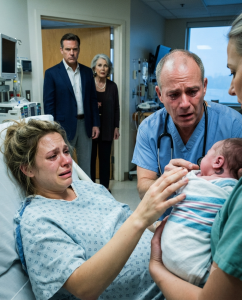
Dr. Esteban Valdés, the attending physician, took the baby, wrapped him, glanced down at the newborn’s face—and froze.
The nurse noticed first. “Doctor?”
He didn’t answer. His expression had emptied into shock. Then his eyes filled. Real tears gathered and slid down his face before anyone understood why.
“This can’t be possible,” he whispered.
Mariana tried to rise. “What’s wrong with my son?”
Dr. Valdés swallowed hard. His gaze stayed fixed just below the baby’s left ear where a dark, distinct birthmark curved like a crescent.
“Who is the father?” he asked.
“Rodrigo Alcázar.”
Something in the doctor broke.
Before he could say more, the door opened and Rodrigo walked in wearing a navy blazer and the smug confidence of a man who believed every room would eventually adjust itself to him. Beatriz entered behind him, immaculate, controlled. Two attorneys waited in the hall.
“Well,” Rodrigo said, glancing toward the bed. “You held on after all.”
Mariana stared at him in disbelief. There was no apology in his face. No guilt. Just annoyance wrapped in charm.
Beatriz approached with a cool smile. “We’re here to avoid unnecessary conflict.”
Rodrigo looked at the bassinet, then at the paperwork on the side table. “This doesn’t have to become ugly. Sign the custody terms, accept the settlement, and stop pretending you can fight this family.”
Dr. Valdés turned toward him slowly, tears still wet on his cheeks.
“What custody terms?” he asked.
Rodrigo dismissed him with a glance. “Doctor, with respect, this is private.”
“Not anymore,” Valdés said.
Beatriz stiffened. “Complete the record and step aside.”
But he did not move. He was no longer looking at Rodrigo. He was staring at Beatriz with something like horror and recognition blended together.
Rodrigo frowned. “Do I know you?”
Valdés looked down at the baby again. At the birthmark.
Then he whispered, “No. But I know that mark.”
The nurse stopped writing.
Mariana felt every nerve in her body go cold.
Beatriz’s hand rose slowly to the pearls at her throat, not adjusting them this time, just touching them as though she needed to remind herself she was still composed.
“What exactly are you implying?” she asked.
Valdés took a breath that shook on the way in and out.
“Twenty-six years ago,” he said, “I was a first-year resident in a private maternity unit connected to San Gerardo Clinic.”
Rodrigo’s irritation softened into confusion. “What does that have to do with this?”
Valdés ignored him. “A newborn boy was brought to us for observation. He had a distinctive mark under the left ear. I remember because his mother wouldn’t stop saying they were taking the wrong baby. She kept screaming it. Security removed her. The file vanished by afternoon.”
The room went completely still.
Rodrigo stared at him. “What mother?”
Valdés turned to Beatriz. “Yours knew.”
Beatriz’s face did not collapse all at once. That would have been almost human. Instead, tiny signs appeared: the tightening around her mouth, the shallow breath, the loss of color beneath her foundation.
“You are confused,” she said.
“No,” Valdés replied. “I have been confused for twenty-six years. Now I am not.”
Rodrigo laughed, but there was no confidence in it. “This is insane.”
Valdés pointed toward the newborn. “When I saw that mark, I thought I was seeing that same child again. But this baby isn’t the child from that file. He is proof of the bloodline that file tried to bury.”
Mariana’s heart pounded. The pieces had not formed yet, but she could feel them moving.
Rodrigo turned to his mother. “Explain this.”
Beatriz lifted her chin. “You are exhausted. All of you. This is absurd.”
“Mother.”
His voice cracked on the word.
Valdés spoke more softly now, almost to himself. “I remember the husband too. Wealthy. Influential. Furious that the first child was not a suitable heir. I remember being told to forget the case if I valued my future.”
Mariana looked from one face to another. Rodrigo’s arrogance was slipping into panic. Beatriz was calculating. The nurse had backed away from the bassinet as though the truth itself had become contagious.
Then Valdés said the words that changed the room forever.
“Rodrigo, I don’t think the woman who raised you gave birth to you.”
Silence struck like a physical blow.
Mariana felt the mattress dip as she leaned back, stunned. Rodrigo just stared.
“That’s impossible,” he said eventually.
Valdés looked at the baby, then back at him. “That mark runs in one line. I saw it in the infant your family buried in paperwork. I am seeing it now in your son. Genetics don’t care about social status.”
Beatriz snapped, “Enough.”
But it was too late.
Rodrigo looked at her with naked terror now. “Did you steal a baby?”
Her answer came too quickly. “Don’t be ridiculous.”
Mariana heard it then—not denial, not outrage, but strategy. The same crisp tone Beatriz used whenever she wanted to close a discussion before evidence arrived.
And Mariana had evidence.
Not for this. Not yet.
But if Beatriz had orchestrated fraud in business, forged medical signatures, manipulated custody, and engineered social lies, what else had she touched over the years? Suddenly the impossible no longer felt impossible.
Valdés turned to the nurse. “Call hospital administration. And legal. Now.”
Beatriz took a step forward. “You have no authority to detain us over a delusion.”
Mariana found her voice. “But I do have authority to report forged records, fraud, and coercion.” She looked directly at Rodrigo. “Did you think I came here with nothing?”
He whipped around. “What are you talking about?”
She gestured weakly toward her backpack. “Every invoice. Every fake contract. Every email your mother sent. Every forged cancellation. Every threat.”
For the first time since entering the room, Rodrigo looked uncertain about which disaster to face first.
“You’re bluffing,” he said.
Mariana almost smiled despite the pain. “You always thought I was quiet because I was weak.”
The doors opened. Another nurse entered, then hospital administration, then security. The attorneys in the hall came in talking loudly, then stopped when they saw Rodrigo’s face.
Valdés repeated what he remembered. Calmly this time. Precisely. A vanished file. A mother dragged away. A newborn with a crescent mark beneath the left ear. Pressure from influential people to forget.
One of the administrators asked for names.
Valdés gave them.
Beatriz tried to interrupt twice. Security asked her to step back.
Rodrigo looked as if the ground had fallen out from under him. He had arrived expecting to bully a woman in a hospital bed into surrendering her child. Instead he was standing in a delivery room listening to the possibility that his own life had been built on a crime older than his marriage.
“Is it true?” he asked his mother again, but this time the anger was gone. All that remained was a frightened son.
Beatriz held his gaze and said nothing.
That was the answer.
Within hours, the story had escaped the hospital in fragments. Not through gossiping nurses, but through the machinery of law Mariana finally set in motion. She handed over copies of everything from her backpack and cloud storage. Fraud investigators got involved. A judge was notified about the attempted custody pressure. The forged insurance cancellation triggered its own criminal review. And because Dr. Valdés insisted on making a sworn statement, the old maternity case was reopened.
The weeks that followed were brutal.
Tests were ordered.
Records were searched.
Retired employees were found.
One woman, now living quietly outside Puebla, came forward after seeing a news mention of the reopened inquiry. She said that twenty-six years earlier she had given birth to a son, been sedated, and awakened to be told the baby had suffered complications. She had never believed it. She remembered the mark under his ear because she kissed it before they took him.
DNA confirmed it.
Rodrigo Alcázar was not Beatriz’s biological son.
He was the child of Lucía Herrera, a young woman from a poor family whose baby had been stolen and folded into a wealthier household because Beatriz had delivered a stillborn child and refused to let the Alcázar name go without an heir.
The revelation detonated everything.
Old allies distanced themselves overnight. Business partners started reviewing old agreements. Social friends who once repeated rumors about Mariana suddenly went quiet. The same circles that had helped destroy her now pretended they had never believed the lies.
Rodrigo disappeared from public view for nearly a month.
When he finally contacted Mariana, it was not with anger but with a kind of broken disbelief.
“I didn’t know,” he said over the phone.
Mariana believed him.
That did not erase what he had done.
Not knowing he had been stolen as a baby did not excuse abandoning her while pregnant, spreading lies, trying to bully her into surrender, or letting his mother use power as a weapon. Pain explained him; it did not absolve him.
He asked once if he could see his son.
Mariana said, “Your son is not a strategy meeting.”
There was a long silence after that.
Eventually, supervised visitation was arranged through the court. Not because Mariana trusted him, but because she would not make choices from revenge. She had spent too much of her life being acted upon by other people’s cruelty. She wanted her son’s future built differently.
Beatriz was charged in connection with the historical child theft conspiracy and the forged insurance documentation. Her image collapsed in public with the speed of a structure that had only ever been held up by money and fear. The pearls disappeared first. Then the smiles. Then the invitations. For a woman who had once ruled rooms without raising her voice, disgrace was loud.
Dr. Valdés visited Mariana once after the dust began to settle.
He stood awkwardly at the hospital exit when she brought the baby out for a pediatric follow-up. He looked older than he had in the delivery room.
“I should have spoken years ago,” he told her.
“You were afraid,” Mariana said.
“Yes.”
“So was everyone.”
He looked at the baby sleeping against her chest. “He changed that.”
Mariana kissed the mark beneath her son’s ear before settling him more securely in the blanket.
“No,” she said. “The truth did.”
Months later, on a warm Sunday, Mariana took her son to Xochimilco.
Not because of Rodrigo’s promise from years ago, but because she had decided some places did not deserve to stay contaminated by broken memories. The canals were crowded. Music drifted over the water. Vendors called out. Her son slept for most of the ride, one tiny hand opening and closing against her shirt.
She watched the sunlight flicker on the water and thought about how close she had come to signing away her voice simply because she was tired, alone, and frightened. That was what people like Beatriz counted on—that exhaustion would do what force could not.
But Mariana had known documents. She had known patience. And when the moment came, she had known how to keep one copy of the truth where no one could erase it.
The strange part was not that Rodrigo had become a villain in her story. The stranger part was realizing he had also been someone else’s stolen child all along. Victim and perpetrator in the same body. A man raised by power, shaped by cruelty, then unleashed to repeat it.
Was he responsible? Yes.
Was he also broken by a lie he never chose? Also yes.
Mariana did not forgive Beatriz. Some thefts are too intimate for forgiveness. A baby, a mother’s grief, a woman’s pregnancy, a reputation—she had treated all of them like movable pieces on a board she believed she owned.
As for Rodrigo, Mariana never fully answered the question of whether he deserved redemption. Perhaps that was the hardest truth of all: someone can suffer something monstrous and still become capable of monstrous things.
When her son stirred against her chest, Mariana looked down at the small crescent beneath his ear.
Once, that mark had exposed a buried crime.
Now it reminded her of something else.
Blood may reveal where people come from.
But it does not decide who has the courage to break the pattern.
And if there was one red flag Mariana knew she would teach her son to fear, it was not poverty, silence, or social class.
It was the kind of power that believes love can be forged, family can be purchased, and truth can be buried forever.