The dog started digging beside the old barn at midnight.
At first, everyone thought Rusty had finally lost what little sense he had left. He was old enough that his muzzle had gone almost white, his eyes were cloudy around the edges, and one of his ears was torn from a fight with a coyote years ago. On cold mornings, he moved like every bone in his body had to be argued into motion.
But that night, Rusty did not look old.
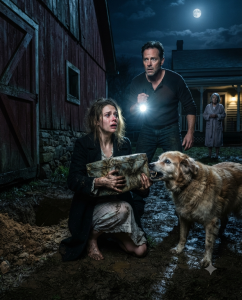
He stood behind the barn beneath a thin blade of moonlight, barking at the ground as if the dirt itself had offended him. His claws tore through the mud beside the back door, flinging wet clumps against the rotting boards. Every few seconds, he stopped, shoved his nose into the hole, whined, and dug harder.
Ellie woke to the sound with her heart in her throat.
For two weeks, the farmhouse had been too quiet.
Her grandfather, Samuel Whitaker, had died on a rainy Tuesday morning with one hand resting on Ellie’s and the other curled loosely against Rusty’s head. Ellie had been sitting beside his bed for three nights, refusing to leave even when Aunt Marlene told her she needed sleep.
Samuel had raised Ellie since she was seven years old. Her parents had died young, and from the day she came to the farm with a suitcase too heavy for her arms, Samuel had made room for her everywhere. At the breakfast table. In the truck. Beside him in the fields. In the will, she had believed, because he had promised her more than once that the farm would always be home.
Then Uncle Ray arrived.
Ray was Samuel’s only living son, though no one in town would have called him devoted. He had left the farm at eighteen, returned only when he needed money, and spoke to his father with the impatient tone of a man waiting for an old debt to clear. Still, the day after the funeral, Ray walked into the kitchen with a folder under his arm and a lawyer’s name on his tongue.
“The farm’s mine,” he said.
Ellie remembered staring at him from across the kitchen table. Samuel’s coffee mug was still beside the sink. His coat still hung on the peg by the door.
“That can’t be right,” she said.
Ray slid a paper across the table. “It’s right.”
She looked at the signature. It resembled Samuel’s, but something about it felt thin and wrong, as if someone had copied his name without knowing the weight behind it.
“He wouldn’t leave me nothing,” Ellie whispered.
Ray’s mouth curved. “He left you memories. Be grateful.”
Aunt Marlene stood at the sink, washing the same plate over and over, eyes fixed on the water.
Ellie wanted to fight. She wanted to scream. But Ray had papers. Ray had lawyers. Ray had already changed the locks on the equipment shed and spoken to a realtor about selling the far pasture. Every time Ellie asked questions, he smiled as if she were a child protesting bedtime.
“Blood matters,” he told her one afternoon while packing Samuel’s books into boxes. “You were raised here, sure. But raised isn’t owned.”
Those words followed Ellie for days.
And Rusty seemed to feel the change too.
He had always been Samuel’s shadow. When Samuel fixed fences, Rusty lay in the grass nearby. When Samuel drove the tractor, Rusty trotted along the lane behind him until his legs got too tired. At night, the dog slept under the porch, close enough to hear Samuel step outside before dawn.
After the funeral, Rusty stopped sleeping there.
He slept beside Samuel’s boots.
No one had the heart to move them. They sat on the porch with dried mud still crusted along the soles from Samuel’s last walk to the barn. Rusty pressed his body against them every night and sighed in his sleep.
Until midnight.
Ellie threw back her quilt and ran to the window. Lights flickered on downstairs. From the porch, Uncle Ray’s voice cracked through the dark.
“Shut that mutt up! He’s waking the whole county!”
Ellie looked toward the barn.
Rusty was a dark shape against the mud, digging with the desperation of something half wild. He was behind the old barn, the one Samuel had refused to tear down even after the newer storage shed was built.
Ellie grabbed her coat and ran downstairs.
“Ellie, don’t go out there barefoot,” Aunt Marlene called from the hallway.
Ellie was already out the door.
The cold hit her hard. Mud squeezed between her toes as she crossed the yard, but she barely felt it. Rusty barked once when he saw her, then immediately thrust his paws back into the hole.
“Rusty,” she said, dropping beside him. “What is it?”
He did not stop.
His breathing was rough. His old shoulders shuddered with effort. Dirt flew onto Ellie’s coat, her hands, her nightgown. When she reached for his collar, he jerked away and whined so sharply that she froze.
He wanted her to look.
So she looked.
The hole was beside the barn’s back wall, near the warped door Samuel used to keep locked. Ellie remembered him standing there often during his final year, leaning on his cane, staring at the ground with a strange expression. She had asked once what he was doing.
“Remembering,” he had said.
Now Rusty was digging in that exact place.
Ray came across the yard with a flashlight, boots sinking into the wet ground.
“I said get him away from there,” he barked.
Ellie turned toward him. “Why?”
Ray stopped.
The beam of his flashlight wavered over her face, then dipped to the hole. Something passed over his expression so quickly Ellie might have missed it if she had not spent the past two weeks studying him.
Fear.
Not annoyance. Not anger.
Fear.
Then his face hardened.
“Because he’s destroying my property.”
Ellie rose slowly. “Your property?”
“That’s what the papers say.”
Rusty dug again.
A dull knock sounded beneath his paw.
Wood.
Everyone went still.
Aunt Marlene stood halfway across the yard, one hand clutching her robe shut, her face pale under the moon. Ray’s flashlight beam trembled against the barn wall.
Ellie crouched.
“Move away from that,” Ray said.
She ignored him.
Rusty scraped around the edge of something flat. Ellie plunged her hands into the mud and clawed at the cold earth until her fingers struck a corner wrapped in slick oilcloth. Her pulse kicked hard.
“What is this?” she whispered.
“Ellie,” Ray said, warning in his voice.
She pulled.
The thing was stuck deep, sealed by wet soil and roots. Rusty shoved his nose into the hole beside her hand and pawed faster. Together, they loosened it inch by inch until it came free with a wet sucking sound.
It was a small metal box wrapped in blackened oilcloth.
Ray lunged before Ellie could stand.
“Give me that.”
Rusty moved first.
The old dog planted himself in front of Ellie and growled.
It was not a bark. It was not frantic. It was low, steady, and full of memory. Ray stopped so abruptly his boots slid in the mud.
“Call him off,” he said.
Ellie clutched the box to her chest. “Why? What’s inside?”
“Nothing that belongs to you.”
Aunt Marlene’s voice shook behind him. “Raymond. What did you bury?”
Ray spun toward her. “Go inside.”
“No,” she said.
It was a small word, but it landed like a slap.
Ellie tore at the oilcloth. Her hands were slick, and the knot had hardened from years underground. She used her teeth, pulled until the fabric split, and revealed the dented metal box beneath.
Her breath caught.
She knew it.
Samuel used to keep spare nails in that box when she was little. One summer afternoon, after Ray’s sons had laughed and told her she would never truly belong on the farm, Samuel had painted her initials on the bottom in blue barn paint.
E.W.
Ellie Whitaker.
He was not her father by blood, but he had given her his name in every way that mattered.
She flipped the box over. The initials were still there, faded but visible.
“Grandpa,” she whispered.
Ray’s breathing changed.
Ellie forced the rusted clasp open. Inside, wrapped in a dry scrap of cloth, were Samuel’s silver pocket watch, three yellowed photographs, and a folded deed.
The photographs came first.
One showed Samuel and Ellie when she was about eight, both of them standing beside a calf with a crooked white stripe down its face. Ellie was missing two front teeth. Samuel’s hand rested proudly on her shoulder.
The second showed Samuel’s wife, Eleanor, years before Ellie was born, standing in front of the barn with that same metal box in her hands.
The third made Aunt Marlene gasp.
It showed Samuel at a courthouse, holding papers beside a woman Ellie recognized only from old family albums: Samuel’s sister, Ruth. Ruth had been a notary before she died. On the back of the photograph, Samuel had written: The day I kept my promise.
Ellie unfolded the deed.
The paper was yellowed but intact. Her eyes searched the lines, stumbling over the legal language until she reached the names.
Samuel Whitaker.
Eleanor Whitaker.
And below them, listed as beneficiary and future owner upon Samuel’s death, was Ellie Whitaker.
Not Ray.
Ellie read it again, certain grief was playing tricks on her.
But the name did not change.
The farm was hers.
The back pasture. The farmhouse. The barn. The orchard. The creek lot where Samuel taught her to skip stones.
All of it.
Aunt Marlene began to cry silently.
Ray stared at the paper with a hatred so naked that Ellie took a step back.
“This is fake,” he said.
Ellie looked at him. “Then why did you bury it?”
Ray’s jaw tightened.
No one spoke.
Rusty leaned against Ellie’s leg, panting hard, his muzzle streaked with mud. His body trembled from exhaustion, but his eyes stayed on Ray.
Ellie turned the deed over.
There was writing on the back.
Not legal print. Not a stamp. Samuel’s handwriting, shaky but unmistakable.
If this is found after my death, then Raymond has done exactly what I feared.
Ellie’s throat closed.
Aunt Marlene covered her mouth.
Ray’s face drained of color.
Ellie kept reading.
I signed no new will giving him the farm. I told him this land would go to Ellie, as Eleanor and I decided years ago. If the papers in the house disappear, Rusty knows where I hid the first proof. There is another copy where only Ellie will think to look.
Rusty knows.
Ellie looked down at the dog.
His torn ear twitched. His cloudy eyes blinked up at her, tired and certain.
Somehow, Samuel had trained him. Or maybe Rusty had simply watched. Maybe he had followed Samuel one night to the barn and remembered the place where his old master buried the truth. Maybe for two weeks he had waited, confused and grieving, until Ray’s presence in the house became too much for him to bear.
Ray suddenly moved toward the farmhouse.
Ellie’s body reacted before her mind did.
She ran.
“Ellie!” Aunt Marlene shouted.
Ray was ahead of her, but he was heavier, slower in the mud. Ellie cut across the yard, slipping once, catching herself on the rain barrel, then bursting onto the porch. Rusty barked behind her, his voice hoarse but fierce.
Ray reached the door just as Ellie did.
He grabbed her arm.
“You don’t understand what you’re doing,” he hissed.
She yanked free. “I understand you stole from a dead man.”
“He was my father.”
“He was mine too.”
Ray’s face twisted. For a moment, Ellie thought he might shove her aside. Then Aunt Marlene appeared at the bottom of the steps.
“I called Sheriff Dalton,” she said.
Ray froze.
Marlene held up her phone with both hands, as if it were a shield. “He’s on his way.”
“You stupid woman,” Ray whispered.
“No,” Marlene said, tears shining on her face. “I was stupid when I stayed quiet.”
Ellie pushed into the house.
The kitchen smelled faintly of coffee, old wood, and the lemon soap Samuel liked. Everything was as Ray had begun to rearrange it. Boxes lined the wall. Samuel’s books were stacked carelessly near the pantry. His favorite chair had been pushed into the corner, as though Ray could make the old man disappear faster by moving what he loved.
Ellie stopped in the center of the kitchen and forced herself to breathe.
There is another copy where only Ellie will think to look.
Ray stood in the doorway behind her, his eyes darting around the room.
“Where is it?” he demanded.
Ellie ignored him.
Where would love remember?
Not the safe. Samuel hated the safe. He said safes were for men who trusted metal more than people.
Not the desk. Ray would have searched it first.
Not the bedroom. Too obvious.
Ellie looked at the stove.
A memory rose so suddenly it hurt.
She was eight years old, crying because she missed her mother. Samuel had sat in his chair by the stove and handed her a peppermint from the pocket of his coat. When she asked why he kept candy there, he said, “Because sad little girls always check coat pockets before they check cupboards.”
His coat.
Ellie turned toward the back door.
Samuel’s old brown coat still hung on its peg.
Ray saw her look.
He lunged.
Ellie reached the coat first, but Ray grabbed the sleeve and yanked it from the hook. Buttons snapped loose and scattered across the floor. Ellie clung to the collar. For one ugly second, they were both pulling on the coat like children fighting over a blanket.
Then Rusty appeared in the doorway.
He was limping now, mud to his chest, but he barked once with such force that Ray flinched backward.
The coat tore open along the lining.
Something slid out and hit the floor.
A sealed envelope.
Ellie dropped to her knees and snatched it up.
On the front, in Samuel’s handwriting, were two words.
For Ellie.
Ray’s face collapsed.
Not in grief. Not in shame.
In defeat.
The sheriff arrived fifteen minutes later.
By then, Ellie had opened the envelope with Aunt Marlene beside her and Rusty lying across her feet. Inside was a certified copy of the deed, a letter from Samuel’s attorney dated three months before his death, and a handwritten statement explaining that Samuel feared Ray would try to take the farm after he died.
There was also a note for Ellie.
She read it only after Sheriff Dalton had taken Ray into the sitting room and begun asking questions.
Ellie,
I wish I could hand this to you myself. I wish I had more time and a stronger heart and one more spring to watch you mend the orchard fence wrong before I show you how to do it right.
This farm is yours because you loved it when it had nothing to give you back. You stayed through drought, debt, sickness, and silence. You became its heart long before I put your name on paper.
Ray will say blood matters. Let him. Blood is only the beginning of a family, not the proof of one.
Trust Rusty. I did.
Ellie pressed the letter to her mouth and cried so hard her shoulders shook.
Aunt Marlene cried with her.
Rusty slept.
For the first time since Samuel died, the old dog rested like his work was finished.
Ray’s forged papers did not survive the week. Samuel’s attorney confirmed the deed was valid, the hidden copy matched the courthouse record, and the supposed new will Ray had produced was already under investigation. Aunt Marlene admitted that Ray had come to the farm two nights before Samuel’s funeral and burned documents in the old barrel behind the shed. She had not known what they were then. She only knew he told her never to mention it.
Ray claimed he had only been trying to “protect the family land.”
But no one believed him.
Not the sheriff.
Not the attorney.
Not the town.
And certainly not Ellie.
In the months that followed, she stayed on the farm. She put Samuel’s chair back beside the stove. She rehung his coat, torn lining and all, because she could not bear to throw it away. She repaired the barn door, cleaned the mud from the metal box, and placed Samuel’s watch on the mantel.
Rusty grew weaker that winter.
Some mornings, Ellie had to help him down the porch steps. Some nights, he wandered to Samuel’s boots and slept with his nose resting across them. But he also followed Ellie to the barn whenever she went, slow and proud, as if making sure she understood the farm was truly hers now.
One evening in early spring, Ellie stood behind the barn where the ground had been filled in. The mud had dried. Grass was beginning to return. Rusty sat beside her, leaning heavily against her leg.
“You saved us,” she whispered.
Rusty looked toward the barn, then toward the house, then closed his cloudy eyes as the wind moved softly through the apple trees.
Ellie never found out exactly how Samuel made Rusty understand where the box was buried. Maybe he had trained him with scraps of bacon and patience. Maybe he had spoken to him the way lonely old men speak to loyal dogs, trusting that love could carry instructions better than paper.
But Ellie knew one thing.
Ray had underestimated the wrong witness.
He thought the old dog was useless because Rusty could not sign an affidavit, argue in court, or read a deed.
But Rusty remembered where truth had been buried.
And in the end, that was enough.
Years later, people in town still told the story of the midnight digging, of the old barn, of the farm dog who dragged a family secret out of the mud. Some told it like a miracle. Some told it like justice. Ellie told it differently.
She said the farm was never saved by luck.
It was saved by a grandfather who knew greed when he saw it, a woman who finally found the courage to speak, a girl who refused to believe love could be erased by a forged signature, and an old dog who waited until the whole house was awake before digging up the truth.
And whenever Ellie passed the barn at night, she still looked toward that patch of earth and wondered what the biggest warning sign had really been: Ray’s papers, his smile, his sudden claim of ownership, or the fact that Rusty had started growling at him long before anyone else understood why.