Maria had long ago stopped expecting anything from people in clean clothes.
Three years on the street had taught her that the well-dressed were often the quickest to look away. They passed through the station with expensive coats, coffee in hand, and the fixed expression of people who had somewhere warm to be. They saw the cardboard, the frayed blanket, the plastic bags, and made a decision in a single glance: not my problem.
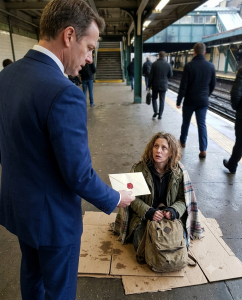
So when a man in a dark blue tailored suit stopped directly in front of her on a cold gray morning, Maria’s first instinct was not curiosity. It was fear.
She had been gathering her things to avoid the morning security sweep, moving slowly because the damp in her joints had been especially bad that day. Her spot was tucked against a stained wall near the lower platform, close enough to the tracks that the vibration of arriving trains traveled up through the concrete and into her ribs. It was not a safe place, not a comfortable one, but it was dry when the rain blew from the right direction, and after enough nights in one place, the body learns its corners.
Then those polished shoes appeared in front of her.
She looked up.
The man was in his forties, maybe a little older, with the kind of bearing that came from a life spent being listened to. Broad shoulders. Perfectly knotted tie. A navy suit that fit too well to be off the rack. He smelled faintly of cedar and something expensive. His watch flashed silver when he shifted his arm.
But it was not the money in his clothes that frightened her.
It was the look on his face.
He was staring at her with a hard, searching intensity, as if he had crossed half the city with one purpose and had only just reached it.
“Are you Maria?” he asked.
The sound of her own name in his mouth sent a jolt through her. Very few people there knew it. Among the unhoused, names were traded carefully. Among everyone else, she was usually “ma’am” if they pitied her, “hey” if they wanted her to move, or “that woman” if they spoke about her as though she couldn’t hear.
Maria clutched her backpack straps. “Yes, sir,” she said quickly. “I haven’t done anything wrong, I swear.”
She had learned to say that before anyone even accused her. It sometimes saved time.
The man didn’t call security. He didn’t ask her to leave. Instead, he took one measured step closer and said, “Two weeks ago, an old man slept here on the floor in the middle of the storm. Everyone ignored him. That old man was my father.”
The words landed with strange force.
Maria blinked, and the station around her blurred. She knew exactly which night he meant.
It had rained with such cruelty that water had run in sheets down the station stairs, turning the lower level into a wind tunnel of cold mist and dirty runoff. Most people had hurried through with their heads down, furious at the weather, furious at delays, furious at anything that slowed them from getting home. Near the tracks, under a broken light, an old man had been sitting alone.
He didn’t look like he belonged there.
Even soaked and shivering, there had been signs: the cut of his coat, the quality of his shoes, the expensive umbrella lying broken at his side. Yet he had been disoriented, almost dazed, as if the city had swallowed him whole. He kept looking out toward the darkness beyond the tracks, not really seeing it.
Maria had watched him for a while before moving closer.
“Sir?” she had said then. “You can’t stay sitting in that wet.”
He had turned toward her with red-rimmed eyes, startled, as though he had forgotten another human might speak to him.
“You should keep your blanket,” he had murmured when she draped it over his shoulders.
“It’s already ruined,” she had lied.
And when she offered him the last half piece of bread from her bag, he had stared at it so long she thought he might refuse. Instead, he accepted it with both hands, as if it were something far greater.
“Why are you helping me?” he had asked.
Maria had shrugged. “Because nobody else is.”
She had not asked his name. On the street, sometimes the kindest thing you can do is avoid questions that force a person to explain how far they have fallen.
Now his son stood in front of her, eyes full of something impossible to read.
“I didn’t know who he was,” Maria said softly. “I just gave him my blanket and some bread.”
For a second the man said nothing. His jaw moved as though he were grinding back words before they formed. Then he reached into the inside pocket of his suit and withdrew a thick cream-colored envelope sealed with dark red wax.
“My father died yesterday,” he said. “Before he passed, he made me promise I would find you and put this in your hands.”
Maria stared at the envelope.
It looked absurd there in the station, among the gum-stained floor tiles and flickering fluorescent lights. The paper was heavy, expensive, old-fashioned. Even the wax seal bore a raised emblem, elegant and formal.
“For me?” she asked.
He nodded once.
She took it carefully, almost afraid it would crumble if she touched it. But the paper was sturdy. Weighty. There was more than just a letter inside.
“Open it,” he said.
Maria broke the seal with shaking fingers and unfolded the first page.
The handwriting was uneven, but the words were clear.
Maria, if this reaches you, I am gone before I could thank you properly.
She felt her throat tighten.
In a world that stepped over me, you were the only one who looked me in the eye. You gave me your blanket though you had none to spare. You fed me when you had almost nothing yourself. I have met many respectable people in my life, and that night the only true dignity I found was beside you on a dirty station floor.
Maria pressed her lips together to stop them trembling.
Then the tone of the letter shifted.
What happened that night was not an accident. I was not merely lost. I had learned something terrible about my family, and before I acted, I needed proof that goodness still existed where wealth and comfort had failed me.
She lowered the paper and looked at the man in the suit. He held himself rigidly, as if bracing for impact.
Beneath the letter was a legal document with signatures, stamps, and her full name typed across the top: Maria Alvarez.
She frowned. It was one thing to receive a thank-you note. Quite another to see your name printed on official paper when you had spent years feeling erased.
Then she read the first lines of the document.
It was a transfer of assets.
A very large transfer.
Her knees buckled. She dropped to the concrete with the envelope slipping from her fingers. The man instinctively reached down, but she barely noticed him. She was staring at figures so large they looked fake, attached to language about inheritance, trust holdings, and immediate disbursement.
It was more money than Maria had ever imagined existing in one place.
But even that was not the worst shock.
Tucked behind the document was another handwritten page. Shorter. More urgent. The opening line sent a wave of ice through her body.
You were never supposed to survive.
Maria’s breath caught.
“What is this?” she whispered.
The man crouched quickly, his polished shoes scraping the concrete. “Don’t read the rest here.”
That warning only made her more afraid.
People flowed around them, some glancing over with mild annoyance before continuing on. A train announcement echoed overhead. Somewhere nearby, a child was crying. The ordinary world moved forward, indifferent, while Maria’s entire life tilted on its axis.
She looked back at the page.
If my son is standing before you, watch his face when he hears the truth.
Her eyes lifted.
The man’s expression had changed. It was subtle, but unmistakable: a flash of alarm.
“What truth?” Maria asked.
“My father was sick,” he replied too quickly. “He wrote things when he wasn’t in his right mind.”
But the handwriting on that final page was firmer than before, not weaker. Deliberate. Controlled.
Maria kept reading.
The woman who raised you was not your mother by blood. She took you after the fire and vanished. I spent years searching for proof. When I finally found it, my own house had become a place of lies. I was already too old and too ill to undo what had been done without help.
The station seemed to tilt.
Maria had almost no memories of childhood before the age of eight. Just flashes. Smoke. A loud cracking sound. Running. A woman gripping her wrist so tightly it hurt. After that, there had been years of instability, cheap apartments, strangers coming and going, then abandonment, then shelters, then the street. The woman she called Mama Elena had died years ago without ever explaining where they came from.
“No,” Maria whispered. “No…”
The man said her name then, but not like a stranger. Not even like a messenger.
Like someone who had heard it before.
“Maria, stop.”
The familiarity in his voice chilled her more than the letter itself.
She looked at him closely for the first time.
His eyes. The shape of his mouth. Something disturbingly familiar in the line of his brow.
Her pulse began to race.
At the bottom of the page, cramped into the margin, was one final sentence:
Ask him what happened the night your father died in my house.
Maria looked up.
The man stood abruptly. “We’re leaving,” he said.
“I’m not going anywhere with you.”
“You are if you want answers.”
She should have refused. Every instinct she had built over years of survival told her not to follow a wealthy stranger into a car. But the envelope lay open on the floor between them, filled with impossible documents and the first real clue about her life she had ever been given. And beneath the fear, another feeling had begun to rise.
Anger.
A hard, dangerous anger.
He led her outside to a black sedan idling at the curb. The driver opened the rear door without surprise, as if this strange pickup from a train station had been expected all along. Maria hesitated before getting in, memorizing exits, faces, street names. Survival had not made her trusting.
They drove to an old stone house on the edge of the city, the kind with iron gates and trees trimmed into obedient shapes. Inside, everything was polished wood, muted rugs, and expensive silence. Maria’s shoes left faint damp marks on a marble floor, and she almost laughed at the absurdity of it.
The man introduced himself at last.
“Daniel Varela.”
The surname struck her immediately. It matched the one on some of the legal papers.
“Your father was rich,” she said flatly.
“Yes.”
“And he left part of it to me.”
“Yes.”
“Why?”
Daniel’s face closed. “Because he believed he owed you more than gratitude.”
Maria folded her arms. “Start talking.”
He took her to a study lined with books and opened a locked drawer. From it he removed an old photograph, edges worn, colors faded with time.
He handed it to her.
Maria stared.
A man she now recognized as the old stranger stood beside a younger woman holding a little girl of about four. The child had dark hair, large solemn eyes, and a tiny silver bracelet on her wrist.
Maria’s hand flew to her own wrist.
She no longer had the bracelet. It had been stolen years ago. But she remembered it. She remembered turning it around and around as a child while a woman scolded her not to lose it.
“That’s me,” she whispered.
Daniel nodded.
The room felt too small.
“My father had a younger brother,” Daniel said. “His name was Tomas. He married a woman named Isabel. They had a daughter.”
Maria didn’t move.
“They died in a house fire,” he continued. “At least that is what everyone in the family was told. There was no body recovered for the child, but the official report listed her as presumed dead.”
Maria’s voice came out hoarse. “You’re saying I’m that child?”
Daniel did not answer right away.
Instead, he placed another document on the desk: a private investigator’s report. Then a birth certificate. Then an old newspaper clipping about the fire.
Maria read with shaking hands.
Years earlier, Daniel’s father, Arturo Varela, had come to suspect that the blaze had not been an accident. Tomas had recently changed his will. There had been disputes over family property, investment holdings, and control of a charitable foundation worth millions. If Tomas died before filing certain papers, those assets would remain under Arturo’s management until a direct heir came of age. If no heir survived, the structure of control favored Daniel’s branch of the family.
“Why would he suspect that?” Maria asked.
Daniel stared at the fireplace without seeing it. “Because a housekeeper heard my mother arguing with Tomas the day before the fire. Because money went missing afterward. Because my father found records years later that should never have existed.”
Maria’s skin prickled.
“Your mother?” she said.
Daniel looked at her then, and for the first time he seemed less like a controlled executive and more like a son dragged unwillingly into his parents’ sins.
“My mother is the woman who took you,” he said quietly. “Elena wasn’t your mother. She was my mother’s sister.”
Maria stepped back.
The room swayed.
Elena. Mama Elena. The woman who had raised her in fear and silence, who drank too much, changed cities too often, and snapped whenever Maria asked questions about the past.
“No,” Maria whispered.
Daniel’s voice hardened, but the hardness seemed aimed at himself as much as her. “My father discovered it too late. My mother had hidden you after the fire and paid Elena to raise you under another name. She claimed it was to protect the family from scandal. My father stopped believing her a long time ago.”
“And my father?” Maria asked. “What happened to him that night?”
Daniel said nothing.
Maria slammed her palm against the desk. “What happened?”
He closed his eyes once, briefly. “He died in the fire.”
“That’s not what the note said.”
“No.”
She stared.
At last, Daniel opened another file and slid it toward her. Inside was a statement—unsigned, old, stained at the edges. It came from a servant who had left the Varela house decades earlier. The statement claimed Tomas had survived the first minutes of the fire and made it to Arturo’s estate, injured and frantic, accusing someone in the family of betrayal. He collapsed there. By morning, he was dead.
Maria’s stomach turned.
“In your house,” she said.
Daniel’s voice was barely audible. “Yes.”
“Did your father kill him?”
“No.”
“Did your mother?”
Daniel’s silence answered before he did.
He sank into the chair behind the desk like a man surrendering to gravity. “My mother gave him something while everyone believed she was helping. He was badly burned. Weak. He trusted her. The servant overheard enough to understand that Tomas knew about forged papers and missing funds. He intended to expose everything if he lived.”
Maria stepped backward until her legs hit the edge of a chair.
“So she finished it,” Maria said.
Daniel looked sick. “That is what my father came to believe.”
The old man at the station. Arturo. He had spent years living inside that truth, under the same roof as the woman who had helped destroy his brother and steal his niece. Then, near the end of his life, he had gone to the station alone in the rain to see what remained of the child everyone had buried on paper.
Maria thought of the bread in his shaking hands. Of his wet coat. Of the way he had looked at her, not with pity, but with an unbearable sadness she had not understood.
“Why didn’t he come to me then?” she asked.
“Because he was ashamed,” Daniel said. “And because he was trying to gather enough evidence to destroy what was left of the lies before he died.”
Maria laughed then, a sharp broken sound. “Destroy? By leaving me money?”
“Not just money.”
He turned the final page of the investigator’s file.
Arturo had changed his will six months earlier. The portion Maria saw first at the station was only the beginning. He had also transferred to her the controlling interest in the charitable foundation originally intended for Tomas’s line. It was not simply wealth. It was legacy. Public recognition. Legal acknowledgment that she was the surviving heir.
Maria sat down because she no longer trusted her legs.
“And your mother?”
Daniel’s mouth tightened. “Gone.”
“What does that mean?”
“She died eight months ago.”
Maria stared at him.
All those years. All that theft, all that silence, all that damage—and the woman at the center of it had escaped the reckoning of hearing the truth spoken aloud.
Daniel must have seen the fury in Maria’s face, because he said, “I know. It isn’t enough.”
“No,” Maria said. “It isn’t.”
Silence stretched between them.
Then Daniel reached into the desk and removed one final item: a small velvet pouch. He set it gently in front of her.
Maria opened it and nearly stopped breathing.
Inside was a silver child’s bracelet, slightly tarnished, with a tiny engraved initial on the clasp.
M.
Tears rose so fast they blurred everything.
“My father found it among my mother’s things,” Daniel said. “He kept it, waiting for the day he could return it to you himself.”
Maria held the bracelet in her palm and felt something inside her crack—not neatly, not cleanly, but wide open. Grief for parents she barely remembered. Rage for years stolen. Shame for every time she had believed she was worthless, unwanted, disposable. And beneath all of that, a terrible aching tenderness for the old man who had gone into the rain to find out whether goodness still existed.
He had found it in the one person his family had discarded.
Days later, the lawyers came. Then the documents. Then the tests that confirmed what the papers had already shouted: Maria Alvarez, once nameless and forgotten on a station floor, was in fact Maria Isabel Varela, daughter of Tomas Varela and lawful heir to what had been taken.
The news spread. Some people called it miraculous. Others called it scandal. Some insisted Arturo had been manipulated by guilt and loneliness. A few whispered that Maria had somehow tricked an old dying man.
Those whispers hurt less than they once would have.
For the first time in years, Maria had walls around her at night. Hot water. Clean sheets. A closet with clothes that fit. But the strangest adjustment was not comfort. It was being seen.
Lawyers looked her in the eye. Journalists waited for her answers. Board members stood when she entered rooms they once would never have allowed her to approach. She learned quickly that money changed how people behaved, but not always who they were.
She did not move into the Varela estate.
She sold it.
Too many lies in the walls.
Instead, she kept one smaller house and used much of the inheritance to fund shelters, legal aid, and transitional housing for women whose lives had slipped through everyone else’s hands. She renamed the foundation after Tomas and Isabel, and on the plaque beneath their names she added one line Arturo would have understood:
For the people the world steps over.
Daniel remained in her life, though not easily. Some days Maria saw in him the shadow of a family that had destroyed her. Other days she saw a man carrying a guilt he had not created but could not escape. He testified publicly about his mother’s actions, turned over every document his father had collected, and walked away from enough money to prove that remorse, at least in his case, was not performance.
Maria never called him family.
Not then.
Maybe not ever.
But she also never forgot the look on his face at the station when she read the letter. It had not been the fear of losing money. It had been the fear of becoming the final keeper of a truth too ugly to survive in silence.
In the end, the old man’s last act did not just change Maria’s life. It exposed the lie an entire family had built itself on.
And sometimes, late at night, Maria still thought about that storm.
About how close she had come to keeping her blanket wrapped around herself.
About how one half piece of bread, given without expectation, had opened a door buried for decades.
It was enough to make anyone wonder what mattered more in the end: the fortune that changed hands, the name that was restored, or the simple fact that when a broken old man sat shivering on a station floor, the only person who treated him like a human being was the one his family had tried hardest to erase.