He freed the eagle from the barbed wire.
At dawn, it returned with proof.
By the time Crisanto Mendoza understood that, the men had already come for his forest, his spring, and the last piece of land his wife’s hands had helped keep alive.
The morning the news reached him had begun like every other. A cow with a swollen leg. Dust rising low over the yard. The smell of hay and wet earth lingering from the night before. He was bent under the corral shade, his hands steady despite his age, working medicine into the animal’s skin when Don Catarino’s blue pickup came fast up the road.
The commissioner climbed down looking smaller than usual. He took off his cap and rolled it between his fingers, his mouth opening twice before the words came out.
“The assembly approved the logging at Ojo de Agua.”
Crisanto did not stand immediately. He finished wrapping the cloth around the cow’s leg, then straightened one slow inch at a time, his joints speaking before he did.
“That forest doesn’t get touched.”
“The papers are signed.”
“By who?”
Catarino looked away. “Several. Mateo too.”
There are names that hit harder than a bullet because they pass through places no doctor can stitch. Mateo was one of those names.
He was not Crisanto’s blood. He had been Concepción’s nephew, the son of a dead sister and a father no one could ever rely on. But blood had stopped mattering years ago. Concepción fed him, clothed him, fought for him in school, sat with him through fevers, slapped sense into him when needed, and loved him hard enough that the whole town spoke of him as if he were theirs.
Crisanto had taught him to ride, to mend fences, to tell a sick calf from a lazy one. Mateo had once followed him through the pines at Ojo de Agua carrying a canteen bigger than his chest, swearing that one day he would protect the spring the same way Crisanto had.
When Concepción died, Mateo had cried with his face in both hands.
At the grave, with the dirt still fresh, he had promised, “I won’t let anything happen to the ranch.”
Now he had sold the forest behind his back.
“El Güero paid well,” Catarino added carefully. “He’s bringing five men this afternoon. Two chainsaws. Says not to make trouble.”
Crisanto stared past him toward the line of pines in the distance. Ojo de Agua was not only forest. It was water, shade, root, and memory. The spring rose there from beneath the stones and fed the troughs, the cattle, the mud, the little garden Concepción used to keep in chipped buckets by the kitchen wall. Cut the pines and the sun would strike hard. The soil would loosen. The water would thin. One dry season later, maybe less, the spring would be a trickle and then a stain.
A ranch without water is just land waiting to die.
After Catarino left, silence settled over the yard with the heaviness of bad weather. Crisanto walked through the rooms of the house without seeing much. The adobe walls held the cool. Concepción’s sewing basket still sat on the shelf. Her rosary hung by the bedpost. A cedar trunk under the window remained locked, just as she had kept it. He had not opened it in months.
By late afternoon he could no longer bear the waiting. He slung a pair of old pliers into his pack and went up the trail toward the canyon to check the upper fence line. He told himself that was the reason.
The truth was he needed the mountain.
He needed the pines to remind him something older than greed still existed.
The Sierra felt wrong the moment he entered it.
Usually there was movement everywhere—small birds hopping through brush, the rough calls of chachalacas, the distant sweep of vultures riding warm air. That day the sounds had thinned into something brittle and watchful.
Then came the thrashing.
Deep in the brush near the ravine, he found the eagle tangled in barbed wire where an old section of fence had collapsed and twisted into a wicked knot. She was huge, dark, furious, and close to dead from panic. One wing was caught hard. One talon clenched around the wire so tightly the scales of her foot looked bloodless. Her amber eye fixed on him with a force that made him stop breathing for a second.
Around her were boot prints.
Fresh cigarette butts.
A crushed beer can.
Six men had stood there and watched.
Maybe more.
Someone had seen her suffering and left her anyway.
“Same kind of world everywhere now,” Crisanto muttered.
He took off Concepción’s brown shawl and spoke to the bird the way he used to speak to frightened horses.
“Easy now. I’m only going to help.”
The eagle fought the wool when he covered her head, then went still enough for him to work. The first twist of wire snapped. The second cut his finger. The third was buried too deep, pressed dangerously near bone and feather. He had to lean in with both hands and use more force than he wanted.
That was when she struck.
A talon ripped across his left shoulder. Fire shot through him. He nearly fell sideways. Warm blood ran down his arm.
Still, he kept cutting.
“Hold on,” he hissed through his teeth. “Hold on a little more.”
When the final strand broke, the trapped wing unfolded with a violent shiver. He stumbled backward to his knees and yanked the shawl free.
The eagle remained there for one suspended second, enormous and breathing hard, then lifted her head and looked at him.
Not glanced.
Looked.
The late light caught one white feather on her wing, bright as a warning.
Then she launched toward the cliffs.
That night Crisanto cleaned his wound with cane alcohol and sat in the doorway until the stars hardened over the ridge. Sleep never came. He thought of Concepción. Of Mateo as a boy. Of the first calf he and the boy had delivered together. Of the growing softness that had entered Mateo over the years whenever easy money came near him. Crisanto had noticed it. Concepción had noticed it too. They had both corrected him, argued with him, forgiven him.
Maybe too many times.
At dawn, engines growled up the road.
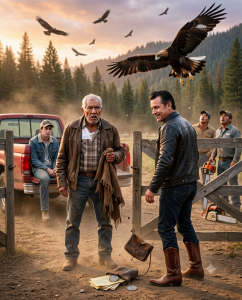
The first truck was white and clean enough to insult the dirt. El Güero stepped out wearing pressed jeans, snake-skin boots, and a smile practiced on weaker men. The second truck carried workers, chainsaws, and Mateo in the back, shoulders tight, gaze fixed downward.
Crisanto went to the gate.
His shoulder was bandaged. Concepción’s torn shawl hung from one hand.
El Güero spread his arms as if arriving for business instead of theft. “Move aside, Mendoza. We’ll make this quick.”
“No.”
The younger workers shifted. One laughed uncertainly. Another started unloading a chainsaw.
Then the scar-faced one looked up.
His expression changed first.
Above Ojo de Agua, seven golden eagles were circling.
The workers stared. Even El Güero squinted for a second, annoyed more than afraid.
“They’re birds,” he said. “Start the saws.”
One chainsaw coughed, sputtered, and died. The man pulling the cord swore and tried again. The eagles drifted lower, their shadows moving over trucks, dust, and men. It should not have meant anything. But in the hush of that hour, with the forest behind them and the old man planted at the gate, it meant enough.
Then one eagle separated from the others.
The female.
Crisanto saw the white feather and knew.
She passed low over the road and released something from her talons. It dropped into the dust at El Güero’s boots: a small leather pouch tied with rawhide.
El Güero bent fast to grab it, but the eagle swept down again so close that he threw up his arm. The pouch hit the ground, cracked open, and spilled its contents.
Papers.
A tarnished silver medallion.
A folded map drawn by hand in old brown ink.
Mateo went pale enough to look sick.
“I told you to burn those,” he blurted.
Every head turned toward him.
The silence that followed was worse than shouting.
El Güero straightened slowly, dust on his fingers. “What did you say?”
Mateo backed up one step. “Nothing.”
But it was too late. The scar-faced worker had already snatched up the map. He stared at it, then at the tree line, then back at the map.
“This isn’t ejido sale land,” he said. “These markers show inherited family protection. Spring rights too. It can’t be logged without voiding the whole transfer.”
El Güero lunged for it. “Give me that.”
The worker stepped back. “It’s signed and stamped by a notary from fifty years ago.”
Crisanto stared at the medallion on the ground.
Concepción’s medallion.
It had disappeared the week she died, along with the original boundary papers she kept locked in the cedar trunk. During the mourning, people had come and gone from the house. Coffee. Candles. Soup. Noise. Tears. Mateo had insisted someone must have stolen them in the confusion.
Crisanto had believed him.
Because grief softens suspicion.
Now the truth lay in the dust.
“Where did that eagle get those?” one of the workers whispered.
No one answered.
The female had landed on a fence post above the road. She was still as carved stone, watching.
Mateo’s lips trembled. His eyes moved from El Güero to Crisanto, then to the medallion. He looked less like a traitor in that instant than a man who had been afraid for a very long time and had just realized fear was no longer enough to protect him.
“Aunt Concepción knew,” he said hoarsely.
Crisanto’s voice came out rough. “Knew what?”
Mateo swallowed hard. “She found out El Güero wanted the spring before she got sick. He came with papers back then too. He knew the land couldn’t be sold if the originals existed, so he wanted them gone. She refused. She hid them.”
El Güero snapped, “Shut up.”
Mateo flinched, but something had broken open inside him. The words kept coming.
“She said she was going to tell you everything. That night—” He pressed a shaking hand against his mouth. “That night I was drunk. I owed money. El Güero told me he’d clear the debt if I got the trunk key and brought him the papers. I thought he just wanted copies. I swear I thought—”
Crisanto took one step toward him. “You stole from her?”
Mateo looked at the ground. “She caught me.”
The world seemed to narrow around those three words.
The workers did not move. Even the eagles overhead had gone quiet except for the whisper of wings.
“What happened?” Crisanto asked.
Mateo’s eyes filled. “She tried to stop me from leaving with the papers. We argued. She grabbed my shirt. I pulled away.” His breathing turned ragged. “She fell against the bed frame.”
Crisanto felt his blood turn cold.
Concepción had died two days later after what the doctor called a sudden collapse made worse by her weak heart. She had never fully regained strength after that fall. She had tried twice to speak privately with Crisanto during those last two days, but Mateo had always been nearby, bringing water, adjusting blankets, answering questions before she could. At the time it had looked like devotion.
Now it looked like control.
“She wanted to tell you,” Mateo whispered. “The second night, she tried again. El Güero came to the back window after dark and told me if she talked, I’d lose the ranch, the town would know what I did, and he’d make sure I went to prison alone. He took the papers. He took the medallion too. Said he’d keep them until I did what he asked.”
El Güero laughed, but there was strain in it now. “You drunk fool. You think any of them will believe this?”
The answer came from an unexpected place.
“Actually,” said Don Catarino.
He had arrived without anyone noticing, driving in behind the trucks during the commotion. He stood by his pickup holding something in one hand: a small digital recorder.
“I might.”
All eyes turned.
Catarino looked embarrassed, then grim. “I started recording meetings after rumors began about forged votes and pressured signatures. Yesterday El Güero met Mateo by the store in Creel. They were close enough to my truck that this caught more than I expected.”
He pressed play.
Static crackled. Then voices.
El Güero’s came first, unmistakable. “You already kept quiet when the old woman tried. Keep quiet now and once the saws start, there’ll be nothing to prove.”
Mateo’s voice followed, low and panicked. “He’ll kill me if he learns what happened to her.”
El Güero answered, “Then pray the old man dies ignorant.”
No one spoke when the recording ended.
El Güero’s face changed. The easy smile vanished, and what remained was something mean and cornered.
He turned as if to snatch the recorder, but two workers moved before he could. The scar-faced man blocked him with one arm. Another took the chainsaw from the truck and set it on the ground well out of reach.
“We came to cut trees,” the scar-faced worker said. “Not bury old women.”
“You idiots,” El Güero hissed.
Catarino stepped beside Crisanto. “The sale is void if the land title is protected. And with this recording…” He glanced toward Mateo, then away. “There will be a real investigation.”
Mateo sank to his knees in the dust.
Crisanto looked at him for a long time.
He saw the boy who used to bring Concepción wildflowers tied with grass.
He saw the young man who had started staying out late, borrowing money, speaking with too much admiration about people who got rich fast.
He saw the nephew who had lied at a deathbed.
And he saw, most painfully, that none of those versions erased the others.
“You let her die carrying your silence,” Crisanto said.
Mateo bowed his head until it nearly touched the ground. “I know.”
The old man could have struck him. The workers would have understood. The mountain itself might have understood.
He did not.
Some grief is too large for anger. It leaves only exhaustion.
Sheriff’s officers from town arrived an hour later after Catarino made the calls. El Güero was taken first, cursing all the way to the truck. Mateo went next, not resisting, looking as though he had been carrying handcuffs inside his chest for years and had finally stopped pretending otherwise.
By noon the road was empty again.
The chainsaws were gone.
The spring forest still stood.
Crisanto picked up the leather pouch and the silver medallion with careful hands. Inside the pouch, folded between the deed and the map, was one more thing he had not noticed in the dust: a small square of cloth torn from Concepción’s apron. She must have wrapped the papers in it before hiding them.
He sat on the gatepost and held that cloth for a long time.
Don Catarino spoke gently. “Do you think the eagle took it from where El Güero hid it?”
Crisanto looked toward the cliffs.
“Maybe from some hole in the rocks. Maybe from God’s own hand. I don’t know.”
High above them, the female eagle lifted from the fence post. The others rose with her, one by one, and turned over Ojo de Agua in widening circles before gliding back toward the canyon.
The white feather flashed once in the sun.
Then she was gone.
In the weeks that followed, the town talked of little else. The logging contract collapsed. The assembly reopened the case. The protected status of Ojo de Agua was confirmed, and the spring forest was placed under stricter communal watch. Men who had signed without reading admitted it. Men who had read and taken money admitted that too.
Mateo confessed to theft, fraud, and withholding the truth about the night Concepción fell. Whether he meant to hurt her or only save himself mattered less than the years of silence that followed. He would live with both.
Crisanto repaired the broken fence near the ravine himself. He left one section lower than before, not enough to trap anything big again. On some mornings he carried scraps of meat to the ridge and left them on a flat stone, feeling foolish every time.
He never once saw the female eat.
But twice, maybe three times, he glimpsed seven shadows circling over Ojo de Agua at first light.
By the next rainy season, the spring was running strong.
Wild mint grew again by the water. The cattle drank deep. The garden by the kitchen wall came back under Crisanto’s care, though the rows were never as straight as Concepción’s had been.
On feast days he wore the silver medallion.
Not because he believed objects could protect a man, but because some things deserved to be kept where greed could not reach them again.
People who heard the story argued over what mattered most. Some said the miracle was the eagle returning with the pouch. Others said the real miracle was truth surviving long enough to be found. A few insisted Mateo should never be forgiven. A few said fear ruins weak people in ways strength never understands.
Crisanto never argued with any of them.
He only knew this:
A forest had nearly died because one man wanted money and another man was too afraid to tell the truth.
A woman had tried to protect what would outlive her.
And an old man who refused to walk away from a wounded creature learned, one dawn later, that mercy sometimes circles back in forms no one is prepared to explain.
Even now, that may be the hardest part of the whole thing to forget.
Not that the eagle returned.
But that Concepción had been right all along about what the first real warning sign was.
It was never the stranger with money.
It was the loved one who started choosing silence over loyalty.