The envelope was still in her coat pocket when Carol’s party fell apart.
But I’m getting ahead of myself.
—
Margaret Hollis spent thirty-one years delivering mail in Ames, Iowa. She knew every street, every name on every box, every family that had a secret they thought was sealed tight.
She knew how to wait.
And she knew, better than most, that what’s inside an envelope matters a whole lot more than what’s written on the outside.
—
When their mother passed last spring, the farmhouse on County Road F was supposed to go to both of them — Margaret and her brother Dale, split clean down the middle, the way Mama had always intended.
Carol had other ideas.
Dale’s wife had been circling that property for years. The original white clapboard. The wraparound porch. The forty acres of good black Iowa soil. Carol talked about it the way some women talk about jewelry they haven’t been given yet.
Like it was already hers.
The estate auction was supposed to be a formality. A fair process. Family only, an agreed-upon appraiser, everything aboveboard.
Except the appraiser was Carol’s college roommate.
Except the minimum bid was set at a number Margaret couldn’t reach on a postal worker’s retirement.
Except somehow, someway, Carol walked out of that auction with the deed in her name and a smile that Margaret would not forget for the rest of her natural life.
“Better luck next time, Margaret.” That’s what Carol actually said. Standing on Mama’s porch. In Mama’s yard.
—
Margaret drove back to Ames. She sat at her kitchen table for a long time.
Then she opened her junk drawer, found a rubber band, and snapped it around a water-stained manila envelope she’d been holding onto since the reading of the will.
She put it in her coat pocket.
And she started making phone calls.
—
Nobody thinks much of a retired mail carrier who wants to talk.
Nobody thinks much of a quiet woman who brings good coffee cake to a Thursday morning appointment and asks a few gentle questions about estate accounting procedure.
Nobody — least of all Carol — thinks much of Gerald Fitch.
Gerald had been the family accountant for eleven years. Quiet man. Cardigan sweaters. Carol had dismissed him approximately four hundred times in front of other people without seeming to notice he was still in the room.
That was Carol’s way. If you weren’t useful to her in a given moment, you were furniture.
Gerald, it turned out, had an excellent memory.
And an even better filing system.
Margaret spent eight months having coffee with Gerald Fitch. They talked about his late wife. About Margaret’s route, all the houses she’d watched change over the decades. About how a person’s whole life can hinge on one document that somebody hoped would never surface.
The envelope went everywhere Margaret went.
She had it at Christmas dinner, quiet in her coat on the back of Dale’s chair, while Carol held court across the turkey and described her renovation plans for the farmhouse porch.
She had it at the church rummage sale in March when Carol spotted her across the folding tables and called out — loudly, so people would hear — “Margaret, honey, are you still carrying that sad little nothing around?”
A few people laughed.
Margaret smiled and patted her pocket.
Not yet.
—
Carol’s housewarming party was the first Saturday in June.
Sixty people. Catered. White tent in the side yard, right where Mama used to grow sweet corn. Carol had repainted the whole exterior — covered up the original white clapboard with a gray that Margaret’s mother would have hated — and hung a wreath on the front door that had never been there before.
Dale stood near the fireplace looking like a man who had lost something but couldn’t quite name what.
Margaret arrived at four o’clock, same as everyone else.
She hung up her coat herself.
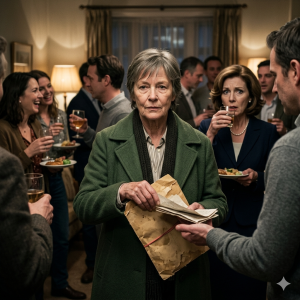
Then she took the envelope out of the pocket first.
Held it in her hands for just a moment.
Rubber band still on. Water stain still there. Eight months and sixty guests and a catered housewarming and Carol’s gray paint and her mama’s sweet corn field now a parking area — all of it led to right here.
Margaret walked to the center of the room.
She did not raise her voice. She did not have to.
She simply removed the rubber band, opened the envelope, and placed the papers into the hands of Carol’s husband’s accountant — the other accountant, the one Carol had never once bothered to learn the name of — and said, quietly, “I believe these belong to the estate.”
The room went dead quiet.
Every face turned from the papers in Margaret’s hands to Carol’s.
And that’s when Carol’s husband stood up from the back row and said the four words nobody in that room was ever supposed to hear.
—
“I already knew everything.”
His name was Dennis Kaufman. He had been married to Carol for nineteen years, and in all that time, Margaret had never once heard him raise his voice, challenge a seating arrangement, or send back an overcooked steak. The man was so quiet and so still that Carol had long since stopped factoring him into any room she entered.
That was Carol’s second great mistake.
Dennis reached out and took the papers from his own accountant’s hands with the careful, unhurried movement of a man who had been waiting a very long time to pick something up.
He looked at them for a moment. Then he folded them neatly and put them in the inside pocket of his sport coat.
He looked at Carol.
“Gerald called me in February,” he said. “Margaret, I think you should know that.”
Margaret had not known that. But she found, standing there in the middle of the room with sixty people around her and Carol’s hired caterers frozen near the kitchen doorway, that it did not surprise her one bit.
Carol had gone a color that the gray paint on the outside of the house might have been named after.
—
Here is what was inside the envelope.
It was not dramatic, as documents go. It was not a secret will, not a forged deed, not anything you’d see in a movie. It was something quieter and more devastating than any of that.
It was a letter from Margaret’s mother. Handwritten. Dated fourteen months before she died, when she was still clear-minded enough to know that clarity might not last.
In the letter, their mother described in plain English what she had told her attorney separately in a sworn statement: that she had been visited, three times in the final year of her life, by Carol. That during those visits Carol had raised, gently and repeatedly, the idea that the farmhouse might be better left entirely to Dale and herself, given that Margaret had no husband, no children, no real use for forty acres. That their mother had said no. Each time. Clearly.
And that Carol had suggested — not threatened, just suggested — that if the property did end up split, Dale’s portion of the inheritance from their father’s side, a separate small account their mother controlled, might need to be reconsidered to keep things balanced.
Their mother had written it all down because she did not trust what would happen after she was gone.
She had sealed it and mailed it to Margaret.
Margaret had been on vacation that week. By the time she got back, the will had already been read and the machinery had already begun to turn.
She’d kept it. Waited. Made sure she understood what she actually had before she did anything with it.
What she had, as it turned out, was a sworn statement from their mother’s attorney confirming the same conversations. That was Gerald’s contribution. He had known about the attorney. He had made a phone call of his own.
And what Dennis had, from Gerald’s February call, was enough to instruct his own attorney to begin a quiet review of the estate accounting — specifically, how the minimum bid at that auction had been calculated, and who had authorized the appraisal fee paid to Carol’s college roommate from the shared estate account before the auction even took place.
By the time Margaret walked into that housewarming party, the property transfer was already under a court-ordered review.
She hadn’t known that part either.
—
Carol did not make a scene. That surprised people later, when they talked about it — and people talked about it for a long time.
She set down her glass of white wine on the fireplace mantel. She straightened the hem of her blouse. She looked at Margaret with an expression that was not quite anger and not quite grief and was mostly, Margaret thought, the look of a person who had simply been outrun.
“You held onto that for eight months,” Carol said.
“I did,” Margaret said.
“Waiting for the right moment.”
“Waiting until I was sure I had everything right. I only wanted to do it once.”
Carol looked around the room. Sixty people who had eaten her food and admired her renovation and listened to her plans for a kitchen expansion. Sixty people who were now very still.
She picked up her purse.
She walked out her own front door.
—
Dale didn’t say anything for a while. He stood by the fireplace where he’d been standing all afternoon, and he looked at the floor, and he did the private arithmetic that a man has to do when he realizes his wife has been lying to him in a direction he’d chosen not to examine too closely.
Margaret didn’t push him. She knew her brother. She knew he had loved Carol, or the idea of Carol, for a long time. She knew that untangling what a person knew from what they’d allowed themselves to know is a kind of grief all its own.
She went and stood next to him.
After a while he said, “Mama knew.”
“Mama knew,” Margaret agreed.
“She wrote it down.”
“She mailed it to me herself.”
Dale was quiet for another long moment. Outside, through the windows, they could see Carol’s car backing out of the gravel area where the sweet corn used to be.
“I’m sorry,” Dale said. Not to Carol. To Margaret.
“I know,” she said.
She put her arm through his, the way they used to walk as kids down County Road F on summer evenings, and she stood there with him while the room slowly, carefully, began to breathe again.
—
The court’s review took four months. The transfer was voided on the grounds that the auction had not met the procedural standards required under Iowa estate law — specifically, the independent appraisal requirement, which Carol’s accountant-roommate did not satisfy, a fact that had apparently been noted and set aside at the time by someone who should have known better.
The farmhouse went back into the estate. It was appraised by a firm out of Des Moines. The forty acres were valued fairly. Margaret and Dale each received their half.
Dale sold his half to Margaret for one dollar, on the condition that he could come out and walk the fields whenever he wanted.
She said that was the most reasonable thing he’d said in years.
—
Margaret moved back into the farmhouse in October, just before the first hard frost.
She repainted the exterior herself, with help from Gerald Fitch, who turned out to be a surprisingly capable painter for a man in cardigans. She used the original white. It took three weekends.
She pulled up Carol’s wreath and put back the plain brass knocker that had been on the door since 1974.
She planted garlic in the side yard where the white tent had been. It was the right time of year for it, and her mother had always said that garlic planted in fall comes up in spring with more conviction than anything else in the garden.
She kept the envelope. She put it in the junk drawer in the kitchen, rubber band and all, next to a spare key and a coupon for the hardware store and all the other small things a person holds onto because you never know.
She did not need it anymore. But it had done its job, and she felt it deserved to rest somewhere it had earned.
—
People asked her afterward — mostly at church, mostly women who had watched Carol for years with the patient eyes of women who watch — they asked her how she had stayed so calm. How she had carried that envelope around for eight months without ever once letting Carol see that she had it.
Margaret always thought about that question before she answered.
“Thirty-one years,” she’d say finally. “You spend thirty-one years delivering other people’s mail and you learn something about the difference between carrying something and using it. The carrying is just carrying. It’s patient work. Anybody can do patient work if they care enough about what’s inside.”
She’d usually pause there.
“And I knew what was inside,” she’d say. “Mama’s handwriting. That was always going to be enough.”