I found my own baptismal certificate tucked inside a church organ pipe. It had my name on it. And my father’s signature.
The father my mother told me had walked away before I ever drew my first breath.
—
I’m a pipe organ restorer. Have been for twenty-two years. It’s quiet, careful work — the kind that suits a woman who learned early not to ask too many questions.
The call came in October. A little Episcopal church in Grafton, Illinois, right where the Illinois River bends toward the Mississippi. Stone walls. Stained glass gone soft with age. The kind of place that smells like candle wax and old wood and something else you can’t quite name — like prayers that soaked into the floorboards and never fully dried.
They said the organ hadn’t been played in eleven years. They said the pipes were in bad shape.
They didn’t say anything else.
I drove down on a Tuesday with my toolbox and my thermos and my twenty-two years of not asking questions.
—
The first thing I noticed was the knob.
It was on the organ console — a tarnished brass pipe-stop pull, the kind you’d see on any instrument built before 1940. Round. Heavy. Unremarkable, except for one thing.
Engraved right into the face of it, just one letter.
*R.*
I turned it over in my palm. Set it aside. Wrote it in my notes out of habit — *brass stop knob, engraved R, condition: oxidized but intact* — and moved on.
I didn’t think much of it. Not then.
—
The interior pipes were my second day’s work.
Grafton is a flood town. The river gets into everything eventually — the basements, the walls, the lungs of old instruments. I was braced for water damage, for warped wood, for the particular sadness of a beautiful thing left to suffer.
What I was not braced for was paper.
It was folded twice, tucked up inside the longest, oldest bass pipe, the one farthest left, the one that would have held the deepest note.
I almost missed it.
I almost put it in the trash pile without unfolding it.
I don’t know why I didn’t. Some instinct. Some pull I still can’t explain.
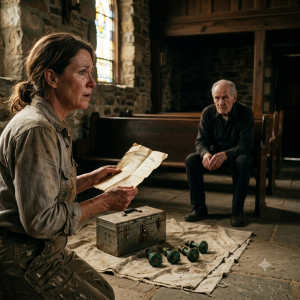
I unfolded it under my work light, and the first thing I saw was the date — March 1971.
The second thing I saw was a name.
My name.
*Margaret Anne Collier.*
My hands went cold.
It was a baptismal certificate. Signed by the minister. Witnessed by two members of the congregation.
And at the bottom, in the space marked *Father,* in handwriting I had never seen before in my life —
A signature.
*Robert D. Collier.*
—
My mother told me his name exactly once. I was nine years old. I asked on a Tuesday, and she answered on a Wednesday, and she never spoke of him again.
*Robert,* she’d said. *He left before you were born. Some men do.*
I stood in that cold church nave holding a piece of paper that said something different entirely.
—
I should have packed my tools and driven home.
Instead, I kept working.
And the knob kept showing up.
I found one in the vestibule coat closet, hanging from a hook with no coat attached to it.
I found another behind the altar, sitting on the ledge like someone had set it there and forgotten it.
A third one turned up in the church kitchen, next to the coffee urn, engraved the same as the first.
*R.*
Every time, that same initial. That same tarnished brass. That same weight in my palm when I picked it up, like something that wanted to be held.
I started leaving them in a row on my worktable. Three of them by Thursday. Four by Friday morning.
I didn’t tell anyone. There was no one to tell. Just me and the organ and the old stone walls and the faint smell of river water underneath everything else.
—
The deacon had been watching me all week.
Quiet man. White-haired. Moved slowly, the way people do when their knees have earned the right to take their time. He’d bring me coffee in the mornings without being asked and set it on the pew end beside my drop cloth and never say more than *good morning, miss* and *hope it’s not too cold in here for you.*
I thought he was just kind.
I thought he was just lonely the way old men in old churches sometimes are.
I did not think he was keeping something.
Friday afternoon, the light coming through the south window, I was reassembling the stop action when I heard him walk up behind me.
I heard him stop.
I heard him breathe.
And then, for the first time in a week, he said more than *good morning.*
His voice came out barely above a whisper.
*”Your daddy didn’t leave, sweetheart.”*
I turned around.
*”He’s been the one paying to keep this church standing for forty-three years — and he’s sitting in that back pew right now.”*
The church was completely silent.
I turned toward the back.
—
There was a man in the last pew.
He was sitting very still, the way you sit when you’ve been practicing stillness for a long time. When you’ve made a discipline of it. White-haired like the deacon, but taller, even sitting down you could tell. Wide hands folded in his lap. A canvas work coat, the faded olive green kind that farm supply stores still sell. And he was looking at me the way you look at something you have memorized from a photograph and are now seeing, for the first time, move.
I didn’t walk toward him right away.
I couldn’t have told you how long I stood there. The deacon had stepped back, quiet as he’d been all week, giving us the space the way you give a room to people who need it.
The man in the back pew didn’t stand. I think he understood, somehow, that standing would have been too much. That this had to happen at whatever pace I set.
So I set it slow.
I walked up the center aisle with my work gloves still on my hands and the baptismal certificate still in my apron pocket where I’d been carrying it all week without quite meaning to.
I stopped two pews in front of him.
He said, *”Maggie.”*
Just that.
And something broke open in me that I had been sealing shut since I was nine years old on a Wednesday morning.
—
His name was Robert Collier. Everyone called him Rob. He was seventy-one years old and he had been born forty miles north of Grafton and he had met my mother at a dance in Alton in the summer of 1970 and he had loved her completely, the way young men do when they don’t yet know how complicated love can get.
He told me all of this sitting in that back pew with the afternoon light going amber through the old glass.
He told me that they were not married. That this was 1970 and 1971 and that her parents were strict and his situation was complicated — he’d been helping support a sick father, money was thin, timing was impossible. That they had argued about what to do and said things that couldn’t be unsaid and my mother had made a decision and he had not been strong enough or brave enough or something enough to fight for what he should have fought for.
*”I was twenty-seven years old and I was a coward,”* he said. *”I want you to know I know that.”*
He said he found out I’d been born through a mutual friend, months after the fact. That he’d driven to my mother’s parents’ house and she’d refused to come to the door. That he’d written letters she returned unopened. That eventually he’d understood, or told himself he understood, that she didn’t want him near her or near me.
*”I should have tried harder,”* he said. *”I know that too.”*
He said he’d thought about me every year. That he’d hired a person, a private researcher, back in the nineties, who had tracked enough to confirm I was alive and well and had become something called a pipe organ restorer, which he’d had to look up.
*”I didn’t reach out,”* he said. *”I didn’t think I had the right.”*
But when this church — his church, the church he had joined in his thirties when he’d moved to Grafton, the church where he’d been a deacon himself for twenty years before his knees went, where he’d made his own quiet peace with God and with what he’d done and failed to do — when this church finally had to restore its organ, he had made a call.
He had asked specifically for the best pipe organ restorer in the region.
He had not told anyone why.
*”I put that certificate in the pipe myself,”* he said. *”Forty years ago. Right after your baptism. I attended it, did you know that? Your mother didn’t see me. I stood in the back. Same pew.”* He nodded toward where he’d been sitting. *”I held you for about thirty seconds while she was talking to the minister. You were wearing a white dress with yellow smocking. You grabbed my finger and held on.”*
He stopped talking for a moment.
*”I put the certificate in the pipe because I wanted some part of me to be in there with the music. It was the only thing I could think of. I was not a smart man about feelings.”*
—
I had questions. I had a thousand questions and about half of them were furious ones and I asked those too, right there in the pew, and he answered every one of them without flinching or deflecting. He didn’t make excuses beyond the ones that were true. He didn’t try to make himself the hero of his own story.
That, maybe more than anything, is what made me stay in that pew instead of walking out.
I’ve known people who could only tell their lives in a way where everything painful was somebody else’s fault. He wasn’t one of those. He just laid it out flat, the way it was, and let me look at it.
—
The knobs.
I finally asked about the knobs.
He smiled for the first time. It was a careful smile, like he wasn’t sure he’d earned it yet.
*”My initials,”* he said. *”Robert. I carved them myself. Over the years, when I’d have reason to be in here alone. Just little things. Just — I was here. I was in this building. Like signing your name to something.”*
He’d been leaving traces of himself in the same building where he’d left a trace of me.
I don’t know what to do with that, theologically or emotionally or any other way. I’m still working on it.
—
I finished the organ.
It took another four days after that Friday. Rob came in each morning the way the deacon had, quiet, respectful of the work, and we talked while I tuned and he sat in the front pew instead of the back one. Small things at first. What his life looked like. What mine looked like. He’d never married. He had a daughter who was not his blood, the daughter of a woman he’d loved in his fifties who had died of cancer and left behind a girl named Trish who still called him every Sunday. He grew soybeans. He’d had a dog named Walter for fourteen years who had died the previous spring and he still wasn’t over it.
I told him about my work. About the organs I’d loved most — a 1929 Kimball in a Baptist church in Memphis, a tiny one-manual tracker in a Vermont village that was older than the country itself. I told him I’d never married either, that I’d come close once, that close-but-not was its own kind of education.
He listened the way people listen when they are aware that they are owed nothing and grateful for everything.
—
On my last day, I played the organ.
I always do, when a restoration is finished. Just scales, usually. Just enough to hear whether the voice has come back.
But that day I played more than scales.
I played everything I knew from memory — old hymns my grandmother had taught me, a Bach prelude I’d learned in college, a few measures of something I couldn’t name that my hands just found on their own.
Rob sat in the front pew with his eyes closed.
The old stone walls held the sound the way stone walls do, letting it build and bloom and fill up the space between the floor and the vaulted ceiling.
When I stopped, neither of us said anything for a long time.
Then he said, *”She would have liked that. Your mother. She loved music.”*
I hadn’t known that.
I hadn’t known that, and it was mine now, and I was fifty-three years old and receiving it for the first time, and it felt like finding paper in a pipe — like something that had been waiting a very long time for someone with the right hands to come along.
—
My mother is still alive. She’s eighty-one and she lives in a memory care facility in Decatur and most days she knows me and some days she doesn’t.
I haven’t told her about Rob.
I don’t know if I will. I don’t know if there’s anything in that conversation worth the weight it would cost her. Maybe that’s a decision I make differently a year from now. I’m leaving room for it.
—
Rob and I have talked on the phone six times since October. We’re supposed to have lunch in the spring, when the roads between here and Grafton are reliably clear.
I still have the baptismal certificate. It’s in a frame now, on the wall of my workshop, between a photograph of the Grafton church and a photograph of the Memphis Kimball.
And the four brass knobs are on my worktable in a row.
I keep meaning to find a better place for them.
But there’s something I like about having them there where I can see them while I work.
R. R. R. R.
Four of them. Like a chord.
Like a note held so long it became something else entirely — not an absence, not a loss, but a sound that had been waiting in the pipe all along, needing only the right conditions, the right set of careful hands, to finally be heard.