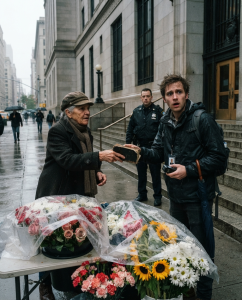
They told the woman selling flowers outside the courthouse to move because she made the building look cheap.
Nobody said it loudly at first. Nobody had to. The message came the way those messages always do in places built on hierarchy and polished stone—through a tight smile, a security uniform, and the kind of apology that means a decision has already been made somewhere above your pay grade.
But by the time that order reached Irene, the damage to the courthouse’s image was no longer being caused by a folding table, plastic buckets, or a woman in a weathered coat selling roses on the sidewalk.
The real damage was hidden inside.
Irene had stood on that corner for eleven years.
That was long enough to become part of the scenery. Long enough for passing attorneys to stop seeing her as a person and start seeing her as a fixture, like the newspaper box by the curb or the stone benches near the fountain. Long enough for people in expensive suits to speak too freely while waiting for rides, smoking in the alley, or pacing with phones pressed to their ears. Long enough to learn that the most powerful people were often the least careful when they believed no one around them mattered.
Every morning she arrived before most courthouse staff. She unfolded her table with a practiced motion, set out the buckets, topped them off with fresh water, and arranged the flowers in rows by color. Red roses at the center. Carnations in pink and white to one side. Sunflowers catching the first clean light of the day. Daisies near the front because they sold quickly and because she liked the way they made people soften.
She had not planned on spending a decade there.
Years earlier, after her husband died and the rent rose faster than her savings could handle, she began selling flowers because it was what she knew. Her mother had worked in a florist shop. Irene had learned how to trim stems, strip leaves, revive tired petals, and build a bouquet with balance before she turned fifteen. Selling outside the courthouse had seemed practical. Foot traffic was steady. Emotions ran high. People bought flowers on important days—weddings, funerals, apologies, reconciliations, celebrations that arrived too late, grief that came too soon.
Business was unpredictable, but the corner gave her enough to survive.
What nobody realized was that it gave her something else too.
A front-row seat.
The courthouse was one of those old downtown buildings that looked dignified from a distance and exhausted up close. The columns were chipped if you stood near enough to inspect them. The brass handles were polished daily. The steps carried the weight of a thousand anxious shoes. Inside, people argued over children, money, property, blame, punishment, and truth. Outside, they braced themselves, made phone calls, rehearsed lies, swallowed panic, and sometimes fell apart.
Irene saw all of it.
She saw defendants come in looking reckless and leave looking old. She saw grandparents clutching manila folders with both hands. She saw spouses refuse to stand beside each other even under the same umbrella. She saw lawyers switch expressions in an instant, going from bored to compassionate the second a client turned around. She saw judges’ staff move in packs, efficient and guarded, carrying files as if they contained weather instead of lives.
She also heard things she was never meant to hear.
At first, they were the kind of courthouse whispers that never seemed important enough on their own. A defense attorney muttering to a witness, “Just keep it simple and don’t add anything.” A clerk complaining that one family court matter had been “decided upstairs” before anyone entered the room. A paralegal hissing into her phone that “the envelope was delivered, so relax.” A bailiff joking that some people should save time and hold hearings in the parking garage if the outcome was already arranged.
Most of the time Irene kept her head down. She stripped leaves, tied ribbon, counted cash, and memorized more than she admitted even to herself.
What changed was repetition.
The same attorneys appeared together too often. The same assistant seemed to move between courtrooms with unusual freedom. Certain cases ended with suspicious speed. People arrived terrified and walked out stunned, not in the way ordinary bad rulings created, but in the way betrayal did.
Irene did not know legal procedure. She knew faces.
And faces told their own stories.
She could tell when someone expected to lose and when someone had been promised a win. She could tell when a clerk had seen something ugly and regretted it. She could tell when someone felt untouchable. She could also tell when fear entered a routine and made it dangerous.
So one day, without making much of it, she bought a notebook.
The first entry was bare and practical.
March 14. Blue sedan parked by side entrance 8:12 a.m. Tall man gray suit carried sealed envelope. Entered without screening.
Then another.
March 22. Assistant from Judge Hall’s chambers met with attorney on steps. Mentioned “before hearing.”
Then another.
April 3. White SUV, partial plate 4KD-19. Woman crying after custody hearing. Hearing less than 10 mins.
She wrote only what she witnessed directly. If she guessed, she left it out. She trusted patterns more than emotion. Over months, then years, the notebook thickened with names she caught from greetings, plate numbers she repeated silently until she could write them down, physical descriptions, overheard phrases, hearing dates, and strange coincidences that happened too often to remain coincidences.
The notebook lived beneath the flower table, wrapped in an old plastic sleeve to keep out dirt and rain.
Nobody knew it existed.
Then came the young mother.
Her name was Lena Morales, though Irene did not learn that until later. To Irene she was, at first, the daisy woman.
Lena came every Friday around five in the afternoon, usually with a tired smile and exact change folded in her hand. She worked nearby, maybe in one of the medical offices two blocks over. She never wore expensive clothes, but they were neat. Her hair was usually pulled back in a loose knot. Some Fridays she looked cheerful, other Fridays strained, but she always paused when she reached the daisies.
“For your daughter?” Irene asked once.
Lena laughed softly. “For both of us, maybe. She thinks flowers fix bad days.”
“Do they?”
“Not fix,” Lena said. “But they help.”
Over time Irene learned only fragments. The daughter was six. She liked purple crayons, strawberry yogurt, and bedtime stories read twice. Lena and the child’s father were in court over custody. Lena tried not to discuss it, but the strain showed. Some Fridays she bought fewer stems than usual and apologized for counting coins. Once she stared at the courthouse doors for a long time before saying, “I never knew people could take so much from you using calm voices.”
Irene remembered that.
On the rainy morning everything changed, Lena arrived early, clutching a folder to her chest so tightly the edges bent. Her coat was damp at the shoulders. She looked as if she had not slept.
“Big day?” Irene asked.
Lena forced a nod. “Emergency hearing.”
“Do you want flowers for later?”
Lena almost smiled. “I’ll come back.”
She hurried inside.
A few minutes after she disappeared through the main doors, Irene saw something else. A dark car pulled into the staff area near the side entrance. The judge’s assistant stepped out holding an umbrella over a man Irene had seen twice before but never formally identified. He was broad-shouldered, silver at the temples, dressed too casually for court but moving with the confidence of someone who belonged. He handed over a large envelope, the thick kind that stayed rigid even in rain. The assistant tucked it beneath her coat and slipped inside through the side door.
Irene watched the license plate.
She repeated it twice under her breath and wrote it in the notebook.
At 10:17 a.m., Lena came back out.
The hearing had lasted seven minutes.
It was not the length that shocked Irene first. It was Lena’s face. She looked stripped raw. Rain hit her, but she didn’t lift the hood of her coat. Her folder was open, papers crooked. She walked down the steps as if the ground had tilted.
Irene left the table and caught her elbow gently.
Lena tried to speak and couldn’t. Then the words came in a flood.
“They gave him temporary custody,” she said. “They said there were concerns. They wouldn’t even hear everything. My lawyer barely spoke. I brought records, photos, school notes—she didn’t even look.”
“Who didn’t?”
“The judge.”
Lena’s mouth trembled. “It was over before I understood what was happening.”
Irene handed her a bunch of daisies and closed Lena’s fingers around the stems.
“No charge,” she said.
Lena began to cry in earnest then, the helpless, exhausted crying of someone whose worst fear had just been made official by people in robes.
Irene looked up toward the courthouse windows and felt something in her settle into place. Suspicion stopped being abstract. The pattern had a face now. A mother who bought daisies every Friday had just lost her child in a hearing that moved with the cold speed of a transaction.
That afternoon a decision was made inside the courthouse.
Maybe someone noticed Irene looking too carefully. Maybe someone worried about what she had heard over the years. Maybe the flower stand had simply become an irritation to administrators preparing for an inspection or a donor visit. Whatever the reason, a security guard named Thomas approached her around three o’clock with the expression of a man who hated his own assignment.
“Irene,” he said, hands clasped in front of him, “I’m going to need you to pack up.”
She kept trimming rose stems. “For the day?”
“For good.”
That made her look up.
Thomas was not cruel. He had bought anniversary bouquets from her twice. Once he had confessed he forgot his wife’s birthday until she saved him with last-minute carnations and baby’s breath. Now he could barely meet her eyes.
“Why?” Irene asked.
He hesitated. “Orders.”
“From who?”
“You know I can’t say.”
She looked past him at the courthouse entrance. Associates in fitted suits moved in and out. A clerk slowed near the steps, then hurried off. The rain had let up, leaving everything bright and slick.
“I’ve been here eleven years,” Irene said. “Nobody minded yesterday.”
Thomas swallowed. “Please don’t make this difficult.”
That was when she knew. This wasn’t about appearances. Or not only appearances. Someone wanted the corner cleared. Someone wanted her gone fast.
She set down the shears.
Without another word, she crouched beneath the table. Thomas shifted, likely expecting her to reach for permits or begin packing. Instead she pulled out the notebook. Its cover was worn, corners bent, pages swollen slightly from years of damp weather.
“What’s that?” he asked.
Irene stood.
Across the street, a local reporter named Daniel Cho waited beneath the awning of a closed café, scrolling through his phone while the last of the rain dripped from the sign overhead. Daniel covered city politics, budgets, public corruption, and stories most larger outlets only noticed after someone else did the hard work first. He had bought flowers from Irene once for his mother after forgetting Mother’s Day until the final hour. Since then he always said hello.
“Daniel,” Irene called.
He looked up, surprised, then crossed the street when he saw the notebook in her hand and the expression on her face.
“I need you to take this,” Irene said.
Thomas stiffened. “Irene—”
But Daniel had already opened the cover.
At first he looked politely curious. Then his eyes began moving faster. He turned a page, then another. His face lost color.
“What is all this?”
“Years,” Irene said. “Of things people thought nobody noticed.”
Daniel flipped to a page dense with dates and initials. “You wrote all this yourself?”
“I wrote what I saw.”
Thomas stepped back as though the notebook itself might implicate him.
Daniel looked at one of the entries, then at the building, then back at Irene. “Do you have copies?”
“No.”
“You should have kept copies.”
“I knew you’d ask that,” she said. “That’s why I’m giving you the original before they make me disappear from this sidewalk.”
Daniel closed the notebook carefully, almost reverently. “I need to verify everything.”
“Then start with today,” Irene replied. “The assistant. Side entrance. Dark sedan. Plate number’s on page ninety-two. Then look at the hearing calendar for Lena Morales.”
Daniel’s reporter instincts sharpened all at once. “The custody case?”
“You’ll see.”
He did.
Within two hours he had checked the plate number. The car was registered to a property company connected through shell filings to a man named Victor Hale. The name meant nothing to most people outside a small legal circle, but to Daniel it rang faintly. He kept digging and found the connection that made him sit up straight in his car: Victor Hale was the brother of Judge Evelyn Hale, the family court judge who had ruled in Lena’s case.
By early evening Daniel had verified more. Multiple entries in Irene’s notebook lined up with courthouse calendars, parking records, and archived footage requests he knew how to pursue through sources. Several attorneys listed in the notes had appeared repeatedly before Judge Hale in emergency motions that favored the same side under suspicious circumstances. Hearings were abnormally short. Ex parte communications were hinted at in timelines. One maintenance supervisor on Irene’s pages had access to chambers after midnight on dates that matched internal file discrepancies.
Then Daniel found an entry Irene had marked with a pressed daisy petal.
June 4. 12:43 a.m. Boxes removed rear records door. Assistant crying. Smell of smoke. Maintenance supervisor + male, silver hair.
That line bothered him enough to start making calls.
One courthouse employee refused to speak on record but admitted that after-hours “records consolidations” had happened more than once under irregular authorization. Another source mentioned missing paper attachments from several family cases. A third source went silent the second Daniel said Judge Hale’s name.
Meanwhile, Lena sat in her apartment staring at the temporary custody order while her daughter’s room remained untouched. She had expected to lose things in court: money, sleep, dignity, maybe time. She had not expected the process itself to feel predetermined. When Daniel called and asked if she would meet him that night because a flower seller had seen something connected to her hearing, Lena almost hung up. The day had already broken her enough.
Then Daniel said, “I think your case wasn’t just unfair. I think it may have been arranged.”
She arrived twenty minutes later, wearing the same damp coat.
Daniel spread photocopies of several notebook pages across a diner table. Irene had insisted he scan them immediately before anyone could seize the original. Steam curled from untouched coffee. Lena read in silence.
At first she looked confused. Then focused. Then frightened.
“Judge Hale’s assistant,” she whispered, pointing to a repeated name.
Daniel nodded.
“That’s the woman I saw speaking to my ex’s lawyer before the hearing.”
“Did your lawyer mention it?”
“He said not to overreact.”
Daniel slid over another page. “This car showed up before your hearing and three others with similar outcomes.”
Lena stared at the plate number, then at the owner’s name Daniel had written beneath it.
Victor Hale.
She blinked. “Hale?”
“Judge Hale’s brother.”
The diner suddenly felt too small.
Lena leaned back, pressing a hand over her mouth. “No.”
“There’s more,” Daniel said.
He explained the property company. The courthouse connections. The repeated appearance of the same law firms. The after-hours records removals Irene had noted. The seven-minute hearing. The sealed envelope.
Lena’s eyes filled, but this time the tears were mixed with something harder than grief.
Anger.
“She looked at me like I was wasting her time,” Lena said. “Like she had already decided who I was before I sat down.”
Daniel said nothing.
“My ex hasn’t paid support consistently in two years. He misses pickups. His mother covers for him constantly. I brought school records, doctor records, even messages.” She laughed once, bitter and disbelieving. “My lawyer told me the judge must have been worried by something in the file. What file?”
Her voice cracked on the last word.
Daniel reached for the notebook. “I think we need to find out what happened to the file after midnight.”
The next morning his first article went live.
He kept it careful and factual. No wild accusations, only verified details: an elderly sidewalk flower vendor had documented years of suspicious patterns outside the county courthouse; repeated contacts appeared to connect certain attorneys, a judge’s assistant, unexplained side-entrance deliveries, and unusually fast rulings; one recent custody case raised fresh questions. He named no minor children. He requested comment from the court, the judge, and the attorneys involved.
By noon, the courthouse issued a statement calling the allegations “misleading, incomplete, and irresponsible.” By 1:30 p.m., two attorneys named in follow-up questions had become unreachable. By 2:00 p.m., Judge Hale’s chambers announced she was taking immediate leave due to a “family emergency.”
That phrase spread fast.
By evening, state investigators had reportedly requested preliminary records.
Irene did not return to the corner that day. Thomas later claimed he had no idea where she went after handing off the removal notice. In truth, Daniel had arranged for her to stay with his aunt on the other side of town until the first wave of attention passed. Irene had not asked for protection, but Daniel understood enough about corruption to know that people who embarrassed powerful institutions often became vulnerable in quiet ways.
When he visited her that night, she was trimming wilted stems in a borrowed kitchen, hands moving from habit more than necessity.
“You changed everything,” he told her.
“No,” Irene said. “I just stopped keeping quiet.”
He showed her the article on his phone. She read it slowly, lips tightening at the official denials.
“They’ll say I’m confused,” she murmured.
“They already have.”
She nodded as if she expected nothing else.
“What made you write it all down?” Daniel asked.
Irene rested the scissors on the table. For a moment she looked older than he had ever seen her.
“Because people think poor women don’t know the difference between bad luck and corruption,” she said. “And because after a while, I couldn’t stand watching people come out of that building looking like they’d been buried alive.”
The investigation widened over the next two weeks.
The maintenance supervisor in Irene’s notes resigned abruptly. The judge’s assistant retained counsel. Digital backups thought to be deleted turned out to be recoverable from an external vendor that handled archival transfers. Those backups showed access logs at times when no lawful file review should have occurred. In two custody matters, attachments unfavorable to one parent appeared to have vanished before hearings. Internal emails suggested that calendar assignments had been steered, though whether by request or coercion remained murky.
The most devastating discovery came from a batch of scanned financial records tied to Victor Hale’s property company. Through layers of invoices and consulting fees, money had moved toward intermediaries linked to at least two attorneys who frequently appeared before Judge Hale. Nothing on paper said bribery. Corruption almost never labels itself so plainly. But paired with the notebook, the timing was damning.
Lena’s case was reopened on emergency review.
This time the hearing lasted nearly three hours.
A visiting judge presided. The courtroom was crowded but hushed. Lena sat rigid beside new counsel arranged through a legal aid organization suddenly very interested in her case. Her ex looked pale, indignant, and far less confident than before. When confronted with discrepancies in his filings and communication records that had somehow never been addressed, he stumbled. When asked about his contact with a lawyer tied repeatedly to Victor Hale, he blamed everyone else. When the issue of missing file materials arose, the room changed temperature.
By the end of the hearing, the temporary custody order was suspended pending full review, and supervised terms were imposed on the father instead.
Lena cried in the hallway afterward, but not the way she had cried on the rainy day outside the courthouse. This time the tears came with breath. With disbelief. With the first raw hint of relief.
She found Irene two days later.
Daniel had arranged it quietly in the back room of a neighborhood florist willing to lend space. Irene stood among crates of peonies and eucalyptus, looking suddenly shy without the courthouse behind her.
Lena walked in holding a bunch of daisies.
For a second neither woman spoke.
Then Lena crossed the room and hugged her so tightly the flowers crushed between them.
“You saved us,” Lena whispered.
Irene’s eyes filled. “No, honey. I wrote things down. The truth saved you. It just took too long.”
The criminal inquiry moved slowly after that, as such inquiries do, but the public scandal moved fast. Judge Evelyn Hale resigned before formal disciplinary proceedings concluded. Her assistant was charged with obstruction-related offenses connected to record tampering. Two attorneys faced ethics complaints and later criminal conspiracy counts. Victor Hale denied everything, then stopped speaking entirely after investigators traced payments and late-night building access to his network.
No single piece of evidence had toppled them.
That was what made Irene’s notebook so powerful.
It was not dramatic on its own. It was patient. Specific. Human. A ledger of details collected by someone everyone underestimated. It proved that corruption does not always hide behind brilliance. Sometimes it hides behind arrogance—the arrogance of believing the woman with the flowers could never matter.
Months later, the courthouse corner looked bare without Irene’s buckets. The administration eventually installed decorative planters there, as if curated landscaping could replace what had been lost. People still hurried up and down the steps. Cases still began and ended. But the building no longer felt untouchable.
Daniel won an award for the series that grew out of the notebook. He mentioned Irene by name every chance he got.
Lena regained primary custody after the full review exposed manipulated evidence and false claims in the original hearing. On the first Friday after her daughter came home for good, she visited Irene’s new stall in a small weekend market across town.
“Daisies?” Irene asked.
Lena smiled. “Two bunches.”
“For your daughter?”
“For both of us,” Lena said. “Still helping.”
Irene wrapped the flowers in brown paper and watched them leave hand in hand.
Sometimes she thought about the eleven years she spent on that courthouse corner and wondered which moment had really mattered most. The first envelope? The first repeated plate number? The first whisper she realized was not harmless?
Maybe it was none of those.
Maybe it was simply the moment she decided that seeing counted, even when nobody else believed it did.
Because that was the thing the people inside the courthouse had forgotten. They were so used to moving past the invisible that they mistook invisibility for silence. They assumed dignity lived in marble halls and polished shoes, not in a woman standing in the cold with flowers and a sharp memory.
They were wrong.
And that may have been the hardest truth for anyone involved to live with afterward: not just that they were caught, but who caught them. Not an investigator. Not a rival attorney. Not a judge from above.
A flower seller.
A woman they had looked through for eleven years.
The biggest red flag had never been the envelopes or the seven-minute hearings or the side-door meetings in the rain. It was the confidence. The absolute, careless confidence of people who believed no ordinary person would ever write anything down.