They laughed her right out of the building.
That was the part Remy Thibodaux remembered most clearly, even after twenty years. Not the exact wording of the papers. Not the legal phrases the Baton Rouge lawyers used to strip her life down to terms she had never asked to learn. Not even the way her dead husband’s name looked on the documents, cold and final under fluorescent light.
It was the laughter.
Small, polished laughter. Educated laughter. The kind that pretended it wasn’t cruelty because it wore a tie and sat in a leather chair.
Remy had been thirty-one that day, wearing her best cotton dress and shoes she had cleaned with a damp rag the night before. She had ironed the dress three times in the tiny kitchen of the rental she and her husband had shared near Dulac, pressing each seam as carefully as if neatness could protect her from what waited in Baton Rouge.
It couldn’t.
The Arceneaux family office was on the third floor of a building downtown, all dark wood and expensive silence. She remembered how the receptionist looked at her mud-splashed truck through the window before letting her in. She remembered the polished brass nameplate on the senior partner’s door. She remembered how every man in that room seemed to have inherited the same expression: mild annoyance that someone like her had entered a place built for people like them.
Her husband, Luc Arceneaux, had died six weeks earlier in a boating accident no one in the family liked to discuss. The public version was simple—weather, bad visibility, a terrible turn of chance. The private version shifted every time it was retold. What mattered was that Luc was gone, and the family he had never fully escaped had moved quickly.
They spoke of the estate as if she were barely connected to it. They spoke of bloodlines. Holdings. Preexisting trusts. Protective structures. Family stewardship. They never once said the uglier thing plainly, but Remy heard it anyway.
You were good enough to marry him in private, but never good enough to inherit him in public.
She had no lawyer. She had called two in Houma, but one told her he didn’t handle legacy-family disputes, and the other quoted a retainer so high she nearly laughed herself. So she drove up alone.
She sat through forty minutes of explanation while the Arceneaux sons stared past her and the family attorneys pretended this was all regrettable but unavoidable. At one point she caught two younger associates exchanging a glance when one of the older men used the phrase “temporary marriage.” Remy had been married to Luc for eight years.
Gold-digger, somebody murmured near the far end of the table.
Bayou trash, another voice said.
She looked up. No one apologized.
The senior partner finally slid a sheet of paper toward her. “This settles the matter,” he said. “You waive any further claim against the Arceneaux estate.”
She read none of it the first time. Her eyes had gone to a side shelf where an old tin box sat among the things brought over from Eugenia Arceneaux’s kitchen. Eugenia had been Luc’s mother, a woman with a face like carved wood and a voice so soft people leaned in without realizing they were obeying. During the few holidays Remy had spent at the Arceneaux house, she had always noticed that tin on a high kitchen shelf, held together with a thick rubber band and treated with a care that made no sense if it held only index cards and old recipes.
When Remy asked for it, the room changed.
One young lawyer laughed out loud. Another rolled his eyes.
“Take it,” someone said. “It’s worthless.”
The senior partner gave a thin smile, relieved perhaps that the poor widow was making this easy.
Remy signed.
Then she walked out with the tin in her arms.
Outside, the humidity hit like a wall. She sat in her truck for a full minute before putting the key in the ignition. The tin rested on the passenger seat. She looked at it once, then started driving.
On the long road home to Dulac, she thought about opening it. More than once, her right hand twitched toward the lid at a stoplight or on an empty stretch of road. But each time she stopped herself.
Because Eugenia had looked at her differently than the rest of them.
Not warmly. Not exactly kindly. But with an intensity that made Remy uneasy. Once, during Luc’s last Christmas, Eugenia had reached for the tin while the others were drinking in the next room. She had touched the lid, then looked at Remy and said, very softly, “Some things don’t belong to the loudest people in the room.”
Remy had never understood what she meant.
So she did not open the tin. Not that day. Not that week. Not the year after. She placed it on a kitchen shelf in the small house she rented and, later, the modest house she bought after years of saving and church-lady loans and impossible budgeting. The tin moved with her. It sat where she could see it every morning while making coffee and every night while checking the locks.
Life in Dulac left little time for mystery. Remy rose before dawn to work crab traps and took any cooking job the parish hall needed. She made étouffée for funerals, gumbo for fundraisers, sweet dough pies for families too busy grieving to feed themselves. She patched drywall, replaced shingles, and learned to ignore the ache in her back. Her daughter, Celeste, grew up in that house among hand-me-down books, damp summers, and the constant lesson that pride was not something you announced. It was something you practiced.
Celeste noticed the tin young.
“What is it?” she asked one summer afternoon, standing on a chair at the counter.
“Recipes, baby,” Remy said.
“Then why don’t you use them?”
Remy smiled. “Not every recipe is for cooking.”
Celeste rolled her eyes the way girls do when mothers speak in riddles, and the matter passed. But she noticed the rules all the same. Nobody touched the tin. Nobody borrowed it. Nobody moved it while dusting. During hurricanes, when half the house went into trash bags and plastic tubs, the tin traveled in Remy’s own overnight bag.
Years passed. Celeste left for nursing school, married a shrimper, divorced him, and came home stronger than she left. Remy aged in the quiet way hardworking women do. Her face narrowed. Her hair silvered. She did not soften, but she steadied. The Arceneaux name turned up every few years in the paper attached to another expansion, another foundation gala, another lawsuit everyone in south Louisiana pretended not to enjoy.
Then the articles changed.
First came tax disputes. Then a land-use fight. Then whispers of debt. One grandson lost money in speculative shipping contracts. Another mortgaged acreage no one realized was already tied up in litigation. A daughter sued a nephew. A creditor forced disclosures the family had spent generations preventing. By the time the biggest headline landed, the name Arceneaux no longer suggested permanence. It suggested rot.
On a Thursday morning in early spring, Remy opened the Advocate at her kitchen table and saw the notice.
Arceneaux Family Estate. Forced Liquidation. All Assets To Be Sold.
Her coffee cooled in her hand while sunlight edged across the table. The cat jumped up and nudged her wrist. She barely blinked.
So this was how it ended.
She folded the paper carefully and made two phone calls. The first was to Celeste.
“Do you want me to come with you?” Celeste asked after a long silence.
“No.”
That answer came without hesitation.
The second call was to a retired notary in Terrebonne Parish who had known Eugenia years before through church circles and family business he never fully explained. He listened to Remy’s brief request and went quiet.
“You still have it?” he asked.
“I do.”
Then, after a pause long enough to feel like a prayer, he said, “All right.”
The Tuesday of the auction arrived warm and bright. The Arceneaux house sat outside Baton Rouge on land that had once made people lower their voices when passing through the gate. Even in decline, it was beautiful in the theatrical way old money often is—columns, sweeping stairs, gardens grown a little wild, windows that reflected sky like they still believed themselves untouchable.
Cars lined the drive. Reporters waited beyond the hedge.
Remy parked farther down than she needed to, smoothed her navy dress, and stepped out with the canvas tote on her arm. Inside was the tin, newly wrapped with a fresh rubber band after the original had snapped the previous winter. Also inside, hidden beneath it, was nothing else. Whatever had to happen would happen with what she already had.
The ballroom was crowded. Creditors with legal pads. Dealers eyeing furniture. Old families pretending they were only there for “sentimental reasons.” Remy recognized some faces from newspaper society pages. A few she recognized from long ago, though age had made them puffy, stooped, or hard around the mouth.
No one recognized her.
Time had given her a strange freedom. At thirty-one, she had been easy to dismiss because she looked exactly like what they feared—a younger woman from the bayou with beauty they could call opportunism. At seventy-one, she looked invisible in the way grandmothers often do to arrogant people. Trim, composed, silver-haired, wearing pearls from her own mother, she might have been any respectable widow come to watch an old house emptied out.
She took a seat near the back.
The auction began.
A chandelier sold first. Then hunting prints. Then silver trays. Then the dining room set where Remy had once eaten one strained Christmas dinner while the family tested her table manners more closely than her husband’s happiness. She watched it all without expression.
The auctioneer, Gerald Saucier, had the smooth voice of a man used to turning emotion into increments. He kept things moving, cracking mild jokes, coaxing numbers upward. But even he seemed more alert as the catalog approached the major lot.
Lot Seven.
The property itself.
The house, the surrounding parcel, the last grand symbol of the Arceneaux name.
A murmur swept the room. Buyers adjusted in their seats. One reporter inside the doorway raised a phone. Gerald cleared his throat and began the formal introduction.
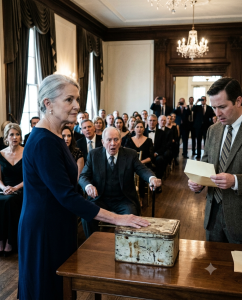
That was when Remy stood.
At first, no one paid attention. Then they noticed she wasn’t heading toward the exit. She walked calmly down the center aisle with the canvas tote over her arm and stopped at the auctioneer’s table.
She held out a sealed envelope.
Not new. Cream stationery, slightly softened with age. Her own name was written on the front in dark ink, but the handwriting belonged to Eugenia Arceneaux.
Gerald blinked. “Ma’am, I need a registration card for any—”
“Open it,” Remy said.
Something in her voice stopped him.
He took the envelope and looked, perhaps for the first time, directly at her face. Then he broke the seal and unfolded the paper inside.
He read once.
Then again.
His posture changed.
Conversations faded in pockets around the room as people sensed a disturbance before understanding it. Gerald looked from the page to Remy, then back to the page, then out at the assembled heirs, creditors, and buyers as if suddenly none of his prepared procedures applied.
“What is this?” someone called.
Remy didn’t answer.
Instead, she reached into the tote and lifted out the recipe tin. Even from across the room it looked humble—water-stained, dented, domestic. Nothing in its appearance justified the silence that fell when she set it on the table.
Then Henri Arceneaux stood up so abruptly his cane struck the floor.
“No,” he said.
The single word cracked across the ballroom.
Henri had been Luc’s older brother and, after their mother’s death, the man who acted as if the family itself were a title deed he had inherited. He was in his eighties now, broad through the shoulders but diminished around the eyes. Remy remembered him as handsome once, cruel in the easy way privileged men can be when no one has ever made them pay for it.
Gerald looked from Henri to the letter in his hand.
“Read it,” Remy said.
So he did.
The first document was a signed statement by Eugenia Arceneaux, dated and notarized three weeks before her death. In measured, unmistakable language, she declared that the contents of the tin included personal papers relating to an unrecorded property transfer and a corrective bequest she intended for Remy Thibodaux, widow of her son Luc. She further stated that the family had been informed, years earlier, of an irregularity in the estate structure and had chosen to ignore it.
The room erupted at once.
“What irregularity?”
“This is outrageous.”
“Who notarized that?”
“Cameras off—get those cameras off—”
Henri moved forward. “That paper was never filed. It has no standing.”
Gerald, still reading, lifted a hand for silence. “There is an instruction attached.”
A second page, also initialed by the late family attorney, directed that the tin remain sealed and in Remy Thibodaux’s possession unless and until any forced sale, liquidation, or partition of the Arceneaux estate occurred. At such time, and only in person, the documents inside were to be presented to the acting auctioneer, executor, or supervising legal authority.
Eugenia had anticipated this exact moment.
That realization changed the room more than the letter itself. What sort of woman had hidden a trigger inside a recipe tin and tied it to the public unraveling of her own family? The answer, Remy thought, was the same sort of woman who understood her sons perfectly.
Henri’s face had gone the color of wet paper. “Mother was manipulated at the end.”
Remy turned to him then, calm as still water. “By who?”
He said nothing.
Gerald removed the rubber band. It snapped softly against the table. He lifted the lid.
Inside, on top, were recipe cards after all—gumbo, fig preserves, oyster dressing, biscuits. Eugenia had not abandoned the disguise. But beneath the cards lay a packet tied with blue ribbon, a folded deed on yellowed paper, and a small leather notebook.
Gerald unfolded the deed.
His eyes widened. “This concerns the southern tract.”
There was a stir among the lawyers in the room. The southern tract was the most strategically valuable acreage remaining—river-adjacent, commercially desirable, long believed unquestionably part of the main family holdings.
The deed told a different story.
In 1968, Eugenia Arceneaux had directed family funds to purchase the tract through an intermediary company. The deed, however, named not Henri’s line and not the trust currently collapsing under debt, but Luc Arceneaux and his lawful spouse, with survivorship rights and a reversion clause triggered by concealment. Because the transfer had never been properly recorded, the land had continued to be represented as part of the broader Arceneaux portfolio. That misrepresentation now touched decades of tax filings, collateral agreements, and secured loans.
Someone near the front whispered, “My God.”
There were three signatures at the bottom: Eugenia’s, the intermediary seller’s, and Paul Broussard, the old family attorney who had sworn under oath years earlier that no such deed existed.
The leather notebook made things worse.
It was Eugenia’s hand again—dates, account numbers, amounts diverted, notes about “Henri’s interference,” and one line underlined twice: Luc insisted Remy be protected. If they punish him through her, release papers at liquidation.
Luc had known.
That was what punched the air out of Remy’s lungs, even after all these years. She took a step back and gripped the edge of the table as if the room had shifted under her. Luc had known his family might retaliate. He had tried to make provision anyway. Somehow he and Eugenia—unlikely allies if there ever were any—had built a trap that would only spring when the family was weak enough to be unable to bury it.
Henri recovered first, or tried to.
“This is fabricated,” he said, though his voice lacked force. “Old papers, private notes. Nothing more.”
One of the creditors’ attorneys was already on his feet, asking to inspect the deed. Another was on the phone. The reporters had abandoned all pretense and were filming openly now. Gerald looked like a man who had wandered into a thunderstorm while carrying a match.
Then the retired notary Remy had called that Thursday morning stepped through the ballroom doors.
Elias Boudreaux was eighty-six, stooped but sharp-eyed, with the deliberate pace of a man who had outlived enough rich people not to rush for them anymore. He raised one hand and announced, in a voice far steadier than Henri’s, that he had witnessed Eugenia Arceneaux execute the instruction letter and had retained a certified copy in his personal records after concerns were raised about the family’s attorney.
The room split open after that.
Lawyers clustered. Creditors demanded postponement. An heir fainted or pretended to. Gerald suspended the bidding on Lot Seven pending legal review. But the delay no longer mattered. The house had already changed hands in the one way that counted—not by sale, but by truth.
The next several months turned ugly in the expensive, paperwork-heavy way family collapses do. The deed was authenticated. The old attorney’s records were subpoenaed. Banking trails, once thought buried, resurfaced. The southern tract and associated rights were confirmed as having passed to Luc and then, by survivorship and the concealed reversion terms, to Remy. That single correction destabilized the structure supporting several Arceneaux obligations. Creditors howled. Heirs sued one another. Settlements were negotiated under seal and then leaked anyway.
In the end, Remy did not receive the entire Arceneaux estate, as gossip later exaggerated. But she received what had been denied her—and more importantly, what Luc had intended.
The southern tract, free and clear after litigation.
A substantial settlement tied to years of fraudulent concealment.
Formal acknowledgment in court that the original estate representations had been materially false.
Henri avoided criminal charges only because age, infirmity, and the death of key participants complicated prosecution. That did not save his reputation. In south Louisiana, being legally spared and socially believed are not the same thing.
Remy returned to Dulac with the same steadiness she had brought to Baton Rouge. The money repaired the church roof. It paid off Celeste’s old debts. It put three local kids through technical school on quiet scholarships that carried no family name. She kept her own house. She replaced the porch, redid the kitchen, and refused every suggestion that she move somewhere “finer.”
The tin stayed on the shelf.
This time, though, it sat open.
Celeste came by one afternoon and found her mother at the table, sorting the recipe cards into neat stacks.
“So they really were recipes,” Celeste said.
Remy smiled. “Mostly.”
She handed her daughter one card stained with age and butter. Eugenia’s handwriting filled the front with measurements for fig preserves. On the back, in smaller letters, one sentence had been added years later:
A woman doesn’t always win by speaking first.
Celeste sat down slowly. “Did you hate them all this time?”
Remy considered the question. Outside, the marsh wind pressed softly against the window screens. Somewhere down the road, somebody’s dog barked. Ordinary sounds. Honest sounds.
“No,” she said at last. “I hated what they thought I was.”
“And Eugenia?”
Remy looked at the open tin.
Eugenia had never apologized. Never defended her publicly. Never invited her in fully. Whatever existed between them was too complicated for simple names. But she had seen what the others were capable of. And in the only language that family truly respected—documents, timing, leverage—she had made sure the last laugh would not be theirs.
“I think,” Remy said, “she knew exactly who her sons were.”
The story spread, of course. First through Baton Rouge, then down the bayou, then everywhere people enjoy hearing that arrogance has an expiration date. Some versions made Remy a folk hero. Others made her a schemer who had played a long game. She ignored both. The truth was plainer. She had been humiliated. She had been underestimated. And she had been trusted, by the one person no one expected, to hold still until the right moment arrived.
Sometimes that is all power is.
Not noise. Not revenge. Just patience strong enough to outlive contempt.
On certain evenings, Celeste would find Remy in the kitchen with one of Eugenia’s cards propped beside the stove. Actual recipes now. Biscuits. Oyster dressing. Bread pudding. Dishes she had never made before because she had never let herself open the past.
“Any good?” Celeste asked the first time.
Remy tasted the sauce with the back of a spoon.
Then she gave the smallest smile.
“Would’ve been better,” she said, “if she’d used more garlic.”
That became the version Celeste loved most—not the courtroom filings, not the newspaper cameras, not the image of Henri Arceneaux turning ghost-pale in the ballroom. Just her mother, finally cooking from the tin everybody had called worthless.
Because that was the aftershock no headline captured.
The money mattered. The land mattered. The public correction mattered.
But the deepest thing restored to Remy was not wealth.
It was definition.
For twenty years, a roomful of powerful people had tried to decide who she was. A widow to dismiss. A wife to erase. A woman to laugh at because she came from the bayou and did not know their rules.
In the end, the thing that undid them had been sitting on her shelf all along, waiting under a rubber band in plain sight.
And maybe that was the sharpest judgment of all.
Not that the Arceneaux family lost their house.
But that they lost it because they mistook a quiet woman for a powerless one, a kitchen tin for trash, and a memory they had mocked for something that would never open again.