Sofía had learned early that survival could make almost anything feel normal.
A voice screaming your name from another room. A bucket of dirty water sloshing onto your shoes before dawn. Knees bruised from scrubbing stone floors in a house so huge your footsteps echoed back at you like you were trespassing in a museum. Hunger that made you lightheaded by noon. Fear that followed you from room to room and never quite left your shoulders.
At twenty, she was already tired in a way that had nothing to do with sleep.
The mansion where she worked sat on a hill above the rest of the city, all white columns, iron gates, and windows polished so perfectly they reflected the sky. People slowed their cars to stare at it. Tourists photographed it from the road. Inside, it smelled of lemon wax, cut flowers, and money.
To Sofía, it smelled like bleach and humiliation.
She worked there because she had run out of choices. Rent was late. Her savings were gone. The café that had been giving her occasional shifts closed without warning. A woman from the church knew someone who knew someone looking for a live-out cleaner to help in a private residence. The pay was terrible for the amount of work, but it was cash every week, and cash every week meant food, bus fare, and one more month with a roof over her head.
So she said yes before she even knew whose house it was.
On her first day, Victoria barely looked at her. She wore cream silk and diamonds at ten in the morning, with hair pinned so tightly it made her face seem sharp. Everything about her was immaculate except her eyes.
Those were hard.
“You will not touch anything in my bedroom unless I give direct permission,” she had said. “You will not speak unless spoken to. You will not make excuses. And if something goes missing, I will know who took it.”
Sofía remembered blinking at her, stunned.
“I don’t steal,” she had said quietly.
Victoria gave a faint smile that never reached her eyes. “They all say that.”
From then on, the pattern never changed. Victoria found fault in everything. A fingerprint on crystal. A towel folded the wrong way. A spoon in the wrong drawer. If a flower arrangement looked sparse, Sofía was blamed. If the dog tracked mud into the hall, Sofía was blamed. If Victoria was already angry before breakfast, she simply found Sofía and made sure the mood had somewhere to land.
The strangest part was how personal it felt.
Victoria didn’t look at her like an employee. She looked at her like an intrusion.
At first Sofía told herself it was class snobbery. Rich women like Victoria had probably spent years perfecting the art of making poor girls feel small. But after a few weeks, Sofía started noticing something else. Sometimes Victoria would stop in the middle of an insult and stare at her face too long. Once, passing in the hallway, Victoria had gone pale and snapped, “Tie your hair back. Immediately.”
Sofía had obeyed, confused. Her hair was dark, thick, and usually twisted into a low knot while she worked. That day a few strands had escaped around her face.
Another time she caught Victoria standing in the kitchen doorway while she polished silver. The older woman wasn’t speaking. She was just watching her with a strange, tight expression, as if trying to force down a memory.
Then the moment would pass and the cruelty would return.
Sofía endured it because she had always endured worse than people knew.
The orphanage had not been cruel in the dramatic ways people imagined. There had been no chains, no obvious monsters. Just scarcity. Too many children, not enough hands, not enough money, not enough answers. The nuns fed them, clothed them, and kept them alive, but affection was rationed like sugar. Questions were brushed aside. Some children had names written neatly in files, mothers who visited twice a year, fathers who sent money but never came. Sofía had almost nothing.
No parents on record. No family to call. No photograph. No note.
Only a small gold necklace.
It had been found with her when she arrived as an infant, wrapped in a blanket and handed over in the middle of the night. Sister Elena, the only nun who ever spoke to Sofía with softness, once told her, “Whoever left this with you meant for you to keep it. Some things are not accidents.”
The necklace was a thin gold chain with a tiny oval locket. It had grown fragile over the years, but Sofía kept it hidden under her shirt every day. She almost never removed it. When she was lonely, she touched it. When she was frightened, she held it in her fist until her palm grew warm. It was the only object in the world that belonged to her before she belonged to herself.
Sometimes she opened it and examined the inside. Time had worn away much of the detail, but there was an engraving there, something elegant and deliberate. She had always thought it might be a crest or symbol from some family she would never know.
She never imagined anyone else would recognize it.
The Tuesday everything changed began badly and kept getting worse.
The cook called in sick. A delivery man brought flowers to the wrong gate and left half of them wilting in the sun. Victoria spent the morning raging through the mansion as if everyone on the property had conspired to ruin her life personally.
By eleven, Sofía had cleaned the breakfast room, the front stairwell, and two upstairs bathrooms. By noon, she was on her knees in the kitchen, scrubbing beneath the marble island after one of Victoria’s imported preserves shattered on the floor.
Her shoulders throbbed. Her hands smelled like chemicals. She was thinking about whether she could stretch rice and beans for three more nights when she felt the chain catch.
A tiny snap.
She looked down just in time to see the necklace slide free beneath her collar. It struck the marble with a bright metallic sound and bounced once. The locket sprang open.
“No,” she whispered.
She dropped the rag and grabbed for it, panic flashing through her. The chain was old. She had repaired it once already with a borrowed clasp and a prayer. If it was broken for good, she had no money to fix it.
She picked it up carefully, fingers trembling.
And then Victoria walked in.
The older woman had been calling for her from somewhere on the first floor. The kitchen door swung open hard enough to strike the wall.
“There you are,” Victoria snapped. “How many times do I have to—”
She stopped.
Sofía looked up from where she knelt on the floor, the open locket in her hand.
The silence lasted only a second, but it changed the room completely.
Victoria’s face drained of color.
Not surprise. Not irritation. Terror.
Her lips parted. Her eyes fastened onto the gold locket as if it had risen from the dead. One hand went to the edge of the counter to steady herself.
Sofía straightened slowly. “Ma’am?”
Victoria took a step forward. “Where did you get that?”
Sofía’s confusion deepened. “It’s mine.”
Something violent flashed across Victoria’s face. “Don’t lie to me.”
“I’m not lying. I’ve had it since I was little.”
Victoria’s whole body started trembling.
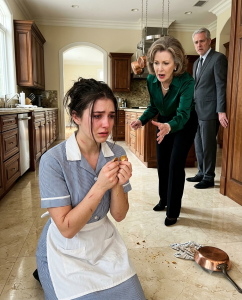
“Thieving little rat!” she shouted. “Where did you get that?”
Sofía stood, instinctively clutching the necklace to her chest. “It’s mine, ma’am, I swear—”
Victoria lunged.
Later, Sofía would replay that moment in her head again and again, unable to decide which part terrified her most: the fury itself, or the certainty that it came from panic. Victoria wasn’t attacking to punish her. She was attacking to erase evidence.
Her nails raked down Sofía’s arms. One hand clawed for the chain. Sofía stumbled backward, gasping.
“Give it to me!”
“You’re hurting me!”
Victoria grabbed at her throat. Sofía twisted away, but pain burned across her neck. A saucepan crashed to the floor. A bowl shattered. Sofía tried to shield the locket with both hands, crying out as Victoria dragged her by the sleeve.
“It’s mine!” Sofía screamed.
The chaos rang through the house.
A door upstairs slammed.
Heavy footsteps thundered down the staircase.
Alejandro entered the kitchen with murder in his face.
He was a tall man in his early fifties, still imposing despite the streaks of gray at his temples. Sofía had seen him only in passing—coming and going in dark suits, absorbed in phone calls, carrying the detached arrogance of a man used to owning every room he entered. His reputation in the city was enormous. People called him brilliant, ruthless, untouchable.
He took in the overturned chair, the broken dishware, his wife disheveled, Sofía pressed against the counter with tears on her face.
“What is this?” he barked.
Victoria released Sofía at once. “This girl—”
But Alejandro wasn’t listening.
His eyes had found the floor.
In the struggle, the locket had fallen again. It lay open on the marble, the chain twisted around itself, the small gold surface catching the light.
Alejandro stopped moving.
For a long moment, no one breathed.
Then he walked toward it with a strange stiffness, as if his body had forgotten how. He bent down, but before he could touch it, his hands began to shake. He looked up at Sofía, then at Victoria, then back to the locket.
And his knees gave out beneath him.
Victoria gasped. Sofía stared, frozen.
Alejandro sank to the floor and picked up the necklace with trembling fingers. When he opened the locket fully, a broken sound escaped his throat.
“That necklace…” he whispered. “It was my daughter’s.”
Sofía felt the room tilt.
Alejandro looked like a man seeing a ghost wearing a shape he almost recognized. Tears spilled down his face unchecked. “They told me she died twenty years ago.”
Sofía could not speak.
Victoria could.
She turned and bolted toward the service door.
That movement told Alejandro everything.
He surged up, grief turning sharp in an instant, and caught her by the arm before she reached the handle. “No,” he said. It was not loud, but the word cracked through the room like a whip. “You do not leave.”
“Alejandro, let go of me.”
“Where did she get this?”
Victoria jerked against his grip. “How should I know? She probably stole it—”
“From where?” he demanded. “From whom? There is no second one.”
He opened the locket with shaking fingers and stared inside. The tiny engraving, worn almost smooth with time, caught under his thumb. “I designed this. There was a crest placed inside. Hidden. It was custom made.”
He looked at Sofía then—really looked at her.
At her dark hair. Her eyes. The line of her jaw. Features he might once have seen in a crib and then buried in memory under twenty years of grief.
Sofía felt exposed down to the bone.
“What is happening?” she asked, voice barely audible.
Neither answered immediately.
Victoria’s face had become something ugly and cornered. “This proves nothing,” she said.
Alejandro swung toward her. “You told me our child died in the accident.”
“She was gone!”
“You said there was no chance of survival.”
“There wasn’t.”
“Then why are you trying to run?”
Silence.
Sofía pressed one hand to the scratches on her neck. Every instinct told her to leave, to get out before these rich, dangerous people swallowed her whole. But she couldn’t move. Not when her whole life might be standing, shivering and furious, in the center of that kitchen.
“Alejandro,” Victoria said, shifting tactics, softening her voice. “You’re emotional. You’re seeing what you want to see.”
He stared at her as if he no longer knew her.
“My daughter was in a car with you,” he said slowly. “The car crashed. I was told the fire made identification impossible. I was told there was nothing left to save. I was told to mourn.”
Victoria’s mouth tightened.
Sofía whispered, “I grew up in an orphanage.”
Both adults looked at her.
“I had this necklace when I arrived,” she said. “They said it came with me. No one ever told me who my parents were.”
Alejandro shut his eyes.
When he opened them again, there was devastation there—and something almost worse. Suspicion.
He turned back to Victoria. “Tell me the truth.”
She laughed once, a sharp, broken sound. “The truth? After twenty years, that is what you want from me?”
“Yes.”
Victoria’s eyes glittered. “Be careful. You may not survive hearing it.”
Alejandro did not blink. “Say it.”
For a second Sofía thought Victoria still might deny everything. That she would cling to the lie and force them all to drown in doubt. But something in her shifted. Maybe she understood the locket had ended the game. Maybe she was too proud to beg. Maybe she had spent two decades carrying something too poisonous to hold any longer.
She looked at Sofía first.
Not with disgust this time. With naked hatred.
Then she said, “The baby never died in the crash.”
The words punched the air from the room.
Alejandro’s face went white.
Sofía gripped the edge of the counter to stay upright.
Victoria continued, voice low and cold. “The crash was real. The fire was real. But when I pulled her from the back seat, she was alive.”
Alejandro made a sound somewhere between a gasp and a groan. “You told me—”
“I know what I told you.”
“Why?” he shouted.
Victoria flinched, but only for an instant. “Because by then I understood what your precious daughter meant.”
Alejandro stared.
Victoria’s expression sharpened into bitterness. “She meant the end of any life that belonged to me.”
The pieces still did not fit for Sofía, but they were moving now, and fast.
Alejandro’s voice shook. “She was our child.”
Victoria’s smile was horrible. “Was she?”
The kitchen went silent again.
Sofía blinked. Alejandro looked as if he had been struck.
Victoria saw it and pressed on.
“You want truth? Fine. Let’s tell all of it.” She turned toward Sofía but spoke to Alejandro. “She wasn’t the only one in that car that night.”
Alejandro’s face drained further.
Sofía’s pulse hammered in her ears. “What does that mean?”
Victoria laughed again, softer now, almost pitying. “It means your husband knows more than he is admitting.”
Alejandro shouted her name, but she no longer seemed afraid of him. Cornered people sometimes became fearless.
“You told me the child threatened your legacy,” Victoria said. “You told me if certain people discovered the timing, the dates, the inheritance arrangements, everything would collapse. You told me to fix it.”
Sofía looked from one to the other, dizzy.
Alejandro’s voice dropped to a hoarse whisper. “Stop.”
Victoria didn’t.
“The baby was proof,” she said. “Proof that before our marriage was even public, you had already tangled your life with someone else. Someone whose family would have ruined you, and ruined me with you. I was the one expected to smile while the city gossiped behind velvet curtains.”
Alejandro’s hands curled into fists. “I told you to handle the scandal, not murder a child.”
Victoria’s eyes flashed. “And yet here we are.”
Sofía felt ice spread through her chest.
So there had been another woman. Another family. Secrets buried under money. A child—her—caught inside them.
Alejandro turned to Sofía with such misery in his face that she took a step back. “I didn’t know what she had done,” he said. “I swear to you, I didn’t.”
But Victoria cut in. “No. You only made it possible.”
The next hour came apart in pieces.
Alejandro called his attorney, then the police, then a retired physician whose name made Victoria finally lose composure. The old doctor had signed the original documents after the crash. He arrived before the authorities did, pale and sweating, and one look at the locket told Sofía he had been carrying fear for years.
Under questioning, the story spilled out in fragments no one could stop.
The crash had happened on a mountain road during a storm. The driver lost control. The car rolled. Victoria survived with minor injuries. The baby—Sofía—was found alive. Bruised, crying, but alive.
Victoria had made a decision on that roadside.
No ambulance records would mention the child. No hospital would receive her under the family name. Instead, Victoria paid the driver and later the doctor to sign papers stating the infant had died from injuries sustained in the crash and that fire damage prevented viewing. Alejandro, away on business and already trapped in a web of personal scandal, accepted what he was told because the alternative was unthinkable.
The child was handed off through intermediaries and left where someone would find her.
At an orphanage.
By the time Alejandro returned and demanded details, the arrangements were complete, the records sealed, the cemetery prepared, the grief staged.
He buried a small white coffin with no daughter inside it.
When Sofía heard that, she sat down on the kitchen floor because her legs no longer worked.
She wanted to hate him instantly. Part of her did. He had been powerful enough to question everything, and he hadn’t. He had believed the version of events that was easiest to survive. Yet the devastation on his face looked real, and real pain did not erase guilt, but it complicated it in ways she was too shattered to sort through.
Victoria was arrested before midnight.
As officers led her out, she stopped in the foyer and turned toward Sofía one last time.
“You think this ends well for you?” she said quietly. “You think blood fixes what was broken?”
Sofía did not answer.
Victoria smiled with venom. “He lost you once because he chose ambition over truth. Do not expect him to be better now.”
Then she was gone.
The mansion fell into a silence so heavy it seemed to press down on the walls.
Alejandro stood in the library later that night with the gold locket in his hand. For the first time, without Victoria there, the house looked less grand than lonely.
“I searched for answers in the beginning,” he told Sofía. “Not enough. Not long enough. That is on me.” He swallowed hard. “Nothing I say can repair that.”
Sofía looked at him across a room filled with books and portraits of people whose names she did not know. “Why was I hidden?”
He did not lie anymore.
“Because I was a coward,” he said. “Because my life was built on image, power, and promises to people who cared about legacy more than love. By the time the crash happened, too many things had already been concealed. I thought I could contain disaster. Victoria turned that weakness into something monstrous.”
Sofía’s throat tightened. “So I was inconvenient.”
His eyes filled. “You were innocent. That should have mattered more than anything.”
It should have.
The weeks that followed were ugly. Police reports. DNA testing. Lawyers. Headlines. A city that had once admired the couple now fed on every secret that emerged. The results confirmed what the locket had already told them: Alejandro was her biological father.
The woman who had given birth to Sofía had died years earlier. Sofía learned her name from sealed records and said it aloud in private until it stopped feeling foreign. She learned there had once been plans, arguments, pressures from wealthy families, and a desperate attempt to hide scandal behind a respectable marriage.
She also learned that no revelation could give back a stolen childhood.
Alejandro offered her everything money could offer—housing, education, medical care, access to records, the kind of security she had never known. Sofía accepted some of it and rejected the rest. She would not move into the mansion. She would not instantly become a daughter because blood and sorrow said so.
Trust was not inherited.
It was built, if it could be built at all.
Months later, she visited the orphanage with repaired papers and a new copy of the old records. Sister Elena, now retired and frail, cried when she saw the locket.
“I always believed it meant something,” the older woman said.
“It did,” Sofía answered.
She donated money anonymously to repair the dormitory roof and replace broken windows. Not because wealth suddenly made her generous, but because she knew exactly what it felt like to grow up in a place where everything important had to last longer than it should.
As for Alejandro, he kept showing up. Not with grand speeches. Not with expensive gifts. With questions, apologies, and a willingness to hear anger without defending himself. Sometimes Sofía sent him away. Sometimes she let him stay for coffee. Once, when he asked what she remembered most from childhood, she told him the truth: “Feeling like I belonged to a story no one would tell me.”
He cried quietly at that.
Victoria went to trial. The city watched every moment. The driver testified. The doctor testified. The lies collapsed one by one under the weight of time, greed, and paper trails no one had fully erased. Victoria’s defense tried to paint her as unstable, jealous, manipulated. Maybe she had been all three. None of it changed what she did.
When the verdict came, Sofía did not feel triumph.
She felt tired.
Justice, she discovered, did not sound like a gavel. It sounded like the end of one lie and the beginning of a hundred painful truths.
On the first anniversary of the trial, Sofía stood alone in front of the small cemetery plot where Alejandro had once buried the empty coffin. There was no body there, only a stone and years of misplaced grief. She touched the top of it gently, then opened the gold locket.
The engraving inside had been professionally restored now. A crest. Elegant. Delicate. Once hidden, now visible.
She closed it again and slipped it back around her neck.
For most of her life, that necklace had been a mystery. Then it became proof. Then evidence. Then a weapon that split open a house built on secrets.
Now it was something else.
A beginning.
She was not the helpless child Victoria had discarded. She was not the servant girl scrubbing floors while her past walked the halls pretending not to know her. She was not even only Alejandro’s lost daughter.
She was Sofía.
And maybe that was the strangest part of all. After everything—the lies, the theft of twenty years, the mother she never knew, the father she might someday forgive, the woman who tried to erase her existence—the biggest question left was not who she had been.
It was who she wanted to become now that no one else could decide for her.
Some people would say blood won in the end. Others would say money buried the truth until it could not anymore. Others would blame Victoria alone, as if monsters are born in isolation and never fed by the cowardice around them.
Sofía knew better.
The biggest red flag had never been Victoria’s cruelty, though there had been plenty of that. It had been how easily everyone with power accepted a story that made a child disappear.
That was the part she could never forget.
And maybe that was also why forgiveness, if it ever came, would have to be earned in the only currency that mattered now:
Not tears.
Not wealth.
Not blood.
The truth, told before it is too late.