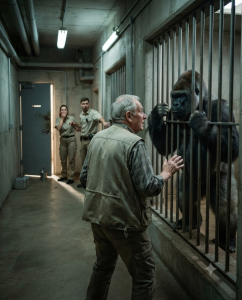
When Henry returned to the zoo after eight years away, he expected many things.
He expected the corridors to feel smaller than he remembered. He expected the younger staff to look at him with polite curiosity. He expected the old ache in his chest that always came when memory collided with time.
What he did not expect was fear.
Not his own.
Max’s.
The morning Henry decided to go back, the sky was pale and cloudy, the kind of quiet morning that made old men think too much. He had woken before dawn with the same thought that had haunted him for years: If I don’t go now, I may never go at all.
He moved slowly through his house, pausing more often than he would admit. In the bedroom wardrobe, behind winter coats he no longer wore, hung the old khaki keeper’s vest. He stared at it before touching it, as if it belonged to someone else. The fabric smelled faintly of cedar and dust. One seam had been repaired by hand years ago. There was still a faded pen mark near the breast pocket from a long-forgotten shift report.
He slipped it on carefully.
Then he opened the drawer where he kept the photograph.
It was one of his favorites: Max at perhaps four years old, not a baby anymore but still soft-faced and bright-eyed, one hand wrapped around a bar while Henry crouched beside the enclosure grinning as if nothing in life could ever go wrong. Henry had carried that picture through hospital stays, birthdays spent alone, nights when the silence in the house seemed too big.
He tucked it into his pocket and looked in the mirror.
Age had changed him more than he liked to admit. His face had fallen inward. His hands shook slightly at rest. His shoulders bent forward in a way they never used to. But the vest did something strange to him. For a second, he saw not a frail retiree but the man who had mattered to something.
To someone.
He didn’t tell his daughter he was going. She would have worried. She worried about everything now—the stairs, his medicine, his balance, his lungs. Henry had grown tired of being handled like glass.
At the zoo entrance, almost nothing looked familiar. The ticket booths were newer. The pathways wider. Bright signs with modern logos stood where weathered boards once had. Children laughed in the distance. Somewhere, a peacock cried.
Henry went through the staff entrance after identifying himself twice. The young woman at the desk blinked when he gave his name, then smiled with the startled politeness of someone who had heard stories but never expected the storyteller to walk in.
“Mr. Collins? Henry Collins?”
He nodded.
Her face brightened. “I’ve heard about you from Martin. He said you practically lived here.”
Henry gave a faint smile. “Some weeks, I did.”
Another staff member escorted him down the service corridor toward the primate wing. Along the way, two more employees were introduced. They were kind, but to Henry they felt distant, as if he were being guided through a museum of his own life.
Then they turned the corner.
And there it was.
Max’s enclosure was larger than the old one, with reinforced barriers, elevated platforms, climbing structures, and a transfer system connected to the back corridor for cleaning and medical access. The sight of it should have made Henry happy. Better conditions, more space, improved safety.
Instead, he barely noticed any of it.
Because Max was inside.
The gorilla sat near the middle of the enclosure, vast and dark and motionless. Time had transformed him into something almost mythic. The tiny, trembling infant Henry once held a bottle for was now a silverback with immense shoulders and a scar near one temple Henry didn’t remember. His presence changed the air.
One of the employees lowered her voice. “He’s usually wary with people he doesn’t know.”
Henry almost laughed at the phrase.
People he doesn’t know.
He stepped forward.
Max turned.
Their eyes met.
Everything inside Henry tightened so hard he thought his chest might fail him on the spot. He had imagined this moment for years. In some versions, Max ignored him. In others, he approached gently, perhaps recognizing something buried beneath age and absence. Never once had Henry imagined that he himself would look away first.
But he didn’t.
“Max,” he said softly. “It’s me.”
The corridor held still.
Then Henry took one small step closer.
Max lunged to his feet.
Gasps scattered behind Henry. He heard the click of a radio being unclipped. The young woman by the wall took two quick steps back. But Henry remained where he was, because there had been no hatred in Max’s movement.
Only urgency.
Max came to the front, slammed a fist against the bars, and stared at Henry with such force it felt like being physically pushed. Then he hit the bars again, wheeled away, gave a deep warning call, and rushed back.
“Sir, I think you should step away,” one of the keepers said.
Henry shook his head.
Because memory arrived in him all at once.
Years ago, during a storm, a section of roofing had come loose above the old primate house. Before any of the humans noticed, Max had begun pacing and calling in the same agitated rhythm. Henry had evacuated the area minutes before part of the structure crashed down.
Another time, a sedated animal in a neighboring unit had gone into respiratory distress. Max had reacted long before the monitors signaled trouble, becoming restless and fixed on the service gate until the veterinarians realized something was wrong.
Max had never behaved like this without cause.
And this was not aggression.
It was warning.
“No,” Henry said, more to himself than to the staff. “He’s trying to tell us something.”
The younger employees exchanged uncertain looks. One seemed ready to object when Max abruptly spun toward the closed service door at the end of the corridor. It was part of the transfer access system, used only by authorized staff when moving animals between secure sections.
The door should have been locked.
Max’s entire body hardened.
He emitted a low sound that rattled through Henry’s ribs.
Everyone looked at the door.
Nothing happened for a beat.
Then came a metallic scrape from the other side.
The change in the corridor was instant. Curiosity became tension. Tension became fear.
“What was that?” the desk employee whispered.
No one answered.
A senior keeper named Martin, who had joined the scene halfway through the reunion, frowned and stepped closer to inspect the corridor layout. “That access should be clear,” he said. “No transfers today.”
Another sound came—this time a faint clink, then what sounded like something dragged across concrete.
Max struck the bars again with thunderous force.
Henry’s pulse accelerated. Not because of the sound behind the door, but because of Max’s reaction to it. The gorilla wasn’t only alert. He was desperate. Each time Henry shifted his weight forward, Max planted himself in front of him again, physically blocking the line between Henry and the service passage.
The old man understood then with a chilling certainty: Max had recognized him immediately. He had known him at once.
And the first thing he had tried to do was keep him safe.
Martin signaled for silence and moved cautiously toward the door. Another keeper finally managed to press his radio and called for security in a voice that was lower and tighter than normal.
The handle moved.
Everyone froze.
It turned halfway, stopped, then twitched again as if whoever was behind it was testing whether the corridor was occupied.
Max gave a sudden explosive bark and pounded the barrier.
Martin took one step back. “Who’s in there?” he called.
No answer.
A younger employee whispered, “Should we open it?”
“No,” Martin said. “No one touches that door.”
But the door touched itself.
Very slowly, it shifted inward by less than an inch.
Through the gap, Henry saw darkness. Then a sleeve. Then the edge of a gloved hand retreating out of view.
Martin’s face changed.
“Everybody back,” he said sharply.
No one obeyed fast enough.
The door opened another inch, and something small rolled through the gap onto the concrete floor of the corridor.
A syringe.
The world seemed to narrow to that single object.
One of the employees made a choking sound. Another muttered, “Oh my God.”
Martin bent just enough to see without approaching. “Do not touch it.”
Henry felt cold spread through his arms.
Tranquilizer.
Or worse.
The implications arrived all at once. Someone had entered a restricted transfer access behind the gorilla enclosure. Someone had brought a syringe. Someone had tampered with a secondary lock visible now near the frame, its cover plate half loosened. This wasn’t an accident. It wasn’t a maintenance issue. It was a person hiding where no one should be.
And Max had known.
Security arrived within moments, though to Henry it felt like much longer. Two officers took positions along the corridor while Martin explained in clipped phrases. The door remained partly open, but whoever stood behind it didn’t come out.
“Sir,” one officer called, “step into the corridor with your hands where I can see them.”
A man emerged slowly.
He wore maintenance overalls, but something about him was wrong. Henry couldn’t place it at first. Then he realized the uniform was old—an outdated version the zoo hadn’t used in years. The badge clipped to his chest was turned inward. He had gloves on both hands. In one hand he held a compact metal tool. His expression was tight and calculating, not startled like an employee caught somewhere he wasn’t supposed to be, but angry to have been interrupted.
The officer repeated the command.
The man hesitated.
Max roared.
It was such a vast, explosive sound that even the security officers flinched. The fake maintenance worker glanced toward the enclosure, and in that instant Henry saw it plainly on his face: not fear of the animal, but frustration. He had been close to finishing something.
That realization was somehow worse.
The officers moved in. The man tried to step back into the service access, but there was nowhere to go. One officer pinned him against the wall while the other took the tool from his hand. A third employee, breathless from running, arrived and identified the uniform as one that had gone missing from storage weeks earlier.
“What was he doing?” the young woman whispered.
Martin didn’t answer immediately. He peered through the service opening with a flashlight. What he saw made him go still.
“There’s another syringe back here,” he said quietly. “And meat.”
Henry stared. “Meat?”
“Drugged, probably.”
No one in the corridor spoke.
The plan became horrifyingly clear. The man had somehow entered the transfer passage to lure Max toward the interior gate, likely to sedate him. Whether it was for theft, trafficking, black-market animal trade, or something else, no one knew yet. But it was planned. The tampered lock, the disguise, the tranquilizers—it had all been arranged.
And the only reason it failed when it did was because Henry had arrived.
Or rather, because Max had seen Henry arrive and reacted instantly.
Max hadn’t wanted Henry near the front of the enclosure because the service corridor behind that door created a dangerous angle. If the intruder had panicked, or if the animal had been provoked, or if some part of the locking system had been compromised, Henry could have been directly in harm’s way.
The gorilla had understood the danger before any human in the hallway did.
Security led the man away in restraints while staff stood in stunned silence. Someone began crying softly. Someone else kept repeating, “I can’t believe this,” under their breath. Martin was already on the radio with administration, veterinary staff, and police.
Through all of it, Max remained at the barrier.
Watching Henry.
Not the others.
Henry stepped forward once the security officers gave the all-clear and Martin confirmed the enclosure itself was secure. This time, Max didn’t slam the bars. He didn’t pace. He simply stood there breathing hard, eyes locked on the old man’s face as if checking, over and over, that he was still unharmed.
Henry’s throat tightened.
“You remembered,” he said.
Max made a low sound, quieter now.
Henry raised a trembling hand to the bars.
For a moment, nothing happened.
Then Max extended his own hand—not all the way, not in the careless way of youth, but slowly, deliberately, until his fingers curled around the space between the metal.
Henry placed his hand there too.
The younger employees who had been frightened minutes earlier stood motionless, watching a bond older than most of their careers reappear in complete silence.
Martin exhaled a laugh that sounded almost broken. “Well,” he murmured, “that answers that.”
Henry smiled, and to his embarrassment tears blurred his vision. “He used to do this,” he whispered. “When he wanted me to stay.”
Max stayed that way for nearly a full minute, hand against the barrier, eyes calm now but still searching Henry’s face. The agitation slowly drained from his body. His shoulders lowered. His breathing steadied.
One of the vets arrived and began coordinating a full check of the access system. Police took statements. Administrators whispered in tense circles about security failures, public relations, possible criminal charges. By afternoon the entire zoo knew what had happened. By evening, local authorities had confirmed that the intruder was not a current employee at all but a former contractor with a record of illegal exotic animal dealings under investigation in another state.
He had entered through a service route before shift turnover, hidden in restricted access, and prepared to sedate Max during a vulnerable window.
He never got the chance.
Because Max saw Henry.
And because, instead of rushing to greet the man he loved, the gorilla chose to warn him first.
In the days that followed, the story spread far beyond the zoo. Reporters called. Security policies were reviewed. The staff who had been there retold the moment again and again: the reunion, the shock, the pounding on the bars, the strange sounds from behind the door, the realization that what looked like aggression had actually been protection.
Henry returned three days later.
And then again the week after.
Soon, visiting Max became part of his life once more.
The younger staff stopped seeing him as a retired keeper from old stories. They started asking him questions—about Max as a baby, about animal behavior, about the signs they missed that day and the ones they should never miss again. Henry answered patiently. Sometimes he sat outside the enclosure for an hour saying almost nothing at all while Max rested nearby, watchful and calm.
Their years apart had changed things, but not the thing that mattered most.
Trust had survived absence.
Recognition had survived age.
Love, in its own strange durable form, had survived everything.
Months later, after the legal case against the intruder had begun, one journalist asked Henry the question everyone seemed to ask eventually.
“Do you think Max really knew you were in danger?”
Henry looked through the glass where Max sat in afternoon light, large hand folded over one knee, gaze steady as ever.
“I know he knew,” Henry said.
The journalist hesitated. “How can you be sure?”
Henry smiled faintly.
“Because if he’d only wanted to protect himself,” he said, “he would’ve moved away from the bars. Instead, he stood between me and the danger.”
That was the part that stayed with people. Not just that an animal recognized a man after eight years. Not just that he remembered being loved.
It was that, in the first moment of reunion, Max didn’t think about what he had missed or what he wanted back. He thought about the person who once stayed beside him when he was helpless—and did everything he could to keep that person safe.
Some people who heard the story called it instinct.
Others called it loyalty.
A few said it was proof animals understand more than humans like to admit.
Henry never argued with any of them.
But on quiet afternoons, when he sat near the enclosure and Max settled close by, he sometimes wondered whether the biggest red flag that day hadn’t been the tampered lock or the hidden syringe.
Maybe it was how quickly the humans were ready to misread fear as violence.
Max had been trying to tell them the truth from the very beginning.
Only one old man knew him well enough to listen.