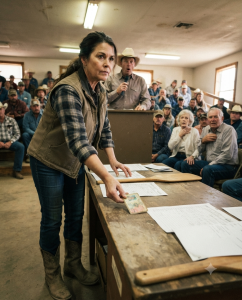
She walked into the auction house in Tulsa wearing dusty boots and a look on her face that made the room go quiet.
That was unusual enough.
The Granger Ranch Annual Cattle Auction had always drawn a crowd that knew exactly who belonged and who didn’t. Ranchers, bankers, lawyers, widows holding old grudges, men in pressed shirts pretending they weren’t worried about interest rates, women with perfect hair and sharper memories than they let on. It was half business, half theater, and everyone understood the roles.
So when a woman no one immediately recognized stepped through the double doors dressed plain as weathered wood and took a seat in the third row without greeting a soul, people noticed.
They just didn’t understand why.
Luanne Draper had counted on that.
Twelve years earlier, she had been one of the easiest people in the room to dismiss.
Back then, she was still spoken of in relation to someone else. Dale Granger’s ex-wife. The woman who hadn’t lasted. The one who never quite fit the Granger family image of legacy and polish, despite having done more honest work around the ranch than most people who wore the name. By the time the marriage ended, the public story had already been written for her: she was the disposable chapter before the prettier, louder sequel.
And Tiffany had made sure everyone knew it.
Luanne still remembered the exact smell of that day years before. Dust. Coffee. Leather. Perfume too sweet for morning. She remembered standing near the sale sheets in borrowed pearl-snap jeans because she didn’t own anything people in that room would have approved of. She remembered trying to keep her face neutral while pretending to study lot numbers she could never afford.
Then Tiffany leaned toward a friend and said, loud enough for three rows to hear, “The help doesn’t bid, sweetheart.”
The laughter that followed was controlled, almost civilized.
That was what made it cruel.
Not one person stepped in. Not Dale. Not his father. Not the women who later liked to call themselves church ladies. Everyone simply let the moment happen, as though humiliation was a harmless local custom.
Luanne had placed one hand against the left side of her boot, checking for the thing tucked inside, and walked out without giving the room so much as a backward glance.
When she left Tulsa for good, she had thirty-eight dollars, a borrowed truck, and a laminated business card hidden in that same boot.
The card had come from a stranger outside a diner three days before the auction.
She had gone there because it was cheap and because the waitress refilled coffee even when a customer looked too distracted to drink it. Luanne had sat in the shade near the gravel lot after paying, staring at the truck she wasn’t sure would make it another hundred miles. Her life felt smaller than it ever had. Her marriage was finished, her reputation had been flattened into gossip, and the little practical future she’d tried to build around the Grangers had collapsed with no apology from anyone who had benefited from her labor.
A man she had never seen before stepped out of a pickup and paused when he noticed her.
He was older, not flashy, dressed like someone who did not need to announce his money to prove it existed. He looked at her a moment longer than strangers usually do, then handed her a card.
“Call me if you ever get serious,” he said.
That was all.
No explanation.
No pitch.
Just a name, a number, and a look that stayed with her.
She didn’t call him right away. Pride stopped her at first. Then exhaustion. Then the daily chaos of surviving with too little money and too much anger. But she could not make herself throw the card away. On her way out of Oklahoma, she stopped in Oklahoma City, walked into a Kinko’s, and paid to have the card laminated. She counted out coins on the counter while the clerk watched without expression. When she got back to the truck, she slid the card inside her left boot.
It stayed there for years.
Luanne didn’t become successful all at once. The people who later described her rise as luck had not seen the beginning.
The first land she leased in east Texas was the kind of place people had already given up on. Thin grass. Poor drainage. Broken fencing. Soil that looked dead until she started studying it properly. She took on ugly work because ugly work came cheap. She fixed what she could with her own hands and bartered for help when she couldn’t. She slept in a trailer that groaned in every storm. She learned to read weather patterns, water movement, and pasture fatigue. She learned which men lied because they were greedy and which lied because they were desperate. She learned that a woman in boots could be underestimated into opportunity.
A drought year nearly ended everything.
Her lease payments were due. Feed costs climbed. Water had to be hauled in. Cattle dropped weight. Two neighboring operations folded. Luanne spent nights with ledgers spread across a table, trying to make numbers cooperate when they clearly hated each other.
That was the year she finally called the number.
The man answered on the second ring.
He remembered her.
That surprised her more than anything.
He asked a series of questions she did not understand at first. About acreage. Debt structure. Water rights. Mineral rights. County records. Title history. He listened without interrupting, and at the end he said, “Good. Now you’re serious.”
His name was Russell Vance.
To most of Oklahoma and north Texas, Russell Vance was a private investor with old energy money, a reputation for buying what everyone else had mispriced, and a talent for staying out of newspapers. To people who had done business with the Grangers twenty years earlier, he was something else too: the man Jasper Granger had crossed once and never fully shaken.
What Luanne did not know back then was that Russell had recognized her name at the diner because Jasper Granger had mentioned her years earlier in a conversation over whiskey and bad land. Not kindly. Jasper had spoken of her as though she were useful but temporary, a woman with more instinct than status. Russell remembered that because Jasper rarely respected anyone he could not control.
Over the next several years, Russell did not hand Luanne success. He did something more valuable. He forced her to think like an owner, not a survivor. He financed selectively, advised rarely, and said no often. When she wanted to rush, he made her wait. When she wanted to prove herself, he made her calculate. He taught her to look past the surface value of land toward what hidden pressure, bad management, poor timing, or quiet legal trouble had done to its price.
The card in her boot became a ritual.
Every major decision, she touched it once.
Buy or walk.
Trust or refuse.
Speak or stay silent.
She made mistakes, but never the same one twice.
Within a decade, she controlled more land than anyone back in Tulsa would have believed possible. Her banking shifted from local to private. Her attorney stopped being surprised. Men who once would have spoken over her started waiting for her answer before they showed their own cards.
Still, she never mentioned Russell’s name publicly.
That secrecy was partly loyalty, partly strategy.
And partly because of what Russell told her three years before he died.
He called her to his office one winter afternoon and handed her an envelope thick with copies of old documents. His breathing was shallow by then, his voice rougher than she remembered from the diner years before.
“If the Granger place ever comes apart,” he said, “you’re the one I want there.”
Luanne frowned. “Why me?”
He studied her for a long moment.
“Because Jasper wronged you in public,” he said. “But that isn’t the worst thing he did.”
Then he told her the story.
In the late 1990s, Jasper Granger had used a network of shell agreements and pressure tactics to acquire a key access parcel and related grazing rights from a widowed neighbor during a year when her finances were collapsing. The paperwork was technically legal, but only because one set of disclosures had been withheld from the county filing and another side agreement had been buried. Russell knew because he had been in the room when Jasper bragged about it, and because Jasper, drunk on his own cleverness, had once shown him a note he kept as proof that the deal could never be challenged if the original document stayed hidden.
The widow died within two years.
Her nephew fought and lost.
The Grangers folded the land into their operation and built part of their long-term valuation on it.
Russell, disgusted but too calculating in those years to intervene, kept copies later when the chance arose. It was one of the few things in his life he considered a moral debt.
There was more.
The hidden parcel had eventually been tied to water access and a transport route that materially inflated the operational value of the entire Granger Ranch. If the estate sale ever represented the ranch as a clean, unified property without disclosing the contested title history and side agreement, it could trigger serious legal review.
“Jasper knew it,” Russell told her. “And before he died, I suspect he made Dale responsible for keeping it buried.”
Luanne stared at the documents.
“Why didn’t you expose it yourself?”
Russell gave a tired, humorless smile. “Because men like me always think there’ll be time later to fix what we were willing to benefit from earlier.”
He slid a card across the desk. The same design as the one she carried.
On the back, he wrote a note in his own hand.
If the Granger Ranch is ever auctioned as a full clean package, present this card and attached record before final hammer. Jasper Granger knew why.
Then he signed it.
A year later, Russell Vance was dead.
Luanne never told anyone what she had.
She only added the note, folded tight, behind the laminated card in her boot.
When Jasper Granger died two springs later and the family finances began unraveling, Luanne watched from a distance. Dale, never as disciplined as his father, borrowed against reputation as though it were collateral. He expanded at the wrong time, trusted the wrong lender, and made side deals with money that did not fully belong to him. Court scrutiny followed. Quietly at first. Then less quietly.
By the time the Granger estate was forced into sale, Luanne was ready.
She registered late, under her full legal name, knowing almost no one in Tulsa associated Draper with power anymore. She drove in herself. Wore the same old style of boots. Carried no visible show of money. She wanted the room to underestimate her one more time.
The auction began at ten.
It narrowed by ten-forty.
Luanne could feel recognition moving through the room in little waves. One whisper. One stare. One second look. Dale sat in the back row with Tiffany beside him, both looking older in the particular way stress ages people unevenly. Tiffany still held herself like someone who believed posture could overpower truth. But when she finally recognized Luanne, a flicker of alarm crossed her face before she could hide it.
The bidding reached the final stage.
One bidder dropped.
Then another.
Then another.
At last only Luanne remained.
Gary Potts, the auctioneer, began the final call on the full property package. He had presided over Granger events for nineteen years. He knew the family history, at least the public parts. He also knew enough county rumor to sense when a room was about to turn dangerous.
That was when Luanne stood.
She reached into her left boot and removed the laminated card.
The movement alone drew the room into silence.
She walked to the front and laid it face-up on the registration table.
Gary looked down, ready to be irritated by the interruption.
Instead, his expression emptied.
He recognized Russell Vance’s name immediately.
Then he noticed the folded page tucked behind it.
“What is this?” he asked.
“A notice that concerns title representation on the full property package,” Luanne said.
Dale was on his feet before she finished.
“That’s irrelevant,” he snapped. “This is a court-supervised sale.”
“Then the court should appreciate accurate paperwork,” Luanne replied.
Tiffany had gone pale.
Gary unfolded the paper and read the first few lines. His mouth stopped moving. He looked toward the estate attorney, then back at Luanne, then toward Dale with a caution usually reserved for explosives.
“You need to review this,” Gary said to the attorney.
Dale came down the aisle fast. “That doesn’t belong to her.”
Luanne finally turned to look at him.
It was the first time their eyes had met all morning.
“No,” she said evenly. “It belongs to the truth.”
The attorney, a tight-faced man named Miller Reeves, took the note and read it under the harsh fluorescent lights. His expression changed almost instantly. He asked for the attached envelope.
Luanne handed it over.
Inside were copies Russell had preserved for years: the hidden side agreement, the access parcel correspondence, annotated filing discrepancies, and one photograph of Jasper Granger standing beside the widow’s nephew at a fence line the year before the disputed acquisition. On the back of the photo, in Jasper’s handwriting, was a note about “closing him out before he understands the water position.”
Tiffany covered her mouth when she saw it.
Dale looked as if the blood had drained out through the soles of his boots.
The attorney flipped through the copies faster, then slowed, then stopped. He turned to Dale with a look that was no longer legal caution but personal disbelief.
“Were you aware of this history?” Reeves asked.
Dale said nothing.
“Dale.”
His silence was answer enough.
The room erupted.
Whispers turned into open voices. Men craned their necks. A woman near the side wall said Jasper always had skeletons. Another said this would freeze the whole sale. Gary banged his gavel for order, but even he knew the performance was over. The mythology of Granger Ranch had just cracked open in public.
Tiffany hissed at Dale, “You said it was handled.”
Luanne heard every word.
Reeves conferred rapidly with a county representative and then with Gary. After several tense minutes, the announcement came: the full-package sale was suspended pending review of title disclosures and estate representations.
People began shouting questions.
Was the sale canceled?
Would the court reopen the property in parcels?
Could bidders sue for misrepresentation costs?
Could the estate survive any of it?
Dale lunged toward Luanne then, stopped only when two men stepped between them. He wasn’t trying to hit her. He was trying to reach certainty, to seize the documents, to deny the moment physically because it had already gone beyond verbal control.
“You planned this,” he said.
Luanne met his stare. “No. Your father planned it years ago. You just inherited the lie.”
That hit harder than anything else she could have said.
Three weeks later, county review confirmed what Russell’s file suggested. The disputed access and water-related parcel history required separate legal handling. The Granger estate could not market the ranch as the clean unified package it had presented at auction. Creditors pushed. The court ordered a restructured disposition.
The ranch would be divided.
By then, most bidders had either backed away from the mess or shifted interest to cleaner parcels.
Luanne did neither.
She pursued the auction house tract, the core grassland nearest the north boundary, and—most importantly—the parcel whose buried history had caused the entire collapse. She negotiated with the surviving heirs of the widowed neighbor’s family, offering a settlement far better than what they had lost decades earlier. It was not charity. It was restitution with legal precision.
Because she had come prepared, financed, and informed, she acquired the pieces that mattered.
Not the Granger legend.
Not the family pride.
The actual bones of value.
Months later, the old gate bearing the Granger name came down.
In its place went a simpler sign: Draper Land & Cattle.
No launch party. No newspaper interview. No dramatic public statement.
Luanne walked the fence lines herself that first week. She stopped at the auction house door one evening as the light went gold over the pasture and stood where she had once been humiliated in borrowed jeans. She could hear echoes if she let herself: Tiffany’s voice, the soft laughter, the silence that followed.
She reached down and touched her left boot out of habit.
The card was no longer there.
After the court review ended and the acquisitions closed, she had taken it out one final time. The plastic was scratched. The edges were worn. Russell’s note had yellowed at the folds. She placed both in a small cedar box in her office, along with the settlement agreement and a copy of the new deed.
Not trophies.
Evidence.
Months after that, Tiffany saw her once in town and turned away.
Dale never approached her again.
People in Tulsa still argue about what happened. Some say Luanne destroyed the Grangers. Others say she only stopped them from selling a lie and happened to profit because she was the first person in that county willing to bring the truth into the room. Some say Russell Vance used her for revenge from beyond the grave. Others say he saw in her the one person stubborn enough to finish what he hadn’t had the courage to do himself.
Luanne rarely comments.
When pressed, she says only that land remembers more than people think.
Maybe that is the part that lingers.
Not that she came back rich.
Not that she bought what once excluded her.
Not even that a single laminated card stopped a ranch auction cold.
It’s that she returned to the exact place where people had laughed at her when she had nothing, and she did not come back asking to be treated differently.
She came back holding proof that the people who had judged her were standing on borrowed honor the whole time.
And depending on who you ask, that was either justice long overdue—
or the first moment anyone in Tulsa finally realized what the biggest red flag had been all along.