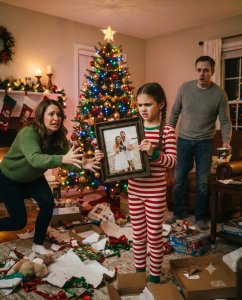
Ben Harlow had learned that after divorce, even joy came with pickup times.
The first time he really understood it was not in court, not while signing papers, not even when he carried a box of his clothes out of the house they used to share. It was when his seven-year-old daughter, Emily, stood in his kitchen three weeks before Christmas and asked, with heartbreaking calm, “Whose house do I wake up in first?”
She asked it the way a child asks whether school starts at eight or eight-thirty. Practical. Careful. Already trained to manage adult instability like it was weather.
Ben had smiled for her. He had crouched to eye level and said they would make a plan. It would be fine. Christmas would still be Christmas.
But later, after she fell asleep on the couch with a cartoon still flickering softly across the TV, he sat alone in the dark and admitted to himself that she should never have had to ask.
She was seven.
Seven-year-olds should believe in magic, not handoff schedules.
The divorce from Lauren had been final for six months. Civil, everyone called it. Mature. Respectful. The kind of separation people praised because there were no screaming matches on front lawns, no vicious social media posts, no police reports. Just paperwork, quiet compromises, and two adults who had become expert at hiding their injuries in front of the one person they loved more than they hated how things had turned out.
Lauren asked to host Christmas morning.
“For Emily’s sake,” she had said over the phone.
Ben had gone silent long enough for Lauren to notice.
“You can be here,” she added quickly. “I’m not asking to keep her from you. I just… I want one normal morning for her.”
Normal. The word had landed badly. Nothing about their life was normal anymore. Emily had one toothbrush at his place and one at Lauren’s. She had duplicate pajamas, duplicate stuffed animals, duplicate routines. At seven, she already knew how to say, “I left it at Mom’s,” with the weary resignation of someone twice her age.
Ben wanted to say no. Not to hurt Lauren. Not because he couldn’t survive one room with her. But because lately, whenever he saw her, something felt off.
She was too polished. Too controlled. Too eager to project steadiness. The old Lauren had once been warm and impulsive, quick to laugh, quick to cry, quick to pull him into the kitchen and dance barefoot while pasta boiled over on the stove. The Lauren of the last year looked almost like her, but not quite. She smiled at the right moments. She said the right words. And yet every answer seemed measured, every expression chosen.
Like someone building a version of herself and hoping no one noticed the scaffolding.
He might have refused if Emily had not thrown herself into his lap that same evening and said, “Please, Dad? Just this once? I want us both there when I open presents.”
That decided it.
So on Christmas morning, Ben drove across town with a tray of cinnamon rolls in the passenger seat, a backup battery kit in his coat pocket, and the private determination to keep everything steady for three hours.
Lauren’s townhouse glowed from the outside, every window warm with candlelight. When she opened the door, the smell of pine and vanilla drifted into the cold morning air.
The place was beautiful.
Too beautiful, Ben thought immediately.
The tree stood in the living room like a showroom display, every ornament perfectly spaced, every ribbon cascading in elegant gold loops. The mantel was decorated with winter greenery and white stockings. Soft instrumental carols floated from hidden speakers. Even the coffee table held a centerpiece of dried orange slices and cinnamon sticks arranged with suspicious precision.
It looked like the set of a holiday commercial.
And somehow that made Ben more uneasy, not less.
“Morning,” Lauren said.
She wore a cream sweater and fitted jeans, her hair curled, her lipstick flawless. There was a brightness to her smile that strained at the edges.
“Morning,” Ben said.
Then Emily came barreling out of the hallway in red pajamas and reindeer slippers, and for a while the rest of it didn’t matter.
She launched herself at him. He caught her with an oomph and laughed despite himself. She smelled like syrup and shampoo and childhood.
“You made it!” she yelled, as though there had been any universe in which he wouldn’t.
“For you? Always.”
Her face lit so completely that for one dangerous second he felt hope trying to return.
They gathered around the tree. Emily ripped wrapping paper with the absolute focus of the very young. She gasped over books and hair clips and a chemistry kit she was probably too young for but would adore anyway. Ben assembled a toy vanity mirror. Lauren handed out coffee. The cinnamon rolls warmed in the oven.
At one point Emily made them both wear Santa hats. At another, she insisted they sit on opposite sides of her on the couch while she showed them a bracelet-making set. Her joy had a frantic edge Ben recognized but pretended not to. She was trying to build a bridge across something too wide for her.
So he helped her.
He laughed when appropriate. Thanked Lauren for the coffee. Let the conversation hover over safe topics. School. Emily’s winter concert. Whether the dollhouse would fit in the car.
And little by little the room softened. The tension didn’t disappear, but it changed shape. It became survivable.
Then Emily leaned sideways near the tree and frowned.
“There’s another one.”
Ben looked over. Half-hidden behind the lowest branches was a small silver gift box with no tag.
Lauren saw it the same moment he did.
He watched her expression change with shocking speed. Her face emptied. Her shoulders tightened. Her hand came out before she seemed aware she had moved it at all.
“Wait,” she said.
Emily already had the box.
“It doesn’t have a name,” she said happily. “Maybe it’s from Santa.”
Lauren crossed the room too quickly. “Emily, sweetheart, that one isn’t—”
The lid came off.
Inside was a framed photograph.
The air changed.
Emily looked down at the picture with initial curiosity, then confusion. “Who’s that?”
Ben set his coffee mug on the floor and stood.
Lauren stopped so abruptly she nearly slipped on a piece of wrapping paper.
Emily raised the frame.
In the photograph, Lauren looked younger by several years. Younger and freer. She stood on a beach in a white sundress, hair blown wild by wind, smiling with a softness Ben had never seen on her face. Beside her stood a man Ben did not know, tanned and dark-haired, one arm looped possessively and tenderly around her waist. Between them they held an ultrasound image toward the camera.
For a beat, Ben heard nothing but the faint hum of the tree lights.
“That’s not Dad,” Emily said.
No one answered.
Lauren’s lips parted, but the denial never came. She didn’t laugh and say it was an old friend. She didn’t explain. She just stared at the frame in Emily’s hands as if the room had become a cliff edge.
And in that silence, old math came rising back.
Ben had met Lauren shortly after what she described as a devastating breakup. She was pregnant by the time they married at the courthouse, and Emily had been born seven and a half months later. At the time, Ben had done the calculation in a flash of private confusion, then hated himself for it. Lauren had been stressed. The doctor had mentioned the due date might be off. There had been enough uncertainty to let love choose the kinder interpretation.
So he had chosen it.
And then he had spent seven years being Emily’s father in every way that mattered.
Emily touched the glass over the ultrasound. “Why am I in that picture if I wasn’t born?”
Lauren dropped to her knees. “Honey, give it to me.”
Emily drew it protectively to her chest. “No.”
Ben barely recognized his own voice when he said, “Lauren. What is this?”
Tears filled Lauren’s eyes instantly.
“I was going to tell you.”
The sentence seemed to suck all the remaining warmth from the room.
Not because it raised a possibility. Because it confirmed one.
Emily backed toward the couch until her calves touched it. “Tell us what?”
Ben wanted to say something steady, fatherly, containing. Instead he stood motionless, staring at the photograph and the woman he had once trusted with every fragile part of himself.
Lauren reached again for the frame. Emily refused again. In the movement, something shifted inside the silver box. A folded envelope slid out and landed on the rug.
Ben bent and picked it up before Lauren could.
His eyes found the name written on the front in Lauren’s familiar handwriting.
For Daniel Mercer.
The name meant nothing to Emily.
It meant nothing to Ben either, except that suddenly it meant far too much.
“Who’s Daniel?” Emily whispered.
Lauren made a strangled sound. “Ben, please.”
But the envelope was unsealed.
He drew out a second photo first. Recent. Very recent. The same man from the beach, older now, silver at the temples, seated at an outdoor café. Across from him sat Lauren in the same coat she had worn when she told Ben she was meeting a friend from work one Thursday evening two months earlier.
Beneath the photo was a sheaf of documents.
Ben unfolded the top page.
It was a laboratory form.
DNA paternity testing.
For a second his vision narrowed so sharply the print blurred.
Lauren covered her face and began to cry.
Emily’s voice shook. “Is Dad my dad or not?”
Ben looked at the date. The test had been completed six weeks earlier.
Six weeks.
Six weeks Lauren had known enough to ask the question scientifically but had chosen not to answer it out loud.
“I never sent the results,” she whispered.
Ben looked up. “You had the results?”
Lauren nodded without lifting her face. “I couldn’t—I didn’t know how.”
“How long have you known this was possible?”
Lauren dragged her hands down her cheeks. “Since before I married you.”
The words landed with surgical precision.
Ben turned away for one staggering step, then back again. Emily stood frozen in the center of the room, the frame still in her hands, watching the adults who were supposed to make the world coherent.
“Explain it,” Ben said.
Lauren swallowed. Her voice came in pieces.
Daniel Mercer had been the man she loved before Ben. They had been together for nearly three years. The relationship had been serious, intense, all-consuming in the way some relationships become when two people mistake emotional dependence for destiny. Then it collapsed fast. Lauren discovered Daniel had accepted a job overseas without telling her, assuming she would simply follow when he asked. They fought. Badly. Cruelly. Things were said that could not be unsaid. She left.
A week later, she discovered she was pregnant.
She tried to call him.
He didn’t answer.
She called again.
Nothing.
By the time he reached back out, she had convinced herself he didn’t really want the baby. Then he said something in anger during their final conversation—something about not wanting to be trapped, not wanting to spend the rest of his life tied to a decision neither of them had planned. Lauren hung up and never called again.
Then she met Ben.
“He was kind,” Lauren said, crying harder now. “He was stable. He wanted us. He loved me. He loved her from the beginning.”
Ben stared at her. “So you let me believe she was mine.”
Lauren’s face crumpled. “I wanted to believe it too.”
That answer enraged him more than if she had simply said yes.
Because it was not an explanation. It was an abdication.
Emily started crying then. Not loud, dramatic sobs. Just confused tears that seemed to appear all at once because the structure holding her morning together had collapsed.
Ben went to her immediately.
That was instinct. Not choice.
He crouched in front of her, took the frame gently from her hands, and set it aside. Then he held her shoulders.
“Look at me,” he said softly.
Her eyes lifted to his. “Are you my dad?”
He had never been more aware that the next sentence of his life mattered.
There were papers in his hand. Biology waiting in black ink. Rage waiting in his throat. Betrayal everywhere. But none of it was more important than the trembling child in front of him.
“I am your dad,” he said.
Lauren covered her mouth and sobbed.
Emily threw herself at him so hard he nearly fell backward. He held her while she cried into his shoulder, and somewhere over her head he saw Lauren watching with the expression of a person realizing too late what truth costs when it finally arrives.
Then someone knocked at the front door.
Three firm knocks.
Lauren’s head snapped toward the hallway.
Ben felt Emily stiffen in his arms.
Another knock came, louder this time.
Lauren whispered, “He wasn’t supposed to be here until noon.”
Ben stood slowly.
He already knew who it had to be.
He walked to the door on legs that felt disconnected from the rest of him and opened it.
The man on the porch matched the photographs exactly, just weathered by time. Dark hair with gray at the temples. Sun-marked skin. Intelligent, wary eyes. He held a wrapped gift in one hand and uncertainty all over his face.
“I’m looking for Lauren,” he said.
Ben did not move aside. “You found her.”
Daniel’s gaze shifted past him into the house, and whatever he saw there—a crying woman, a weeping child, a Christmas tree glowing behind wrecked wrapping paper—made him go still.
Lauren stepped into the hall. “Daniel.”
He looked at her, then at Emily, and some quiet internal calculation transformed his expression into stunned recognition.
“You told me the baby was gone,” he said.
Emily clutched Ben’s hand.
Lauren’s voice broke. “I know.”
Daniel’s jaw tightened. “You said you miscarried.”
“I panicked.”
“For seven years?”
No one answered.
He looked at Emily again, and Ben saw it then: the same eyes. Not enough that a stranger would notice, perhaps. More than enough once the possibility existed. Daniel seemed to see it too. His face drained.
“I got your letter yesterday,” he said. “I came because I thought maybe after all this time you were finally ready to explain. I didn’t know…” His gaze slid helplessly back to Emily. “I didn’t know she was here.”
Ben’s hand tightened around the folded DNA report.
Daniel noticed it.
“What is that?”
Ben handed it to him.
Daniel read in silence. His face changed slowly, then all at once.
Probability of paternity: 99.98%.
A long, broken exhale left him. He lowered the paper as if it had weight.
Emily was peeking out from behind Ben now, scared but curious in the unguarded way children are when reality becomes stranger than their fears.
Daniel looked at her and whispered, “Hi.”
She didn’t answer.
Ben stepped slightly in front of her without thinking. Daniel saw that too.
There should have been shouting then. There should have been some dramatic collision of male anger and old betrayal. Instead the room filled with something much sadder: the sight of three adults standing in the wreckage of one woman’s cowardice and one child’s stolen certainty.
Lauren told the whole story then.
Not the abbreviated version. The real one.
She had lied to Daniel because she was furious and scared and didn’t trust him not to leave. Then when Ben offered stability, she let the lie grow roots. Later, after marrying Ben and watching him become a devoted father, she convinced herself exposing the truth would only destroy more lives. When the marriage began to fail for unrelated reasons, guilt intensified. She contacted Daniel in secret. They met once, then twice. She ordered a DNA test, intending to confirm what she already suspected before deciding whether to tell anyone.
But once she had the answer, she froze.
She couldn’t bear to lose Emily’s love. She couldn’t bear Ben’s hatred. She couldn’t bear Daniel’s grief over the years he had missed. So she did the one thing people do when truth becomes unbearable.
She hid it.
Ben listened with cold clarity. Not because it hurt less, but because at some point pain becomes too large to feel all at once.
Daniel asked the only question that mattered to him. “Why now?”
Lauren looked at Emily. “Because she’s getting older. Because she asks questions. Because every time she smiles at either of you, I feel sick. Because I knew if I didn’t tell the truth soon, I’d lose the chance to do it at all.”
Ben laughed once, without humor. “And Christmas felt like the right day?”
“No,” Lauren whispered. “I was going to tell you after.”
Ben thought of the hidden box. The unsent letter. The test results folded inward so the crucial line wouldn’t be visible at a glance. She hadn’t been preparing to tell the truth. She had been preparing to keep postponing it.
Emily finally spoke.
“Do I have two dads?”
Every adult in the room stopped.
Daniel’s eyes flooded instantly.
Ben crouched again so he could answer at her level. “You have one dad who raised you from the day you were born.”
Then he looked at Daniel, because cruelty would have been easy and he was too tired for easy cruelty.
“And you have another man who should have been told about you a long time ago.”
Emily processed that with the solemn seriousness only children can summon.
“Did Mom lie?”
Lauren made a sound like something tearing. “Yes, baby. I did.”
Emily looked at her for a long time. Then she did something that seemed to split Lauren open more thoroughly than any accusation could have. She said, very quietly, “I don’t want you to touch my presents right now.”
Lauren sank onto the couch and cried into both hands.
The rest of the day passed in fragments no one would ever call good but all of them would remember forever.
Daniel stayed only long enough to speak gently to Emily, to tell her he was sorry he had not known, to promise he would not disappear now that he did. He did not try to force instant connection. He did not call himself Dad. For that, Ben was grateful.
Ben took Emily home by noon.
She fell asleep in the car clutching the red sleeve of his coat in her fist.
That night she woke from a nightmare and crawled into his bed. He moved over and held her without asking questions. At dawn she whispered, “You still love me the same, right?”
He kissed the top of her head. “Exactly the same.”
And it was true.
The next months were ugly in the administrative ways emotional disasters often are. Lawyers. Therapists. Emergency revisions to custody agreements. Difficult conversations about legal paternity, visitation, and what role Daniel would have in Emily’s life moving forward.
Ben could have fought harder than he did.
Part of him wanted to. Some primitive wounded part wanted to weaponize the years he had given, the bedtime stories, the school pickups, the doctor visits, the scraped knees, the fevers, the birthdays. He wanted the law to confirm what his heart already knew.
But in the end, the truth was less clean and more human. Daniel had been wronged too. He had not abandoned a daughter. He had been denied one.
So Ben made the hardest choice of his life.
He stayed.
Not as Lauren’s anything. That door was burned to ash. There would be no rebuilding there, no new understanding, no sentimental reconciliation. But for Emily, he stayed exactly where he had always been.
Her father.
The man who packed lunches, remembered favorite songs, and knew she hated the crusts on grilled cheese. The man she reached for in pain without thinking. Biology had entered the picture. It had not erased history.
Daniel entered Emily’s life gradually. Weekend park visits at first. Then ice cream. Then awkward conversations that became less awkward. He learned she loved astronomy and hated peas. She learned he whistled while thinking and had once worked on marine restoration projects overseas. There were difficult days. Jealous days. Confused days. Days Ben hated him on principle, and days he saw Daniel trying so carefully not to intrude that hatred felt childish.
Lauren, meanwhile, had to live with the consequence no court could fully measure. Emily loved her, but trust no longer came automatically. The lie had not merely altered facts. It had altered safety. That took time—years, really—to mend.
One evening nearly a year later, after Emily had spent the afternoon baking cookies with Ben and the evening building a telescope kit with Daniel, she sat cross-legged on the floor and announced, “This is weird, but I think weird doesn’t always mean bad.”
Ben looked at Daniel across the room. Daniel gave a small, exhausted laugh.
“No,” Ben said. “It doesn’t.”
Emily nodded as if she had settled something important.
The next Christmas was quieter. No forced performance. No shared morning under one roof. Just honesty arranged into a shape they could all survive. Ben had Emily first. Daniel visited later with a carefully chosen book about constellations. Lauren came in the evening. It was imperfect, fractured, nothing like the old fantasy of one happy family in matching pajamas.
And still, somehow, it was more real.
Years later, Ben would think back to that silver box and understand that the worst thing Lauren had hidden was not paternity. It was choice. She had chosen silence again and again until silence became its own kind of violence. She had stolen truth from three people and called it protection.
But he would also think about what happened after the lie broke open.
A child had been loved hard enough to survive it.
A man had discovered biology was not the whole measure of fatherhood.
Another man had learned that being robbed of years did not excuse wasting the years still left.
If there was any mercy in the story, maybe it was that.
Even now, if someone asked Ben what the biggest red flag had been, he would not say the dates or the hidden calls or the too-perfect smile. He would say this: the moment someone insists they are protecting everyone by keeping one terrible secret, the damage has already started.
And if someone asked whether Lauren deserved forgiveness, he would answer honestly.
Maybe eventually.
But forgiveness was never the same thing as getting the old life back.
That part was gone the moment a little girl in red pajamas opened the wrong Christmas gift and found out that love, truth, and fatherhood were not always the same story.